

Choosing a bone conduction platform is not a comparison exercise. It is a claim exercise with a comparison attached to it, and the order matters: the claim sentence comes first, the market route comes second, and the acoustic and runtime questions come third. A buyer who opens with the decibel figure will spend the meeting on the row that decides the least, because a gain figure without a reference point is a number rather than a specification.
Here is the short version, in the form we would put it in an internal note.
If you are sourcing a bone conduction platform for a private-label programme, write one sentence describing what the product does for the person using it, and have it reviewed by legal counsel before you request a quotation. If that sentence can be written without referring to hearing, to a hearing condition or to an assistive benefit, the programme is workable. If it cannot, you are buying into a regulatory route that has to be established market by market, and that changes the schedule more than the specification does.
If the requirement is private listening plus communication, our range holds exactly one bone conduction entry. What it publishes is a 35 dB amplification gain, a 200 mAh cell, a charge time of two hours or less, roughly seven hours of rated runtime and Type-C charging. What it does not publish is the model designation, the certification status, the frame weight, the ingress position, the acoustic measurement and the microphone specification. Every one of those is a row you ask the supplier for, and two of them are rows you cannot work around.
Do not choose this platform if your channel's proposition depends on a performance comparison. We publish one gain figure and no measurement conditions, so we cannot compare two bone conduction products on any acoustic row, and neither can you from our catalogue. A programme sold on "louder" or "clearer" needs data nobody in this chain publishes today.
Bone conduction glasses technology: claim first, shortlist second
The buyer in this category is usually a brand-side product manager or a channel buyer who has been shown a demo. What they are holding is a target retail price, an expected first order quantity, a market list and two or three quotations. What they are missing is the one document that decides whether any of it can be sold: a sentence that says what the product does.
That sentence is harder to write than it looks, and the difficulty is where the money is. A bone conduction platform amplifies sound that reaches the wearer through the skull rather than through the ear canal. Write that sentence as a technical description and you have a communications product with an amplification circuit. Write it as a description of what the user gets, and you may find that the honest version mentions hearing — which is a different regulatory conversation entirely, and one that has to be settled before the sample order rather than after the packaging is printed.
The reason this comes first is structural rather than legalistic. The claim determines the route. The route determines the evidence package. The evidence package determines the documents the supplier has to produce, and the production schedule for those documents sits on your critical path, not the factory's. A claim settled at the artwork stage means a reprint; a claim settled at the quotation stage costs one email.
Three things a buyer in this position is usually defending against, and none of them is the wrong product:
- A listing that makes a statement the evidence does not support. The classic version is a product page that says the device helps you hear better, sold into a market where the route for that class of claim was never established.
- A market that cannot be entered at all. The United Kingdom operates a framework that diverges from the European Union in this category, and the divergence has to be tracked rather than assumed.
- A supplier answer that is technically correct and commercially useless. "The gain is 35 dB" is a true sentence. As a basis for a purchase order it is incomplete, because nothing in it tells you what the gain is measured against.
The commercial consequence of getting this wrong is not a fine. It is a launch date. A product that cannot be listed on the intended launch date has a season, a shelf position and a marketing plan built around it, and none of those survive the delay.
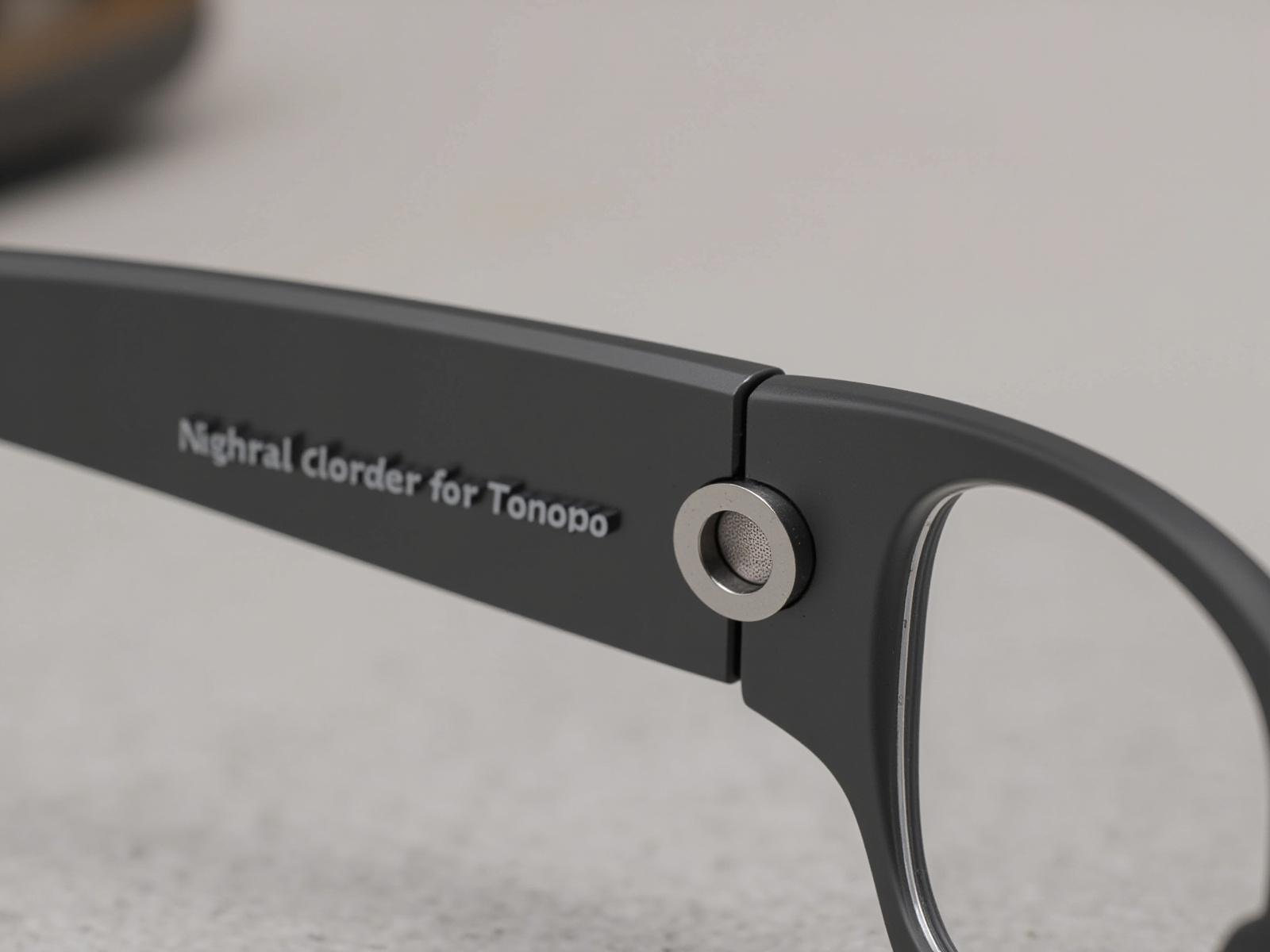
What our single bone conduction entry publishes, and what that leaves open
Our range holds one bone conduction platform. The published rows are narrow and they are consistent across our documentation: an amplification gain of 35 dB, a 200 mAh cell, a charge time of two hours or less, a rated runtime of roughly seven hours, and Type-C charging.
Those rows are worth reading as a package rather than as a list, because they describe a specific kind of product. A 200 mAh cell with a Type-C interface and a roughly seven-hour rated runtime is a device that is charged overnight and used in blocks, not a device that is carried with a battery anxiety. The interface tells you something about the customer too: Type-C means the customer probably owns the right cable already, which is a genuine commercial advantage over a proprietary charging contact in a retail channel.
What is not published is longer, and it is the longer list that decides the programme:
- No model designation. This is the first and worst gap. Without a formal model code, the product cannot be named on a certificate, cannot be described correctly at customs, and cannot be checked against a document on receipt. Every downstream question becomes harder.
- No certification status. We are not able to tell a buyer whether the product may be sold in a given market, because the company has not confirmed the certification position to us.
- No acoustic measurement. No frequency response, no output level at a defined measurement point, no coupling reference, no leakage figure.
- No microphone specification. No part number, no pickup distance, no signal-to-noise figure, no description of what the noise cancellation acts on.
- No frame weight, no frame dimensions, no ingress position. The temple pressure of a bone conduction platform matters more than it does on an audio product, because the transducer sits against the skull for the whole session. We publish one unit weight in the entire catalogue — 158 g for the MT6 — and it is not for this entry.
The cost structure follows from the technology rather than from the factory's overheads. A bone conduction platform carries a transducer, a drive circuit and, if it takes calls, a microphone chain with an open-ear pickup problem built into it. That is more electronics in the temple than a passive audio product needs, and it is why the category sits at a different price point from a standard open-ear platform. Add a route that has to be established, and the fixed cost of the programme — the documentation, the assessment, the label sets per market — becomes a larger share of the total than the unit price ever will.
That is the practical point about negotiating this category: the negotiating room is in the number of markets, the number of configurations, the artwork rounds and the schedule structure. The unit price is a small number on a large fixed cost, and it is the number the supplier knows you will look at.
Turning a 35 dB gain into questions a supplier can answer
The gain figure is the most aggressive published parameter in our range, and it is also the least usable on its own. A gain expressed in decibels is a ratio between an output and a reference. Which reference? Measured at the transducer, at the skull, or at the ear canal? At what coupling? Over what frequency band? At what input level? A 35 dB figure with those five answers is a specification; a 35 dB figure without them is a marketing number, and the gap between the two is the whole substance of the technical question.
So the first thing to do with the figure is to convert it into a request. The requests that close it are specific and they are the kind a supplier either answers immediately or cannot answer at all:
- The reference point for the gain. What the output is measured relative to, and where the measurement is taken.
- The frequency band. A gain quoted across the speech band and a gain quoted at a single frequency are different claims.
- The coupling assumption. How the transducer-to-skull transfer is treated, and whether the figure is a laboratory average or a worst case.
- The input level. A gain figure is only meaningful against a stated input.
- The measurement method. Whether the figure comes from a standard measurement, a bench measurement or a datasheet transcription from the component supplier.
If a supplier cannot answer the first two, the gain figure cannot be used in a specification, and the honest move is to remove it from the comparison table rather than propagate it into a quotation.
The route question sits alongside this, and it is a different question with a different owner. Whether the product is sold as a communications platform, as an assistive listening product, or as a device whose claim is limited to amplifying sound the wearer can otherwise hear is a decision that belongs with marketing and legal, not with engineering. It is also per market. The United States is the market to settle first, because the over-the-counter hearing aid definition at 21 CFR 800.30 describes air conduction devices, which places a bone conduction product outside that definition and means the category has to be established rather than inherited. The United Kingdom diverges from the European Union framework in this category and has to be tracked separately. South East Asian markets frequently require a local representative, which is a cost and a lead time line rather than a technical one.
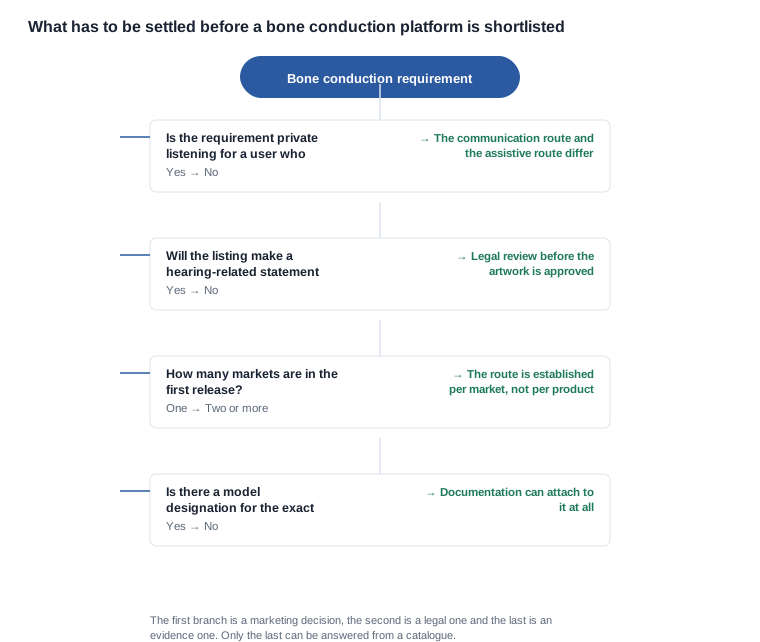
The practical test for the claim sentence is simple: read it aloud to somebody who has not seen the product and ask whether it could appear in a listing. If the sentence needs a qualifier to stay inside the evidence, the qualifier belongs in the listing, not in the internal brief.

Building the bone conduction evidence file, step by step
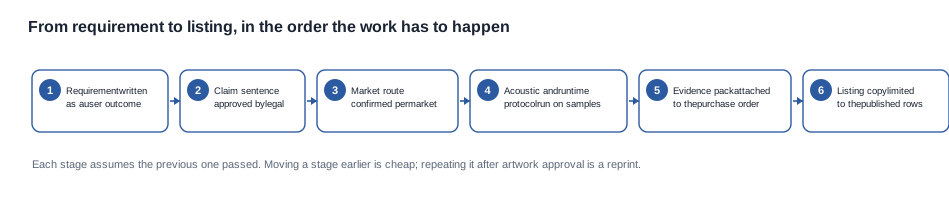
Verification in this category is documentary, and it is fast once you know which five documents to ask for. The sequence below is deliberate: each step assumes the previous one passed, and a failure at any step tells you what the next step would have told you.
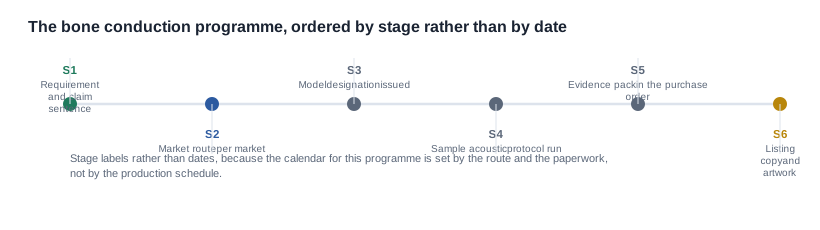
Step one: get the claim sentence approved in writing, before the sample order. One page, signed, with the market list attached. It costs a legal review and it removes the most expensive failure mode in the category.
Step two: ask for the document numbers rather than the documents. A number is the only part of a compliance document that a broker, a marketplace or your own compliance team can check later. An attachment can be a document for a different product. Ask for the list of numbers with the issuing body and the validity dates, in the body of the email.
Step three: resolve each number in the issuing body's public register. Confirm three things on each entry: that the model designation on the document matches the model you are ordering, that the document covers the functions you are shipping, and that the validity date has not passed. Compare the model string character by character. Where a family holds several models with similar names, this is the check that catches a substitution, and a mismatch is a stop condition rather than a query.
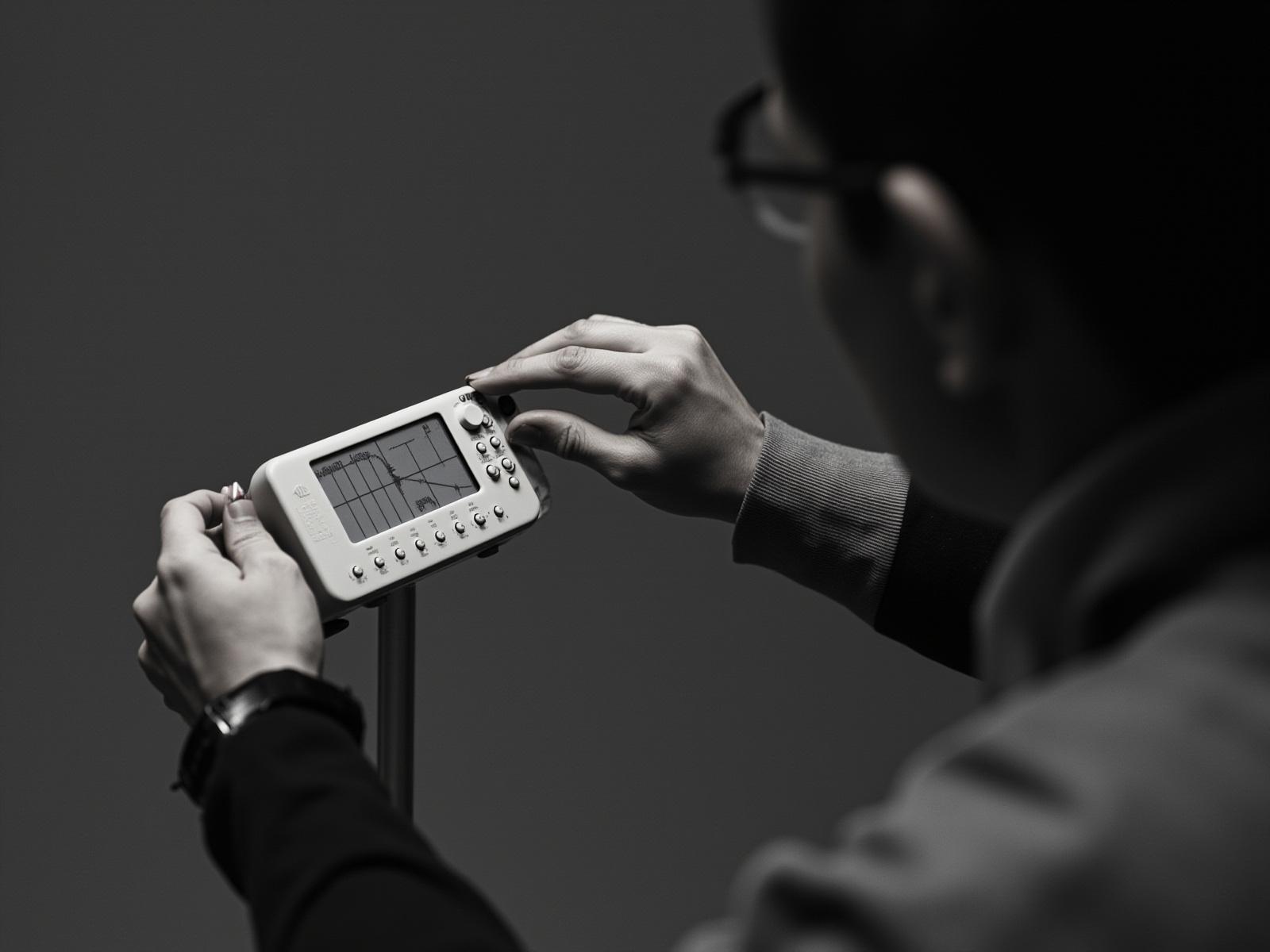
Step four: establish the acoustic measurement conditions and run them on a sample. Write the protocol down before the first reading, because a protocol designed afterwards is a description. Fix the input level, the content, the distance, the ambient noise and the pass condition. Run the same protocol on every candidate you are comparing, including any competitor sample you buy for reference. Record what you measured as your measurement.
Step five: put the criteria and the sample identity into the purchase order. In a category with no published standard, the contract is the standard. A criterion that lives in an email is not binding; a criterion in the purchase order is an acceptance standard, and a lot that fails it is a lot you can refuse.
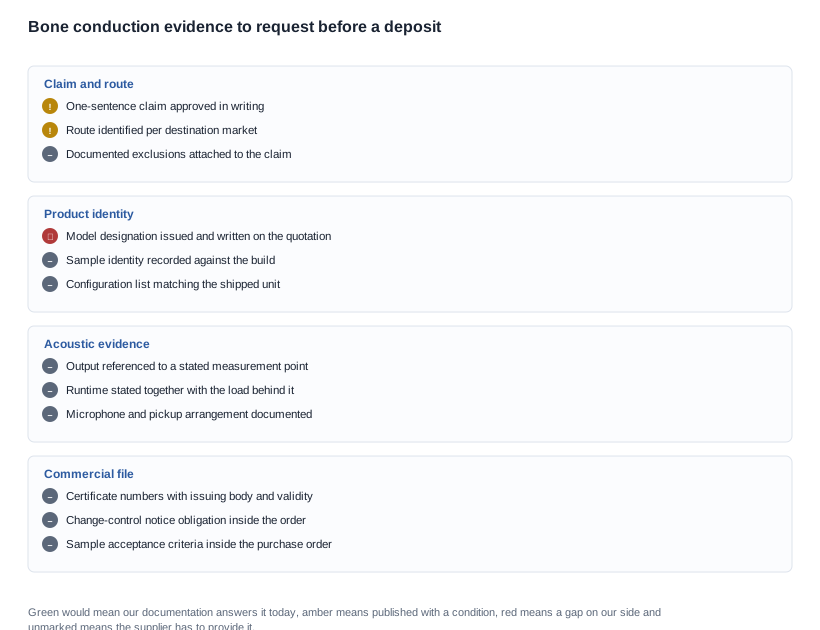
The documents to request before a deposit are these:
- The model designation, written on the quotation and on the purchase order.
- The certificate numbers per market, with the issuing body and the validity dates.
- The written statement of the acoustic measurement conditions, or a written statement that they are not published.
- The microphone arrangement and the noise-cancellation implementation, if the product takes calls.
- The runtime figure with the load behind it, stated separately from the figure.
- The sample identity: the batch, the build and the number of units.
- A change-control notice obligation covering the transducer, the drive circuit, the frame material and the charging interface.
A worked order, and the three ways it goes wrong after the deposit
The following is a hypothetical order written to show a decision sequence. It is not a client project and it does not report an outcome.
Assume a European consumer electronics brand with an existing open-ear audio line, selling into three European markets and one non-European market, and considering a bone conduction platform as a second line for a channel that wants private listening. The binding constraint is not the price. It is that the brand's own listing reviewer has already rejected two copy lines in this category at other suppliers, and the brand will not print packaging it cannot defend.
Step one: the claim sentence. The brand drafts "a pair of glasses that lets you hear your music and calls privately". That sentence mentions hearing, so it goes to legal. Legal rewrites it to describe the mechanism and the use case: sound is delivered through the temple contact point rather than through the ear canal, so the wearer can keep the surroundings audible. The rewritten sentence describes a communications product, and the brand accepts it because the claim it can defend is the claim it wants.
Step two: the market route. The brand's compliance lead asks for the route per market and receives, for the three European markets, an established position, and for the non-European market, a requirement for a local representative. The brand moves the fourth market to the second release rather than holding the whole programme for it. That single decision removes a representative cost, a document set and a label set from the critical path.
Step three: the acoustic protocol. Because no acoustic data is published, the brand writes its own: a fixed input level, a fixed piece of content, a fixed distance, a quiet room for the leakage reading and a street corner for the microphone reading, with the pass condition agreed before the first sample arrives. It runs the same protocol on the supplier sample and on one competitor sample bought on the open market.
Step four: the commercial structure. The brand negotiates the per-market document scope rather than the unit price, because the document scope is the expensive part of this programme. It asks for a staged delivery split against the sample approval, because a split that is tied to the paperwork milestone is worth more to the supplier than a price concession and costs the buyer nothing.
The result is a programme with one precondition — a documented model designation — and a claim the brand can print. The decisive decisions were all made before the sample order, and none of them was about the 35 dB figure.
Three things go wrong in this category after the deposit, and they are worth naming because each of them is cheap to prevent beforehand.
The certificate arrives naming a product nobody is shipping. Seen from the buyer's side, the symptom is a marketplace rejection, a customs query, or a warranty claim that will not settle. The root cause is that a family-level document was treated as coverage for a branded unit. The prevention is to make the exact model designation a condition of the purchase order and to check the string against the units on receipt.
The gain figure is repeated in a listing, the packaging is printed, and then the claim is questioned. The symptom is a takedown request or a regulator enquiry, and it arrives during the launch window when the marketing spend is already committed. The root cause is that the copy was written from the parameter rather than from the approved claim sentence. The prevention is to make the approved sentence the only source of the listing wording, and to require a second review when any copy changes.
The runtime does not match the rating under the actual load. The symptom is a return pattern concentrated in the first month, in the hours the brand told the customer to expect. The root cause is that the roughly seven-hour rating was carried across from a catalogue without the load behind it. The prevention is to measure a sample against the brand's own session pattern before the first article, and to state the condition in the listing rather than the bare figure.
On commercial terms, the structure is clearer than the prices. Negotiable: the number of markets you enter, the number of configurations you commit to, the artwork round count, the per-market label scope, the staged delivery split, the minimum order quantity tiers, and the payment schedule — a deposit on the first order, a balance payable against the inspection result, and a retention on the document file, which protects the buyer on the failure that costs most, a product that arrives with paperwork that does not cover it. Not negotiable: the certification cost and the certification lead time, which follow the process and the assessment body rather than your order size, and the acoustic design itself, which is not a commercial variable. If the requirement needs a specific transducer arrangement, a supplier who will not change it is telling you the performance is fixed, and the programme should be built around that fact.
What we can answer from our documentation, and what we will not
Concretely, narrow on purpose. We publish the amplification gain as the catalogue states it, and we will not carry it into a comparison as a hearing-aid specification, a hearing-aid benefit or an assistive-listening claim. The over-the-counter hearing aid definition at 21 CFR 800.30 describes air conduction devices, and a bone conduction product sits outside it, which is exactly why the route has to be established rather than inherited and why this article puts the compliance question before the acoustic one.
We also publish what we hold and mark the rest as open. For this entry that means the gain, the cell, the charge time, the runtime and the interface are available to you today, and the model designation, the certification status, the acoustic measurement, the microphone specification, the frame weight and the ingress position are not. We will not estimate any of them from typical values, and we will not present a gain figure without a measurement reference, because a plausible-looking number on a product page becomes a claim somebody has to defend in a market with a regulator.
Three things to do this week, in this order.
- Write the one-sentence claim and send it for review. It is the deliverable that decides the programme, and it costs an afternoon.
- Send the seven document requests as a list, in one email. A supplier who answers all seven has a documentation habit. A supplier who answers two is telling you something you need to know before the deposit.
- Send us the destination markets, the intended claim and the price band. We will tell you which of the four route questions are decisive for you, what our documentation answers today, and which rows you will have to obtain from the company or from a test.
The technical background is under bone conduction audio technology, the platforms are on the bluetooth audio glasses range page, and the neighbouring documents are bone conduction how it works, how to test bone conduction and bone conduction real world performance.
Related reading
Send the destination markets and the intended claim, and we will tell you which regulatory questions are decisive.


