

Bone conduction glasses technology: obligations, not certificates
Most buyers arrive at this question with a list in mind: which certificates do I need. That framing produces the wrong work, because in this category the answer is not a list of certificates but an allocation of obligations across a supply chain, and the allocation changes depending on whose name the product is sold under.
The published position in this entry makes the point. It publishes a 35 dB amplification gain, a 200 mAh cell, charging in two hours or less, roughly seven hours of rated runtime and Type-C charging. It publishes no model designation, and the certification status is not published to us. No acoustic measurement, no microphone specification, no frame weight and no ingress rating are published either. So the document that names the product does not exist in our published material, and every document that has to name it inherits that gap.
That is the reason to think about frameworks as obligations rather than certificates. A certificate is the output of someone else's laboratory. An obligation is a job that has to be done by somebody, and the question worth asking is not "which certificate covers this" but "who holds this obligation once my name is on the box, and who holds it while it is still the factory's box".

Who ends up carrying which obligation
The reader is a brand product or channel lead with a launch date, a market list and a product they intend to sell under their own name. The thing they are usually surprised by is how much of the work moves onto their side of the line when the product is branded.
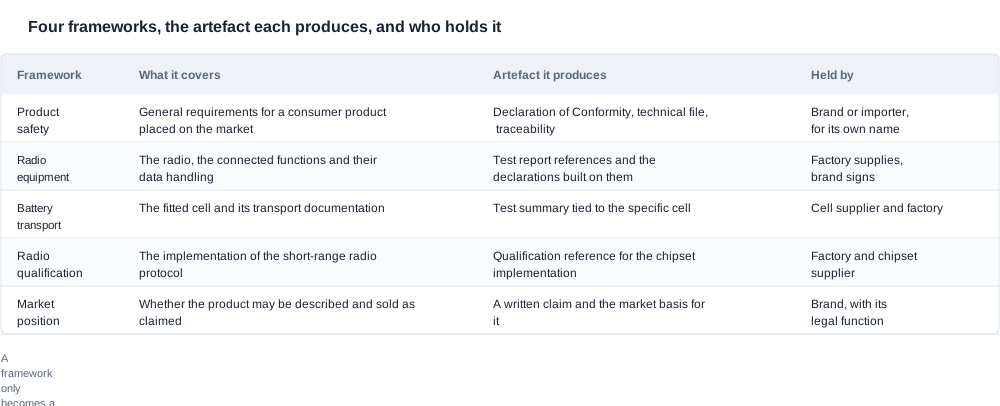
The general structure is consistent across the frameworks. A factory can hold the material evidence: the radio test report references, the material declarations for the frame and the cell, the battery transport summary for the fitted cell, the radio qualification reference for the chipset implementation, and the samples that testing laboratories need. What a factory cannot do on your behalf is make the decision about what the product is called, in which market it is sold, and on what basis. That decision, and the documents built on it, sit with the party placing the product on the market.
The structural point behind that is worth understanding precisely, because it is the reasoning that a reviewer applies. The United States framework distinguishes a medical-device hearing aid, including the over-the-counter category, from a non-device personal sound amplification product, and the over-the-counter hearing aid definition at 21 CFR 800.30 is written around air conduction. A bone conduction product sits outside that definition, which does not place it in an unregulated category — it places it in a category that has to be named in each destination market, by the party that has decided to sell it there. In the European Union, the radio framework is the Radio Equipment Directive (EU) 2014/53/EU, with the EN 18031 harmonised standards cited into it covering the cybersecurity and data-handling requirements that apply to a connected wearable with a microphone and an app, and the General Product Safety Regulation (EU) 2023/988 has applied since 13 December 2024. The United Kingdom runs UKCA on a framework that has drifted from the European one, and in the United States the radio is covered by FCC equipment authorisation while the radio qualification attaches to the implementation.
The practical consequence for a buyer: the factory's evidence is a necessary input and never a sufficient one. The file is assembled, and the assembly is a job, and in a programme where nobody has assigned the assembly it does not happen.

The four frameworks that reach the product, and the document each one produces
Product safety. This produces the Declaration of Conformity, the technical file, the traceability, the instructions and the responsible-person details for the market concerned. The work is not a laboratory exercise; it is the assembly of the evidence, the designation of who holds the technical file, and the production of a document that names the product. The threshold to hold is that every document in the pack carries the same model string, and that the string appears on the packaging, the artwork and the instructions. The way it is usually done badly: the file is assembled by copying the format of the previous product without checking whether the product changed.
Radio equipment. Any product with a radio in it is a radio product in every market it reaches. The document set is a set of test report references and the declarations built on them, and in the European Union the harmonised standards cited into the directive carry the cybersecurity and privacy obligations for a wearable that handles personal data. The threshold to hold is that the reports on file cover the band and the functions the product actually ships with, and that the connected functions are declared rather than assumed. The way it is usually done badly: treating the radio as the only thing in scope, when the app, the microphone and the data handling are the part that a reviewer asks about in a connected wearable.
Battery transport. A 200 mAh cell inside the product carries a UN 38.3 test summary covering that specific cell, and the summary is invalidated by a cell substitution even though the finished product is unchanged. The threshold to hold is that the cell in the summary is the cell in the bill of materials, in the units you receive. The way it is usually done badly: treating a cell-level document as a permanent property of the product rather than of the cell that was in it on the day the summary was issued.
Radio qualification. The Bluetooth SIG qualification attaches to the implementation rather than to the finished product, which is why it sits with the chipset and the factory rather than with the brand. The threshold to hold is that the qualification reference on file matches the implementation the product ships. The way it is usually done badly: carrying a supplier's statement that the product is qualified without a reference to check.
The market position. This is the row that has no external issuer, and it is the one that decides everything above. It is a written claim, the market basis for that claim, and a determination of how the product may be described in each destination market. The threshold to hold is one written claim per market, with the reviewer's name and the date, signed before the artwork is approved. The way it is usually done badly: the claim is drafted by whoever wrote the product page, after the file was built, which means the file no longer describes the product being sold.

The order to work in, and what each step produces
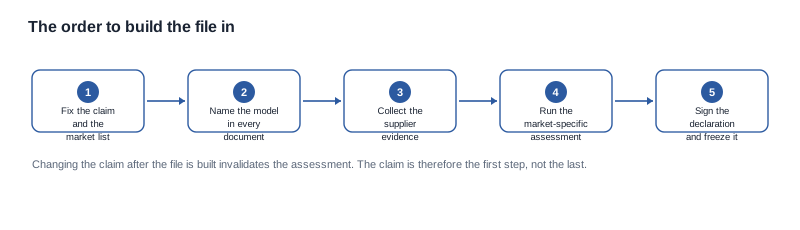
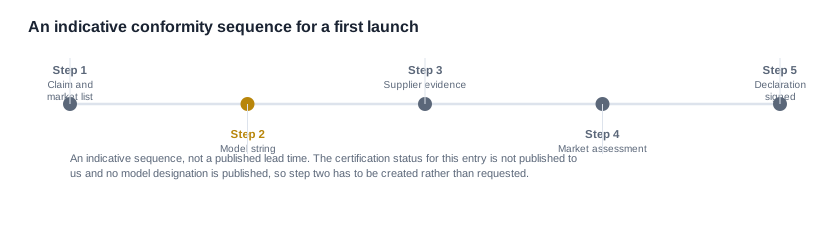
Step one: fix the claim and the market list. Everything downstream inherits this step, because a file built around one claim does not cover a different one. In this category the claim has a specific consequence, because the boundary at 21 CFR 800.30 is written around air conduction and a product with a 35 dB gain sits outside the over-the-counter hearing aid definition. The claim you write — a mechanism, a benefit, or a loudness promise — determines which market frameworks bite and how the file has to be built. The completion test: one written sentence per market, with a named reviewer and a date.
Step two: name the model in every document. This step is where this entry is blocked. Our published position is that it carries no model designation, and a product without a designation cannot be named on a declaration of conformity in the way the rest of the range can. The completion test: a formal model string, on the order, on the packaging, on the artwork and on the file. If a string cannot be issued, that is a development task with a schedule attached, and the schedule belongs in the plan from the start.
Step three: collect the supplier evidence. Ask for the radio test report references, the material declarations, the battery transport summary for the fitted cell and the radio qualification reference, in writing, with the identifiers rather than the attachments. A PDF attachment is a claim; an identifier is a record. The completion test: a list you can look up.
Step four: run the market-specific assessment. This is the part that does not delegate, and it is where a buyer who skipped step one discovers the cost. The assessment is per market, it is done against the frozen claim, and it produces the market basis recorded in the file. The completion test: a written basis per market, in the file.
Step five: sign the declaration and freeze it. The signature belongs to the party placing the product on that market. The freeze is the discipline that matters: any change to the claim, the model string, the cell, the firmware or the packaging invalidates the file, and the file has to be reissued rather than reinterpreted.
Where the file fails, and the cost of a gap found late
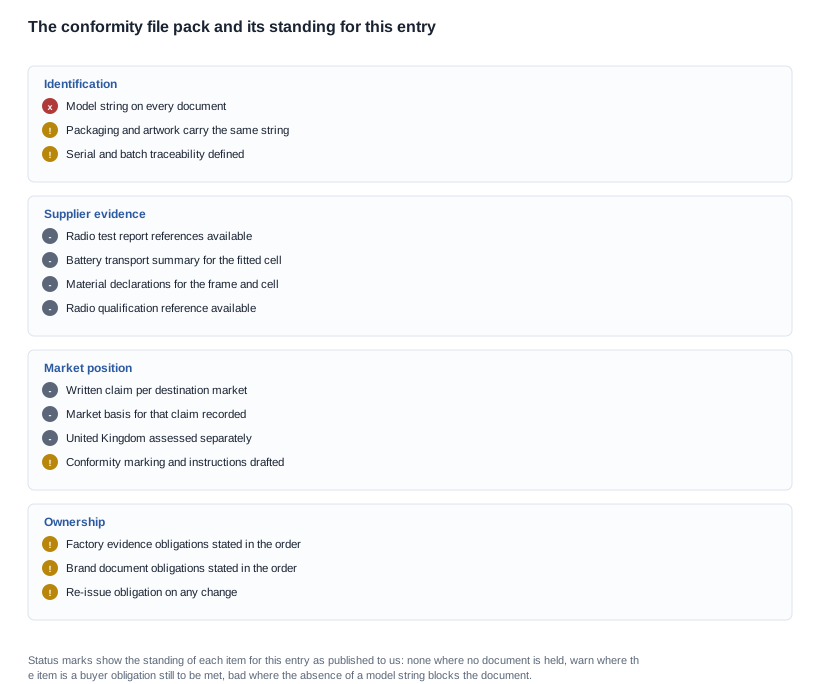
A family-level document is treated as coverage for this entry. The symptom is a customs query on the first shipment, or a channel onboarding that stalls. The root cause is that a document naming a sibling model was accepted as evidence for a product with no model string of its own. The prevention is to compare the string on the document with the string on the order, character by character, and to treat a mismatch as a stop condition rather than a query.
The claim is written after the file is built. The symptom is a file that is technically valid and describes a product nobody is selling. The root cause is that the copy was treated as a downstream task. The prevention is to freeze the claim first, and to make any change to it a reissue trigger.
The connected functions are treated as radio. The symptom is a question from a channel about app permissions and data handling, at the least convenient moment. The root cause is that the radio was scoped as the radio. The prevention is to declare the connected functions in the file rather than assuming the radio report covers them.
The cell is substituted and the transport document is not reissued. The symptom is a logistics hold on a battery shipment, in a market you have already announced. The root cause is that the cell was treated as a component rather than as a documented item. The prevention is a change-control clause that names the cell, and a reissue obligation attached to it.
The United Kingdom is assumed to be covered by the European file. The symptom is a launch that is live in the European Union and stopped in the United Kingdom. The root cause is that the market list was treated as one market. The prevention is to assess it separately, as a line item, with its own basis recorded.
A gap is found after the goods have landed. The symptom is a market withdrawal, a suspended listing, and inventory that cannot be sold in the market it was shipped to. The root cause is that the file was treated as a launch formality rather than as a precondition. The prevention is to treat the frozen file as a gate on the first shipment, which is the same argument as the gate on the artwork, and for the same reason: a market withdrawal is a supply chain event, not a marketing one.
What the file is worth commercially, and what we can issue
The cost of a conformity gap lands in a predictable order. First the document work: the reissue, the re-review and the external fees, which are fixed and are not negotiable by pressure. Then the schedule: an artwork round per affected asset, and the launch date moving. Then the inventory: units in a market that cannot sell them, which is the most expensive of the three because it is a sunk cost sitting in a place it cannot be sold from.
What can be negotiated around the file is the support for building it. Whether the factory supplies a declaration-ready evidence list, so that the file is assembled from a checklist rather than reconstructed from correspondence. Whether documentation is issued per configuration rather than per family, which matters most in this category precisely because the entries do not always share a model string. Whether test units and samples are provided for laboratory work, and whether that is included in the order or sold. Whether the factory reviews the draft file against its own published rows before signature, which catches the rows where a document and a catalogue row disagree. Whether the reissue obligation is written down, so that a change of cell or firmware comes with a file update rather than a question.
What cannot be negotiated is the laboratory cost and the laboratory queue, which are the same in every negotiation, and the marking of a radio product on the product itself, which is a design constraint rather than a commercial term. Nor can the market decision: a supplier that offers to make the determination for you is offering something it is not positioned to give, and accepting it is how a buyer ends up with a file that describes somebody else's product.
The documents to request before a deposit: the model string, on the order; the identifiers for the radio test reports, the material declarations, the battery transport summary for the fitted cell and the radio qualification reference; a written claim per market with the reviewer's name and the date; and a written statement of what the supplier can and cannot issue for this entry. The clauses to write into the purchase order: that the model string appears on every document and on the packaging; that any change to the claim, the model string, the cell, the firmware or the packaging triggers a reissue of the affected documents; that a document naming a different model is a non-conformance the buyer may refuse at inspection; and that the market determination and the declaration signature are the buyer's, not the factory's.
A worked scenario: three markets and a trade show date
The worked case below is an illustration, not a client project; it shows how the requirements would be checked in sequence.
Assume a brand entering three markets with a private-listening product, with a launch date set by a trade show, and a supplier who has been helpful but has not been asked to produce a conformity file. The brand's constraint is the trade show, because a date that is visible externally is the hardest to move.
The claim is fixed first. The brand writes one sentence describing an amplified open-ear listening product with no hearing-related wording, and it reviews it against the 21 CFR 800.30 boundary with its own legal function, per market. The European Union, the United Kingdom and the United States are treated as three decisions, not one, and the United Kingdom gets its own line because the framework has drifted. The brand then freezes the sentence and tells the supplier that the file is built around it.
The model string becomes the first blocking item. The brand asks for a formal model string and is told that the entry carries none. The brand treats that as a development task with a date, and places it in the critical path rather than the administrative path, because nothing in the file can be named without it. The brand asks the same question of a second supplier for comparison, which is the point at which the difference between the two becomes clear.
The evidence is collected as identifiers. The brand asks for the radio test report references, the material declarations, the battery transport summary and the radio qualification reference, and receives what the factory holds. Where the factory holds nothing, the file records the absence rather than leaving a blank, because a blank in a file is a finding a reviewer will make for you.
The market assessment is run in-house. The brand's compliance function produces a written basis per market, referencing the evidence and the frozen claim, and signs it. That signed basis is the document the factory's evidence is attached to, and it is the document that would be produced to a regulator if the product were challenged after launch.
The commercial step. The brand negotiates documentation issued per configuration, a reissue obligation, samples for laboratory work, and a first shipment gated on the frozen file. The result is a launch that carries a file it can actually produce, in a form that survives a due diligence question, and a schedule that has one blocking item in it rather than four.
What we can and cannot issue for this entry
A file is only worth what it can be handed to, and for this entry the honest statement is that the certification status is not published to us and no model designation is published, so no model-specific document can be produced for it at all. We will say that rather than let a buyer assume a certificate is waiting in a folder.
What we can do is supply the material the technical file genuinely holds, and we will tell you which rows in our published specification support which document: the radio, the cell and the charging interface bear on the radio and battery transport elements; the 35 dB gain bears on nothing, because it is an electronics figure and is not a measurement in any of these frameworks. We will review a draft file against the published rows and point out the places where a document and a catalogue row disagree.
We will not issue a declaration that names a model string we do not hold, and we will not sign a market determination on your behalf. We will not make a hearing-aid claim, a hearing-protection claim or any medical claim, and we will decline a brief that asks us to. The boundary is set out under medical device boundary and the mechanism behind the published gain figure is described under bone conduction audio technology.
Three things to send with a market list
Send the market list and the claim sentence. We will tell you which frameworks are decisive for that combination, and which parts of our published rows bear on each document.
Send the model string you have been given. If a string can be issued, we will tell you which documents it can be used on and which need a per-configuration document instead.
Send the draft file or the draft claim. We will mark the places where a document asserts something the published rows do not support. The range is under bone conduction glasses range and the market boundary is under medical device boundary.
Related reading
- Bone conduction audio technology
- Medical boundary compliance
- Bone conduction myths that cost money
- How to test bone conduction
Send the destination markets and the intended claim and we will say which frameworks are decisive.


