

Bone conduction glasses technology: myths carry a delay
Bone conduction myths are the most consequential myths in this category, because the one that is most widely believed is the one that creates the largest legal exposure. The belief is that a bone conduction product with a strong amplifier is simply a headset that happens to conduct through bone, and that the difference between the two is a technical detail rather than a regulatory one.
It is not a technical detail. The over-the-counter hearing aid definition in the United States at 21 CFR 800.30 covers air-conduction devices, and a bone conduction product with meaningful amplification sits outside that definition and in a different regulatory position. Everything else in this article is a footnote to that.
The practical way to hold all of this is to stop treating a myth as an incorrect opinion and start treating it as an unpriced liability. A myth that sits in a buying decision gets paid for in a purchase order. A myth that sits in a marketing decision gets paid for in a reprint. A myth that sits in a support team gets paid for in returns. Each has an owner and a delay, and the delay is what makes these expensive: none of them is visible on the day the belief is formed.
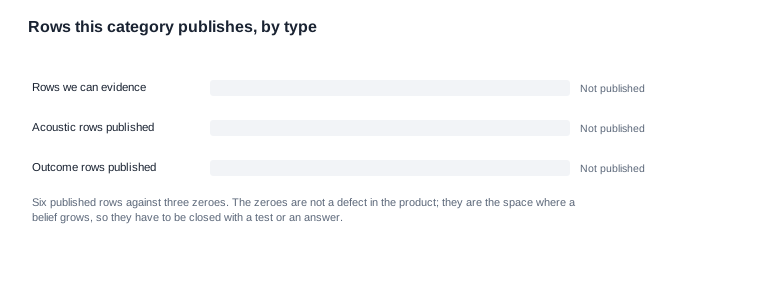
Three of the beliefs that follow fail on a single missing measurement rather than on a disputed interpretation. Our position is that the 35 dB gain, the 200 mAh cell, the charge time of two hours or less, the roughly seven hours of runtime and Type-C charging are what we publish for this entry, and that we publish them with no model designation, no certification status, no acoustic measurement, no microphone specification, no frame weight and no ingress rating attached to them. The myths that cost money are the ones that quietly assume one of those six absences has already been filled in.
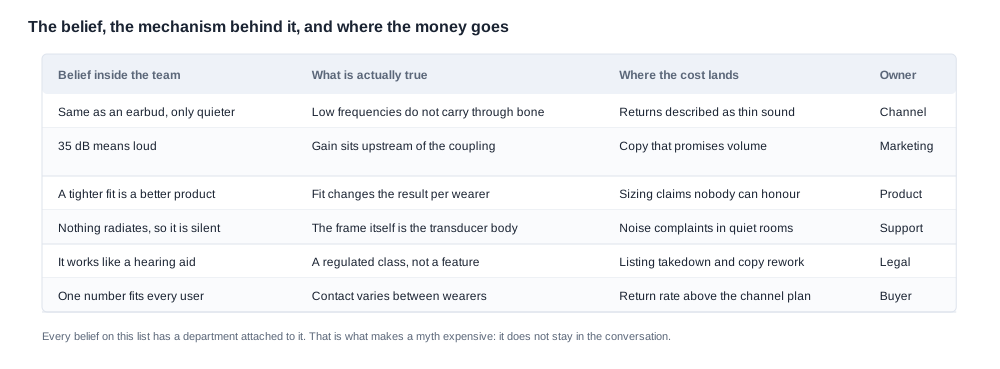
The four technical beliefs and what each one is worth
"It sounds the same as an air-conduction headset, just quieter." It does not. Bone transmission has a different frequency response, and the response varies between wearers because the coupling and the skull's own structure both vary. A product described as "the same but quieter" is describing something that does not exist, and a customer who has been told that will find the difference.
The cost sits with the channel. It arrives as returns where the stated reason is "sound quality", and it arrives with a rating that a competitor with a conventional open-ear product can out-quote. It also constrains the price, because a buyer who believes the product is a quieter headset will price it against a headset and will find it expensive, when the correct comparison is against situational-audio products where the open ear is the point.
"The 35 dB figure means it is loud." It does not. The gain is upstream of the coupling, and the coupling is where the variation lives. A gain figure is an electronics measurement, not a loudness measurement, and treating it as one produces both wrong expectations and wrong claims.
The cost sits with marketing, and it is the cheapest of the four to fix while it is still a sentence. A listing that says "35 dB of loud, clear amplification" has made a promise that no measurement in this category supports, and the promise will be tested by the first customer who compares it with an earbud. The replacement sentence is shorter and it costs nothing.
"A tighter fit means a better product." For this category, a tighter fit means a louder and brighter result for that wearer, and a worse one for a different wearer. Fit is a variable that changes the product, not a variable that improves it.
The cost sits with product, and it is the most expensive of the four because it changes the SKU strategy. If fit determines the result, then the sizing advice in the listing, the packaging copy and the channel training all become accuracy claims. A brand that has written "one size fits all" has made a statement about a variable it has not measured.
"Nothing radiates into the room, so it is completely silent." The mechanism is real and the advantage is genuine: no sound is emitted into the air, so nobody nearby hears the audio. What is missing is the second half. The frame is the transducer body, and a frame under tension transmits structure-borne vibration into the wearer's skull and, faintly, into whatever the frame is resting against. The claim of total silence is a claim about an acoustic condition nobody in this category has published.
The cost sits with support, and it is the cost most likely to be misunderstood internally. A ticket opened as "the product makes a noise" reads as a defect, gets a replacement, and teaches the support team to distrust the category. The correct handling is a scripted explanation and a documented cause code, not a unit.
The regulatory beliefs, and the paper that settles them
Three beliefs in this category are not technical at all, and they are the ones that carry a regulatory cost rather than a returns cost.
"Hearing-assist level" is a specification. It is a category claim dressed as one. If it means anything precise it refers to a regulatory classification, and a classification is something assigned by a regulator rather than asserted on a datasheet. A supplier using this phrase on a marketing page is describing their positioning, not your compliance position.
"It is basically a hearing aid." This is the claim that crosses the line in most markets, and it is the one a buyer is most likely to inherit without noticing, because it usually arrives in a channel brief written by somebody else. The over-the-counter hearing aid framework in the United States at 21 CFR 800.30 defines a hearing aid as an air-conduction device for adults with mild or moderate hearing impairment, with personal sound amplification products sitting outside that definition. A bone conduction device is not an air-conduction device, so describing it as a hearing aid creates a claim the documentation cannot support. In Europe, the medical device framework under Regulation (EU) 2017/745 is the equivalent test, and a product that describes itself as a medical device enters a route with clinical evaluation requirements.
"It is not a hearing aid, so there is no compliance question." This is the belief that costs the most, because it feels like caution and is actually the opposite. The absence of a medical claim does not create an exemption; it creates an obligation to make sure the description stays clear of the medical category while the product still meets whatever applies to a radio-equipped, battery-powered wearable sold to consumers. Radio, battery transport, electromagnetic exposure and market-specific labelling all continue to apply. In the United States the radio piece runs through the equipment authorisation route; in Europe, through the conformity route with a declaration of conformity and a technical file. The question a buyer needs answered is not "is this a medical device", which is a legal determination made in a specific market, but "which route is the product being placed on the market under, in the market we sell into".
The document that settles all three is a written statement from the supplier about the route, naming the market. It does not need to be a legal opinion and it should not be treated as one. It needs to state which framework the product is being sold under in the market named, and to confirm that the product is not presented as a medical device. That single page, attached to the purchase order, converts the regulatory belief from a thing your marketing team is guessing at into a thing your file can show.

Who carries the belief, and where it surfaces in your organisation
In most organisations the belief is not held by one team. It is held by several, each with a different consequence, and the same sentence arrives in four places: the buyer's comparison sheet, the brand's listing, the retailer's brief and the support script. A buyer auditing a product that is quietly failing usually finds one myth expressed four ways, and the fastest way to find it is to ask each team for the sentences they are currently using about the product and put them in a column next to each other.
The buyer carries it first, and usually pays for it in a price. A buyer who believes the product is a quieter headset will negotiate against headset pricing rather than against situational-audio pricing, and will then discover at the sample stage that the comparison was wrong in both directions — the product is not a headset, and the discount was never available.
The product owner carries it second, in the SKU plan. If one size has to serve every wearer, and the result depends on the seal, then the channel's entire sizing conversation has been built on an assumption that was never tested. This shows up later as a returns rate, which is the most expensive way it can show up.
The copywriter and the listing owner carry it third, and it is the fastest to fix and the most expensive to fix late. A single unevidenced sentence in a listing can be rewritten in a day, or it can survive into print and cost a reprint, a relist and a channel conversation.
The support lead carries it last and carries it longest. Support sees the consequence of every myth, because the consequence arrives as a ticket. A team that has been handed a generic script for a category with one unnamed model and no published acoustic measurement will misclassify roughly half of what arrives, because the script was written for a product whose failure modes were published and this one's are not.
Why this category produces beliefs faster than data
The reason so many myths survive here is structural, and it is worth understanding because it tells you where the defensive spending should go. Our catalogue publishes twelve open-ear audio platforms with full electrical detail each — chip version, cell capacity, rated runtime, charging method — and exactly one bone conduction entry, published without a model designation. For a comparison shopper, one family is a set of documented models and the other is a single entry with six rows.
When documentation is thin, the category fills the gap with narrative, and narrative is much cheaper to produce than measurement. A supplier can assert that the product is hearing-assist level on a product page in one afternoon. Producing a defensible figure for the same claim takes a defined input, a defined coupling, a defined reference point and a defined instrument, and it takes the cooperation of whoever designed the transducer. That asymmetry is the entire reason confident claims are cheap and expensive to inherit.
There is a second structural factor, and it is commercial rather than technical. Bone conduction products are sold into a channel that already carries earbud and open-ear products, and the buyer comparison habit is built around audio products. The narrative of "a headset that goes through your skull" is attractive to a channel that wants a story, and it survives in the channel long after it has been corrected in the factory conversation.
The third factor is the one that should shape a buyer's diligence. In a category where the specification is this thin, the question is not "does this supplier match the catalogue" — there is nothing to match. The question is "what has this supplier measured, and who measured it". A supplier with a thin catalogue and a deep measurement habit is a better prospect than a supplier with a rich catalogue and no measurement at all, and the second of those two is much harder to spot from a product page.
Turning a belief into a rule somebody will actually apply
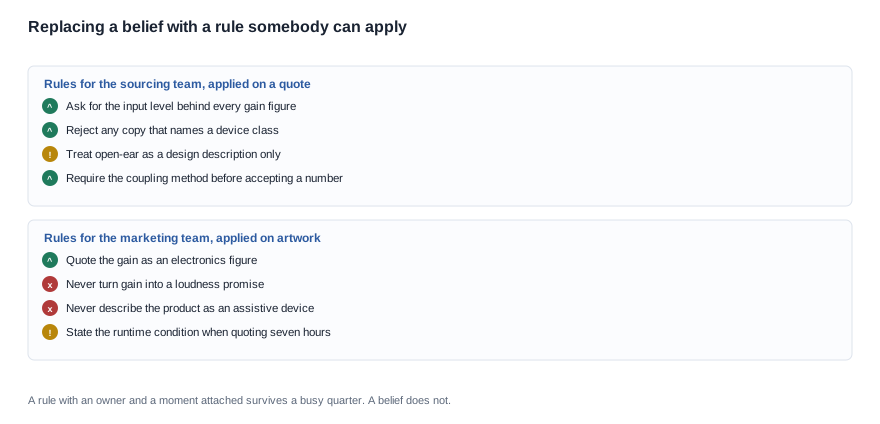
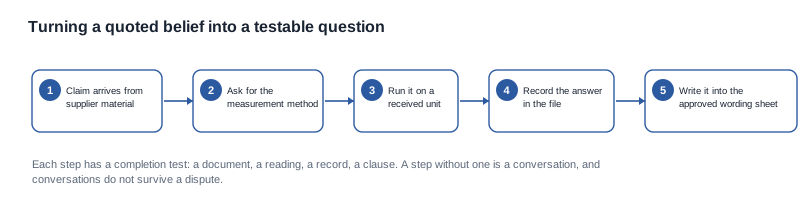
A belief only costs money while it sits in somebody's head unexamined. The defence is not a warning; it is a rule with an owner, a trigger and a recorded answer, and it is worth writing these while the belief is still fresh.
The trigger is any new piece of supplier material, because that is where the beliefs enter. A quotation, a specification sheet, a marketing PDF or a booth conversation. The rule is that no sentence from supplier material is reused in your own material until it has been checked against the published rows, and the check is recorded rather than remembered. If the supplier sends a new claims sheet in the middle of a programme, the sentence set is re-cleared, because the belief that was removed last time is usually reintroduced by the person who wrote it, not by anyone new.
The owner for copy is the person who signs the artwork, and the owner for purchasing is the person who signs the purchase order. Both need the same one-page wording sheet, and the same rule: a sentence may be used only if it appears in the sheet with evidence attached.
The recorded answer matters more than the rule. When a belief is met with a rule, the belief does not disappear; it comes back at the next convenient moment. What stops it is a note in the file that says the claim was checked, the answer was this, and the date was this. A belief answered once in writing costs nothing the second time it appears, because the answer is already written down.
Where the money goes when a belief survives the purchase order
The commercial consequences of a surviving belief fall into three buckets, and only the first is visible on a quotation.
What you overpay for. If the comparison is wrong, the negotiation is wrong. Buyers who believe the product competes with conventional open-ear audio negotiate on audio-platform terms — cell capacity, chipset, unit price against a documented range — and the bone conduction entry wins none of those comparisons, because the published rows for it are six and they are not the same rows. The price gap you are trying to close is a gap between two different products.
What you commit to that you cannot deliver. A listing built on "hearing-assist level" is a commitment to a regulatory position. The exposure is not a fine, it is a withdrawn listing, a re-print and a channel relationship that took a season to build. The correct cost comparison is not the reprint against the unit price; it is the reprint against the margin on the first quarter of that channel.
What your returns line looks like in month four. A returns problem caused by a belief does not appear in the month the belief was formed. It appears once the product has been in the channel long enough to accumulate the wrong users, and by then the cause has usually been misattributed to the factory. The negotiation lever at that point is much weaker, because you are arguing about a product you have already sold rather than about one you have not yet committed to.
What a buyer can negotiate instead is the evidence scope, which is where the real cost lives. The number of model designations committed to, the per-configuration minimum, whether sample units are credited against the first order, whether artwork preparation is included, and whether the delivered documentation package is a condition of the final payment. None of these moves the unit price visibly, and all of them reduce the number of ways a belief can become a cost.
A worked example: the belief that reached the channel
What follows is a worked illustration, included so the order of the steps is easy to follow. It reports no customer outcome.
Assume a distributor in the Netherlands serving outdoor and cycling retailers, who wants a bone conduction product for a spring range. The supplier's material describes the device as "hearing-assist level, 35 dB", and the distributor's own brief repeats the phrase because it came from the same material. The commercial target is a mid-range price band, and the distributor plans to sell through two retailers who both ask for a compliance file.
The first decision is the wording. The phrase names a device class, so it does not go into the brief. The distributor replaces it with a mechanism description and asks the supplier for the underlying method. The answer states the figure is a power amplification gain with no published input reference level, which means it can be quoted as an electronics figure and cannot be quoted as a promise about volume. The replacement sentence is written once and circulated to both retailers so the brief has one version rather than two.
The second decision is the route. The distributor asks the supplier for the route in the European market in writing, before the sample order. The reply establishes that the product is not presented as a medical device and identifies the conformity route being followed. That page goes into the file, because it is the answer to the question both retailers will ask.
The third decision is the retailer question that had not been asked yet. The retailers want a compliance file, and the catalogue publishes no certification status for this entry and no model designation. The distributor does not proceed on the assumption that a file will appear later. Instead the model designation that the certificates name is made a condition of the order, and the sample order is held until the supplier confirms in writing which designation covers which configuration.
The fourth decision is the returns posture. Because nobody publishes an acoustic measurement for this category, the distributor sets up a cause code on every ticket before launch, rather than after the first confusing cluster. Design behaviour, seating, device fault and listing mismatch are four separate codes, and only the third one produces a replacement. The four-way split is written into the support script before a single unit ships.
The fifth decision is the commercial structure. The distributor asks for the sample order to be credited, for artwork preparation to be included, and for the final payment to be tied to the documentation package arriving with the order rather than with the shipment. The last of the three is the one that matters, because it is the clause that makes the file a condition of the programme instead of an aspiration.
The outcome of the sequence is a brief that a retailer can file and a support script that classifies tickets correctly. The distributor did not resolve an acoustic question, and did not need to; the channel was never asking one.
What our catalogue holds, and the limits of that position
The working rule we apply: we publish the rows we hold, and we publish the absences with the same prominence. For this entry that is a 35 dB amplification gain, a bone conduction transducer, a 200 mAh cell, alongside a charge time of two hours or less, and a rated runtime of roughly seven hours and Type-C charging We publish no model designation, no certification status, no customisation capability, no acoustic measurement, no microphone specification, no frame weight and no ingress rating for it.
We will not describe the product as a hearing aid, and we will not make a medical or hearing-assistance claim on it, because a hearing-related description can pull the product into a framework that a catalogue entry cannot address. We will not present the gain as a result the wearer experiences, and we will not repeat a comfort or intelligibility outcome we have not measured. And where a belief is load-bearing in somebody's plan, we would rather say "not published" than offer a typical figure that cannot be verified.
What we will do is name the question precisely, because a precise question gets a precise answer. If you send us the sentences your team is currently using, we will mark the ones our documentation covers and the ones it does not, and for the ones it does not we will tell you what to ask the supplier instead.
What to change in the next seven days
Collect the sentences, not the opinions. Ask the four teams that touch this product for the words they are using. Put them in one list. This takes an hour and it is the only reliable way to find out how many beliefs are actually in circulation.
Turn each belief into a question with a supplier attached. Not "we do not believe this" but "what is the input reference level behind the gain figure". A belief that becomes a question stops costing money the moment the question is sent.
Add a cause code to the support system before launch. Four codes for this category, of which only one produces a replacement. It costs a configuration change and it is the difference between a returns number and a factory conversation.
Write the one approved sentence for the gain. One sentence, used everywhere, including in listings written by agencies. If you have to rewrite it later, it costs four times more.
The technical background is under bone conduction audio technology, the boundary is set out in the medical device boundary discussion, and the consequences of misreading the gain figure are covered in bone conduction gain levels.
The documents behind the advice
When a buyer brings us a myth they cannot settle on their own, we open four documents and work through them in this order. They are the same four we put in writing for customers who ask us to.
- How bone conduction audio behaves at its limit
- The line between certification and the medical device boundary
- What a health claim is allowed to say
- The bone conduction models in the current range
Send us the sentences your team is using and we will tell you which ones our documentation actually covers.


