

If you are comparing two bone conduction suppliers, do not compare the 35 dB gain. That number is an amplifier figure taken upstream of the coupling, so it describes the electronics and says nothing about what arrives at the inner ear. Compare the consistency of the coupling instead: how far the output moves when the same unit goes onto a different head, gets re-seated, or stays on for a second hour. That is the variable a supplier can be held to, and it is the one that predicts whether a return arrives. The right test is a paired comparison — the same person, in the same session, alternating between candidates — because anything less produces a figure about one arrangement on one day. If the supplier cannot name the coupling, the reference and the contact conditions behind any figure they do hold, expect to buy on a ranking rather than on a specification, and write that ranking into the purchase order as a comparison rule.
Bone conduction glasses technology: where 35 dB stops
The buyer who is holding two quotations and one sample
The buyer running this protocol is usually deciding between a bone conduction product and an open-ear one, or between two bone conduction factories, and they are holding three things: a sample, a catalogue entry with a gain figure in it, and a channel with a target customer attached. What they are not holding is an acoustic data set, and the reason is structural rather than accidental. Acoustic data belongs to whoever designed the transducer, and a factory that integrates somebody else's transducer receives it as a component specification with a number on it.
That leaves the buyer with a problem that has no clean answer. The number in the catalogue is not wrong, but it does not describe the thing being bought. The catalogue entry for our own bone conduction platform states a 35 dB gain, a 200 mAh cell, a charge time of two hours or less and a rated runtime of roughly seven hours. All four are real published rows. None of them describes what a person hears, because the gain sits upstream of the point where the signal enters the skull.
The constraint that shapes the whole buying plan follows from that. A buyer cannot produce laboratory-grade output figures. A calibrated measurement at the inner ear needs a defined coupling, a defined reference and a defined method, and a buyer with a sample unit and a desk does not have any of the three. What a buyer can run is a behavioural protocol that ranks two candidates against each other and detects drift within a unit over a session. That is worth doing, and it is worth doing early, because the protocol is cheap and the decision it informs is expensive to reverse.
Why an absolute figure cannot cross a head
Three facts about bone conduction make an absolute output figure nearly useless to a buyer, and each of them has a commercial consequence.
The first is that the transmission path is the wearer. A figure produced at a transducer, at a reference point, in a fixture, describes a fixture. The moment the same unit sits on a person, the signal is filtered by a skull, a jaw, a layer of soft tissue, and whatever the frame happens to be pressing against at that moment. The commercial consequence is that an absolute figure quoted by a supplier is a claim about their measurement, not about their product, and a buyer who prints it on a product page has published a number they cannot reproduce.
The second is that a comparison against an air-conduction specification is not like-for-like. Bone transmits high frequencies differently from the soft tissue that an earphone radiates into, and the response curves are not shaped alike. A buyer who puts a bone conduction figure next to an earphone figure in a comparison table has produced a table that looks rigorous and means nothing. The consequence is a shortlist that is wrong before the first sample arrives, because the two candidates were never comparable.
The third is the regulatory proximity, which sits alongside the acoustic one and should not be separated from it. A gain in the range the catalogue states for this platform puts the product near the boundary of the over-the-counter hearing aid definition in 21 CFR 800.30, a definition that addresses air-conduction devices. We make no health claim for any of our products in any market, and we do not publish a certification status for this entry because it has not been confirmed to us. The consequence for a buyer is that the regulatory position and the acoustic test programme have to be planned together rather than one after the other, because a product whose category is unresolved cannot have a copy position, and a copy position is usually what the acoustic figure was needed for.
Coupling consistency is the variable you can actually buy
The coupling drifts while the session runs
The thing a buyer can actually buy in this category is not an output level. It is consistency: how little the output moves when everything except the product changes. That sounds abstract until you sit with a pair of bone conduction glasses and notice that the same unit sounds different on a different head, different again with the temples adjusted, and different once more after an hour because the contact has migrated.
This is not a defect and it is not a supplier failure. It is a property of a product whose output path runs through the person rather than through the air. The question a buyer can legitimately put to a supplier is therefore about spread rather than level: how much do two units of the same model differ under a fixed setup, and how much does one unit drift across a session.
That reframing changes what the sample programme is for. Under the usual approach, a buyer runs a test, gets a number, and tries to decide whether it is high enough. Under the consistency approach, the buyer runs a paired comparison, gets a spread, and decides whether the spread is narrow enough to be worth pricing into a product page.
The difference matters commercially because the two questions have different answers and different failure modes. A product can have an excellent absolute level and a wide spread, and that product will generate returns from customers whose heads are not the head the sample came from. A product can have a modest level and a tight spread, and that product is far easier to support, to describe, and to write copy for.
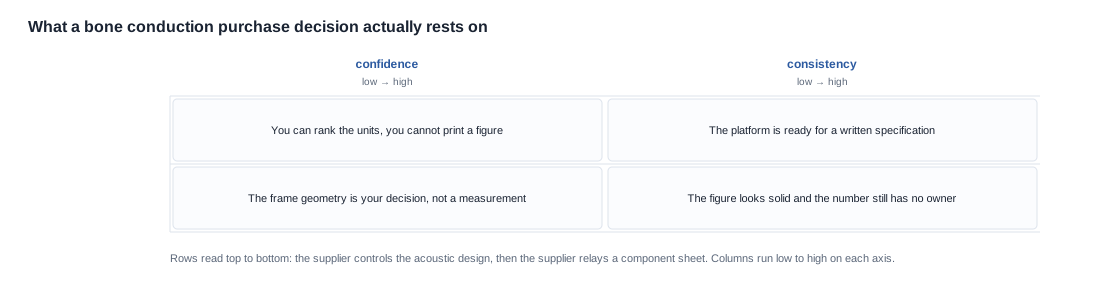
The matrix above puts the two dimensions side by side. A supplier that controls the acoustic design and holds a consistent spread lands in the cell that is ready to be written into a specification. A supplier that relays a component sheet lands in the cell where the figure looks solid and the number still has nobody who owns it, and that cell is by far the most common one in this category.
What a supplier who owns the acoustic design can show you
The way to tell the two situations apart is to ask the same question of two suppliers and compare the shape of the answers. The question is: what measurement do you hold for this platform, and what were the conditions?
A supplier who owns the acoustic design can describe a setup. They can say what the contact pressure was, where on the skull the transducer sat, what the reference was, and what the environment was. Their answer will be long, specific, and slightly awkward, because it will include caveats. A supplier who is relaying a component sheet will give you a single number and, when pressed, a description of the component rather than of the measurement.
The specific rows worth asking for are these, and each of them is a row a supplier either has or does not:
- An output figure at the inner ear, with the coupling and the reference named. Not "35 dB amplification" — a figure that carries the conditions with it.
- A frequency response, with the method and the reference stated. A component datasheet is not a frequency response.
- A leakage figure, at a stated distance, with the coupling held. This is the one that decides whether the product can be described as private.
- A runtime measured with the amplification active, with the workload stated. An amplified product is a different load from an unamplified one, so a general runtime rating does not transfer.
- The force the frame must apply against the head for the contact to be usable, because that number decides whether the frame can be held to a specification or has to be left as a preference.
- The regulatory position the item is placed in, per target market, and the certificate references or a written statement that none are held.
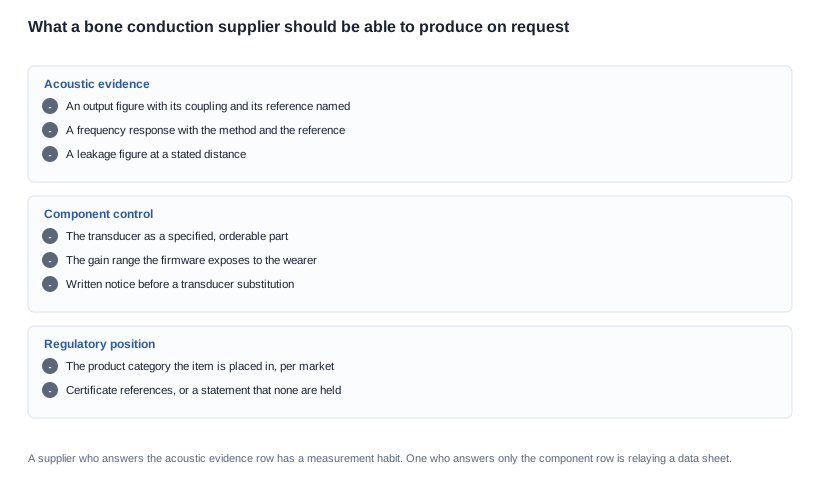
A supplier who answers the acoustic evidence row has a measurement habit. One who answers only the component row is telling you that whatever they print is a description of somebody else's part.

Turning a sample session into a paired comparison you can file
The five setup factors, and the thresholds worth holding a supplier to
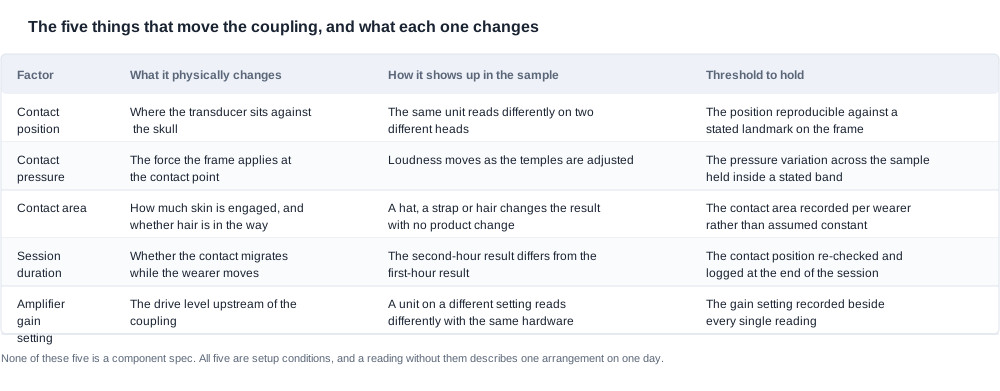
The five factors in the table at the top of this section are the ones that move a reading. They are not component specifications and they are not adjustable by the factory once the frame is tooled, which is why a protocol that fixes them is worth more than a protocol that measures harder.
Contact position is the first thing to fix, because everything else is measured through it. The threshold worth holding is that the position is reproducible against a stated landmark on the frame — a specific point on the temple rather than a general description of placement. A protocol that says "place the glasses normally" produces a reading about one person's habit.
Contact pressure is the second, and it is the factor most often left to chance. The frame tension determines how hard the transducer is driven into the skull, and a wearer who adjusts the temples changes the reading without changing the product. The threshold worth holding is a stated band for pressure variation across the sample, and a protocol that records the adjustment position rather than the measurement alone.
Contact area covers the physical reality that a pair of glasses may be pressed against a head with hair, a hat, a helmet strap or a collar, and each of those changes the coupling without any change in the electronics. The threshold worth holding is that the contact area is recorded per person rather than assumed constant across the panel.
Session duration is the factor that catches a product during a working day rather than a demonstration. The contact migrates as the wearer moves, and a reading taken at minute ten is not a reading taken at minute sixty. The threshold worth holding is that the contact position is re-checked and logged at the end of the session, and that the end-of-session result is the one that goes into the record.
Amplifier gain setting closes the list, and it is the factor that catches a unit configured differently from the one in the demonstration. The gain range the firmware exposes should be recorded beside every reading, because a unit on a lower setting is a different product from the same unit on the shipped default.
The paired sequence, and the record each step leaves
The paired comparison is a sequence, and each step assumes the one before it passed.
Step one is the protocol, written down before any unit is paired. It names the person or the panel, the positions, the adjustment state, the gain setting, the environment, and the criterion that separates an acceptable reading from an unacceptable one. A protocol designed after the first result is a description of that result.
Step two pairs candidates on the same head. The same person wears candidate A, then candidate B, then A again, then B again, in one session, with a reset between each. Alternating rather than blocking is what removes the slow drift of attention and comfort from the comparison. A single-unit reading compares one unit against nothing at all.
Step three records the setup with every reading — position, adjustment, gain setting, elapsed time, and the criterion applied. A number without those five fields cannot be compared with anything, including your own next test.
Step four repeats the comparison on a second person. One person produces a result for one person. A second person, chosen because their head shape is different rather than because they were available, tells you whether the spread you measured is a product property or a person property.
Step five runs the session long enough for the contact to drift. The end-of-session reading is recorded separately from the first reading, and the gap between them is itself a finding about the frame geometry rather than about the electronics.
Step six writes the observations down before anyone discusses them. A supplier disputing a written observation is arguing with a record. A supplier who has never seen the test is arguing from theory, and that conversation costs a round of samples.
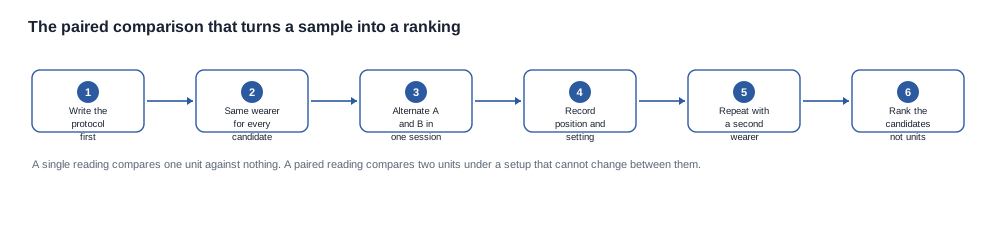
The output of the whole sequence is not an output figure. It is a ranking between two candidates, a spread figure you can put into an acceptance rule, and a written record that says which setup conditions produced it. That is what belongs in the purchase order, and it is the only part of the session that is worth carrying into the acceptance criteria.
Where bone conduction programmes lose their margin
The absolute figure is printed on the listing. The symptom is a support queue that cannot be answered, because the number on the page cannot be reproduced by the person asking about it. The root cause is that the copy was written from a catalogue gain rather than from the measurement. The prevention is to write the claim in the terms the evidence supports — a personal amplification feature with a stated comparison against a named baseline — and to keep the figure in the internal specification where it belongs.
The sample was tested on one head and the returns come from another. The symptom is a return cluster with no obvious defect. The root cause is that a single-person protocol was treated as a population result. The prevention is to build the second-person step into the protocol and to treat a wide spread as a finding about the frame geometry rather than about the wearer.
The contact is compared against an air-conduction specification. The symptom is a shortlist decision that cannot be explained after the fact. The root cause is that two transmission paths were placed in the same column of a comparison table. The prevention is to compare only within the technology, and to keep the published 35 dB gain described as an electronics figure taken upstream of the coupling.
The headset is used where a call has to work, and the sample was tested in a quiet room. The symptom is a customer who cannot be heard in traffic. The root cause is that the environment in the test did not resemble the environment in the use. The prevention is to run the intelligibility check where the product is actually sold into, and to record the noise type and the level alongside the result.
The wearer takes the frame off after an hour and nobody wrote down why. The symptom is an unexplained return that looks like a comfort complaint. The root cause is that the reason for removal was not separated from the fact of removal. The prevention is to record which of the two it was, because a contact that migrates is a frame problem and a frame problem has a supplier attached to it.
A hearing-related phrase reaches the listing copy. The symptom is a listing that has to be pulled. The root cause is that the copy was written from the gain figure rather than from the regulatory position. The prevention is to run the copy past someone qualified for the target market before it is published, and to keep the positioning on personal sound amplification rather than on anything to do with hearing.
A worked scenario: a brand choosing between two bone conduction suppliers
This is a worked case rather than a customer case. What matters is the order of steps.
Assume a mid-size brand building a call-focused line for a market where the customer works outdoors part of the week. Two bone conduction suppliers have quoted. The first publishes a gain figure and offers nothing else. The second offers a written measurement with a named coupling and a named reference, and offers to run a paired session on the brand's own samples. The binding constraint is not the price; it is that the brand's previous listing made an acoustic claim it could not support, and the brand does not want to repeat that.
The exposure comes first. The brand writes down where the product is used: a street, a warehouse, a vehicle, and a desk. That is a communication environment, not a listening environment, so the criterion is whether the far end can hear the wearer, not whether the wearer finds it loud.
The evidence request goes out in one list. The two questions that decide the comparison are whether the supplier holds an output figure with its coupling named, and whether they will run a paired session. The first supplier answers with a datasheet. The second answers with a measurement and a session invitation. That difference is the shortlist.
The paired session runs on the brand's own units. The same two people, the same candidate order, alternating, with the contact position and the gain setting recorded on every reading. The spread between the two candidates turns out to be smaller than the spread between two units of the better supplier. That is a real finding, and it is a finding about consistency rather than about loudness.
The specification is written from the ranking. The brand records the paired result, the spread figure and the setup conditions, and puts the comparison rule into the purchase order as an acceptance criterion for the first article. It does not publish an absolute output figure anywhere, because the evidence does not support one.
The regulatory question is kept alongside. The gain in the catalogue raises the over-the-counter hearing aid boundary in 21 CFR 800.30, so the brand asks for the category position per market before the copy is drafted rather than after it is approved. The listing is written on the capability of the product and makes no claim about hearing.
The result is a programme with a comparison rule in the purchase order, a copy position the brand can defend, and a regulatory question with an owner. The decisive decisions were all made before the sample order, and none of them was about the decibels.
What we can and cannot tell you about our own platform
We publish the rows we hold and mark the rest as open, because a buyer who checks a claim should be able to check ours first.
For the bone conduction platform in our range, what we publish is the 35 dB gain, the 200 mAh cell, the charge time of two hours or less, and the rated runtime of roughly seven hours. What we do not publish, and will not estimate, is an output-at-the-inner-ear figure, a frequency response, a leakage figure at a stated distance, a contact pressure figure, a certification status for any market, and a model designation for this entry. None of those has been confirmed to us with its conditions attached, and a plausible-looking value is worse than an open field because it will end up in somebody's copy.
A measured result carries the same qualification, and it is the part a test buyer most often overlooks. An absolute figure cannot be transferred between one person and another, and the published 35 dB gain is an electronics figure taken upstream of the coupling. A comparison with an air-conduction product's published specification is not like-for-like. The honest evaluation of this platform is a behavioural comparison rather than a datasheet comparison, and a buyer who expects a specification sheet will find that frustrating, and we would rather say so now than at the sample.
We make no vision, health, hearing or eye-protection claim for any of our products, in any market, and we will not describe a product that amplifies sound as a device that improves hearing. That is a regulatory position and not a marketing preference.
Three requests to make before the next supplier call
Ask for the coupling before the number. Whether a supplier can describe how a reading was taken tells you more about the reliability of their other answers than the reading itself does, and it is the fastest way to find out how to compare two candidates whose documentation is written in different styles.
Send the evidence request as a list. Output at the inner ear with its coupling and reference, the frequency response with its method, the leakage figure with its distance, the runtime with the amplification active, the regulatory position per market, and the model designation. The list above is the complete set of questions to ask; a supplier who answers all six has a documentation habit, and one who answers two is telling you something you need to know before the deposit.
Send us the use case and we will tell you what is published. Give us the environment, the target market, the price band and the configuration, and we will say which of our models carry a bone conduction platform, what the qualification would involve for them, and which rows of our documentation answer your question today. The mechanism is described under bone conduction audio, the background is in how bone conduction works, the standards context is in bone conduction industry standards, and the range is at bone conduction glasses.
Where the decisions come from
- Bone conduction audio
- How bone conduction works
- Bone conduction industry standards
- Bone conduction glasses range
Send us the environment, the target market and the price band, and we will say which rows of the documentation you actually need.


