

Bone conduction glasses technology: mapping the buying task
The narrow case for bone conduction
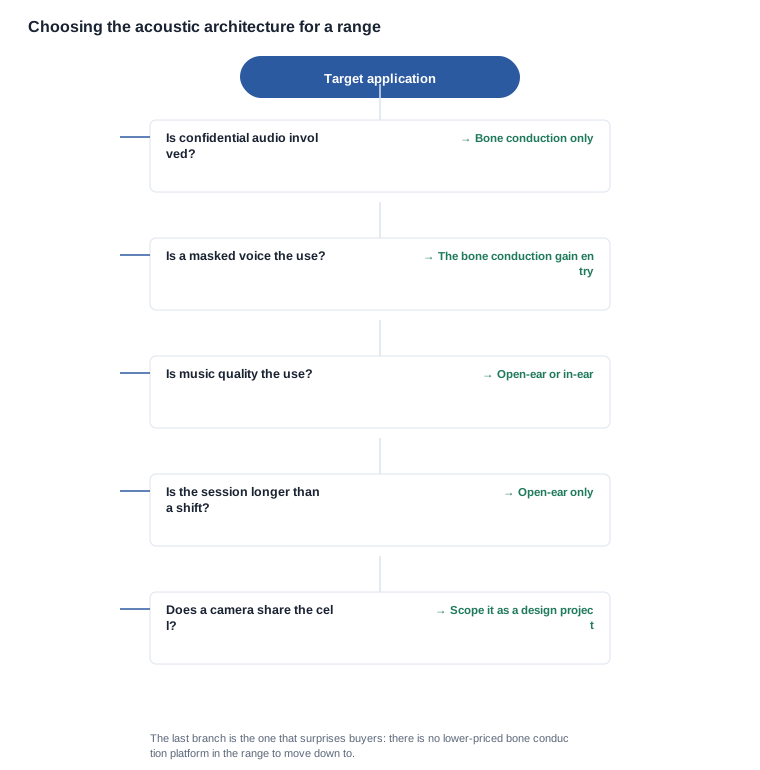
Bone conduction fits only where the ear canal must stay entirely untouched and the session length is bounded. For music, for all-day wear, and for any configuration that also carries a camera, an open-ear temple speaker is the better buy. The one commercially decisive published figure in this category is the 35 dB amplification gain, and it constrains two things at once: the copy you are allowed to write and the market you are allowed to ship into. Choose the form factor from the working environment and the compliance boundary, not from the feature list, because a 200 mAh cell and a 35 dB gain describe a session product rather than an all-day one.
That is the conclusion, but it is not the answer, because a buyer cannot act on it. What a buyer can act on is a mapping: given a working environment and a session length, which architecture is right, which specification row decides it, and what has to be true for the choice to hold.
The buying task behind this article
The reader is a brand owner, an eyewear brand buyer or a channel buyer who has been asked to put a smart audio product on a roadmap and now has to decide which acoustic architecture to build the range around. The task is not to find the best-sounding device; it is to pick a platform that can be certified, shipped, listed and supported in the target market without a listing takedown six weeks after launch.
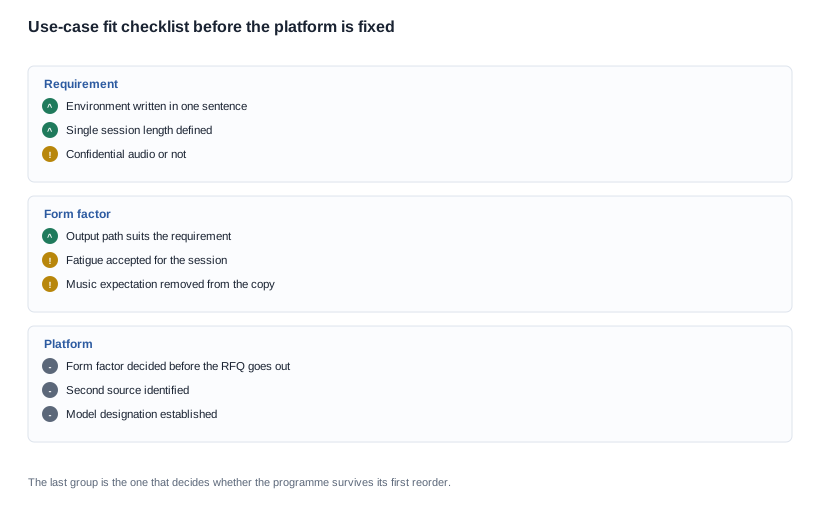
The three predictable failures are a product that reaches the customer with the wrong expectation, listing copy that quietly makes a medical claim, and a platform that cannot be re-ordered from a second source because no model designation is published. None of the three is an acoustic problem, and all three are decided before the sample arrives.
The buying task also has a shape that is easy to get wrong. The instinct is to treat "use case" as a marketing segment — cycling, running, office, driving — and to build a range plan from those labels. The labels are a poor proxy. What actually determines the architecture is narrower: whether the audio has to be private, whether the source is a masked voice, how long one continuous session runs, and whether the customer will tolerate vibration against the temple. Everything else in a use case label is packaging.
What the published specification actually is
What the catalogue holds for our bone conduction entry is a gain of 35 dB, a cell of 200 mAh, a full charge inside two hours, a rated runtime of about seven hours, and a Type-C connector. The model designation is not published. Neither are the acoustic details that would let a buyer compare quality: no driver size, no frequency response, no distortion figure, no microphone pickup distance, no weight.
Two conclusions follow directly from those facts. First, 35 dB is a loudness ceiling, not a clarity measure — decibels are logarithmic, and intelligibility is set by the response curve rather than the gain, so the figure cannot be used to promise speech quality in a noisy site. Second, a 200 mAh cell with a seven-hour rating is a design decision about session length, not a specification gap. It tells you the form factor was scoped for bounded work blocks.
Where this category sits against the alternatives
The division of labour between the two architectures
An open-ear platform and a bone conduction platform are not a cheaper and a more expensive version of the same thing. They divide the work, and a buyer who treats them as a ladder will end up with the wrong product in the wrong channel.
A temple speaker radiates sound from the frame towards the face while leaving the canal open. It can carry more volume and considerably more low frequency than a transducer pressed against the cheekbone, which makes it the better answer whenever the quality of the audio is the reason for the purchase — music, spoken content, a podcast on a long journey. It also radiates sound into the room, which makes it the wrong answer whenever the audio has to be private.
A bone conduction transducer is genuinely absent from the ear. That makes it the better answer when the wearer's ear is occupied, when an inserted device is unacceptable, when a sealed bud is impossible, and when privacy is the requirement. It also means the contact pressure against the temple is part of the product, which is a comfort variable that no specification sheet describes and that a buyer can only establish on a sample over a real session.
The practical consequence: the two architectures compete for different customers, and a range that carries both is not confused, it is covered. A range that carries one and markets it against the other is the confused case.
Where the cost of each sits
The bill of materials diverges at the acoustic element. A bone conduction frame needs an actuator that presses against the skull with a controlled force, and that force propagates into the frame: the temple has to carry the load, the contact surface has to be kept constant, and the mass and stiffness of the frame become part of the acoustic result rather than only part of the fit. It also propagates into assembly, because a transducer that must sit at a defined position and pressure is harder to place consistently on a line than a speaker dropped into a cavity.
The electronics diverge next, and the divergence shows in the cell. Our entry's 200 mAh cell is several times the capacity of the smaller cells typical of open-ear audio platforms in the same range, which is consistent with a transducer and an amplifier stage drawing more current than a small speaker. A larger cell means a larger pack, which means more frame mass, which means more contact pressure for the temple to hold. In this category the power budget and the acoustic result are the same design decision.
Certification is the third block and the one that is fixed. A conformity assessment, a technical file, a declaration, labelling and instructions, and the laboratory time behind them do not negotiate. What does negotiate is scope: how many markets the file covers and how narrow the claim can be kept.
The one number that decides the market as well as the product
The 35 dB gain is the most aggressive published parameter in the range and it carries the highest compliance exposure in the same row. In the United States the framework at 21 CFR 800.30 separates an over-the-counter hearing aid — an air-conduction device intended for a person aged eighteen or older — from a non-device personal sound amplification product, and a bone conduction product is neither air-conduction nor a hearing aid.
This is why the 35 dB figure is not a differentiator in the ordinary sense. A buyer who treats it as a marketing asset, puts it into the product listing, and then has to undo that decision has created a regulatory problem, and the correction is a rewriting rather than a fix. The honest differentiators in this category are the form factor itself, the battery, the charging arrangement, the industrial design, as well as and the fact that the ear stays clear
The thresholds that map an environment to a platform
The two axes, and the matrix they produce
Two variables do most of the work: the length of a single continuous session, and what the audio is for. Reading them as a matrix produces a map that a buyer can apply to any brief.
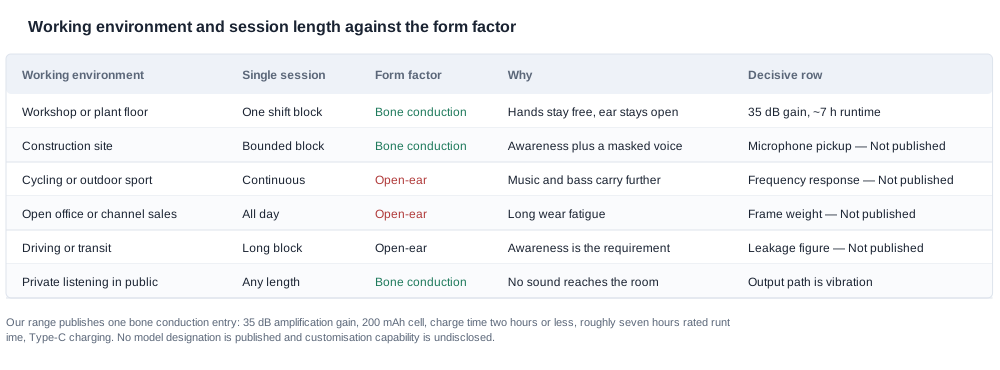
| Working environment | Single session | Form factor | Why | Decisive row |
|---|---|---|---|---|
| Workshop or plant floor | One shift block | Bone conduction | Hands stay free, ear stays open | 35 dB gain, ~7 h runtime |
| Construction site | Bounded block | Bone conduction | Awareness plus a masked voice | Microphone pickup — Not published |
| Security or patrol route | Long block | Open-ear | Awareness dominates, music is incidental | Leakage figure — Not published |
| Cycling or outdoor sport | Continuous | Open-ear | Music and bass carry further | Frequency response — Not published |
| Open office or channel sales | All day | Open-ear | Long-wear fatigue | Frame weight — Not published |
| Private listening in public | Any length | Bone conduction | No sound reaches the room | Output path is vibration |
The table is not a ranking. It is a filter. The question it answers is not "which is better" but "which architecture does this brief require", and the answer is determined by the two axes rather than by a preference.
The signal-to-noise limit, which is where the environment actually decides
The reason the environment column carries so much weight is that bone conduction amplifies the environment as well as the source. The ear canal stays open, so the wearer hears the amplified signal and the real world at the same time, and can adjust the balance between them. That is a genuine advantage over a sealed product in a noisy place, and it is also the limit: in a genuinely loud environment, the effective improvement is bounded by the same noise the wearer is trying to hear past.
Two consequences follow for a buyer, and both are about expectations rather than about hardware.
The first is that additional gain does not rescue a hopeless environment. If the masked source is far below the ambient level, no amplifier figure fixes it, and a front end matters more than a decibel number. A buyer scoping a product for a loud site should therefore treat the microphone specification as the deciding row — which is exactly the row we do not publish for this entry.
The second is that the same environment produces different results for different people, because the coupling through the skull varies with the wearer. A product whose claim is "follow a voice in traffic" will be experienced as remarkable by one customer and as marginal by another, and the difference will not be visible in a specification comparison.
The session-length axis and the duty cycle behind it
A bounded block and a continuous day are different products, and the published battery rows describe the first. A 200 mAh cell with a roughly seven-hour rated runtime is scoped for a shift or a journey, not for a full working day of continuous use. The rating does not state its test condition, so it is a scale figure rather than a planning figure, and a buyer who plans a duty cycle on it should ask for the condition first.
The fatigue mechanism is the second constraint on the same axis. A frame that transmits through the skull has to hold contact pressure against the temple, and sustained pressure produces localised discomfort that appears after roughly an hour. How quickly depends on the individual and on the fit, which means the session length a product can honestly claim is set by the wearer, not by the supplier.
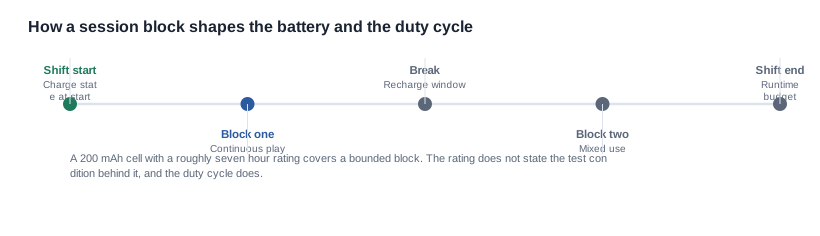
The practical output for a buyer is a scope statement that has to be written before the copy is written: a bounded block, a mixed-use profile, or an all-day claim. The third is not available in this architecture, and the specification should say so rather than leaving it to the customer to discover.
A warning: these numbers are not directly comparable
The same figure from two suppliers routinely measures two different things, and the mismatch is systematic rather than accidental. A gain figure may be a peak at one frequency or a broadband value. A runtime may be continuous playback or a mixed-use average. A cell capacity may describe a cell that will not be the one fitted at shipment. An ingress rating may be quoted for the frame rather than for the assembled product.
The rule that avoids the problem is to ask, for every figure that matters to your decision, what it is measured on and write the answer into your comparison sheet. Where the method is not stated, mark the row "method not stated" rather than scoring it. A comparison sheet that scores a row anyway will produce a total that looks like evidence and is not.

Verifying the fit, and where the fit fails
Verifying that the product matches the environment you scoped
Verification here is a document trail plus one narrow physical test. The document trail decides whether the product is what the quotation says and whether you can ship it. The physical test decides whether it works in the environment, which no document can settle.
Ask for the regulatory classification in writing. Which category does the product sit in, in the market you are shipping to, and what is the reasoning. For the United States, the framework at 21 CFR 800.30 separates an over-the-counter hearing aid — an air-conduction device intended for a person aged eighteen or older — from a non-device personal sound amplification product. A bone conduction product is neither air-conduction nor a hearing aid, so the legitimate positioning is the non-device category. The discipline is the same in every market even though the rules differ, and the question exposes whether a supplier has done the work.
Ask for the acoustic test method, not the number. A gain figure with a stated method can be checked; a gain figure without one cannot be compared to anything, including your own second sample.
Ask for the model designation and trace it to the label. If the model on the purchase order, the model on the packaging and the model on the documentation are three different codes, you have a traceability problem that surfaces at customs rather than at the warehouse.
Check every certificate number in the issuing body's public register. Confirm the model named on it is the model you are ordering, that the configuration you are shipping sits inside its scope, and that the date has not run out. The checklist used across the range is at certification checklist.
Check the battery transport file, because it is a shipping gate rather than a quality item. Air movement of lithium cells requires documentation the logistics provider will ask for at the border, set out at battery transport.
Ask which party owns the listing copy. Some suppliers write the listing, some buyers do. Whoever writes it has to be accountable for the claims in it, and the 35 dB figure is the line where a carelessly written product page becomes a compliance problem rather than a marketing problem.
Run the environment test with a written acceptance criterion. A real session length rather than a five-minute demonstration, several wearers rather than one, and the target environment rather than a quiet room. Agree the criterion before the sample is evaluated, so that a good impression cannot become an order.
The detailed boundary between device and non-device is covered at medical device boundary, and the mechanism behind the published rows is at bone conduction audio.
Where a programme goes wrong in this category
A listing written around the gain instead of around the use. The most common failure is a product page that leads with 35 dB and a picture of a person on a construction site. That attracts exactly the customer whose expectation the technology cannot meet, and the return arrives with the claim that the product is defective. The fix is upstream: the specification should state the working environment and the session length, and the copy should follow the specification.
Fatigue treated as a defect. A frame that transmits through the skull has to hold contact pressure against the temple, and sustained pressure produces localised discomfort that appears after roughly an hour. A support script that treats this as a fault generates replacement cost on a product that is behaving as designed. It is a wear limit with a time to it, and it belongs in the listing and in the training given to channel staff.
A camera added to a 200 mAh cell. This is a power-budget problem before it is an acoustic one. A sensor, a radio, a bone conduction driver and a small cell are competing loads, and the runtime that reaches the customer is set by the hardest of them. Treating the combination as a configuration option is how a project ends with a product that passes a laboratory demonstration and fails in a shop. It is a design project, and it should be scoped as one.
A single unnamed platform with no equivalent. Because the model designation is not published, a buyer who decides to move category after a sample evaluation has no way to re-quote the same product, and no way to check whether a cheaper competitor quote is really the same device. Decide the shortlist, then secure the second source, in that order.
Certification assumed rather than evidenced. Cost and schedule for regulatory work are fixed and are not a negotiation target. A supplier who quotes a low unit price and cannot produce a certificate number for the exact model is quoting a price for a product that cannot ship. That conversation belongs at factory audit stage, not at the purchase order stage.
Commercial structure, and a worked selection
What can move and what cannot
The commercial structure of a bone conduction programme has a clear split, and confusing the two is the most common quoting error.
The acoustic hardware of a bone conduction model, and the regulatory classification work that puts it on a market's approved list, are settled before the commercial conversation starts. Certification cost and lead time sit in the same place: they follow the testing process and the testing body. Tooling cost is usually amortised across the first order, so ask for it as a separate line rather than letting it disappear into unit price. And a second qualification run on the same model is a cost the factory carries whether or not you order in volume.
Everything above the hardware line is where a buyer has room, and in bone conduction that room sits mostly in the order structure rather than in the product itself. The terms worth negotiating time on are:
- Minimum order quantity tiers.
- Colour and temple configuration.
- Logo, lens tint and retail packaging.
- Which models you combine into one purchase order.
- One first production run delivered in two parts, paid for in stages.
- The number of units you take at the pilot tier versus the run tier, which is where most of the real negotiating room sits, since the factory's own risk exposure concentrates in the first run.
- The scope of the conformity assessment and the number of markets it covers.
Before a deposit goes out, this is the set a bone conduction buyer should hold: the designation table, the certificate register with numbers and validity dates, transport paperwork for the battery, artwork proof for the packaging, acceptance criteria for incoming inspection agreed in advance, and a signed statement that the listing copy stays clear of hearing-aid positioning and of any promise about treating, preventing or improving hearing. The clause language to work from is at contract terms, and the commercial structure of a first order is set out at pricing.
A worked selection
Assume an eyewear brand is adding a smart audio product to a line aimed at industrial distribution. The end customer is a site supervisor who needs to follow a colleague over machinery. A single session is one shift block. The first market is the European Union, with a United States launch to follow. The price band is mid-range, and the brand wants to keep one SKU rather than build a range.
Step one is the environment, not the product. The supervisor needs a masked voice and needs to stay aware of the site, and privacy is not the requirement. That combination points at the bone conduction architecture, and it points away from a product whose differentiator is music. It also sets the honest boundary of the claim: the copy can describe following speech in a noisy working environment, and it cannot describe hearing improvement, because that is a claim requiring a regulatory position the entry does not have.
Step two is the session. A shift block is bounded, which is what the published 200 mAh cell and roughly seven-hour rating are scoped for, and it is well inside the point where contact pressure fatigue becomes the dominant complaint. That means the duty cycle can be stated in the specification rather than discovered in returns. It also means the product can carry a camera in a later variant, because the load is being sized for a shift block rather than a full day — though a camera configuration is a design project with its own schedule, not a configuration option.
Step three is the platform, and this is where the decision is uncomfortable. Our own range publishes no model designation for this entry and records its customisation capability as undisclosed, so there is no SKU to place on a purchase order, no code to name on a label, and no disclosed route to a private-label programme. That is a fact about the entry rather than about the category, and it has to be settled before the artwork is approved.
Step four is the compliance route, decided before the artwork rather than after. In the European Union the product is a radio product and the general product safety regime applies, so the file needs a technical file, a declaration, labelling, instructions and an economic operator in the market. In the United States the claim has to remain on the non-device side of the air-conduction line, and because listings are usually global, the same copy serves both markets. The transport file for the fitted cell is a separate gate enforced at the border.
Step five is the sample, and it is scoped to the environment that the mapping identified: a full shift, several supervisors, the actual site, with the acceptance criterion written down in advance. The sample answers the fatigue question and the masked-voice question. It does not answer the regulatory question, and it does not answer the specification-comparison question, because both are document questions.
Our read on the category, and the next step
A specialised form factor, and the cases it fits
The working rule we apply: bone conduction is a specialised form factor with a narrow and defensible set of applications, and saying so plainly is more useful to a buyer than presenting it as a universal open-ear solution. We publish a 35 dB gain, a 200 mAh cell, charging inside two hours, a runtime rated at about seven hours and a Type-C connector, because the catalogue states them. We publish the absence of a model designation with the same prominence, and we will not substitute a typical weight, a driver size or a frequency response for a measured value we do not have. We will also not describe the product in language that positions it as a hearing aid, in the United States or in any other market, and we will not make any claim about protecting or improving hearing.
Target market, environment and channel
Send us the target market, the working environment, the length of a single session and the channel the product will be sold through. We will tell you whether this form factor is the right one for those four answers or whether an open-ear model serves your customer better, we will list which published rows cover your configuration and which remain unpublished, and we will flag anything that must be settled in writing before a deposit is paid. If you are ready to evaluate the form factor physically rather than on paper, the sampling route is at samples, and the alternative architecture is set out at open-ear audio.
Related reading
- The specification and the category in one place — bone conduction audio
- The alternative that wins on music and long wear — open-ear audio
- The market boundary described above — certification checklist
- How the session length changes the design — battery life and runtime
Tell us the environment, the session length and the country you are shipping into, and we will say whether bone conduction is the right form factor for it and what our published specification covers.


