

Bone conduction glasses technology: who reads this glossary
What a glossary is for in this category
A glossary in most product categories is a convenience. In this one it is a control document, because terminology in bone conduction does a specific kind of damage: it lets a mechanism description stand in for a performance claim, and a regulatory category stand in for a compliance position. Both substitutions are easy to make by accident and costly to discover later.
The practical version of the rule is this: every term you use in a document should carry a written note of what it does not license you to claim. A term with no such note is a term that will be stretched the first time somebody wants to use it in a product page, and the stretching is where the exposure appears. This glossary is therefore written to bound the terms rather than to define them generously, and each entry ends with the question that closes the gap.
For the category as a whole, the published position is narrow. Our range holds one bone conduction entry, and it discloses six rows and withholds twelve. The six disclosed are a 35 dB amplification gain, a 200 mAh cell, a charge time of two hours or less, a roughly seven-hour rated runtime, Type-C charging, and the fact that no model designation is published. The twelve withheld are the transducer type, position and count, the frequency response, the perceived loudness conditions, the frame weight, the frame dimensions, the ingress rating, the battery chemistry, cycle life and replaceability, the customisation capability, the acoustic leakage, the microphone pickup distance, and the certification status. Most of the terms below resolve to one of those six or to one of those twelve.
The rules for how to verify a term, and the checklist of questions to ask, sit at the end of each entry.
Who this glossary is written for
Three people use a glossary like this, and they need different things from it.
A category buyer comparing quotations needs to know when two suppliers' words mean the same thing, and which one to shortlist on a claim rather than on vocabulary. A supplier's "35 dB gain" and a competitor's "35 dB gain" can describe different measurements, and the glossary tells you which question to ask to find out. The audit question at the end of each entry is the tool.
A product or marketing owner writing the listing needs to know which words are safe on a product page and which are not, and needs to know that the answer can differ by document. A term that is perfectly safe in a supplier's technical reply can be unsafe on a retail box, because the audience changed and the risk with it.
A legal or compliance reviewer needs the opposite of a marketing guide: not a list of permitted words, but a list of the claims that are not made anywhere in the set, so that they can check a draft against what the product actually is. The entry on hearing-related terms is the one that matters most to this reader, and it is the one where the answer is a hard no rather than a qualification.

Why the wording of a spec sheet decides a programme
The two substitutions, and what each one costs
The first substitution is mechanism for performance. A document says "bone conduction transducer" and a reader concludes "clear sound", because the words feel technical enough to imply a measurement. Nothing was measured. The only published acoustic figure in our range is a 35 dB gain, and without a stated input level it cannot be compared to another gain figure, which means it cannot be compared to anything at all.
The cost of this substitution is a mis-scoped programme. A buyer who believes the product delivers clarity in noise will place it in a noisy application, will write listing copy that promises clarity, and will receive returns attributed to a defect. The correction comes after launch, and it comes from the channel, not from the factory. The red flags are recognisable once you know which term is doing the work.
The second substitution is category for position. A document says "hearing aid level" and a reader concludes that the regulatory position has been settled, because a category name sounds like a decision. It is not. A regulatory category is something a regulator assigns in a given jurisdiction, not something a datasheet asserts. The cost of this substitution is a product that cannot be listed in the market it was designed for, discovered at listing review, which is the worst possible moment because the inventory has already been paid for.
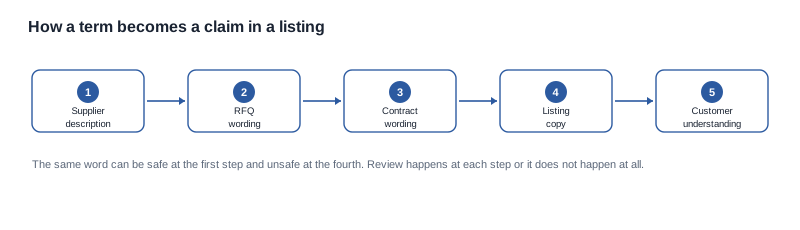
Where these terms sit in the supply chain
The vocabulary problem compounds as you move down the chain, because each document is written by a different function with a different interest, and each function reaches for the nearest term that sounds adequate.
A supplier's datasheet is written to demonstrate capability, so it favours the descriptive terms — transducer, gain, surround sound, open-ear. A purchase order is written to fix a deliverable, so it favours the identity terms — model, designation, configuration, cell. A technical file is written to satisfy a conformity assessment, so it favours the measurement terms — input level, band, test condition, standard. A product page is written to sell, so it favours the outcome terms — clear, comfortable, hours of playback, private listening. A support script is written to close a ticket, so it favours the fault terms — defective, not working, uncomfortable.
The only place these five vocabularies meet is the review that happens before a product page is approved, and that review does not happen by accident. A buyer who has a bounded glossary gives the reviewer something to check against. A buyer who does not has a reviewer improvising, which means the review outcome depends on who reviewed it.
The terms that change what you may write
The acoustic terms
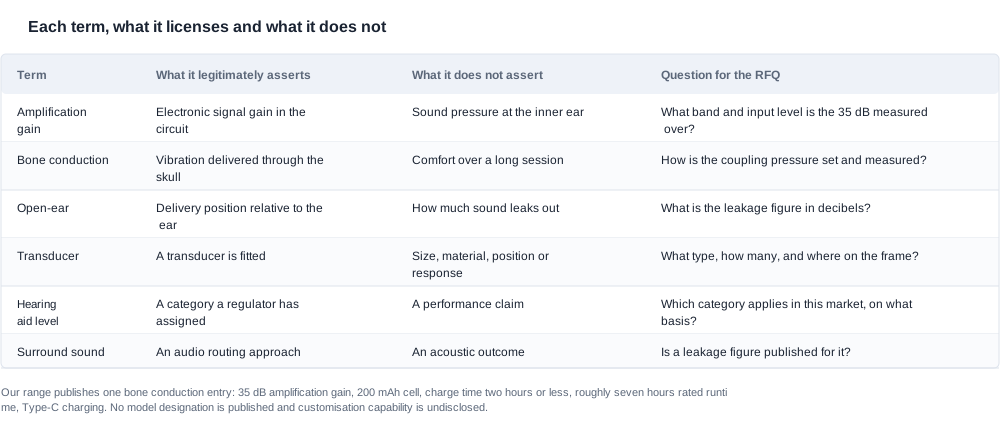
Amplification gain. An electronic figure describing a signal gain applied in the circuit. It does not describe the sound pressure the wearer receives, because the input level, the weighting applied and the transducer's efficiency are all missing. Our entry publishes 35 dB, and without a stated input level it cannot be compared to another gain figure.
The bounded claim is that the circuit applies this much electronic gain. The unbounded claim is that it is 35 dB louder at the ear. Audit question: what input level, what band, and at what point in the circuit is the figure taken.
Bone conduction. A mechanism — vibration delivered through the skull rather than through the ear canal. It does not assert anything about comfort, and it does not assert anything about the level the wearer receives. The common claim that it produces no ear fatigue is not established by the mechanism: contact pressure against the temple produces localised discomfort over a long session, and no specification describes it because no specification can. Audit question: how is the contact pressure set, and over what period has it been tested.
Transducer. The element that converts an electrical signal into mechanical vibration. The term tells you a transducer exists. It tells you nothing about its size, material, position or response, and none of those is published for our entry. The position in particular determines the pressure profile over a long session, and the size determines how much of the frame mass is dedicated to sound rather than to structure. Audit question: what type, how many, and where on the frame.
Open-ear. A description of where the audio is delivered relative to the ear. It is a real advantage for situational awareness and it is not an acoustic performance claim. What it does not assert is how much sound escapes into the environment; that figure is leakage, and no leakage figure is published for our entry. The practical consequence is that "open-ear" cannot be used as a privacy claim, and an open-ear platform and a bone conduction platform are not interchangeable on privacy even though both are sold as open-ear. Audit question: what is the leakage figure in decibels, at what playback level.
Surround sound. An audio routing approach describing how sound is positioned relative to the ear. It is not an acoustic outcome, and it is not a leakage figure. In an industrial or security application, leakage is an exposure question for the people nearby rather than a comfort question, which is exactly the kind of use case where the descriptor is most often used and least often justified. Audit question: is a leakage figure published for the configuration, and does the claim rest on the routing or on the figure.
Frequency response. A term that appears in almost every comparable category and in none of our published rows. It is what converts a gain figure into a claim about quality, and its absence is the reason 35 dB cannot be evaluated. A buyer should treat any comparison in this category that rests on gain alone as a comparison of the least informative figure in the specification. Audit question: what is the response curve, over what range, measured how.
The regulatory and claim terms
Hearing aid level. A regulatory category, not a specification. If it means anything precise it refers to a classification assigned by a regulator in a given jurisdiction — something a product is, not something a datasheet asserts. We do not describe our bone conduction product as a hearing aid and we make no medical claim about it. A gain figure near this range plus a hearing-assistance claim changes the compliance route entirely, which is a question for your legal adviser in your market. The boundary in the United States is at 21 CFR 800.30, which defines the over-the-counter hearing aid by air conduction. Audit question: which category does this product sit in, in this market, on what written basis.
Open-ear hearing. The phrase describes a wearing position and is easily mistaken for a therapeutic category. It is neither a claim we make nor one we would support, and it should not appear in any document in your set. Audit question: does this phrase appear in the draft copy anywhere, and if so, remove it.
The general rule. Each of these terms is a legitimate description of a mechanism. The error happens when a mechanism description is carried into a performance or compliance claim without a supporting measurement. Ask what measurement would be needed, then ask whether it exists. In this category, usually, it does not — which is a finding rather than an obstacle.
The thresholds a bounded term implies
Bounding a term is not a writing exercise; it changes what a supplier has to deliver. If the contract says "rated runtime", the supplier owes a test condition, because a rating without a condition is not a rating. If it says "amplification gain", the supplier owes an input level and a band. If it says "open-ear", the supplier owes a statement of what is not claimed, because the term is the only thing standing between the listing and a leakage figure nobody has.
This is the practical value of a glossary to a buyer: it converts an ambiguity into a deliverable. Each bounded term is a line item on the supplier's document list, and each line item is something you can check on receipt. A term that is not bounded is not a free word — it is an unpaid line item that will be settled by argument at the acceptance inspection.
There is a second-order effect worth noting. A bounded glossary shared with a supplier before the quotation is a cheap way to remove the most common source of late-stage disputes, because it makes the difference between two suppliers' terminology visible before either has built a design around it. It costs a page of writing and it removes a category of rework that is otherwise discovered after tooling.
The trade-offs are worth naming as well, because a glossary is easy to over-apply. A term list that reaches into every sentence of a specification becomes a negotiation and slows the quotation; a glossary that is too narrow leaves the outcome words unbounded, which is the failure it exists to prevent. The useful boundary is the one this glossary draws: mechanism and measurement terms are bounded precisely, and outcome terms are excluded rather than debated.

How to check a term, and where a term misleads
The audit question, applied
The single technique that makes a glossary operational is to ask, for any term in any document: what measurement would be needed to support this, and does that measurement exist? If the answer is that it would be needed and does not exist, the term cannot appear in a customer-facing document. If the answer is that it exists, the term can appear and the measurement can be requested. If the answer is that it would be needed and is available on request, the term can appear in an internal document and can be upgraded later.
Applied to the published rows, the audit produces a clean split. The 35 dB gain, the 200 mAh cell, the two-hour charge time, the roughly seven-hour runtime and the Type-C interface are all supportable as published, and the only thing to add to them is the measurement condition where one is missing. The absent model designation, the absent frequency response, the absent leakage figure, the absent weight and the absent certification status are all cases where the measurement would be needed and does not exist, and each one is a specific request rather than a vague gap.
The technique is also the fastest way to catch a supplier using a term loosely. Ask for the measurement behind the term. If the answer is a definition rather than a number, the supplier is using the term as a description of intent, which is fine in a proposal and unusable in a contract. The common pitfalls in this step are requesting a measurement in the wrong terms — asking for "loudness" when you need an input level and a band — and accepting a verbal method in place of a written one.
Where a term misleads, and what it costs
"35 dB" used as a loudness claim. The gain is upstream of the coupling, and the coupling is where the variation lives. Two units with identical gain can sound materially different to two different wearers. The cost is a product page that attracts a customer expecting a level the product does not deliver, and a return attributed to a defect.
"Hearing aid" used as a category label rather than a regulatory position. The cost is a listing that has positioned the product outside the category it was designed for. In the United States, the over-the-counter hearing aid definition at 21 CFR 800.30 covers air-conduction devices, so a bone conduction product has to argue its own position rather than rely on an inclusion — and that argument is a legal one, and it is different in every market.
"Open-ear" used to imply privacy. The cost is an exposure question in the environments where leakage matters: a security channel, a confidential call in a shared space, a customer who is a translator or a consultant. An open-ear platform leaks more the louder it is played, and that fact has to be in the training material as well as the spec.
"Seven hours" used as an all-day claim. The rating has no stated test condition, and the frame has to hold contact pressure against the temple for the whole session. The cost is a wear limit that surfaces as a fault report.
"Bone conduction" used to imply comfort. The mechanism does not establish comfort; the temple geometry and the frame mass do, and neither is published for our entry. The cost is a range that cannot be specified for a long-wear application.
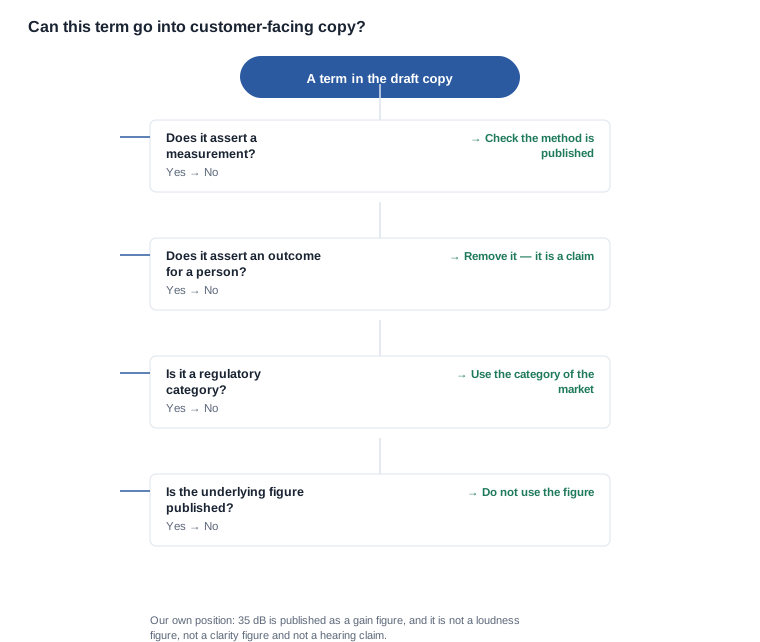

Terms in contracts, and a worked wording review
Where the terms belong in the document set
In a well-run bone conduction programme, each term family lives in a specific document, and the rule is that a term may only appear in a document that can carry the obligation behind it.
The measurement terms — input level, band, test condition, coupling arrangement, leakage figure, frame weight, cell specification — belong in the technical annex to the purchase order, where they are accompanied by the acceptance criteria that make them checkable. They must not appear in the product page, because a product page is not a document anyone can be held to.
The identity terms — model designation, configuration, cell part number, packaging artwork revision — belong in the purchase order, the label artwork, the declaration of conformity and the certificate, and they must be identical in all of them. This is where our own entry is weakest, since no model designation is published.
The claim terms belong in two places and only two: in the product page and the packaging, where they are customer-facing, and in the compliance annex, where they are stated as what the product is and what it is not. A claim that exists only in the annex is a claim the customer will never see, which is exactly what you want for a claim you cannot support.
The prohibited terms appear nowhere. In our set these are the hearing-improvement terms, the assistive-listening terms and the loudness-at-the-ear terms. A short prohibited-terms list, attached to the artwork approval request, is a cheap and unusually effective control. Run it before you order, not after the print run is committed, because a prohibited term found on a proof is a reprint and a prohibited term found on a printed box is a write-off.
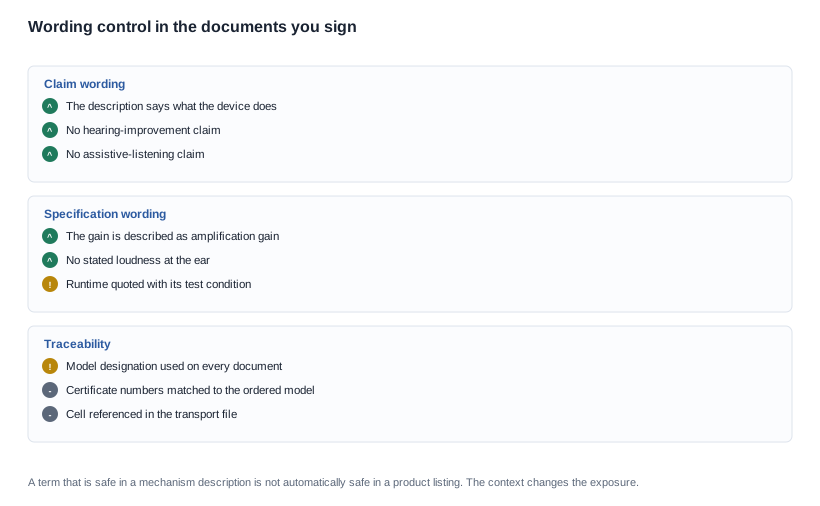
A worked wording review
Assume a channel buyer has a listing draft for a bone conduction frame, written by a supplier's marketing team, and needs to publish it in two markets.
The review starts with the noun phrases, because those carry the claims. The draft opens with "35 dB amplified bone conduction" and "hearing aid level clarity". The first phrase is supportable if it stays an amplification-gain description, because that figure is published, but the placement in a headline invites the reader to read it as an output level. The second phrase is not supportable at all: it is a regulatory category used as a marketing adjective, and it carries a hearing implication that no document in the set supports. The wording change is to remove the second phrase and to move the first into the technical description.
The review also has to decide which model of the claim the listing is running. A listing can be written around the mechanism — an open-ear frame that delivers amplified environmental sound while the ear stays clear — or around the environment and the session, such as a frame built for following speech across a working site. The second is the stronger copy in this category, because it is the claim the published rows can support, and the first is the claim that lets a competitor's marketing write your product page for you.
The review then moves to the performance adjectives. "Crystal clear in noisy environments" fails the audit question, because a frequency response and a microphone pickup distance would be needed to support it and neither exists for this entry. "Up to seven hours of playback" needs the test condition attached, or it needs to become a scope statement rather than a headline. "Feather-light" and "all-day comfort" fail because frame weight is Not published and because the contact pressure mechanism is an argument against the all-day claim rather than for it.
The review then checks the channel, which is where the remaining exposure sits. A product page is a customer-facing document, so the same phrase that is safe in a technical annex is not safe here. The leakage claim, if any, needs a figure, and there is none. The privacy claim survives only because it is structural: the output is a vibration in the skull rather than a sound wave in the room, so "no sound reaches the room" describes the architecture and not a measurement — but it must be written that way, and not as "silent" or "zero leakage", both of which sound like figures.
The review then produces the two artefacts the rest of the programme needs. The first is a one-page approved claim list, naming the phrases that may be used, the conditions attached to each, and the phrases that may not. The second is the open-items list: the measurement conditions that must be obtained before the listing can carry the gain figure, the model designation that must be established before the label artwork can be approved, and the certification position that must be settled before the listing goes live in either market.
The commercial consequence of doing this review before the artwork is approved is a shortened listing cycle. The consequence of doing it after is the familiar one: a copy rewrite, a re-approval cycle, and a period during which the listing is either live with an unreviewed claim or pulled from sale.
Each term's limit, and how to work from this glossary
The five parameters we hold, and what they do not cover
Stated plainly: we publish the five parameters we hold — the 35 dB gain, the 200 mAh cell, the two-hour charge time, the roughly seven-hour runtime and the Type-C interface — and we state plainly that no acoustic specification beyond the gain figure, no model designation and no certification status is available to us. We will not make a hearing-assistance or a medical claim for any product, and we will not present a gain figure as an output level.
We will also not widen a term to cover a claim we cannot support. A glossary is only useful to a buyer if it is written from the position of what the product can be shown to do, and a catalogue entry is well placed to write that honestly because it has the fewest reasons to stretch a word.
How to use this glossary
Take the entries as a questionnaire rather than a dictionary. For each term, the audit question is the deliverable: what would have to be measured, and does it exist. Where it exists, put it on the request list with the supplier. Where it does not, put the term on the prohibited list for customer-facing documents and write down which internal document it is allowed in.
Two habits make the glossary work. The first is to send it to a supplier before the quotation rather than after, so that a term used loosely is caught while it is still cheap to fix. The second is to keep the questions to ask with the entries, because a glossary without a question attached to it is a definition list and a definition list does not change a purchase order.
Send us the use case and the market and we will tell you which of these terms matter for your positioning and which should not appear in it. The mechanism behind the terms is described under bone conduction audio, the published rows are walked through in bone conduction spec sheet explained, and the compliance boundary is at medical device boundary. The questions to put to a supplier are collected in what to ask a supplier about bone conduction.
Related reading
- bone conduction audio technology
- reading a bone conduction datasheet
- bone conduction red flags in claims
Tell me the use case and market and I will say which terms to use.


