

Bone conduction glasses technology: six rows, six claims
Bone conduction glasses technology smart glasses spec sheet explained is a short document with one very large number in it, and the whole of the reading skill is knowing what that number is and what it is not. Our catalogue publishes six rows for this entry: an amplification gain of 35 dB, a bone conduction transducer, a 200 mAh cell, a charge time of two hours or less, roughly seven hours of rated runtime and Type-C charging. There is no model number, and there is no customisation capability published.
The 35 dB row is the one that gets quoted, and it is the one that most often ends up in customer-facing copy without the conditions that make it mean anything. But every row on the sheet carries the same structure: a figure, a condition that is either stated or silently missing, and a sentence the row will support. Once you read the sheet that way, the gaps become obvious, because a row with no condition and no permitted sentence is just a number.
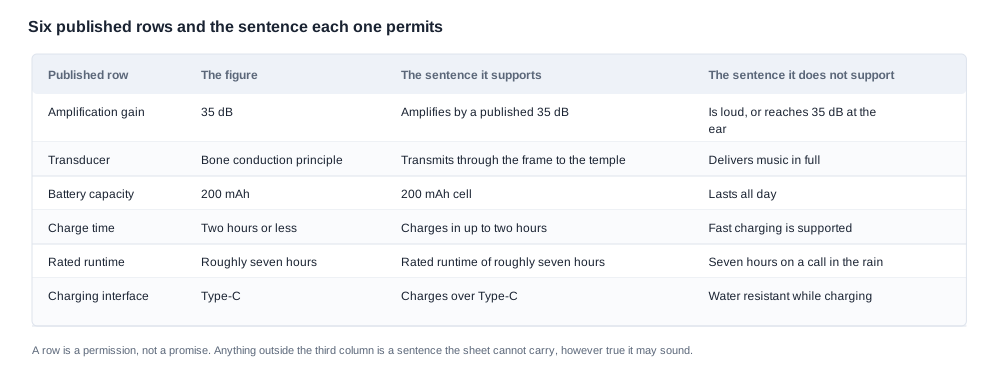
There is a useful discipline in this, and it is the subject of this article. Treat each published row as a permission. A permission says: this is the sentence you may write, and this is the sentence you may not. It is a narrow way of looking at a specification, and it is the only way that works in a category where the sheet is this short and the marketing temptation is this strong.

The gain row: what 35 dB does and does not license
Decibels are logarithmic. A +6 dB change is roughly a doubling of sound pressure, and +20 dB is roughly a tenfold increase. That is worth holding on to, because it is why gain figures sound larger than they are: the gap between 20 dB and 35 dB is not a step, it is a multiplication.
What the row does tell you is that the published figure is the most aggressive parameter anywhere in our range, and that it describes an electronics gain applied to a signal. What it does not tell you is almost everything else. It does not say at what input level the gain was applied, which matters because a gain figure at a quiet input and a gain figure at a loud input describe different amplifiers. It does not say whether the measurement was taken on the device output or on the electrical signal, which are not the same quantity. It does not say whether the gain is adjustable, or over what range, or in how many steps. And it does not say what a wearer actually perceives, which depends on the environment, the source, the fit and the individual.
So the honest way to read this row is as a maximum output capability, not as a result. The sentence the row supports is narrow: the device applies a published 35 dB gain to the signal. The sentences it does not support are the ones that matter commercially — that the product is loud, that it reaches 35 dB at the ear, that it is louder than a given alternative. Each of those converts an electronics figure into a perceptual claim, and the conversion is not available to you.
There is one further reading worth resisting. A gain of this size invites a comparison with the band of figures used for daily amplification, and the number sits in that band. The trap is that the resemblance is a numerical coincidence between an electronics figure and a clinical one, and the two are not interchangeable. A number in a clinical band is not thereby a clinical measurement, and a product is not thereby a clinical device. What settles the question is how the product is described and which route it is sold under — not how the figure compares.

The transducer row, and the consequence nobody measures
Bone conduction means the output is a mechanical vibration in the skull rather than a sound wave in the air, and the transducer is the part that produces it. This row carries two consequences that no number describes.
The first is privacy: no sound radiates into the room, so nothing nearby can hear what the wearer is listening to. That is the one advantage bone conduction has over every other design in our range, and it is a real commercial argument for the category. What it does not license is a claim of complete silence, because a frame under tension transmits structure-borne vibration into whatever the frame is resting against, and no one in this category publishes a figure for that.
The second is that the frame becomes the coupler. The vibration reaches the ear through the contact between the temple and the head, so the result depends on the fit of the frame and on the individual wearing it. Two people wearing the same unit can hear materially different things. That is not a defect; it is the nature of a mechanical transmission path, and it is why a case study needs a named wearer and a recorded fit, and why a product listing in this category has to be careful about anything phrased as a uniform experience.
The row itself is a mechanism statement, which makes it unusually safe to publish and unusually weak to sell on. The sentence it supports is that the product transmits through the frame to the temple. The sentence it does not support is that it delivers music in full, because the frequency content that a listener expects is exactly the part the mechanism attenuates.
The request this row generates is specific and worth making in writing: where on the frame the transducer sits, what it is made of, and whether the frame's own contribution to the output has been characterised. A supplier who answers these has a real engineering conversation behind the product.
The electrical rows, and the condition each one omits
The 200 mAh cell. A smaller cell than most of our camera range, which is consistent with a product that is not carrying a camera. What the number does not tell you is the runtime, because runtime is capacity divided by average power draw and the gain setting, the amplifier and the transducer all contribute. The sentence the row supports is that the product has a 200 mAh cell. It does not support a claim about how long the product lasts, because the cell alone cannot produce that number.
The charge time of two hours or less. From empty. Whether the device accepts a fast-charge protocol is not published for any model in our range, and it is a fair question because it is the difference between charging overnight and charging at a desk. The row supports a charge-time statement. It does not support a fast-charging claim, and it does not support a statement about how long a charge lasts in normal use, which is a different figure again.
The roughly seven hours of rated runtime. No test condition is stated, and the condition matters more here than in most categories: was the gain at maximum during the measurement, and was the device amplifying continuously or intermittently? A runtime measured at maximum gain is a very different number from one measured at a low setting, and a buyer comparing this entry against an open-ear model on runtime alone is comparing two different workloads. The row supports a rated runtime of roughly seven hours. It does not support seven hours on a call outdoors, and it does not support an all-day claim.
Type-C charging. The wired interface on the device, which is the most convenient arrangement for a customer who already owns a cable, and the one that also exposes a port to the ingress that our sport models are marked against. The row supports a statement about the connector. It does not support a statement about water resistance at the port, because no ingress rating is published for this entry.
The pattern across all four is the same, and once you have seen it you cannot unsee it: every electrical row states a quantity and omits its condition. That is normal for a catalogue, and it is the reason a catalogue is not a specification, and it is why the request list at the end of this article is long.
Building a comparison sheet that survives contact with a supplier
A comparison sheet is the tool a buyer actually uses, and in this category most comparison sheets are built wrongly. They are built as a list of numbers, in which the largest number wins, and a 35 dB gain against a 6 dB driver specification is a comparison between two different quantities dressed as a comparison between two products.
A sheet that works has three kinds of row, and mixing them is what breaks most comparisons.
Quantity rows are the published figures. They are the only rows that can be compared directly, and only when the same row is published for both sides. A sheet built entirely of quantity rows, with a column for each product, is the minimum viable comparison and it is enough for a first pass.
Condition rows sit next to the quantity rows and say what the number was measured under. A cell with a condition and a cell without one cannot be compared, and a sheet that places them side by side without flagging the difference is worse than no sheet, because it produces a ranking. In this category almost every cell in the bone conduction column is a quantity without a condition, and the honest annotation is a note in the cell, not a footnote nobody reads.
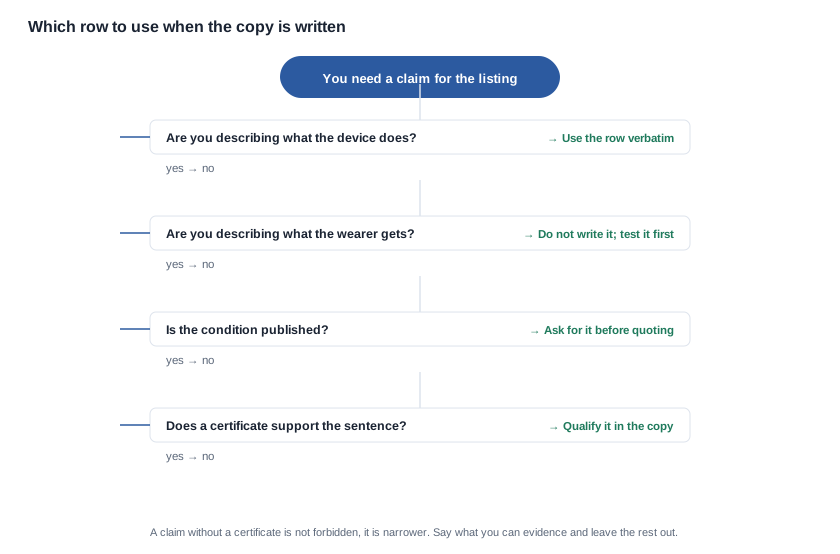
Permission rows are the ones most sheets omit and they are the ones that decide the commercial outcome. For each published row, the sheet records the sentence it supports. This turns a comparison from a list of numbers into a list of what you can actually say about each product, and it is the only version of the comparison that survives contact with a marketing team.
A fourth kind of row is worth adding, and it is not a number at all: a status column. For each row, the sheet records whether the entry publishes the figure, publishes it with a condition, publishes a related figure that is not directly comparable, or publishes nothing. A comparison sheet with a status column is a decision tool; a comparison sheet without one is a document.
The other half of building a sheet that survives contact with a supplier is knowing what to do when a cell is empty. The rule is short: an empty cell is a question, and the question goes to the supplier in writing before the comparison is used to justify anything. An empty cell that is filled in by a buyer with a plausible assumption is how a programme ends up comparing a product against a figure that no supplier ever claimed.
The rows that are missing, and the request to fill them
The absences on this sheet are the commercially important half of it. For this entry the catalogue holds no model number, no customisation capability, no acoustic measurement of any kind, no driver size, no frequency response, no leakage figure, no pickup distance, no frame weight, no frame material, no ingress rating, no microphone specification and no certification status.
Two of those absences are more consequential than the rest. The missing model number is the single most commercially damaging gap, because a product without a model number cannot be quoted, ordered, certified against a specific designation or listed with a stable identifier in a marketplace. It also makes the comparison sheet impossible to complete, because there is no key to join on.
The missing customisation capability is different in kind. The open-ear audio platforms in our range publish logo, colour, packaging, temple shape, lens material and Bluetooth name customisation. This entry discloses no capability at all, which is a considerably larger gap than an empty table cell: an empty cell in a table of options means the option is not offered, whereas a blank capability statement means the position is unknown. A buyer evaluating this entry for a private-label programme has nothing to evaluate, and the request has to be made explicitly.
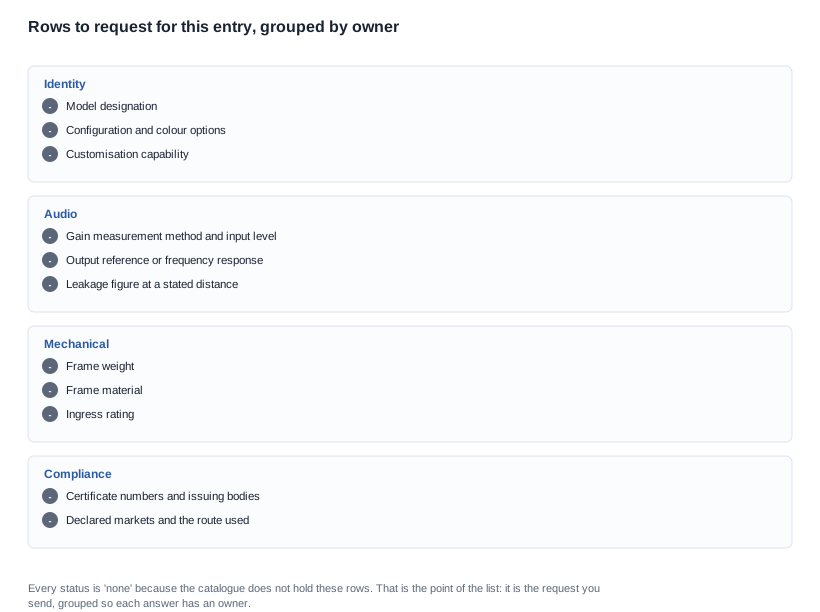
The request itself is a list, and it is worth sending as a list rather than as a question, because a question gets a paragraph and a list gets a table. The grouping matters too: identity, audio, mechanical, compliance. Each of the four groups goes to a different kind of answer, and a supplier who answers three of the four groups completely has a documentation habit, while one who answers two completely and two vaguely is telling you where the programme will get difficult.
What to negotiate when the sheet is incomplete
The incompleteness of a sheet is a commercial matter, and there are two ways to handle it. The first is to negotiate the sheet: to make the completion of specific rows a condition of the order, and to attach the completed rows to the purchase order rather than to an email. The second is to price the incompleteness: to treat the missing rows as a risk carried by the brand, which is acceptable when the volume is small and the exposure is contained, and unacceptable when the programme is the brand's main entry into the category.
The specific commercial asks that follow from a thin sheet are these. The model designation the certificates name becomes a condition of the order, and a variant outside that list is a separate order. The documentation package arriving with the order becomes a condition of the final payment. The gain figure enters the file with its method attached, or it does not enter the file at all. The acceptance criteria for the production lot are written against the published rows, so that the rows the brand does have are the rows the factory is judged on. And the artwork is held until the copy has been checked against the permissions, because a sheet is a marketing asset and the artwork is where a sheet gets spent.
The trade-offs are real and should be stated to whoever is signing. A programme that insists on a complete sheet before it starts will wait. A programme that proceeds with an incomplete sheet and negotiates the completion as a condition gets a faster start and a harder conversation later. What should not happen is the third option, which is proceeding with an incomplete sheet, assuming the gaps will close on their own, and discovering in the second quarter that the model designation on the certificate is not the one on the order.
A worked example: turning a sheet into a listing
An illustrative case is set out below. It exists to show how the checks are ordered, and it stands for no completed order.
Assume a brand that has received a six-row bone conduction sheet from a supplier and is preparing a product page for an industrial channel. The sheet reads: amplification gain 35 dB; bone conduction transducer; battery 200 mAh; charge time two hours or less; rated runtime roughly seven hours; Type-C charging. No model number, no customisation line.
The first decision is to write the permissions, not the copy. The brand builds a table with three columns: the row, the sentence it supports, and the sentence it does not support. The gain row supports "amplifies by a published 35 dB" and does not support "loud" or "35 dB at the ear". The runtime row supports a rated runtime and does not support an all-day claim. The sheet is finished in half an hour, and the finished table is the thing every later approval refers back to.
The second decision is to add the condition notes. Two rows get an annotation: the runtime row notes that no test condition is published, and the charge row notes that fast charging is not published. The annotations are short, and they exist so that a copywriter working from the sheet six weeks later does not have to remember what was said in a meeting.
The third decision is to close the model number. The brand asks which model designation the certificates name and requires the order to be written against it. The supplier answers with a designation. The brand does not need to like it; it needs it to be stable, because the listing, the artwork, the file and the purchase order all have to refer to the same thing.
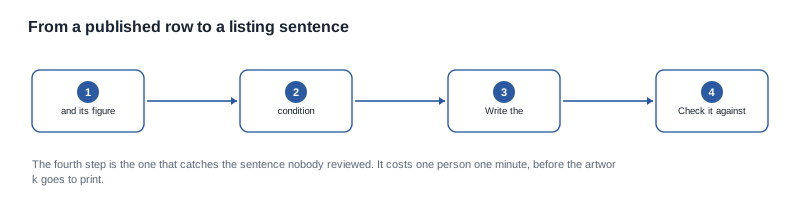
The fourth decision is to write the listing from the permissions. The product page states the mechanism, the gain figure as an electronics figure, the cell, the charge time, the rated runtime with the word "rated" attached, and the connector. It contains no sentence about loudness, no sentence about fatigue, and no sentence about a use case. What it gains is the ability to survive a retailer's compliance query, because every sentence on it points at a row that the supplier published.
The fifth decision is about what the page cannot say. The industrial channel asked for a statement about intelligibility in noise. There is no published row for it and no permission for it, so the brand does not write it. Instead it writes the environment the product is suited to, and it plans a field test in the customer's own site as part of the acceptance programme. The listing ships narrow, and the narrowness is what buys the brand a season in which the supplier produces the acoustic figures that would let the next version of the page be wider.
The rows we hold, and the sentences they carry
The working rule we apply: we publish the six rows we hold for this entry, and we publish the absences with the same prominence as the rows. We publish a 35 dB amplification gain, a bone conduction transducer, plus a 200 mAh cell, a charge time of two hours or less, and a rated runtime of roughly seven hours and Type-C charging We publish no model number, no customisation capability, no acoustic measurement, no frame weight, no ingress rating and no certification status for this entry.
We will not present the gain as a level at the ear, and we will not present the rated runtime as a result in a working condition, because neither conversion is available from a row that carries no condition. We will not publish a frequency response, a leakage figure or a frame weight that we have not measured, and we will not estimate them for you. And we will not describe the product as a hearing aid or make any medical claim on it.
What we will do is tell you which sentence each published row will carry, and which rows a supplier has to complete before the sentence can be written. If you send us the sheet you are holding, we will mark the rows we can support, the rows that need a condition before they can be quoted, and the rows that have to be requested.
Actions to take with the sheet in front of you
Write the permissions table before you write a single sentence of copy. It takes half an hour and it is the artefact that stops an unevidenced sentence from reaching the artwork.
Mark every empty cell as a question. An empty cell that a buyer fills with a plausible assumption is how a comparison ends up ranking products against figures nobody claimed.
Make the model designation a condition of the order. It is the one gap that affects every other gap, because the order, the file, the listing and the packaging all have to agree on it.
Ask for the four missing groups in writing: identity, audio, mechanical, compliance. A list gets a table. A question gets a paragraph.
The underlying mechanism is covered under bone conduction audio technology, the scale of the gain figure is in bone conduction gain levels, and the reading discipline for a datasheet without a method is in reading a datasheet without trusting it.
Where this comes from
- Bone conduction audio technology and its limits
- Gain levels in bone conduction products
- What the spec sheet does not tell you
- Bone conduction glasses in the range
Send us the sheet you are holding and we will mark the rows our documentation covers and the rows a supplier has to complete.


