

Bone conduction glasses technology: the deciding questions
Bone conduction is bought for one reason: it keeps working when the room is loud. That single advantage is real, and it is the reason the route exists at all. It is also the reason bone conduction is the most frequently mis-specified product in the smart glasses category, because the same word covers a decision about the environment, a decision about the channel and a decision about the claim, and those three decisions have different answers in different programmes.
The short answer for a procurement manager is this. Before you compare quotations, establish which environment the product is sold into, whether the sound has to be private, whether the product will be sold with any claim about hearing, and whether your documentation route requires a named model. Those four questions decide the route, the evidence you will need, and which numbers in a quotation are comparable. A quotation for the wrong route is not cheaper than one for the right route; it is a different product with a different conformity position and a different returns profile.
Our own catalogue holds one bone conduction entry, and it is worth reading carefully because of what it does and does not say. The entry publishes a 200 mAh cell, a charge time of two hours or less, a rated runtime of roughly seven hours, Type-C charging, and an amplification gain of 35 dB. It publishes no model designation, no transducer placement, no frequency response and no leakage figure. That combination — a capable product with a published gain figure and no published name — is unusual, and it creates a documentation problem that a buyer has to solve rather than wait for.
We also need to be clear about a boundary. A 35 dB amplification gain is a published electrical figure on a catalogue entry. It is not a hearing-aid claim, we make no statement about the product's effect on hearing, and a buyer who puts such a claim in a listing takes on an obligation that sits under medical device frameworks rather than under consumer electronics ones. The medical device boundary page sets out how we treat that line. This article is about buying an audio product, not about treating a hearing condition.
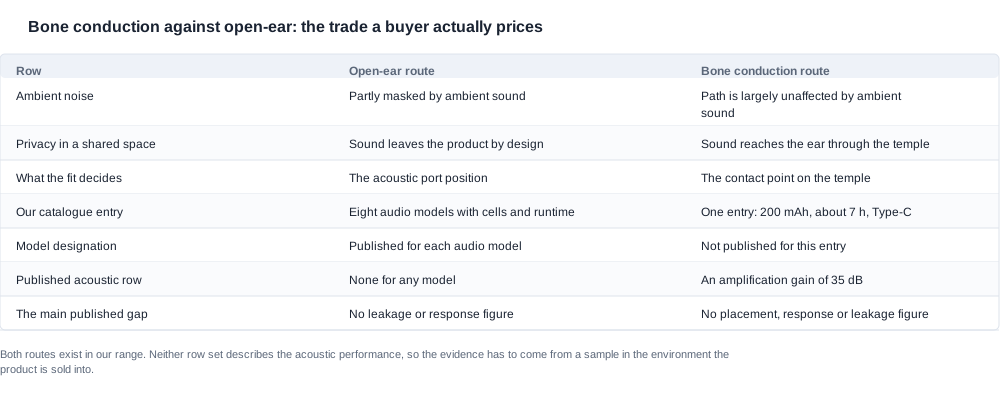
The five questions worth settling before any supplier is contacted
Which environment is the product sold into? This single question decides more than any other, because ambient noise is the entire argument for bone conduction. A product sold for indoor office use has no environmental argument, and an open-ear product will usually serve it better and cost less to build. A product sold for a workshop, a floor, a street or a vehicle has a genuine environmental argument, and the evidence you need becomes a measurement in that environment rather than a demonstration in a quiet room.
Does the sound have to be private? Bone conduction delivers sound through the temple to the wearer's skull, which means less sound radiates into the room than an open-ear speaker does. That is a genuine advantage in a shared workspace, a classroom or a client meeting. It is not silence, and it is not a guarantee. The number that settles it is a leakage figure with a stated distance, volume and environment, and for the same reason as every other figure in this article, a leakage figure without its condition is not usable.
Is the product sold with any claim about hearing? The answer changes the programme rather than the audio route. A product sold as an audio accessory with a call and music use case is a consumer electronics product. A product sold with a claim about hearing, however carefully worded, moves the product into a regulatory conversation, and that conversation is expensive, slow and outside the scope of most factories. The safest answer to a marketing request for a hearing claim is that the claim is not available, and the question to ask the supplier is whether they will stand behind it in writing.
What is the transducer placement, and is it repeatable in production? This is the row that separates a designed product from a selected one. A bone conduction transducer has to sit in a specific place relative to the temple geometry to work at all, and if that position is described only as "in the temple", the production units will not share it. Ask where the transducer sits, what the tolerance around that position is, and how the position is checked at end of line.
Does the documentation route require a named model? A product without a formal model designation cannot be listed correctly on a certificate, described correctly at customs, or tracked correctly through a change control process. Our catalogue's bone conduction entry has no model designation published, and that is exactly why this question has to be asked early rather than after the artwork is approved.
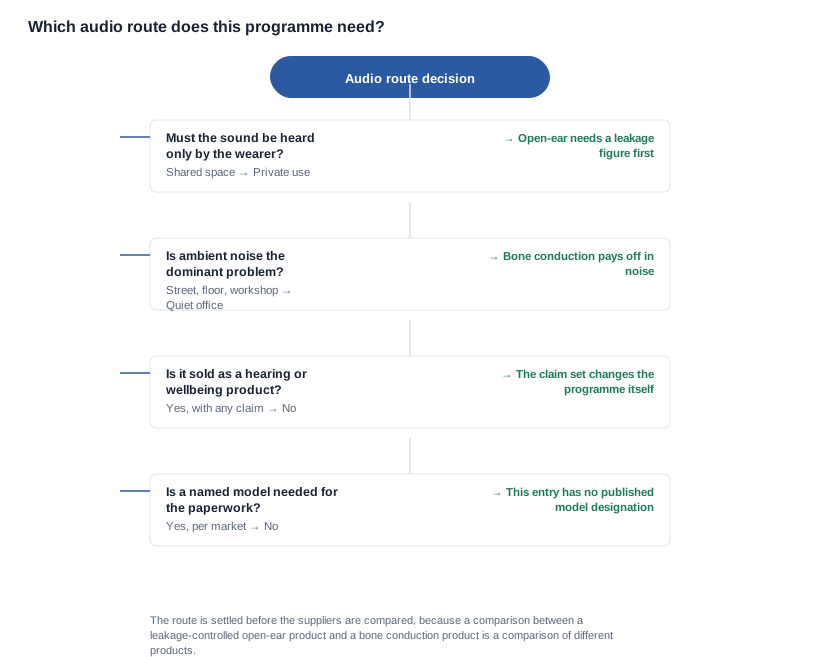
Who signs for a bone conduction configuration, and what they are buying
The reader is a brand-side product owner working with a procurement manager, or a channel buyer building a private-label range, or a distributor deciding whether to stock a specialist audio product at all. The situation is one of three: comparing quotations for an audio line, opening a new material number for a channel that needs the environmental advantage, or evaluating whether an existing open-ear line should add a bone conduction variant.
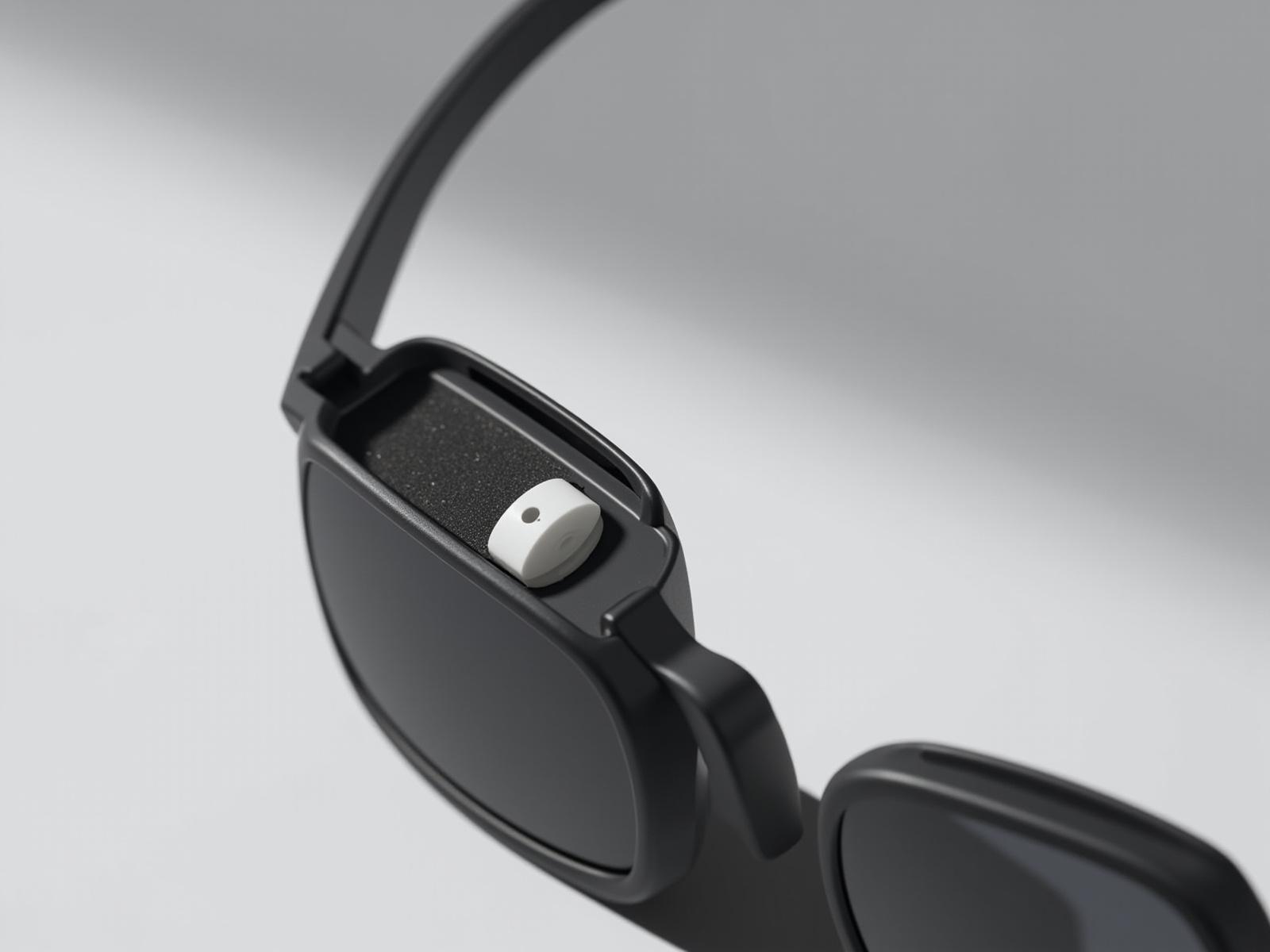
What that buyer is actually buying is not a louder product. It is a different acoustic path, and the path is what creates both the value and the cost. An open-ear product uses a small speaker and an acoustic port, and the port has to be positioned and sealed so that sound comes out toward the ear and not into the room. A bone conduction product replaces that with a transducer that has to sit in physical contact with the temple and be driven hard enough to produce sound through the skull. The two products share a frame and a cell and a radio, and almost nothing else that matters acoustically.
That difference shows up in the buying task in three ways. First, the sample evaluation has to be done on more than one head, because contact position varies with temple geometry and a product evaluated on one person tells you about one person. Second, the returns profile changes character: an open-ear product returns mostly for fit reasons at the nose bridge and the temples, while a bone conduction product can return for the same visible reason and for an invisible one, because the acoustic contact is not what the customer can see. Third, the documentation burden differs, because a transducer sitting against the head is a different acoustic construction from a speaker in a housing, and the conformity position has to be reviewed rather than assumed to carry over.
There is also a channel question that is easy to skip and expensive to skip. A bone conduction product is often bought for a specific job rather than for general use, which means it tends to end up in a procurement list rather than a consumer wish list. That changes the buyer. The decision is made by someone who can write a specification into a tender, not by someone browsing a category page, and it means the documentary package matters more than the demonstration.
Where a bone conduction programme's cost actually sits
The unit price comparison in this category is close to meaningless, and the reason is that the acoustic configuration changes what is inside the product rather than adding a label to it. Two quotations that look like a 15% gap on unit price can be a completely different product, and the gap appears in the bill of materials, in the tooling and in the compliance scope rather than in the price line a buyer usually looks at.
The visible cost is the audio path itself: the transducers, the amplification and the associated circuit, and possibly a second cell depending on the architecture. The less visible cost is the frame. A bone conduction design usually requires a thicker temple or a changed temple geometry to carry the transducer, and that is a tooling conversation rather than a component conversation. A temple change is an NRE item with an amortisation question attached, and the amortisation question is the one worth asking: over what quantity is it amortised, and what happens to the tool if the programme is discontinued.
The third cost is the one that is most often missing from a quotation entirely, and it is the documentation cost. An acoustic construction that differs from the certified platform can require its own conformity work, and that work has a duration the factory does not control. A buyer who learns this at month five has already committed the tooling and the artwork. A buyer who asks at quotation stage can either budget the time or choose the route that does not need it.
The fourth cost sits in the channel and never appears on any quotation: the acoustic consistency across a production lot. Bone conduction performance depends on contact position and on the consistency of the temple geometry that produces that contact. A design where the contact point is sensitive to small assembly variations produces a wider spread of real-world performance than a product with a speaker in a housing, and that spread shows up as a returns rate spread. The only defence is the acceptance criteria, and the acceptance criteria have to be written before the first lot is produced.
So the buyer's negotiating space is in the configuration definition, the tooling amortisation, the number of orderable variants and the acceptance criteria. It is not in the price of the transducer.


Checking a bone conduction answer before the order
Verification in this category is a mix of documentary work and physical work, and the physical part cannot be skipped. The order below assumes each step passed the one before it.
Step one: fix the environment, in writing, before anything else. Name the environments the product is sold into and the noise level expected in each. This step exists because it converts the acoustic argument from a claim into a test condition, and because every downstream number needs a condition to attach to. A supplier who cannot work with a named environment will quote a generic figure, and a generic figure cannot be used.
Step two: ask for the transducer placement and the tolerance around it. Ask where the transducer sits relative to the temple, what the assembly tolerance is, and how the position is verified. Then ask the harder question: what happens when a unit is assembled slightly outside that tolerance. The answer tells you whether the factory has a defined rework path or whether the unit simply ships.
Step three: ask for the leakage figure as a separate number. Leakage and response are different questions and a supplier who answers both with one number has answered neither. Leakage decides whether the product can be sold into a shared space at all, which is a channel constraint rather than a preference. The figure needs a measurement distance, a playback volume and a background level, and it needs to be measured at the volume the customer will actually use.
Step four: evaluate the sample on more than one head. This is the step that catches the failure a single-unit evaluation cannot. Ask the supplier to provide evaluation units, and ask that at least two people with different temple geometry use them. Record the result for each, because the spread between the two is the number you need for the returns model.
Step five: check the power and structural burden in the quotation, not in the sample. A change to the cell or to the temple housing is a bill-of-materials change with a lead time attached, and it is much cheaper to discover at quotation stage. Ask for the configuration to be quoted as a separate line with its own minimum order quantity rather than absorbed into a base model.
Step six: put the criteria in the purchase order. The environment, the leakage condition, the contact tolerance, the acceptance criterion and the remedy for a unit that misses it. If the criteria exist only in an email, they are not binding.
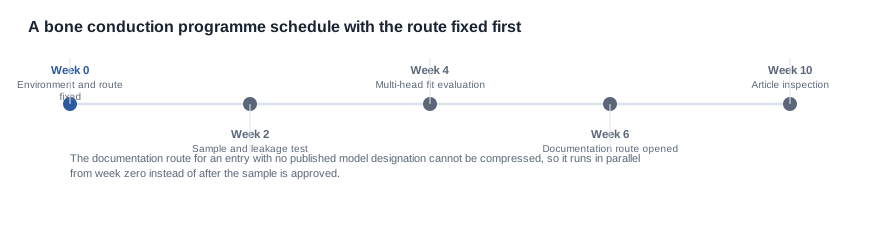
How bone conduction programmes fail in the channel
The failures below are the ones that reach a buyer as a surprise.
The quiet-room evaluation. Performance was judged in a controlled environment and failed on a workshop floor. The root cause is that the evaluation protocol did not name the environment, so the environment was chosen by whoever was present. The control is to add an environment test at the volume the channel expects, with the criterion written down before the test rather than after it.
The contact that only suits one head. Performance depended on a precise contact point, and the returns profile appeared two months into the programme. The root cause is a single-unit evaluation with a single wearer. The control is to evaluate across at least two head shapes, record the tolerance, and write the tolerance into the order as the acceptance basis.
The leakage nobody priced. The product was sold into a shared environment and turned out to be unusable there. The root cause is that a privacy argument was made without a measurement behind it. The control is to require a leakage figure with its conditions and check it against the intended environment before the listing is written.
The feature burden that was not quoted. The audio configuration added parts, tooling and compliance work that appeared in no line of the quotation. The root cause is that an acoustic route was priced as a feature. The control is to ask for the bill-of-materials and tooling consequence of the audio configuration, quoted as its own configuration.
The name that was never settled. The programme reached the artwork stage with no model designation, and the packaging, the customs description and the certificate coverage all waited on it. The root cause is that the designation was requested last. The control is to ask for it in the first round and to treat the launch date as derived from it rather than from the production schedule.
The terms a bone conduction programme can move, and the ones it cannot
Knowing which commercial lines move is worth more than pushing hard on all of them, because a supplier told clearly that a line is fixed will spend the negotiating capital where it can actually change something.
The configuration set and the per-configuration minimums are the live numbers. Where a bone conduction variant sits alongside an open-ear variant in the same programme, ask whether they are separate orderable configurations with their own part numbers. A programme that carries two acoustic routes carries two artwork lines, two packaging lines and two documentation scopes, and the cost of that multiplicity is usually the largest hidden item in the quotation. Committing to a configuration count rather than a unit count is what moves the per-configuration minimum.
Sample cost and evaluation unit quantities are negotiable and are usually given away. Under pressure on a first order, a supplier will often concede sample cost, the number of evaluation units, or a first-article inspection allowance. These are real, easy to obtain, and cheap for the supplier to give, which is why they are worth taking before pushing on anything structural.
The acceptance criteria are negotiable in wording and fixed in substance. A supplier will argue about the method, the distance and the environment. The criterion itself, and what happens to a unit that misses it, are the parts that should not move.
Certification cost, certification time and any re-test following an acoustic change are fixed. They are a per-family cost and a queue at the test laboratory. Pressing on either produces a longer schedule rather than a shorter one, and a re-test is charged per configuration, which means it compounds across a range.
The transducer and the acoustic architecture are not commercial variables at all. If the requirement needs sound to reach the wearer through the temple with a particular level of environmental rejection, no negotiation turns an open-ear speaker into a bone conduction transducer. What negotiation can do is change the number of orderable configurations, the size of the first order, the amortisation of the tooling, the documentation obligations and the acceptance criteria that bind them.
The clauses worth having in the agreement are these. The configuration string, written into the order. The transducer placement and the assembly tolerance, with the end-of-line check that verifies it. The leakage figure with its distance, volume and background level. The fit or contact tolerance, or the stated limitation where one does not exist. The documentation set for the destination market, with the owner named. And the remedy for a unit whose measured acoustic performance does not meet the agreed figure, which is the clause that decides whether a bad lot is the buyer's cost.
A worked example: a distributor evaluating a bone conduction line
This is a worked case rather than a customer case. It sets out the decision sequence.
Assume a distributor serving industrial maintenance teams, currently stocking open-ear audio glasses for warehouse staff, and now considering whether to add a bone conduction line for technicians who work on machinery in loud plant areas. The constraint that matters is not price and it is not the factory. It is that the distributor's customers are buyers in other companies, so the product has to survive a second seller's own comparison, and the distributor cannot afford a returns rate it has not modelled.
The first decision is the environment. The distributor names two: a plant floor with machinery running, and a warehouse aisle with occasional forklift noise. It also names the third, because it is the one that will decide the product: a quiet office where a supervisor occasionally takes calls. If a meaningful share of the use is in the office, the environmental argument weakens for that share, and the distributor asks the supplier whether a single configuration serves both.
The second decision is the claim. The distributor's own marketing team wanted a phrase about hearing clarity in noisy places. The supplier's answer is that the catalogue publishes an amplification gain figure and nothing else, and that no claim about hearing should be written. The distributor accepts this, because the alternative is a regulatory conversation it is not equipped to have, and because the medical device boundary page already explains why the distinction matters commercially. This decision took one email and saved a programme.
The third decision is the sample evaluation. The distributor asks for three evaluation units rather than one, which costs nothing at the RFQ stage and turns out to be the most valuable thing it asked for. Two people with different temple geometry test each unit in the plant environment and in the office, and the difference between the best and the worst unit on the same day is larger than the distributor expected. That spread becomes the returns allowance in the cost model, and it becomes a tolerance clause in the order.
The fourth decision is commercial. The distributor learns that the bone conduction configuration carries its own minimum order quantity and a separate documentation scope, so it asks for the configuration to be quoted as its own line rather than as a variant of the open-ear line. The supplier quotes it separately. The distributor also asks for the evaluation units to be credited against the first order, which is a small concession that is usually available and that the distributor would not have thought to ask for in a second-order negotiation.
The result is a line the distributor can sell into a plant without a claim it cannot support, a returns allowance that reflects a measurement rather than an assumption, and a documentation route that was opened at quotation stage rather than at artwork stage.
What our catalogue says about bone conduction, and what it leaves open
The published material on bone conduction is the part of the specification we can stand behind, and everything else is a question for the supplier's own file. We publish the rows our catalogue states, we mark the open rows as open, and we will not fill an open row with a typical figure from a general data sheet. A buyer who builds a claim on an estimated number finds the error in the channel rather than in the quotation.
These are the rows we do not publish for this entry:
- The transducer placement and the assembly tolerance around it are not published.
- The frequency response and the leakage to the surroundings are not published.
- The model designation for the bone conduction entry is not published, and neither is any customisation capability for it.
- The fit or contact tolerance across head shapes is not published.
These are the rows our published data does settle, and they are the ones to use to structure a comparison:
- A 200 mAh cell, a charge time of two hours or less and a rated runtime of roughly seven hours.
- Type-C charging on this entry.
- An amplification gain of 35 dB, published as an electrical figure and used in no other sense.
- Across the wider range, one published weight figure: the 158 g whole-unit weight of the MT6, which is a camera model with a folding charging case and not a bone conduction product. No frame weight is published for any entry in the range.
We will not infer a transducer type, a response curve or a leakage figure from the gain figure, and we will not present the 35 dB figure as a hearing result of any kind. What we will do is take a use case, a configuration and a target market, and tell you which parts are settled, which are open, and which have to come from a sub-supplier.
The bone conduction spec sheet explained article sets out the row structure in full, how to test before ordering walks through the sample protocol in more detail, and bone conduction cost against performance covers the commercial side with the same set of published rows.
The action to take this week
Write the environment into the requirement before you write anything else. Name the places the product is sold into, the noise level expected in each, and whether the sound has to be private. That single paragraph decides the route, decides the evidence you will need, and decides which lines of a quotation are comparable with each other.
Then put five rows in the RFQ: transducer placement and tolerance, leakage with its distance and volume, the frequency response, the evaluation unit quantity, and the model designation. Ask for the amplification gain to be confirmed as an electrical figure and for no hearing claim to be attached to it.
Finally, write the acceptance criteria and the tolerance before the sample order is placed, and attach them to the purchase order as a schedule. Send us the environment, the quantity and the target market and we will tell you which of the published rows apply to that configuration and which questions are the ones we would put to the factory ourselves.
Related reading
- The specification behind the questions — bone conduction spec sheet explained
- Testing the product yourself — how to test before ordering
- The cost side of the same decision — bone conduction cost vs performance
- bone conduction audio
- medical device boundary
Send the configuration, the quantity and the market, and we will say which parts of the bone conduction specification are settled and which are yours.


