

Bone conduction glasses technology: six rows, twelve withheld
One entry, and an unusual disclosure ratio
Our catalogue contains one bone conduction entry, and reading its specification honestly means confronting an unusual ratio: six rows are disclosed and twelve are not. That is not a formatting quirk. It means the product cannot currently be evaluated against another bone conduction product, because the rows that would allow the comparison are the ones that are missing.
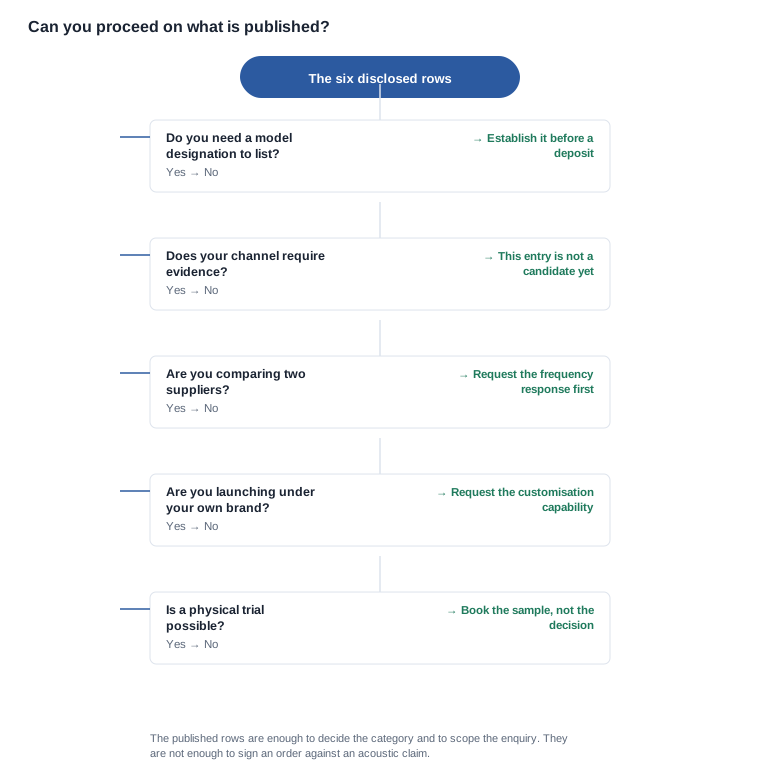
The useful way to read a specification this thin is not to look at what it says and ask whether it is enough. It is to read it row by row and ask, for each disclosed row, which decision it constrains, and for each withheld row, which decision it blocks. Most of the twelve turn out to block something specific and identifiable, which makes them a request list rather than a gap. Three of them — the model designation, the customisation capability, and the certification status if your channel requires evidence — block a purchase order outright, and those are the ones to close first.
The buying task behind a specification review
A specification is read for one of three reasons, and the reason determines which rows matter.
A category buyer comparing this entry against a supplier's own product is looking for a comparable figure and will find that the only acoustic figure has no method attached to it. The task for that reader is to convert a comparison problem into a request list, because that is the only route available.
A product or R&D lead is looking for the design inputs, and the interesting question is which of the withheld rows are design inputs and which are document outputs. Frame weight, frame dimensions, the transducer description, the contact area and the coupling arrangement are design inputs, and their absence is a genuine engineering gap. Certification status is a document output, and its absence is an administrative gap with a schedule consequence.
A channel buyer is looking for what has to be true before a listing can be written and a customer can be supported, and that reader is mostly interested in the three rows that block an order.
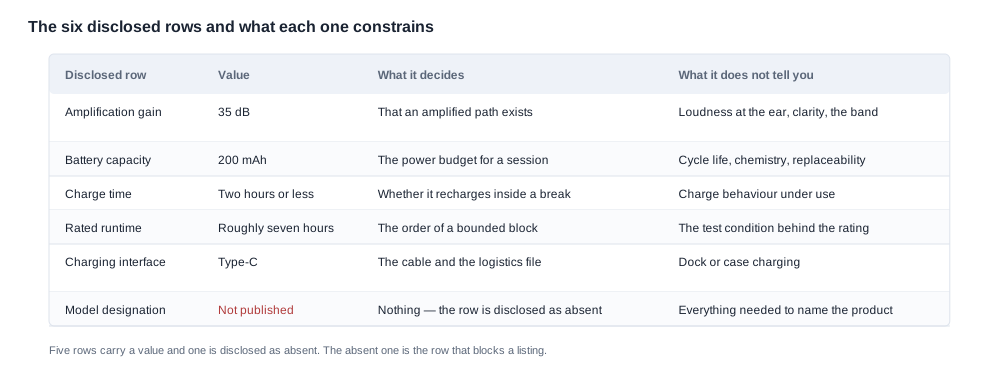
The mistake that these three readers share is treating a published row as a decision rather than as a constraint. A published 35 dB gain constrains what you may write about the electronics; it does not tell you what the wearer will hear. A published seven-hour runtime constrains the product's scope; it does not tell you the duty cycle. A published Type-C interface constrains the charging arrangement and the logistics file; it does not tell you the battery's cycle life. Reading a row for the decision it supports rather than the decision it constrains is what produces a purchase order signed against a number that was never measured.
The practical method for how to evaluate a thin specification is to sort every row into one of four bins before writing anything else. Disclosed and constraining a decision you care about. Disclosed and constraining nothing you care about, which is a row to ignore. Withheld and blocking a decision you care about, which is a request. Withheld and blocking nothing, which is a row to leave open deliberately. The fourth bin is the one that gets skipped, and it is where a specification review turns into a schedule argument.

Where this entry sits against the rest of the range
What the other models in the range publish
Comparing this entry against the rest of the catalogue is instructive, because the difference in disclosure is systematic rather than accidental.
The open-ear audio platforms publish Bluetooth version, battery capacity, runtime, charge time and interface across every model. The camera platforms publish pixel count, battery capacity, charge time, runtime and charging arrangement, with cell sizes from 220 mAh to 290 mAh and camera tiers at 8 MP and 13 MP. Several of the sport and camera platforms also publish an ingress rating, and two of the sport models state a charge time of approximately one hour where nearly every other model in the range states two hours or less. Type-C charging appears on a small group of entries across the range — the sport models, some of the camera models and the most recent Bluetooth audio platforms — while most of the range charges magnetically from a case.
Against that, the bone conduction entry publishes the electrical rows and nothing acoustic beyond the single gain figure. It does not publish a Bluetooth version, a frame weight, an ingress rating, a driver description, a frequency response, a leakage figure, a microphone specification, a certification status or a model designation.
Why the difference matters to a buyer
Two consequences follow, and both are about what a buyer can do rather than about what the product is.
The first is that a comparison against any other model in the range is only possible on the electrical rows. If a buyer is choosing between this entry and an open-ear platform in the same category, the comparison is a comparison of cell capacity, charge time, runtime and interface — which is a real comparison, and it is a comparison of the power system rather than of the audio. It cannot be completed on acoustics at all, because there is nothing to compare.
The second is that the gap is more expensive here than it would be in another category. The frame weight is Not published for this entry and, with one exception across the whole range, Not published for any model — so a buyer expecting to read a weight off a datasheet is likely to be disappointed wherever the category leads. But the frame weight in this entry is not only an ergonomic figure. Because the frame has to hold contact pressure against the temple for the transducer to keep coupling, the mass and geometry of the frame are part of the acoustic result. A weight figure would be the entry point into a much larger set of physical variables, and none of those variables is published either.
The likely reason for the thinner disclosure is development stage rather than anything improper — an entry without a model designation and without disclosed customisation looks like a product earlier in its life than the rest of the range. That is speculation on our part, and we flag it as such rather than stating it.
The disclosed rows, and the twelve behind them
The six rows that are disclosed, and what each one is worth
Amplification gain: 35 dB. This is the only published acoustic figure, and it is the most important row in the table. It is also the row most likely to be misused, because a gain figure without a frequency band and an input level is not an acoustic specification. 35 dB at one frequency and 35 dB across the speech band are different engineering results wearing the same number. And because the gain sits upstream of the coupling, the figure does not describe the sound pressure the wearer receives.
Battery capacity: 200 mAh. Substantially larger than our open-ear audio platforms, which run 55 mAh × 2 to 100 mAh. That is consistent with a transducer drawing more current than a speaker, which is what you would expect from the physics. It is a real figure and it is useful for narrowing the field, and it also sets the frame mass, which is a design variable with an acoustic consequence.
Charge time: two hours or less. Consistent with the rest of our catalogue, where nearly every model states two hours or less and only the sport audio platforms state approximately one hour. It is a real constraint on the customer's working day: a two-hour recharge fits inside a break if the product is used on a charging cable, and does not fit inside a break if it requires a case to be carried and found.
Rated runtime: roughly seven hours. Stated without a test condition, like every runtime figure in our catalogue. It is a scale figure, and it scopes the product to a bounded work block rather than a full day, which is a genuine product definition and a useful one.
Charging interface: Type-C. One of a small group of entries across our range on Type-C, alongside the sport audio platforms and the more recent camera models. It is the row with the largest effect on the customer's daily routine, because it removes the second object.
Model designation: not published. The entry appears in our catalogue without a model number. That is a practical problem rather than a cosmetic one — you cannot write a compliant product listing, file a customs declaration or reference the product in a contract without one. It is also the reason a family-level document cannot be relied on to cover it, since a document that names nothing covers nothing specific.
The twelve rows that are not disclosed
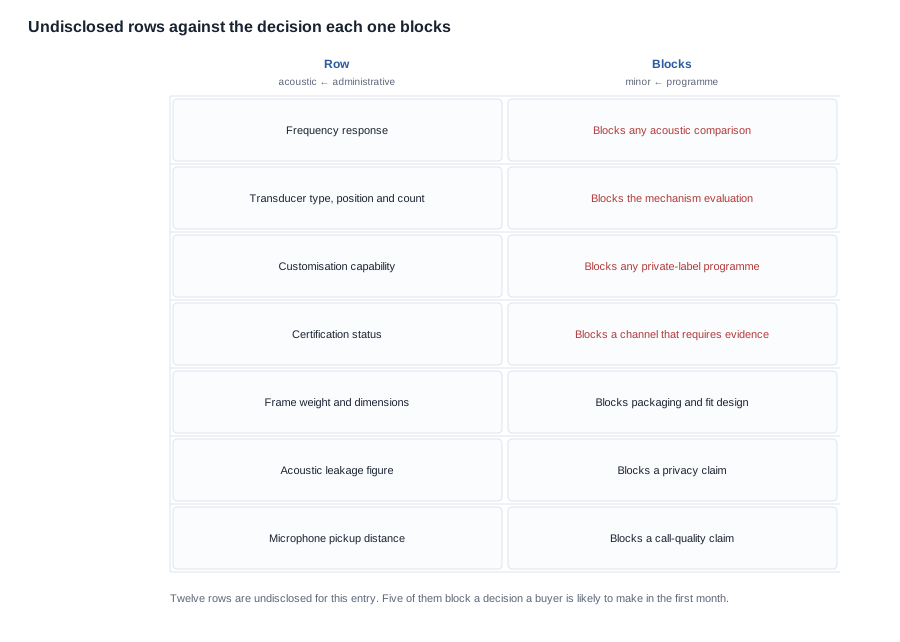
For this entry specifically, our documentation states nothing about the transducer type, placement or count; the frequency response; the perceived loudness conditions; the frame weight; the frame dimensions; the ingress rating; the battery chemistry, cycle life or replaceability; the customisation capability; the acoustic leakage; the microphone pickup distance; and the certification status.
Two of those deserve particular attention, and a third deserves attention for a different reason.
Frequency response is absent, which means the 35 dB cannot be evaluated. There is no basis on which to say whether this entry is louder, quieter or differently balanced than another product, and a buyer who asks for a comparison without asking for the band has not asked the right question.
Certification is stated as not provided. Our own source material notes that selling with a medical or assistive-hearing claim may trigger medical device regulation requiring legal review. If your channel requires evidence, this entry is not currently a candidate — and that is worth establishing before you spend time on the other rows.
Customisation capability is undisclosed, which is the row that decides whether this entry can carry your brand at all. A brand owner, a channel buyer and a distributor all need to know whether a logo, a lens tint, a colourway and a retail package exist. The entry in our range records this as undisclosed rather than as unavailable, and the distinction matters: undisclosed is a question to a supplier, and unavailable is a design decision.
The thresholds each withheld row has to clear
For each withheld row, the threshold is the same shape: what has to be supplied for the row to become usable.
Transducer description. Type, count and position on the frame. Without position and contact area, the coupling cannot be reasoned about, and without the type the gain figure cannot be placed in a chain.
Frequency response and the band for the gain. The band, the input level and the point in the circuit where the figure is taken. This is the row that converts the gain figure from a marketing number into a comparable specification, and it is the highest-value request in the set.
Frame weight and dimensions. Not just for packaging and fit design, but because the frame holds the contact pressure that the acoustic result depends on.
Acoustic leakage. Only relevant if a privacy claim is being made, and the claim is structural rather than measured in this architecture — the output is a vibration rather than a sound wave. The figure is still worth having, because it documents the structural property for a channel that asks.
Microphone pickup distance. Decisive for any application where the source is a masked voice, because the environment is amplified along with the source and the front end sets the outcome.
Battery chemistry, cycle life and replaceability. Cycle life is what determines whether a customer replaces the product or the cell, and it is what determines what your warranty exposure looks like in year two.
Ingress rating. Relevant to any channel where the product is used outdoors or in a wet environment, and it is the row a channel buyer most often needs and least often finds.
Customisation capability and certification status. Both of these are gates rather than attributes, and the thresholds for both are documentary: a written answer and an evidenced document.

Closing the gaps, and where a gap becomes a delay
The order in which the gaps should be closed
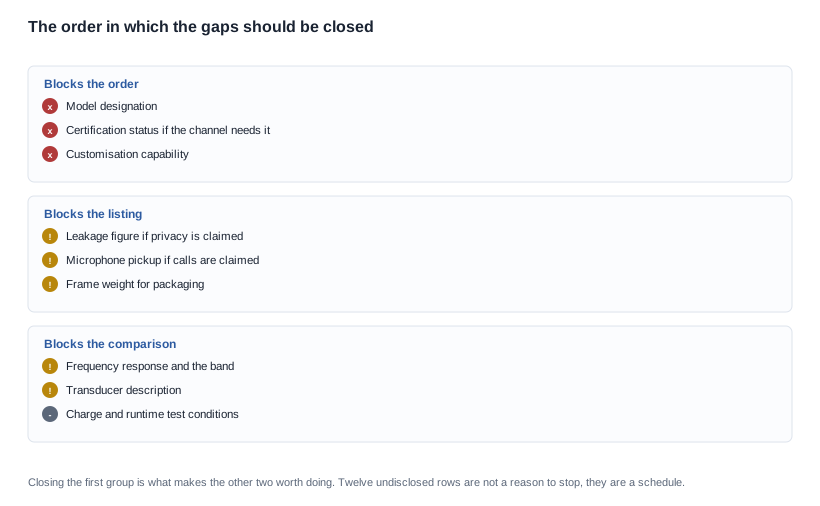
Closing twelve rows is a request list, not a project, but the order matters, because some rows unblock others and some rows unblock nothing until much later.
Close the gates first. The model designation, the customisation capability, and the certification status if your channel requires evidence. These three determine whether there is a product to order at all, and no amount of acoustic detail changes that. If the answer to the third is that the product is not a candidate for your channel, everything else is moot, and you have saved the time you would have spent on the other nine.
Close the listing blockers second. The leakage figure if privacy is claimed, the microphone pickup distance if calls are claimed, and the frame weight for packaging. These do not stop an order; they stop a listing or a packaging release, which means they sit directly on the launch path.
Close the comparison blockers third. The frequency response and the band for the gain, the transducer description, and the charge and runtime test conditions. These are what allow a paper comparison, and they are the rows you would ask for in any other category — the fact that they are missing here is a feature of this entry rather than of the category.
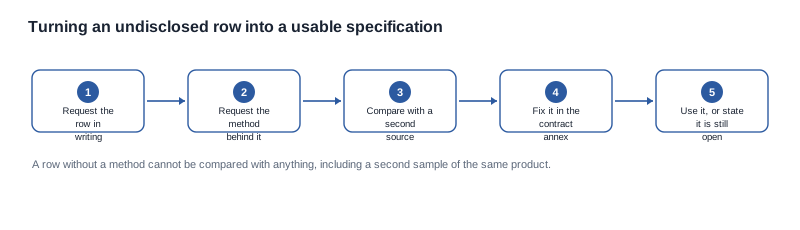
Ask the method, not only the number. For any row that matters, the request is not just the figure but the condition behind it. A row without a method cannot be compared with anything, including a second sample of the same product.
Where a gap becomes a delay rather than a request
A gap that is discovered after tooling. A buyer who signs an order on the six disclosed rows and then asks for the frequency response has already committed the tooling, and the answer arrives as a change rather than as a specification. The cost of asking the same question one month earlier is a week.
A gap that surfaces at the artwork stage. The frame weight is a packaging input, and packaging artwork is usually approved late, on a compressed schedule, with the cost of a reprint attached. A missing weight discovered at the artwork stage is a schedule event.
A gap that surfaces at the border. The cell specification and the transport documentation are shipping gates. A cell that does not match the summary stops the shipment, and the logistics provider enforces it regardless of what the paperwork says.
A gap that surfaces at listing review. A claim written from a gain figure, with no method and no frequency response behind it, is a claim that a reviewer can challenge. The correction is a copy rewrite, and the inventory is already paid for.
The general pattern across all five is worth stating as a rule rather than as five anecdotes. A gap in a thin specification does not create an argument; it creates a deadline, and the deadline arrives at whatever point downstream depends on the missing row. The most common mistakes are the ones where a buyer treats an open row as a supplier's problem, when it is a schedule line on the buyer's own plan, and the ones where the decision is deferred without a criterion for when it has to be made.
A gap that is quietly filled by someone else. The most dangerous version. A distributor, a channel partner or a marketing agency will supply a plausible weight, a plausible frequency response and a plausible certification statement, because the listing cannot be published without them. Those figures are not from the manufacturer and they are not traceable, and they are the numbers that end up in a comparison sheet two years later. The red flags are recognisable: a figure with no measurement condition, a figure that appears on a distributor page but not on a supplier document, and a figure that is identical across several unrelated products.
What to do with a specification that is this thin
Three answers, in order of preference.
Reduce the number of decisions you are asking the specification to support. If you are not claiming privacy, the leakage row does not need to close. If you are not claiming call quality, the microphone pickup distance does not need to close. Every closed row that you do not need is a week of schedule you have bought back. This is also where the total cost of the specification is decided: the cost is not the number of rows but the number of rows your own decisions depend on.
Move the decision from paper to sample, explicitly and in writing. For the rows that describe how the product feels and performs, the sample is the instrument. Write the acceptance criterion before the evaluation, and be honest with yourself that a sample establishes a range, not a specification. The questions to ask a supplier about the sample are listed in what to ask a supplier about bone conduction.
Treat the remaining open rows as a schedule line in the purchase order, with a date and an owner, rather than as a request. A request without a date is a hope. Decide, before you order, when to escalate: a row that is still open at the point where the artwork needs to be approved is a launch-date problem, and it should be treated as one rather than chased.
Commercial reality, and a worked specification request
What the thin specification does to the commercial conversation
A thin specification has commercial consequences, and they are not all bad.
Fixed and not a negotiation target: the acoustic hardware, the tooling, the regulatory classification work, the assessment cost and lead time, and the cost of a second qualification run of the same model.
Negotiable, and unusually important here: the number of units taken at the pilot tier rather than the run tier, which is where most of the real room sits because the factory's exposure concentrates in the first run; splitting a first production run into two deliveries against a staged payment; the logo, lens tint, colour and retail packaging configuration, which is the item most directly tied to the undisclosed customisation capability; which models combine into one purchase order; and the scope of the conformity assessment.
The negotiation agenda that follows from a thin specification is narrower than usual, and it is worth naming. The first item is not price; it is the configuration, because the logo, colour and packaging decision determines the tooling and the artwork and therefore the schedule, and a discount on a unit price is worthless if the configuration is not settled. The second item is the staging of the first run, because the gates that are still open are best carried by a split delivery against a staged payment. The third item is the scope of the assessment, because the compliance work is the largest fixed cost in the programme and its scope is the one part of it that a buyer can influence.
Documents to request before a deposit, in the order of the gates: the model designation table; the certificate register with numbers and validity dates; the written answer on customisation capability; the battery cell documentation for the fitted cell; the acoustic method behind the gain figure; the packaging artwork proof; the agreed acceptance criteria for incoming inspection; and written confirmation that no claim in the listing copy characterises the product as a hearing aid or makes any claim about treating, preventing or improving hearing. The contract terms page carries the clause language; the pricing page carries the commercial structure of a first order.
A worked specification request
Assume a product lead is preparing a technical evaluation of this entry for a private-label audio line, with a target of a pilot run rather than a full first order.
The evaluation opens by sorting the disclosed rows into constraints, which produces three statements that go into the specification as written. The 200 mAh cell and the roughly seven-hour rating scope the product to a bounded work block, so the product definition is "for a shift or a journey" and the duty cycle is written down. Type-C charging means no charging case is in the bill of materials and no second battery has to be carried. The 35 dB gain is described as an amplification gain, placed in the technical description, and not used in the customer-facing copy. The acceptance criteria for those three statements are the specification's own contents, and they are what a sample is later evaluated against.
The evaluation then works through the twelve withheld rows and produces a request list with owners and dates. The model designation is the first request, because it gates the label, the certificate, the purchase order and any re-quote later. The customisation capability is the second, because a private-label line cannot proceed without it and because an unanswered question here is likely to change the commercial structure rather than just the paperwork. The certification status is the third, and the brief is written to accept either answer: a position that supports the channel, or a decision that the entry is not a candidate. The frequency response and the band for the gain are the fourth, because they are what make a paper comparison possible at all.
The evaluation then decides the method of evaluation, which is the part that distinguishes a programme from a shopping exercise. The published rows are enough to decide the category and to scope the enquiry, and they are not enough to sign an order against an acoustic claim. So the acoustic comparison moves to the sample, with the protocol written before the sample arrives: several wearers, a full session rather than a demonstration, a defined environment, and a unit-to-unit comparison once the first batch lands to check whether the factory is holding the coupling consistently. The pitfalls here are the usual ones — a single wearer, a short demonstration and a quiet room — and each of them produces a result that is true and useless.
The commercial conclusion follows from the evaluation. Because the gates are open, the sensible first commitment is the pilot tier, and the useful thing to negotiate is the split of the first run into two deliveries against a staged payment, because that keeps the option open on the rows that have not closed. The unit price conversation happens last, and the first-run risk is the currency the staging spends.
What we publish, and what to ask for
Six rows published, twelve marked absent
We publish the six rows above and we mark the twelve that are absent. We will not estimate a frequency band, a frame weight or a certification status, because those are precisely the rows where an invented value would survive longest and be discovered most expensively. We will not fill a gap with a typical figure from the category, because a plausible number that nobody measured is worse than an open row, and it is the number that ends up in somebody's comparison sheet two years later.
The one thing we will do quickly is tell you whether a specific row can be obtained for this entry, and whether the entry is intended for a production programme at all. Both are quick to answer and both change what you should do next.
What to ask us next
If you need this entry evaluated for a specific application, the two questions worth asking us first are whether we can obtain the transducer and acoustic detail, and whether the entry is intended for a production programme at all. Beyond that, send the application, the target markets and the channels, and we will tell you which of the six disclosed rows carry your decision, which of the twelve need to close and which can stay open, and what a sample would have to establish.
The category background is under bone conduction audio, the ordered purchase sequence is in the bone conduction buying checklist, and the technology comparison against open-ear platforms is in bone conduction technology differences. The claim question that gates the category is at medical device boundary, and the sampling route is at sample evaluation.
Related reading
- How this compares with open-ear platforms — bone conduction technology differences
- The claim question that gates the category — medical device boundary
- Getting the missing rows before committing — sample evaluation
Ask us for the transducer and acoustic detail on this entry and we will tell you plainly whether we can supply it.


