

Bone conduction glasses technology: reading a supplier's material
Bone conduction is a category with almost no published specification, which makes it a place where confident claims are cheap to make and expensive to inherit. Our catalogue contains one entry: a 35 dB amplification gain, a 200 mAh battery, a charge time of two hours or less, roughly seven hours of runtime, Type-C charging. No model designation, no transducer description, no frequency response, no leakage figure, no certification status.
With that little to verify against, red flags are easy to spot. They are mostly linguistic, and they are cheap to look for because they live in the first two pages of whatever the supplier sends you. The more useful point is that the review does not need a sample, a call or a factory visit: a buyer can score a supplier's own material in twenty minutes and decide whether the supplier is worth the rest of the diligence.
The practical conclusion is that a red flag is not a verdict, it is a routing instruction. Some flags tell you to pause and ask a question. Some tell you to rewrite a sentence. Some tell you to stop, because the flag is about a document that cannot be transferred to your brand, and no amount of further conversation fixes a document that names the wrong product.
Five flags account for most of what a buyer sees in this category. The first four are described in detail below, and the fifth is the one that is easiest to miss because it is the most reasonable-sounding of them.
The reason this review is worth doing before contact, rather than during due diligence, is that the flags are answerable in writing and the answers are what scope everything that follows. A buyer who learns how to evaluate a supplier's own material in twenty minutes can decide which suppliers deserve a sample order and which deserve a polite acknowledgment.
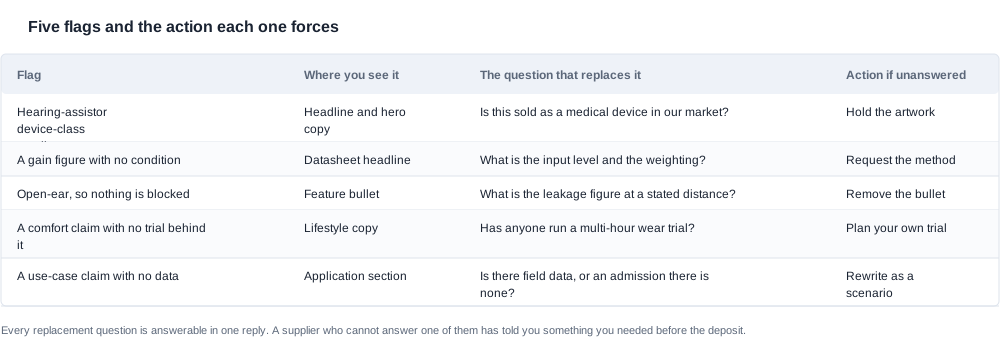
Five flags, and the action each one forces
Flag one: the regulatory category claim. "Hearing aid level" is not a specification. If it means anything precise it refers to a regulatory classification, and a classification is something a product is assigned by a regulator rather than asserted on a datasheet.
A supplier using this phrase on a marketing page is describing their positioning, not your compliance position. The question that replaces it is direct: is this product being sold as a medical device in our market, and who has answered that legally? The action if the question goes unanswered is to hold the artwork. Not to stop the programme, and not to reject the supplier — to hold the artwork, because artwork is the point at which the phrase becomes a published claim, and everything before that point is still reversible.
Flag two: the gain figure without a condition. 35 dB is the most specific-sounding number in this category and among the least self-explanatory. It describes an electronic gain applied to a signal, not the sound pressure the wearer receives. The input level, the weighting applied and the transducer's acoustic efficiency are all missing.
Ask for the input reference level and the weighting. A supplier who has genuinely measured will state them; one who has copied a number from a listing will not. The action if the question goes unanswered is to request the method before accepting the number into any comparison, because once the figure has been used to justify a price, it is very hard to take back.
Flag three: openness described as acoustic performance. "Open-ear, so nothing is blocked" is a design description. What actually determines whether a wearer can hear their surroundings is leakage: how much transmitted sound escapes into the environment, and how much ambient sound reaches the ear. No leakage figure is published for our entry, and neither is one for most of the category.
This matters commercially in a specific way. In an industrial or workplace use, leakage is a comfort question for the wearer and an exposure question for everyone nearby. Both are better answered with a measurement than a descriptor. The action if the question goes unanswered is to remove the bullet from your own copy. It is a harmless sentence, and harmless sentences are exactly how a class of claim grows: a brand repeats the supplier's phrasing, a retailer quotes the brand, and by the third step the descriptor has become a performance promise in a document nobody reviewed.
Flag four: the comfort claim with no trial behind it. "Bone conduction, so no ear fatigue" is a mechanism argument, and it is probably true that a transducer outside the ear canal produces a different fatigue profile. It is not true that fatigue is eliminated — prolonged use produces complaints at any position, and bone conduction users report mastoid pressure after long sessions.
The honest question is whether anyone has run a multi-hour wear trial with published results. If the answer is no, the answer is fine — plan your own trial rather than accepting the claim. The action if the question goes unanswered is to add a wear trial to the acceptance programme, and to price the four hours of participant time that it will take.
Flag five: the use-case claim with no data. "Suitable for high-noise work" is a positioning statement. Nothing in our published data tests intelligibility in noise, because we publish no acoustic specification at all.
Ask for field data or for an admission that there is none. Both are acceptable answers; a confident assertion without either is not. The action is the same as for flag four, and the reason it is the easiest to miss is that it is the most reasonable-sounding claim in the set. It is also the one most likely to be copied from a competitor's material, which means a supplier may be repeating a claim that was never tested by anybody in the chain.
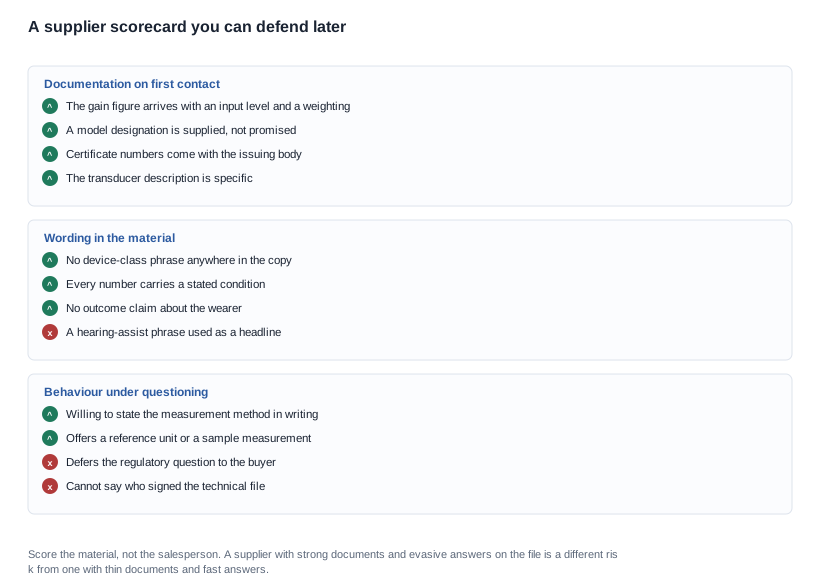

Scoring the flags: continue, pause or stop
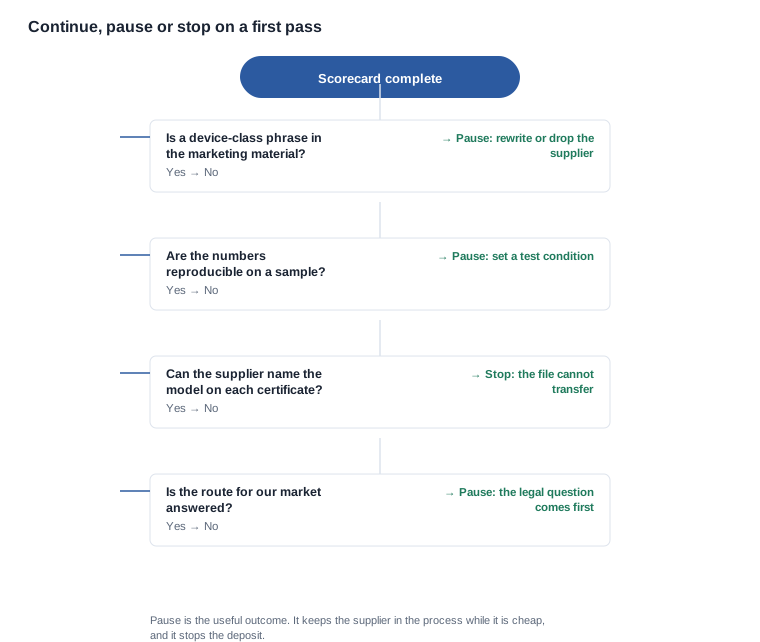
A flag list is only useful if it produces a decision. The scoring model here has three outcomes, and the difference between them is what makes the review worth twenty minutes of reading. The scoring criteria below are deliberately blunt, because the moment a flag review becomes a matter of judgement, two buyers reviewing the same material will reach two different conclusions and the review stops being reusable.
Continue means the material contains no flag that blocks progress, and the programme moves to samples. Most suppliers land here, and the review should say so explicitly rather than leaving the buyer to assume that silence meant approval.
Pause means something in the material has to be answered, rewritten or evidenced before the next step. Pause is the most common outcome and the most useful one, because it keeps the supplier in the process while the answer is still cheap to obtain. Every flag in the table above resolves to a pause with one exception.
Stop means the supplier cannot serve this programme, and the reason is a document rather than a product. A certificate that names a different model is the clearest example: no amount of conversation makes that file transfer to a brand's own product. The other stop condition is a supplier that cannot say who signed the technical file, because a file with no named signatory is not a file that can be audited later.
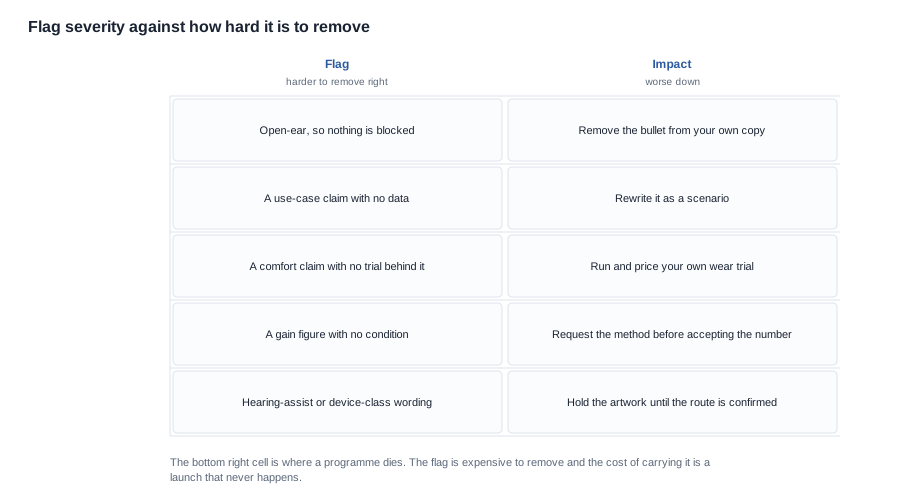
The ordering rule matters as much as the outcome. A pause on the regulatory question comes before a pause on a measurement method, because the regulatory answer can add cost, add elapsed time and remove claims from the copy all at once, and it is the one question that is cheap to answer and expensive to answer late. A pause on a measurement method comes before any sampling, because a sample evaluated without a stated method produces a number without a meaning. Knowing when to stop and when to hold is the practical skill here, and the rule is worth writing down before the material arrives rather than while it is being read.
What a red flag is not
The most common way a red-flag review goes wrong is that it treats a flag as a character judgement, and a supplier with a thin catalogue is judged the same as a supplier with a confident one. That is a mistake, and it is expensive, because the supplier in this category with the thinnest published documentation and the deepest measurement habit is often the best prospect available. The pitfalls are worth naming precisely, because a buyer who knows what the flags are not will spend the review on the material that actually carries risk.
Three things are routinely mistaken for red flags, and none of them is one.
A catalogue with few rows. Our own entry publishes six rows. A supplier who publishes six rows has not done anything wrong; they have published what they can evidence. The red flag is a supplier who publishes a lot and cannot evidence any of it. The question to ask is not "how much do you publish" but "can you tell me how the number you publish was produced".
An answer that is honest about a gap. "We do not publish the measurement method, but here is the method we use internally" is a good answer. The red flag is the supplier who cannot state any method, in either direction. A supplier who says "we have not measured that" has told the buyer something useful; a supplier who says "yes, very loud, 35 decibels" has told the buyer nothing.
A refusal to make a claim they cannot support. A supplier who declines to describe the product as a hearing aid is protecting the buyer as much as themselves. It is also a good sign, because it means the supplier understands the boundary well enough to refuse a piece of revenue.
There is a fourth case, and it is the genuine counterweight to all of the above: a supplier whose material is immaculate and whose answers are evasive. Clean documentation is a formatting outcome, and a company with a good design team can produce immaculate copy about a product nobody has measured. The scorecard has to score the answers as well as the documents, which is why the third group in the scorecard above is about behaviour under questioning rather than about the material itself.
Who runs this review, and what it costs to run
The reader is a sourcing or buying lead who has been sent supplier material and has to decide whether to spend the next three weeks on this supplier. That decision is made on the material, and making it well is worth more than anything else a buyer does in the first week of a programme.
The reason it is worth more is the asymmetry of the cost. The review costs twenty minutes. Sampling costs a week and a sample order. A pilot production run costs a month and a tooling deposit. A launch that has to be withdrawn costs a season of channel relationship. The twenty minutes is not a rounding error against the alternative; it is the cheapest available reduction in the programme's risk, and the only step in the sequence where the buyer can act without spending anything.
In practice the review is done by whoever received the material, and that is usually fine, provided the reviewer is given four things: the list of flags, the list of questions each flag generates, the decision rule for continue, pause and stop, and the instruction to record the result. A review that produces a score but no record is worth much less, because the value of the review is that it can be shown to a colleague who disagrees with the outcome — and in most programmes the colleague who disagrees is the one who did not do the review.
The questions to ask in the first reply are the ones the flags generate, and a shortlist built on the answers is more reliable than a shortlist built on the brochures. A buyer who negotiates the first reply — asking for the method, the model designation and the route in one message — gets a different supplier response than a buyer who asks for a price and a catalogue, and the first reply is also the cheapest point to find out whether the supplier will engage with the questions at all.
The second reason the review belongs early is that it shapes the quotation. A buyer who sends five specific questions in the first reply gets a different answer from the same supplier than a buyer who sends "could you send us your spec sheet and price". The questions generated by the flags are the cheapest way to get a supplier to reveal its method, and the answers are what allow the rest of the diligence to be scoped rather than open-ended.
The market context shapes how hard the review has to work. Our catalogue publishes twelve open-ear audio platforms with full electrical detail on each — chip version, cell capacity, rated runtime, charging method — and exactly one bone conduction entry, published without a model designation. A buyer used to comparing audio platforms will find this material unusually thin, and the instinct is to read the thinness as a lack of substance. The better reading is that the category is under-documented, so the material is a weaker filter than it would be elsewhere and the questions behind the flags do more of the work.
Building a scorecard you can defend to a colleague
A scorecard in this category has to answer a question that a normal scorecard does not: not "is this supplier good" but "is this supplier able to give me evidence I can put my name on". The three groups below are ordered by how much they cost to verify, which is the order in which they should be asked.
The first group is documentation on first contact: whether the gain figure arrived with an input level and a weighting, whether a model designation was supplied rather than promised, whether certificate numbers came with the issuing body, and whether the transducer description is specific enough to recognise. These are all answerable from the first reply, and a supplier that cannot answer them has not got the documentation habits the programme will need.
The second group is wording: whether any device-class phrase appears anywhere in the material, whether every number carries a stated condition, whether any sentence describes an outcome for the wearer, and whether a hearing-assist phrase is used as a headline. This group is scored by reading, and it is the group most likely to be scored generously by a buyer who likes the product.
The third group is behaviour under questioning: whether the supplier will state a measurement method in writing, whether it offers a reference unit or a sample measurement, whether it defers the regulatory question to the buyer, and whether it can say who signed the technical file. This group is the one that discriminates, because it is the only group that requires the supplier to do something rather than to have something.
A scorecard should produce a written result with three fields: the outcome, the reason, and the date. The date is not administrative, because a scorecard that is six months old describes a different organisation.
A worked case: strong documents and a weak answer
To make the order of operations concrete, the next passage walks through an assembled case. No actual order is described.
Assume a buyer receives a bone conduction supplier's material for a European distributor programme. The document is well designed, the specification sheet is clean, and the copy is confident. The buyer runs the review before replying.
The first pass produces two pauses and no stops. A device-class phrase appears in the hero copy. A gain figure appears in the headline with no condition attached. Everything else in the material is defensible: the transducer is described, the electrical rows are present and match the published pattern, and the model designation is stated.
The questions are sent in the same reply as the pricing request. The buyer asks what the input reference level and weighting behind the gain figure are, and asks for the regulatory route in the markets being served. The reply is prompt and partly complete: the input level and weighting are given, with a method described well enough to be recognised as a real one. The route answer is not given. The reply says that the route is a matter for the buyer to confirm with their own compliance team.
The second pass is where the discrimination happens. The reply is technically strong on method and evasive on route, which is the opposite of the usual pattern and therefore worth a second look. The buyer's follow-up asks one narrower question: which framework the product is being sold under in the European market, and whether the product is presented as a medical device. The reply answers the second part clearly — the product is not presented as a medical device — and answers the first part by naming the conformity route.
The outcome is continue, with two conditions. The route is now in the file in writing, and the gain figure is accepted as an electronics figure with a stated method, which means it can be quoted but not converted into a loudness promise. The buyer records the scorecard with the date, and the conditions are carried into the purchase order: the model designation on the order must match the designation on the documents, and the artwork is held until the copy is reworded to remove the class phrase. The trade-offs are acknowledged openly — the programme proceeds with a narrower set of claims than the supplier's own material uses, and the total cost of that narrowing is a rewrite and a delay rather than a lost season.
The important part is what did not happen. The buyer did not reject a supplier with a real measurement habit because its copy was loose, and did not accept a supplier with a beautiful document because the document was beautiful. The review separated the two, which is the only reason it is worth running.
What our catalogue publishes, and where our own flags are
We publish the rows we hold and publish the absences with the same prominence. For this entry that is a 35 dB amplification gain, a bone conduction transducer, a 200 mAh cell, a charge time of two hours or less, as well as a rated runtime of roughly seven hours and Type-C charging We publish no model designation, no certification status, no customisation capability, no acoustic measurement, no microphone specification, no frame weight and no ingress rating.
We will not describe this product as a hearing aid, and we will not make any medical or hearing-assistance claim on it, because a hearing-related description pulls a product into a framework that a catalogue entry cannot address. We will not present a maximum output capability as a result the wearer receives, and we will not repeat a comfort or intelligibility outcome we have not measured. Where a buyer asks us a question that our documentation cannot answer, we would rather say "not published" than supply a typical figure that cannot be verified.
Applied to our own material, the flags read the way you would expect. We publish a gain figure without a published method, which is flag two, and we are explicit about it rather than quietly hoping it is not noticed. We publish no certification status, which is an absence rather than a flag, but it is the absence that will generate a pause in somebody else's review, and it is the one buyers ask us about most often.
What we will do is help a buyer run the review against somebody else's material. If you send us the claims sheet you have been given, we will mark which parts our published rows cover, which parts do not exist, and which of the five flags above it triggers.
Actions for the sourcing team
Read the first two pages of the material against the five flags. It is twenty minutes, and it happens before anything has been spent.
Ask the questions in the first reply, not the third. The questions generated by the flags are also the questions that scope the rest of the diligence, and a supplier that answers them cleanly makes the programme cheaper to run.
Record the score and the date. A review with no written result cannot be shown to the colleague who disagrees with it, and the disagreement is where the real value is. Turn the five flags into a one-page checklist, so the second supplier in the quarter is reviewed the same way as the first.
Separate the document review from the answers review. Clean copy is not evidence, and treating it as evidence is the mistake that lets a programme run for six weeks before it discovers what it was actually buying.
The mechanism and the limits behind these claims are covered under bone conduction audio technology, the boundary a device-class phrase pulls the product across is in the certification and medical device discussion, and the questions to put to a supplier are collected in what to ask a supplier.
Where this comes from
- Bone conduction audio technology and its limits
- Certification and the medical device boundary
- What to ask a supplier before ordering
- Bone conduction glasses in the range
Send us the claims sheet you have been given and we will tell you which of the five flags it triggers.


