

The bone conduction model in this range publishes a 35 dB amplification gain, a 200 mAh cell, a charge time of two hours or less, a rated runtime of about seven hours and Type-C charging. It publishes no model designation, no certificate numbers and no acoustic detail. That combination puts this product in a different procurement category from the rest of the range: for most models the certification question is administrative, and for this one it comes prior to the paperwork, because the classification turns on the intended use and the intended use has not been written down anywhere.
This article is about that boundary and about what a buyer can actually do with it. It is not legal advice, and it is not a classification determination — the determination belongs to your counsel in the destination market, not to us. What we can do is set out the published rows, name the frameworks that will be turned to, show where the evidence for a certificate request can and cannot come from, and put the questions that need written answers before a purchase order is signed.
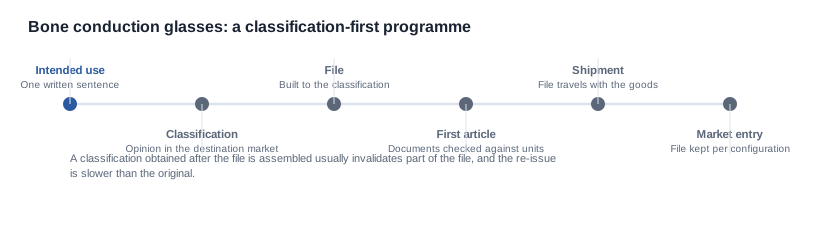
Bone conduction glasses certification starts with one written sentence about intended use
The 35 dB figure is what turns this into a classification question
Every other model in this catalogue publishes cell capacity, runtime, interface, and where relevant a feature row. None of them publishes an amplification gain. The bone conduction model publishes an amplification gain of 35 dB, and that single row is what changes the compliance route.
The distinction that matters is between a device that plays audio the customer selected and a device that captures environmental sound, processes it and delivers an amplified version of it. The first is an audio product in the ordinary sense. The second is doing something to the customer's environment, and an amplification figure attached to it is the kind of number that regulators and counsel examine first.
We are not saying this product is a medical device. That is not our determination to make, and we do not hold the clinical data, the test protocol or the regulatory assessment that would let us make it. What we can say is narrower and more useful: a published gain figure of this size will appear in your counsel's first set of questions, and you should expect to answer it before the product is listed, priced or marketed in any channel.
The three things the sentence has to fix
A classification view is only as good as the intended use it was formed on, and the intended use is a business decision rather than a technical one. Before asking anyone for a classification opinion, the sentence has to settle three things.
- Who the product is for. Not a demographic, and not a general statement about people who want to hear better. A statement of the role the product plays for the organisation buying it — communication in a noisy work environment, awareness of surroundings on a site, or playback of the customer's own content.
- What the customer is told the product does. The claim on the listing, the claim on the packaging and the claim in the seller's script have to match the sentence. A classification formed on one set of words and a listing written on another is the most common way a programme ends up holding a file that does not match the goods.
- What is excluded. An amplification figure inside a general audio product and an amplification figure inside a product positioned around hearing are two different products in the eyes of a regulator, and the difference is written into the intended use, not into the hardware.
The three have to be settled by you, in writing, before the request goes out. We can supply the published rows and the gain figure. We cannot supply the intended use, because the intended use is your commercial position and yours to own.
The order the documentation has to be built in

The sequence in the chart is not a preference. Building a compliance file first and asking for a classification afterwards is how a programme ends up holding documents that do not match the product — a technical file assembled against an assumed route, then a classification that contradicts part of it, then a re-issue that costs more than the original file.
In practice the two halves of the programme run in parallel once the model designation exists. The document request is a set of written questions that can be sent immediately. The classification request is the one item that needs the intended use sentence first. The two meet at the first article, where each document is checked against the designation printed on the units.

What the bone conduction glasses specification publishes, and what it leaves to you
The published rows, in full
There are five published rows for this product, and they are worth reading in one place because the list is short enough to be complete.
- Amplification gain: 35 dB. The only acoustic figure in the entire catalogue.
- Battery: 200 mAh.
- Charge time: two hours or less. A ceiling, not a typical figure — there is no starting state, no termination criterion and no temperature condition attached to it.
- Rated runtime: about seven hours. A rated figure, produced under conditions that are not published.
- Charging interface: Type-C.
There is no Bluetooth version row on this product. The rest of the catalogue publishes a radio version on every model that has a radio, so its absence here is a gap to close rather than a variation to assume.
The rows that are absent, and what each one blocks
No model designation. This is the first item on any list for this product, because every published number in this catalogue is attached to a model designation and this product does not have one. A buyer cannot write a purchase order, a packaging artwork file, a customs declaration, a warranty record or a certificate request against a product with no designation. It is also what stops the compliance file from ever being complete: certificates are issued against a designated product, and a request that names no product comes back as a general enquiry rather than as an answer.
No certification row. There is no per-model certification entry anywhere in the catalogue, and no certificate numbers for this model or for any other. The absence is more consequential here than elsewhere, because a general consumer electronics product needs a compliance file to be sold, whereas a product whose classification is unresolved needs the classification settled before the file can be assembled in the right form. The documentation question has a prior question in front of it.
No acoustic detail. No output level, no frequency response, no leakage figure, no microphone specification. For most models in the range, an unpublished acoustic row limits the product claim. For this one it also limits the classification argument, because the arguments a regulator turns on — what the device does to sound, and who the sound is for — cannot be supported with numbers we do not hold.
No frame weight, no temple length, no lens dimension, no transducer position. We mention this here because it is the same kind of gap: physical parameters that a buyer would normally take for granted are not published, and each of them would ordinarily be a line in a technical file.
No clinical data and no test protocol. We hold none, we will not supply any, and we will not characterise what this product does for a person's hearing.
The two published numbers that are easy to overstate
The 35 dB figure is real and it is unusually high for a wearable product, but it describes gain and not output. It is the ratio between the signal entering the amplifier and the signal leaving it, which is not a sound pressure level and is not comparable to a volume setting. Two products with identical gain can behave very differently, because what follows the amplifier matters as much as the amplifier itself. We publish no output figure, so we make no output claim, and a buyer who needs one has to get it measured on a first article.
The seven-hour runtime is the row a listing will quote and the row a buyer should quote least confidently. It is a rated figure produced under unpublished conditions, and this product's workload is unusually hard to pin down: an amplifier running at the level that makes 35 dB meaningful draws a different amount of power from the same amplifier running quieter. The runtime and the gain figure describe the same product under two different assumptions, and neither assumption is published. The battery specification guidance is written for exactly this situation.

The four frameworks a bone conduction glasses compliance file has to satisfy
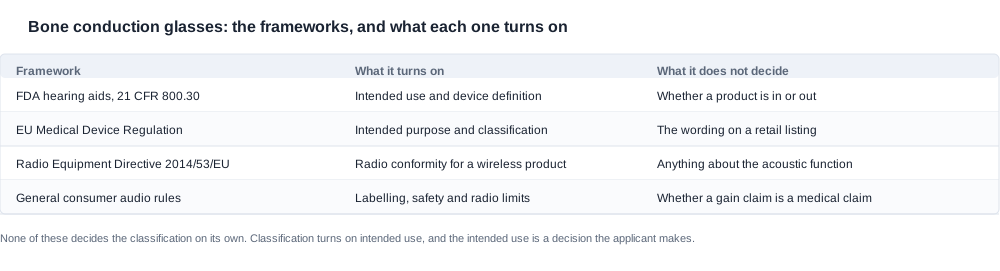
The frameworks, named as plain text
None of the frameworks below is guidance from us, and none of them decides this product's classification on its own. They are the frameworks your counsel will work through, and each one turns on a different thing.
In the United States, over-the-counter hearing aids sold under the FDA's regulation at 21 CFR 800.30 fall under specific controls including labelling and performance requirements, and the framework turns on intended use and the device definition. In the European Union, the Medical Device Regulation determines classification, and it turns on the intended purpose. The Radio Equipment Directive (EU) 2014/53/EU governs radio conformity for a wireless product, and it says nothing about the acoustic function. General consumer audio rules, in every market, govern labelling, safety and radio limits, and they do not decide whether a gain claim is a medical claim.
The last one is the row buyers most often get wrong. A product can satisfy every general consumer audio obligation and still be regulated as a medical device, and it can fail an ordinary radio obligation while sitting outside the medical frameworks entirely. The compliance route is not a single switch.
Why the radio framework is not the acoustic framework
A buyer with a wireless product and a radio obligation will often begin by asking for the radio documentation, because that is the paperwork they know. It is a reasonable place to start, and the radio route is usually the shortest of the four to assemble.
It also answers nothing about the question this product raises. A radio conformity assessment covers the radio characteristics of a wireless device: spectrum, emissions, radio limits. It does not cover what a device does to environmental sound, and it does not decide whether an amplification figure makes a product a regulated medical product. The certification checklist sets out the form a document request should take, and the radio documents are the part of it you can complete fastest — but completing them first and then discovering a classification question leaves a partly built file that has to be re-issued.
The channel rules, which are a fourth framework and not a sub-set of the first three
A retail platform or a distribution partner will have its own requirements, and they are frequently stricter in a specific place than the statutory route: labelling language, what may be claimed in the product title, what a product category requires as a file, what a listing may describe. These are commercial requirements rather than legal ones, and they are set by a counterparty you can negotiate with.
The practical consequence is that the channel's rules are the one framework you can test cheaply and early. A written description of the product and its claims, sent to a channel before the statutory file is complete, tells you whether the listing you have planned is one the channel will accept. If the channel rejects the claim wording, the answer is to change the wording — not to keep the claim and find a different channel. The market compliance routes page is where the destination-market side is worked through, and the bone conduction audio page carries the design context behind the gain figure.
Where the evidence behind a bone conduction glasses certificate request comes from
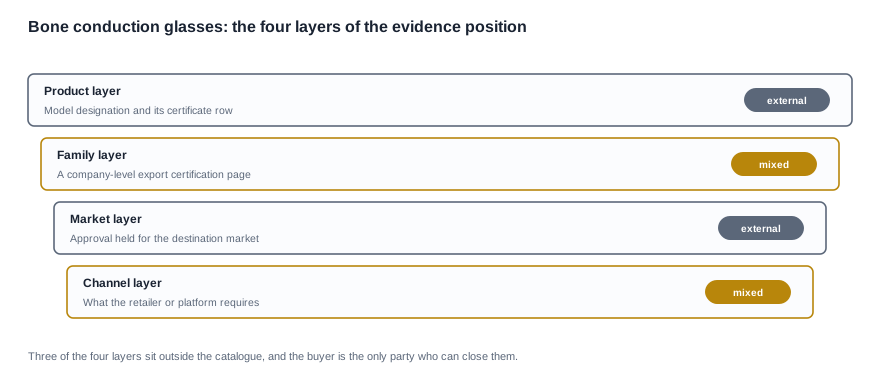
Four layers, and only one of them is ours to answer
A certificate request has to be answered from four different places, and a buyer who has been given one of them often assumes they have been given all of them.
The product layer is the designation and the certificate row that belongs to it. This is the supplier's to answer, and for this product it currently has no designation and no row — which is why the request cannot be framed as "send us the certificate for model X" and has to be framed as "issue a model designation and then send the certificate that applies to it".
The family layer is the company-level capability. It is the layer buyers most often mistake for the product layer, and it is the one that is easiest to over-read.
The market layer is the approval actually held for the destination market. It sits outside the catalogue entirely, and it is the layer that a counsel opinion usually depends on.
The channel layer is what the retailer or the platform requires on top of the legal position.
Three of the four sit outside the catalogue, and the buyer is the only party who can close them.
What the catalogue does carry, and why it is not evidence of conformity
The catalogue has a company-level export certification page. Its content is images rather than text, and the images are ten patent certificates — eight appearance-design patents and two utility-model patents. The catalogue text contains no reference to CE, FCC or RoHS, and there is no per-model certification row anywhere in it.
None of that is a criticism of the catalogue. It is a fact about what the catalogue is: a product listing, not a conformity file. The practical implication is the one that matters for a purchase order. A company-level export certification page cannot be converted into a per-model conformity claim, and it is not evidence that any particular model carries any particular approval in any particular market. When a buyer asks "is this model certified for the destination market", the honest answer from the catalogue is that the catalogue does not carry that row — which is a request for documentation, not a conclusion about the product.
There is a second reason the patent certificates cannot stand in for conformity documents, and it is worth stating plainly because the two are regularly conflated. A patent certificate records that a design or an invention was granted protection. It says nothing about how the product performs, nothing about what it is permitted to do, and nothing about whether it may lawfully be sold into a market. A buyer who finds a page of certificates in a supplier's documentation and reads it as an approval file has misread the document type.
The question that settles it: which document, for which designation, from which body, with what dates
When the documentation arrives, four things have to be checked on the face of it before anything else, because a document that fails on any one of them cannot be filed regardless of what else it contains.
- The designation on the document matches the designation on the units. A certificate that names a model number the factory does not actually assemble is a document for a different product, and it will not survive a customs check or a platform audit.
- The scope covers the intended use, not merely the product. A document that covers the product as a general audio device is not a document that covers it as an amplified ambient-sound device.
- The issuing body is one the destination market recognises. A document from a body the market does not recognise is not a conformity document in that market, however genuine it is.
- The validity dates cover the period of sale. A file assembled once and held for a multi-year programme will expire in the middle of it, and an expired document is a gap that appears at the worst possible moment.
None of these four checks is difficult, and all four are missed when a buyer accepts a document set without reading it. This is the substance of the certification checklist — the form the answer should take, and the checks to run on the answer.
The claims a bone conduction glasses listing must not make, and what to write instead
Four descriptions to keep out of the copy
A listing that drifts into the wrong territory is a compliance problem before it is a marketing problem, because the listing is the evidence of what was claimed. Four descriptions have to stay out of it.
Do not market this model on hearing improvement. The catalogue publishes no clinical data, no test protocol and no assessment, so there is nothing behind such a claim, and a gain figure is not a substitute for one.
Do not use terminology implying compensation for hearing loss or impairment. This is a different prohibition from the first one, and it is the one most easily breached by accident — a phrase chosen for accessibility rather than for a claim can still read as a claim.
Do not fold this model into a general consumer audio range. Positioning it inside an audio line-up is an implicit statement that it is an ordinary audio product, and that implicit statement is what a regulator looks at when the intended use is being reconstructed. The gain figure makes the model a poor fit for that shelf next to models that publish no acoustic figure at all.
Do not present 35 dB as a performance benefit without a determination behind it. An amplification figure without a reference level, an input signal, a frequency band and a measurement method is not a comparable number. It is a specification, and the specification is what should appear in the copy.
We will not make any of those claims ourselves, and we would decline to supply product literature that makes them. That is a supply position rather than a legal opinion, and it holds regardless of what any authority concludes.
What the copy can legitimately say
A narrow, accurate listing is a defensible one, and it is considerably easier to defend than a broad one that has to be walked back later. The material available is short and specific:
- A bone conduction audio device with a published amplification gain of 35 dB.
- A 200 mAh cell, a charge time of two hours or less, a rated runtime of about seven hours, and Type-C charging.
- The device designation, once it is issued.
- The compliance position, in the form the destination market recognises, once the classification is settled.
That is a complete product description. It does not need a hearing claim, and it does not need a comparison against another product's gain, because neither can be supported.
The question the copy has to answer, and who answers it
A listing that says what the device is and what it does is finished. A listing that also has to answer "and what does that mean for the person holding it" is a different kind of listing, and that is where the boundary sits.
The distinction is worth stating in operational terms, because it is the distinction between a specification sheet and a claim. A specification sheet states what was built and measured. A claim states what the buyer will get as a result. The 35 dB figure is on the first side of that line, and it is the published fact of the product. It becomes a claim the moment it is attached to an outcome.
If the intended use is settled as communication in a noisy environment, the listing describes a device that amplifies ambient sound. If the intended use is settled around hearing, the listing needs a classification determination and a clinical basis before it can say anything about outcomes. The same hardware, the same gain figure, two entirely different documentation programmes — and the difference is made by the sentence, before any hardware is ordered.
The question we will answer, and the question we will not
We will tell you the published rows, and we will tell you precisely which documents we hold, which we do not, and which are yours to obtain. We will issue the model designation and state the date it is fixed. We will supply the gain figure as a published specification with its limits stated. And we will tell you what we cannot support, in writing, so that your programme can be planned around the real answer rather than an assumed one.
We will not supply a hearing claim, a clinical claim, a per-model conformity assertion the documentation does not support, or copy that implies any of them. We will not characterise what the product does for a person's hearing, and we will not help you build a marketing claim around an amplification figure whose compliance status has never been shown to us.
If your counsel has already reached a position, tell us what it is and we will tell you what we can and cannot support on that basis. The bone conduction glasses buying guide covers how the parameter set should be read once the regulatory route is settled, and the bone conduction common questions sets out the documentation gaps in more detail.
Related reading
- The design context behind the gain figure — bone conduction audio
- The document set normally required — certification checklist
- Market-by-market compliance routes — market compliance
- This model against the range — bone conduction glasses
Tell us the target market, the intended use and the quantity, and we will come back with what is published, what is not, and what has to be obtained before the first order.


