

Bone conduction glasses technology: upgrade, not a trade-up
Bone conduction glasses technology smart glasses upgrade considerations need a definition before they can be answered, because in this category "upgrade" points at four different things and they cost wildly different amounts. There is also a piece of bad news that a buyer should hear early: our catalogue contains a single bone conduction entry, with no model number and with its customisation capability recorded as undisclosed. So there is no within-category trade-up available. What looks like an upgrade is, in every case, a new product or a new piece of work.
The entry itself is published as an amplification gain of 35 dB, a bone conduction transducer, a 200 mAh cell, a charge time of two hours or less, roughly seven hours of rated runtime and Type-C charging. That is the entire published specification, and it is worth reading as a starting position rather than as a ceiling.
The four things a buyer is usually asking about are these. The first is moving from an open-ear audio product to a bone conduction one, which is a change of supply chain and of compliance position rather than a refinement. The second is trading up inside the bone conduction range, which does not exist. The third is adding bone conduction to a range that already sells audio, which is a new product line with its own tooling, its own file and its own support. The fourth is documenting what already exists, which is the only one of the four available today.
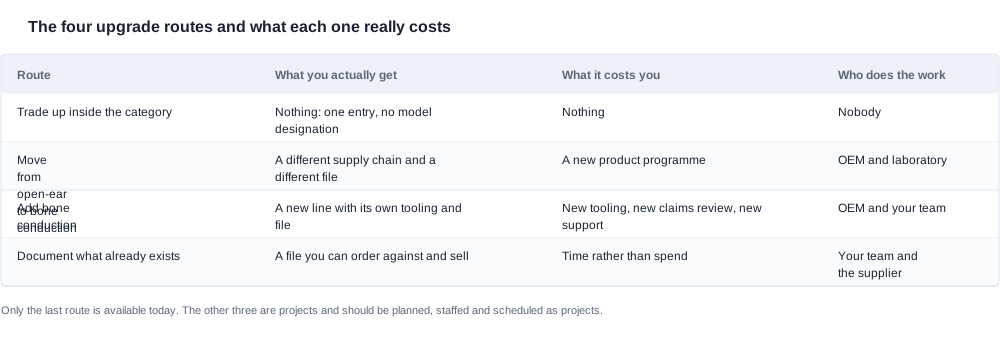
The practical consequence is that a buyer who treats an upgrade as a selection will find the conversation much more expensive than expected, because a selection has a price and a project has a schedule. Deciding which of the four you are actually doing takes an afternoon and saves a quarter.
Route one: moving from an open-ear line to bone conduction
This is the trade most buyers are actually contemplating, and it is a genuine change of product rather than a refinement.
What you gain. Privacy, in a way nothing else in our range offers. A bone conduction device produces no sound in the room at all, because the output is a mechanical vibration in the skull rather than a sound wave. A customer whose use case is amplified listening in an office, on a train or in a meeting gets something no open-ear frame can provide. You also gain assistance in a noisy environment, because a gain of 35 dB works on a masked source, and the ear stays completely open so the wearer still hears the traffic.
What you give up. Bass, and the character of music with it. Low frequencies do not carry through the skull efficiently, and a music product built on bone conduction sounds thin in a way customers describe as broken rather than as a design choice. You also give up long-wear comfort, because the temple contact points carry the vibration as well as the mass, and bone pressure fatigue arrives on a schedule that depends on the individual.
What you do not gain. A cheaper product, or a better-specified one. This is a different supply chain with a different compliance question attached, and the published documentation for it is a single entry with six rows rather than a family of models with full electrical detail. A buyer moving from the open-ear platforms in our range — twelve models with chip version, cell capacity, rated runtime and charging method published for each — moves from a documented family to an undocumented entry, and the diligence has to be built rather than read.
The commercial framing that makes this route sensible is that it is a new product, and it should be funded as one. A new product gets a new compliance position, a new listing, a new support script and a new set of acceptance criteria. A buyer who treats it as a variant of an existing line will under-budget the documentation and over-promise the performance, and those are the two mistakes that make an otherwise sound programme fail in its first quarter.

Route two: adding bone conduction to an existing range
If a brand already sells open-ear audio and wants to add a bone conduction product, this is a new product, not a variant. It needs its own tooling, its own file set entry, its own compliance position and its own place in the channel.
The good news is that the platform work may partly carry over, and the bad news is that the compliance position does not. A product that amplifies environmental sound toward the ear raises a description question that an audio product does not, and in the United States the framework separates a medical-device hearing aid, including the over-the-counter category, from a non-device personal sound amplification product. How the product is described decides which side of that line it sits on, so the copy has to be settled before the product is built rather than after.
There is a second piece of work in this route that is easy to miss, which is the acoustic expectation inside the brand itself. An open-ear line and a bone conduction line sold under the same brand will be compared by the same customers, and the comparison is not kind: the open-ear product will sound better to almost everyone who hears both. The brand therefore has to decide whether the two products share a listing, a channel or a customer, because a customer who buys the open-ear product and then buys the bone conduction product has a bad experience, and a returns cluster follows.
The decision criteria for this route are worth writing down before the project starts. There are three: whether the brand already has the compliance and claims capability in-house, whether the channel can carry a product whose audible character is different from the rest of the range, and whether the brand can fund the second support script, because a single script across two acoustic behaviours will misclassify one of them.
The two questions that decide this route. Does the brand's own marketing team have the ability to write a listing that makes no outcome claim, and does the brand's distribution partner have a channel that will not merge the two products into one product page? A yes to the first and a no to the second is a programme that will fail commercially while the engineering succeeds.

Route three: documenting the product that already exists
This is the upgrade that is genuinely available today, and it is the one most buyers forget to count. Our catalogue's export-certification page carries ten patent certificates, eight appearance-design patents and two utility-model patents, and names no CE, FCC or RoHS marking, so the model-specific conformity documents are a request we have to make rather than a row we can point at. A model number, a file set and a documented compliance position are not paperwork overhead; they are the difference between a product that can be ordered, listed, cleared and sold and one that cannot.
It is also the cheapest of the four, in the sense that it is a decision rather than a build. The work is mostly asking: which model designation appears on each certificate, what is the route in each target market, what is the gain measurement method, what is the frame weight, what is the ingress rating, what is the customisation capability. Some of those answers will come back quickly. Others will not, and the ones that do not come back are the programme's real scope.
The reason this route is so often skipped is that it produces no visible product. There is nothing to photograph and nothing to demonstrate, and the return is a set of documents. But the documents are the only thing that makes the other three routes possible, because the compliance position, the model designation and the measurement method are all inputs to a new product programme. A brand that documents the existing entry this year can evaluate a better one next year; a brand that does not will re-derive the same answers next year at a higher cost.
The sequencing is straightforward and worth stating: documentation first, because its output is the input to every other route, and because the questions are cheapest to ask of a supplier you are already working with.
Route four, and the decision that comes before all of them
Route four does not exist, and the reason should shape how a buyer plans. Our catalogue has one entry, no model number, and no disclosed customisation capability. There is no second model to trade up to and no published option to change.
The practical consequence is that any improvement in this category has to be created rather than selected. That is a different project shape, with engineering and certification attached, and a buyer who treats it as a selection will find the conversation much more expensive than expected. A selection has a price, a lead time and a sample. A project has a specification, a compliance route, a tooling decision and a production schedule, and the last of these is where the elapsed time actually lives.
The decision that comes before all four routes is the first question in the decision tree below, and it is not a technical one. It is whether the brand has a compliance answer for the market it intends to sell into, written down, before anybody spends anything on product work. Everything else in this category is cheaper than that answer, and that answer is cheap to obtain and expensive to defer.
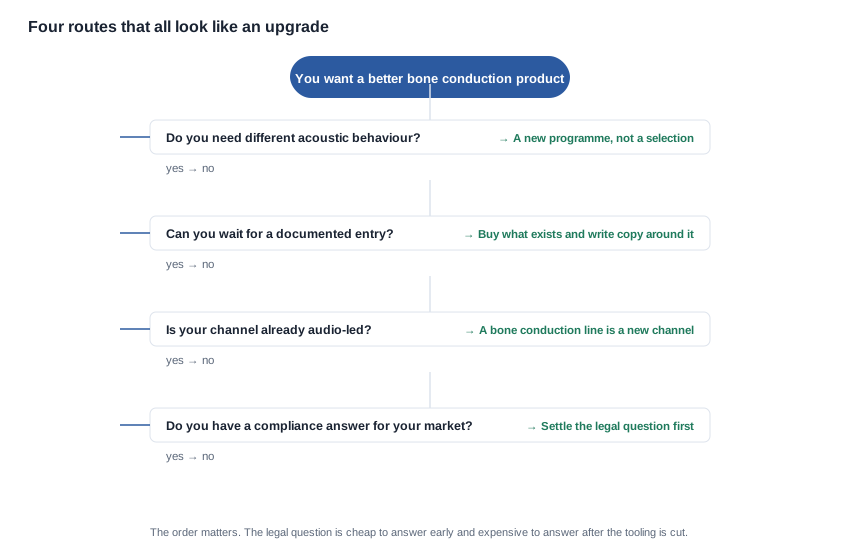
There is a fourth possibility that is often the right answer and is rarely put on the table, which is to wait. If the brand's bone conduction ambition is a two-year plan rather than a two-quarter plan, waiting for a documented entry — with a model number, a published file and a stated method — may deliver a better outcome than building one now with an unnamed starting product. The trade-off is the channel window, and whether the window is real is a question about the brand's own channel rather than about the supplier.
Where the work sits, and who controls the clock
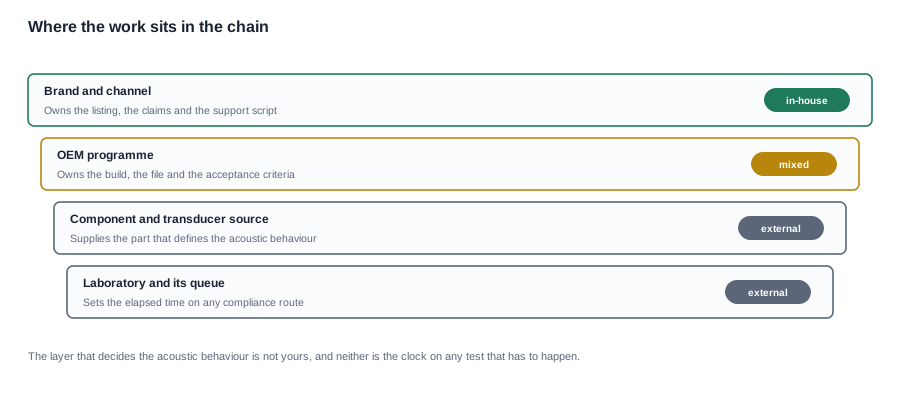
The elapsed time on any of these routes is set by two things that are mostly outside the buyer's control: the compliance route and the laboratory queue that sits behind it. A buyer who plans a project on factory lead times will be surprised, because factory lead time is the small part of the schedule.
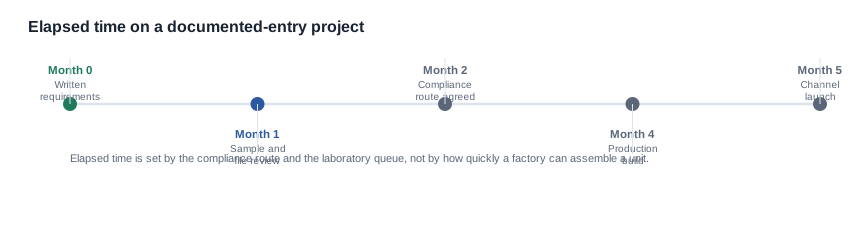
The layer that decides the acoustic behaviour is also not the buyer's. The component and transducer source sets the character of the product, and the factory assembles and documents rather than invents. A buyer who believes the product's performance is a factory choice will negotiate the wrong things; the negotiation is about the transducer, the frame geometry and the measurement method, and the factory's willingness to discuss the method is the thing that determines whether the programme is qualified.
The commercial terms follow from that structure. Negotiable: the number of model designations committed to; the per-configuration minimum, which is where a per-configuration cost actually moves; artwork preparation and round count; the packaging scope, including whether a printed seating instruction can be included in the box; the sample order and whether evaluation units are credited; the delivery structure, including staged delivery; and the documentation package arriving with the order rather than afterwards. Not negotiable: the cost and elapsed time of the compliance route and the laboratory queue; the tooling character, which is a one-off cost amortised across the first order; and the acoustic behaviour of the product, which is set by the component and the frame and is not a commercial variable at all.
A worked scenario: a brand deciding whether to enter at all
The following passage is a constructed illustration of the decision sequence. It is not a report of what a buyer chose.
Assume a mid-size brand whose current range is open-ear audio, sold through two online marketplaces and a specialist retailer. The brand's category manager has been asked to look at bone conduction. The published position is one entry, published as a 35 dB amplification gain, a bone conduction transducer, a 200 mAh cell, a charge time of two hours or less, roughly seven hours of rated runtime and Type-C charging, with no model designation and no published customisation capability.
The first decision is to name the route, not to request a quotation. The category manager had been mentally comparing bone conduction models against the open-ear line, which is a comparison against a family of twelve documented models and will not resolve. Naming the route as "add a bone conduction line to an existing audio range" reframes the work as a project with a compliance position, a new listing and a second support script, and the budget follows the reframe.
The second decision is to get the route answered before anything else. The brand asks, in writing, which framework the product is sold under in its two target markets, and whether the product is presented as a medical device. The answer establishes that it is not, and that the copy will not suggest otherwise. This is a half-day of work that would otherwise have surfaced in month three, after tooling.
The third decision is the channel question. The brand's specialist retailer already sells the open-ear range and has a single product page template for personal audio. Adding a bone conduction product that sounds different, under the same brand, into the same template is a recipe for a returns cluster. The brand therefore decides to route the bone conduction product to a separate listing, with its own copy and its own expectation-setting.
The fourth decision is documentation rather than build. Rather than starting a new product programme, the brand asks the supplier the documentation questions first: which model designation appears on each certificate, what the gain measurement method is, what the frame weight and ingress rating are, and what customisation is available. The answers partly arrive. The customisation capability, which is recorded as undisclosed for this entry, is the one that stays open, and that single gap is enough to make the brand's own private-label plan unevaluable.
The fifth decision is to wait on the build and to act on the documentation. The brand books the unanswered rows as a supplier development action with a review date, and meanwhile runs a small evaluation of the existing entry in the one channel where the acoustic difference is an advantage rather than a problem — a workplace channel where the use case is calls in noise and the customer is comparing against an earbud rather than against the brand's own open-ear product.
The sixth decision is the commercial ask, made at the same time. The brand asks for the sample order to be credited, for artwork preparation to be included, and for the documentation package to arrive with the order rather than afterwards. None of these moves the unit price visibly. All three reduce the working capital tied up in a product that has not launched, and the third one is the one that matters most, because it is the clause that would have closed the customisation gap.
The result is a brand that has not entered the category but has bought the information it needs to enter it, and an open item with a date on it rather than an open item with a hope.
What we can and cannot commit to on an upgrade
Concretely, we publish the one entry we have, with the specifications the catalogue states, and we publish the missing model number and the undisclosed customisation capability with the same prominence as the specifications. We will not present a maximum output as a result, and we will not write a hearing-improvement claim, because a hearing-related description can pull the product into a framework that a catalogue entry cannot address.
What we will commit to is the part we can actually control. We will say which specifications exist for this entry and which do not, without padding the gaps with typical values. We will tell you what a new product programme in this category involves, in terms of the questions that have to be answered, the documents that have to exist and the elapsed time those questions consume. And we will tell you plainly when a route is unavailable — there is no within-category trade-up, and any improvement has to be created, which means a specification and a compliance route rather than a selection.
What we will not commit to is anything we have not measured. We do not publish a frame weight, an ingress rating, an acoustic measurement, a defect rate or a production capacity for this entry, and we will not estimate them to make a business case look tidier. We also will not tell a buyer that a project in this category will take a specific number of months, because the elapsed time is set by a laboratory queue and a route decision that sit outside our control.
Actions for the next planning cycle
Name the route before you request anything. Each of the four has a different budget, a different schedule and a different failure mode, and they are not interchangeable.
Ask the documentation questions first, in writing. Their output is the input to every other route, and they are the cheapest questions in the category.
Answer the market question in writing, before product work. It is the one answer that can change cost, schedule and claims all at once.
Put a date on the open rows. A customisation capability that is undisclosed today needs an owner and a review date, or it becomes the reason the programme is quietly abandoned in the fourth quarter.
The mechanism behind the difference between the two platform families is under bone conduction audio technology, the platform comparison is in open-ear versus bone conduction, and the buying route for a private-label programme is on the OEM and ODM page.
Where this comes from
- Bone conduction audio technology and its limits
- Open-ear versus bone conduction
- Advanced considerations for buyers
- Bone conduction glasses in the range
- OEM and ODM programmes
Tell us which route you are considering and we will say what the published documentation does and does not support for it.


