

The questions buyers ask about bone conduction glasses technology smart glasses what buyers most often ask cluster around one number. Our catalogue publishes an amplification gain of 35 dB for the bone conduction entry, alongside a 200 mAh battery, charging in two hours or less, roughly seven hours of stated use and Type-C charging. Almost every enquiry begins with the same request: what does the 35 dB mean. The honest answer has two halves, and a buyer who needs only one of them will build a listing they cannot defend.
The first half is what the catalogue holds. The second half is what it does not: the frequency range, the input level, the measurement location, whether the figure is typical or maximum, the frequency response, the configuration it was taken on, and a model identifier for the entry itself. Treat 35 dB as an indication that the product is intended for hearing assistance, not as a performance specification that can go on a product page.
For a buyer, that distinction is not pedantry. It determines whether the entry can carry the claim you intend, whether it can enter a channel at all, and who carries the classification burden if the claim goes further than the evidence.
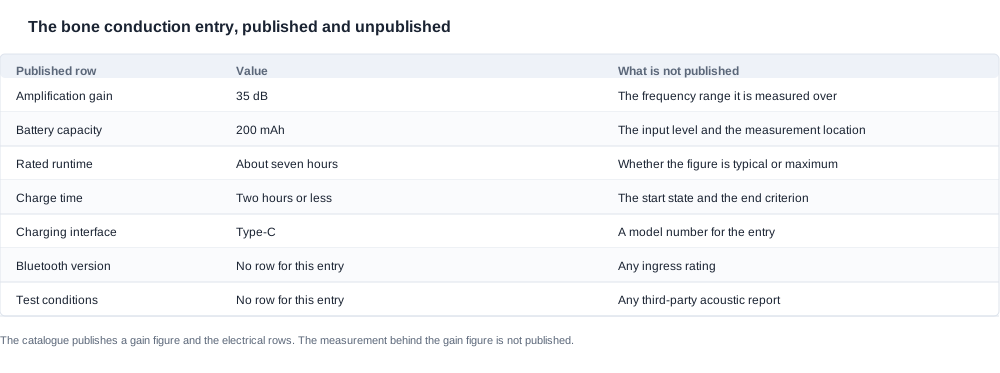
Bone conduction glasses technology: what the 35 dB gain figure cannot say
| Published row | Value | What is not published |
|---|---|---|
| Amplification gain | 35 dB | The frequency range it is measured over |
| Battery capacity | 200 mAh | The input level and the measurement location |
| Rated runtime | About seven hours | Whether the figure is typical or maximum |
| Charge time | Two hours or less | The start state and the end criterion |
| Charging interface | Type-C | A model number for the entry |
| Bluetooth version | No row for this entry | Any ingress rating |
| Test conditions | No row for this entry | Any third-party acoustic report |
Three of those gaps are the same gap taking different forms. The frequency range, the input level and the measurement location are all conditions of the measurement, and without any one of them the figure cannot be reproduced or compared. A gain figure measured at one input level and one frequency band describes a very different product from the same figure measured at another.
The fourth gap — whether the figure is typical or maximum — changes what a buyer may write. A typical figure is a statistical statement about a population, which is what a buyer can use in general language. A maximum figure is the best unit in a sample, which is not a basis for a claim at all, because the customer will not receive the best unit in the sample.
Two further points belong in the same bucket. The rated runtime of roughly seven hours is the quoted operating window, and the catalogue publishes no call test for this entry, so it cannot be turned into a guaranteed session length. The charge time of two hours or less is quoted without a stated start state and without a stated end criterion, so it cannot be turned into an allowance for a shift change either. These are the correct limits of the data rather than defects in it, and a buyer who wants a shift-change allowance needs a figure the catalogue does not hold.
Why the published electrical rows matter for this entry specifically
The 200 mAh cell and the seven-hour rated window are worth reading against the way the technology is actually used. A bone conduction entry exists in this catalogue because an earbud cannot or should not be placed in the ear — in a helmet, in a hearing-protection environment, in a clinical or industrial setting where the ear canal is occupied. In those situations the device is usually on for the working period rather than for a call, which makes the runtime row a duty-cycle question rather than a conversation-length question.
That reading changes the channel. A product bought for a working environment is a product bought on reliability, on the ability to be issued to a person and used all day, and on the warranty position when something goes wrong. It is also a product where a physical-contact and sizing conversation dominates the returns file, which is a different kind of conversation from the acoustic one, and the buyer should know which one they are walking into before the channel is chosen.
The comparison a buyer will be asked to make
The comparison that gets requested in this category is against the conventional open-ear audio platforms in the same range — the models that publish open-ear acoustic structure, directional audio and intelligent noise reduction, with the Bluetooth version, rated runtime, cell configuration, charge time and charging interface published per model. The comparison is legitimate, but it has to be made on the right rows.
The bone conduction entry's advantage is the amplification figure. Its disadvantage is that everything the audio family publishes as a row, it publishes as a row too, with one exception that matters: there is no Bluetooth version row for this entry at all. A buyer who is planning a phone-based or platform-based use case needs to establish the radio situation for this entry in writing before committing to it, and that question has not been answered by the catalogue.
The IP54 marking appears on two models in the range, the V06 and the S7. This entry carries no ingress rating of any kind, and for a product intended for working environments that absence is a substantive commercial fact rather than a documentation gap.
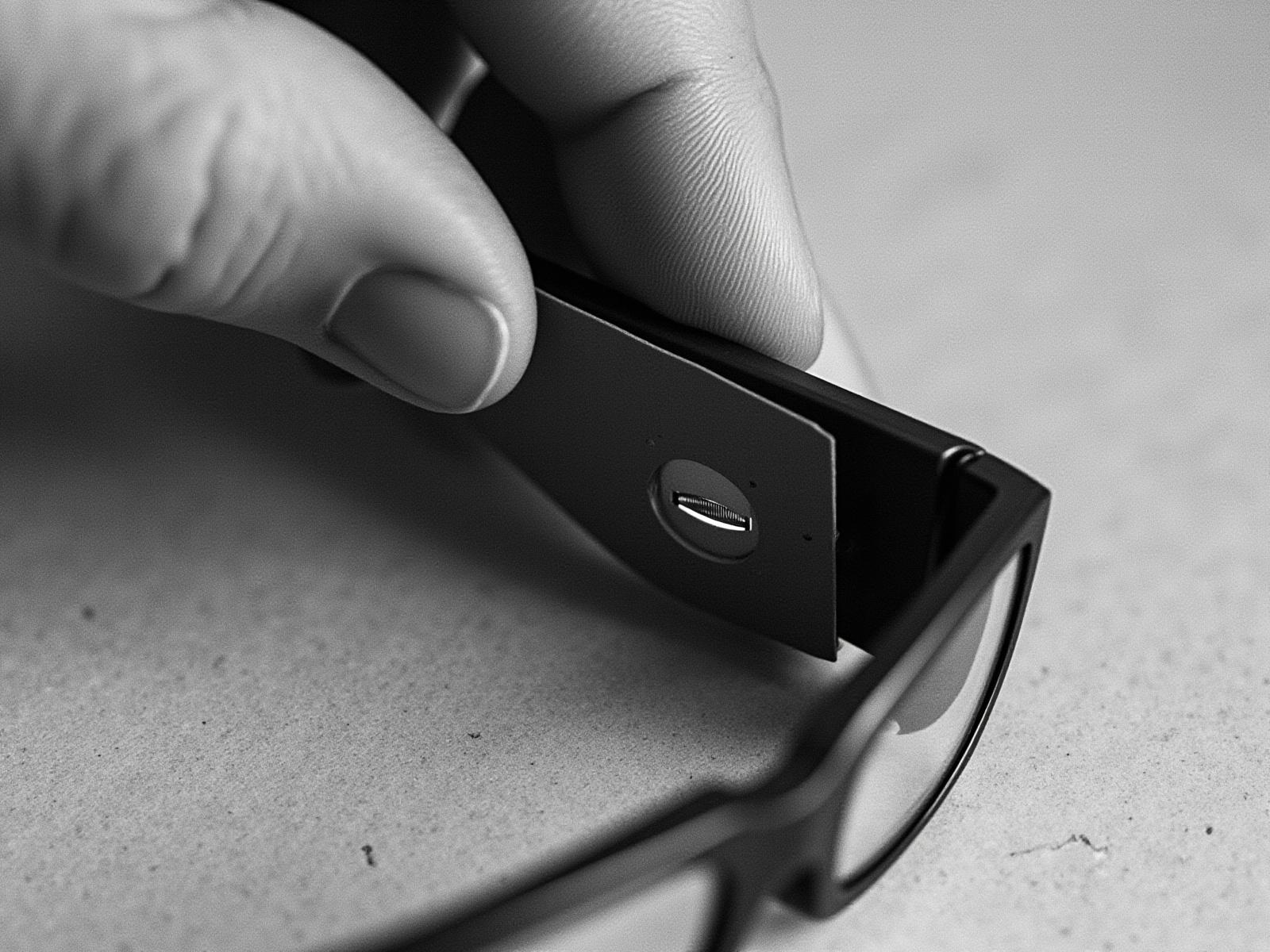
Why this entry has no model identifier, and what that blocks
The bone conduction entry carries no formal SKU in the catalogue. That is an administrative problem with real consequences, and it is the single most consequential fact in this article.
A declaration of conformity needs a model string. In the European Union, a product placed on the market with radio functionality is assessed against the Radio Equipment Directive (EU) 2014/53/EU, and the technical file behind that assessment is built around identified products. A product line with no model identifier cannot be the subject of a declaration of conformity, because there is nothing for the declaration to name.
Retail channels need model-level documentation. A retail or e-commerce listing is indexed by model. Without a designation, the product cannot be listed correctly, cannot be supported in the channel's returns system, and cannot be associated with a certificate in the channel's compliance review.
A quality claim needs something to be claimed against. When a unit fails in a channel, the question is which product was returned and against which specification. Without a model string, that question cannot be answered, and the returns conversation becomes an argument about whether the returned unit was the one that was approved.
We are aware this entry should not be in this state, and we would rather say so than paper over it. If bone conduction matters to your proposition, ask us for a formally identified model before you build anything around it. That request is reasonable and it should be made at the request-for-quotation stage, not after the first order.
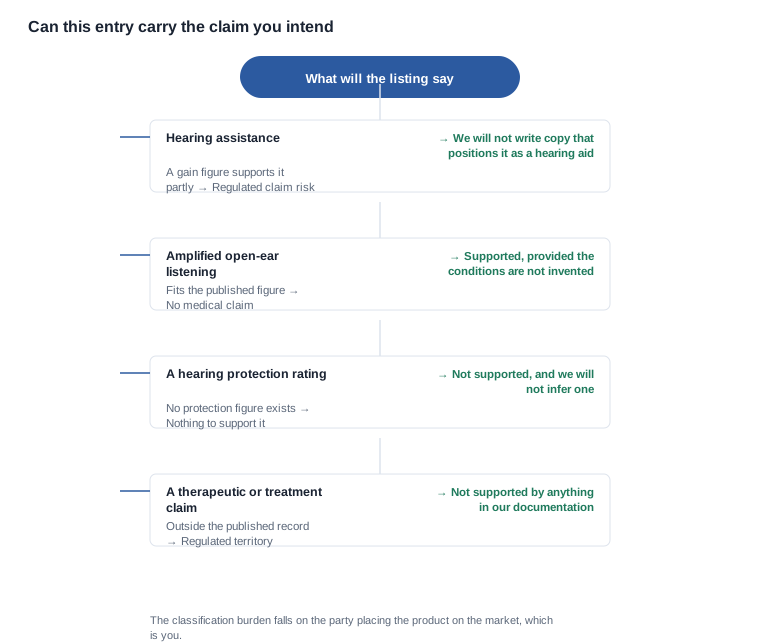
The four claims and what each one is worth
A hearing-assistance claim. A gain figure supports it only partly, and the supported part is exactly the part the documentation covers. The regulated-claim risk sits on the party placing the product on the market, which is you, not us. We will not write listing copy that positions this entry as a hearing aid.
An amplified open-ear listening claim. This is the claim the published figure actually fits. It is supported, provided the conditions are not invented — that is, provided the listing says the product provides amplified open-ear listening and does not attach a performance figure to it that we cannot evidence.
A hearing protection rating. No protection figure exists in the catalogue, so nothing supports such a rating, and we will not infer one. A protection rating is a different kind of claim from an amplification figure and the two are not interchangeable: one says what the device adds, the other says what it keeps out.
A therapeutic or treatment claim. This sits outside the published record entirely. We will not support it with any documentation we hold, and a buyer who intends to make it is outside what this entry can support.
The questions buyers ask about classification, water and endurance
Is this a hearing aid
No, and we will not describe it as one. The distinction matters because in some jurisdictions a product marketed on a hearing-assistance claim is treated as a regulated device, with the classification burden falling on the party placing it on the market. The line between a consumer audio product with amplification and a regulated device is drawn by intended use and by the claims made, not by the hardware.
In the United States, the general wellness policy distinguishes between low-risk products that do not claim to diagnose or treat, and products regulated as devices. The determination turns on intended use and on the claims. A claim about myopia prevention or about treating a hearing condition changes the intended use, and that is a regulatory problem rather than a marketing one. The relevant framework is the FDA's device regulation at 21 CFR 800.30 and the general wellness guidance that sits alongside it.
Is it rated for water or dust
No rating is published for this entry. Two models in the sport range carry IP54 as a catalogue annotation, and even those are not tested ratings that should be quoted as one — no report number, no standard, no test condition and no laboratory behind them. The bone conduction entry has no such annotation at all.
For a working-environment channel this question has a practical answer: the entry cannot be represented as splash-protected, and the warranty position on liquid ingress has to be settled before the product ships rather than during the first support conversation.
Will the runtime last a full shift
The published figure is roughly seven hours of rated use on a 200 mAh cell, with charging in two hours or less. Whether that is a full shift depends entirely on the duty cycle in your channel, and the duty cycle is not published, because it is a property of the use rather than of the product. A buyer should build the answer from the hours the device is actually carried, not from the catalogue figure.
How it behaves across a full working day
This is a physical question about where the transducer sits and how much pressure it applies, and the answer varies by head shape more than a conventional open-ear design does. We do not publish pressure or sizing data, and the only responsible answer is to have more than one person use it for a full day and note what happens after the fourth hour. For a channel where the device is issued to a person and used all day, this is the returns driver, and it should be tested before the channel is signed rather than after the first complaint cycle.
Where it is genuinely strong, and where it is not
Where an earbud cannot or should not be placed in the ear, and where hearing the surroundings matters, that is the honest case for this entry. What it is not good at is bass, and users frequently mistake absent bass for a fault when the device is behaving correctly. If the channel is media playback with ambient awareness, a conventional open-ear model is likely the better product and cheaper to support.
Deciding the conformity route before the listing copy is written
The order matters more than it appears. A buyer who writes the listing first and then asks which route applies has already chosen the claim, and the route follows the claim rather than the other way round. That is how a product ends up in a territory where the documentation cannot be produced.

The sequence runs: obtain a model identifier for the entry; request the conditions behind the 35 dB figure, meaning the band, the level and the location; confirm the configuration the figure was taken on; decide the market and the conformity route for that market; run a sample test in the environment the product is sold into; and write the listing claim to what the evidence supports, and nothing beyond it.
Each step has a document behind it. The model identifier is a written confirmation from us. The conditions are a written response from us. The configuration is a written confirmation. The route is a decision your compliance owner signs. The sample test is a protocol and a recording. The listing is the artefact everyone downstream depends on.
The question that decides the schedule
Which market is the product going into? Not the market you hope to sell into — the market you are actually going to ship to first. The route, the documentation set, the labelling, the packaging language and the claim wording all follow from it, and all of them take time that is easier to plan for before the listing exists than after.
For a buyer in the European Union, the relevant framework for the radio part is the Radio Equipment Directive (EU) 2014/53/EU. It is worth being precise about this, because the directive number is confused often enough to produce technical files with the wrong reference on them, and because EN 301 489 is a harmonised EMC standard rather than a directive. Where the destination market is the United States, the radio part is governed by the FCC equipment authorisation route, and the acoustic and safety claims remain subject to the FDA framework above.
The documents to obtain before this entry enters a channel
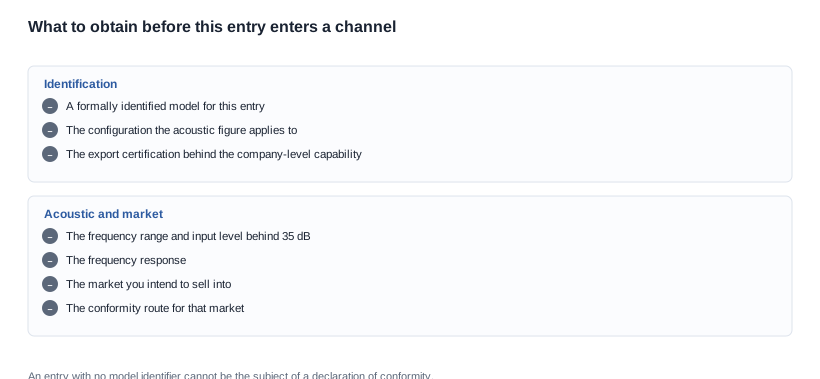
Eight items, grouped by what they unblock. The first group is about identity, and without it nothing else can be filed.
Identification. A formally identified model for this entry. The configuration the acoustic figure applies to. The export certification material behind the company-level export certification page on the catalogue front page, a page whose content is images rather than text — noting that a page which states nothing in words does not establish a per-model position, and that no per-model certification row exists for this entry.
Acoustic and market. The frequency range and the input level behind 35 dB. The frequency response. The market you intend to sell into. The conformity route for that market.
Two things are worth adding to this list that the chart does not carry, because they are the items most often discovered missing. The warranty position on liquid ingress, in writing, given that no ingress rating is published. And the returns and failure-handling process, because a working-environment product generates failures and the process that handles them is what determines whether a return becomes a replacement or a negotiation.
What this entry's documentation state does to the commercial terms
The thin sheet has a commercial consequence, and a buyer is better off pricing it than discovering it. Where a product carries a full technical file, the factory can quote a unit price that assumes a straightforward conformity route, and the documentation is a line item rather than a variable. Where a product carries no model identifier and no per-model certification position, the route has to be built, and the cost of building it lands somewhere that is usually not written down.
Three things are worth negotiating on this entry specifically.
The route work needs to be scoped and owned. Ask who is responsible for obtaining the model identifier, for assembling the technical file, for the conformity assessment and for the declaration of conformity, and ask for the schedule. If the answer is that these will be handled as they arise, the schedule is unbounded.
The sample order should be conditional. A pilot order against a first identified unit is a legitimate structure and it moves the risk from the whole volume to one lot. It also produces the sample data the acoustic question needs, which is the same sample.
The claim wording should be agreed before the artwork is finalised. Packaging and listing copy are where a hearing-assistance phrase gets written by someone who has not seen the classification question. Agreeing the wording first costs a week; reworking printed packaging and a live listing costs a month and a reprint.
The general principle is that where the documentation is thin, the commercial conversation should be specific about who does what and by when. That is not a distrust of the factory. It is the ordinary response to a product whose file has to be assembled rather than issued, and the items below are the ones to ask for.
How we will and will not support a bone conduction claim
We publish the 35 dB figure because it is in our catalogue. We do not publish the conditions behind it, a model identifier for the entry, pressure and sizing data, a frequency response, an ingress rating, a Bluetooth version or any certification position. We would rather a buyer sees a thin, honest sheet than a complete one that a customer discovers is not supportable.
What we will do is take the market and the claim you intend to make and say plainly whether this entry is one we can support. If the claim is amplified open-ear listening, the answer is generally yes, with the claim written to the published evidence. If the claim is a hearing-assistance claim, the answer is partly, and we will write the copy with the restriction in it. If the claim is a protection rating, a therapeutic claim or a hearing-aid positioning, the answer is no, and we will say so before you have paid for tooling and artwork.
We will also flag the one item that is ours to fix rather than yours: the model identifier. If this entry is going into a channel, that identifier has to exist before the channel paperwork starts, and it is the first thing we will pursue when you tell us the entry matters.
The regulatory and commercial traps in this category are set out at bone conduction glasses common mistakes, and the procurement version of the same questions is at bone conduction glasses checklist for procurement.
Related reading
- The regulatory and commercial traps in this category: bone conduction glasses common mistakes.
- The procurement version of the same questions: bone conduction glasses checklist for procurement.
Tell us the market and the claim you intend to make, and we will say plainly whether this entry is one we can support.


