

Bone conduction glasses technology: six mistakes in discovery order
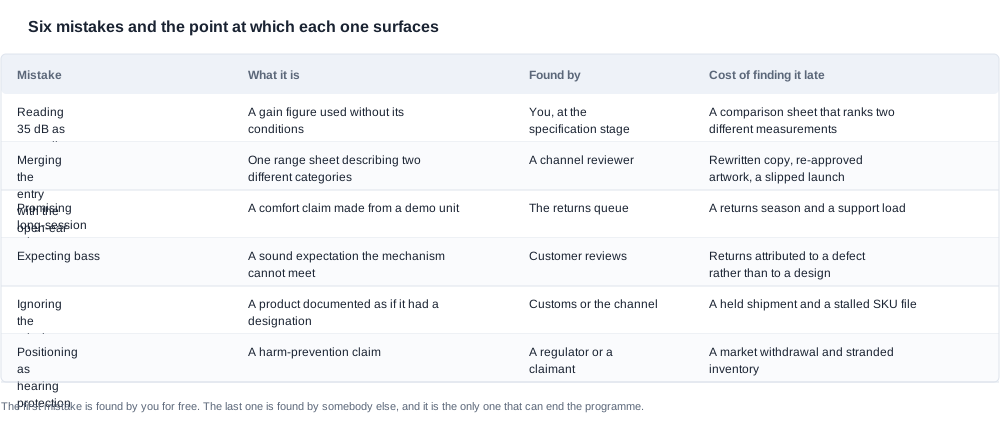
Six mistakes account for almost every bone conduction procurement case, and only two of them are technical. The rest are classification and documentation errors, which are cheap to avoid before artwork exists and expensive to unwind after the goods have shipped. What is unusual about the set is that it can be ordered by discovery moment rather than by severity, and that ordering is more useful than a severity list, because a mistake found at the specification stage costs an afternoon, while the same mistake found in the field costs a season.
Our catalogue carries one bone conduction entry, and it is the entry in the range most likely to be mishandled by a buyer. The published specification makes the exposure concrete. The entry publishes a 35 dB amplification gain, a 200 mAh cell, charging in two hours or less, roughly seven hours of rated runtime and Type-C charging. It publishes no model designation, and the certification status is not published to us. The 35 dB figure is the most aggressive published parameter anywhere in our catalogue, which is why a single word in a product description can move this product from one regulatory route to another.
The order of the six mistakes below runs from the one you will find in an afternoon at your own desk to the one that can only be found by somebody else, usually at the worst possible moment. Two of them are technical and four are classification or documentation, and that split is itself the argument: the technical ones are cheap to find, so the expensive ones are the ones nobody is looking for.
Who carries these mistakes, and what the range comparison shows
The reader is a procurement manager or a compliance lead who is somewhere between a demonstration and a purchase order. The thing they are usually carrying is a spreadsheet that mixes product categories together, because that is how a range gets planned, and it is the origin of the second mistake in this list.
The range comparison is the evidence for that, and it is worth making explicitly. The open-ear audio class in our range publishes model designations, cells from 55 mAh paired units up to 100 mAh, Bluetooth V5.3 and V5.4 variants, roughly six to eight hours of rated runtime, and surround audio, with the IP54 marking published only on the V06 and the S7. The bone conduction entry publishes five rows and no designation. Two products on the same range sheet, one of which arrives with its documentation attached and one of which does not, will inherit each other's language if they sit in the same row of the same spreadsheet.
The other thing a buyer carries is a deadline. The mistakes in this list divide sharply by whether the deadline allows a check. A buyer with a fortnight and a sample can find five of the six. A buyer with a fortnight and no sample can find three, and the remaining three are exactly the ones that surface later, in the channel, in the returns queue, or in a market that has already stopped selling the product.
The two technical mistakes, and why they are the cheap ones
Mistake one: reading 35 dB as an audio specification. The number is real, it is published, and it is the most aggressive figure in the catalogue. It is also a hearing-assistance figure, and a gain without a stated frequency range, input level and measurement point is a number rather than a specification. We do not publish the frequency range, the input level, the measurement location, or whether the value is typical or maximum. If a product page says "35 decibels of amplification" without qualification, the page has published a number that a reviewer with a sound level meter will test and find meaningless. The prevention is the same single question every time: what is the gain measured at what frequency, at what input, and at what point. The cost of asking it is an email. The cost of not asking it is a comparison sheet that ranks two different measurements, and a customer who measures the result.
Mistake three: promising long-session tolerance without testing heads. Bone conduction works through contact between the transducer and the skull, so the device has to press in the right place for the duration of use. Fit varies more across heads than it does for a conventional open-ear design, because the point of contact matters as well as the overall fit. If the claim is long-session tolerance, the test has to be a long session, on more than one head shape, with a note on what happens after the fourth hour. Our published position on comfort under extended wear is Not published, and it is not something we would guess at. The prevention is a day with a sample and a written note; the cost of skipping it is a returns season and a support load that lands on the team with the least capacity.
These two are the cheap ones, and the reason they are cheap is that they are answerable by asking and by testing. Neither requires a document, a signature, or a legal opinion. That is exactly why they tend to be deferred, and deferring them is what makes the other four expensive.

The four classification and documentation mistakes
Mistake two: merging the entry with the open-ear audio class. These products sit on the same shelf and come from the same supplier, so they get compared in the same spreadsheet. They are not comparable. An open-ear product competes on audio quality; a bone conduction product with a hearing-assistance figure competes in a different regulatory space entirely, and it cannot inherit the open-ear language. The consequence of merging them is usually that the bone conduction entry inherits phrases like "surround sound" or "for music and calls", which is inaccurate on the first count and, given the gain figure, potentially the thing that triggers a regulatory question on the second. The prevention is structural rather than editorial: keep the two mechanisms in separate tables, with separate claims and separate documentation, and never let one row carry both.
Mistake four: expecting bass. Air conduction is largely absent on this platform, because the transducer is not moving air through the ear canal. Bass is the first thing users notice missing, and users frequently conclude that the product is faulty when it is behaving correctly. This is a listing-copy problem rather than a product problem, and it is much cheaper to handle before launch than after the reviews arrive. The prevention is to set the expectation in three places — the listing, the packaging and the support script — and to say plainly what the mechanism does instead of what the user hopes for.
Mistake five: ignoring that the entry has no model number. This is not a technical question, it is an administrative one, and it is a genuine obstacle. The entry carries no formal SKU in the catalogue, which means a declaration of conformity cannot name a model string in the way it can for the rest of the range, a channel SKU file has a hole in it, and a quality claim in the field cannot be filed against anything. If bone conduction is material to your proposition, ask for a formally identified model before you build anything around it. The prevention is one question, asked before the purchase order rather than after it, and the cost of asking it late is a held shipment and a stalled onboarding.
Mistake six: positioning it as safety or hearing protection. This is the one that goes beyond marketing. A product positioned as personal hearing protection, or as a safety device for industrial environments, is making a claim about harm prevention. That claim requires its own testing and evidence, in the relevant jurisdiction, and we hold none of it. We will not supply copy that positions this product as hearing protection, and we would rather tell a buyer that plainly than let them discover it later. The gain figure on our entry is an amplification specification; it is not a protective rating, and the two must never be conflated. The prevention is to write the claim as a description of the mechanism, and to leave the protection claim out entirely.

Finding each mistake before it costs money
The six checks below are cheap, and the sequence is deliberate. Two of them are an email, one is a day with a sample, and three are decisions.
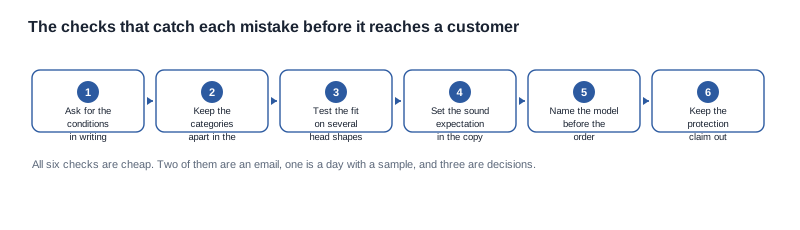
Ask for the conditions in writing. The gain, the runtime, the leakage, the transducer description, each with the measurement condition attached. A supplier who answers with prose and conditions is telling you they have measurements; one who answers with figures alone is telling you the figures came from a marketing sheet. This one check closes mistake one and half of mistake three.
Keep the categories apart in the range sheet. Separate tables, separate claims, separate documentation paths, and no row that describes both an open-ear product and this entry. This closes mistake two at the point where it is cheapest to close it.
Test the fit on several head shapes. Three is the minimum worth doing, with a written note on the contact position and on what changes after the fourth hour. This closes mistake three, and it is the only check on this list that cannot be done by asking.
Set the sound expectation in the copy. Say what the mechanism delivers — sound delivered through the skull, with the ear left open — rather than implying a sound quality the mechanism cannot produce. This closes mistake four, and it costs a paragraph rather than a decision.
Name the model before the order. Ask for the formal model string and put it on the order, the packaging and the documentation. This closes mistake five, and it is the only check that changes the schedule, because a string that has to be created is a development task with a date attached.
Keep the protection claim out. Decide once, in writing, that the product is not positioned as hearing protection, and remove the words from every asset. This closes mistake six, and it is the only one of the six that cannot be fixed after a claim is made.
Read the matrix with the table above and the pattern is clear. Three of the six are cheap and findable before launch. Two are expensive to detect but findable before launch if a protocol exists, which is a different thing: they need a test, not a question. One is expensive and can only be found in the field, which is why it is a decision rather than a check.
What a late discovery costs, and what we will not let you discover late
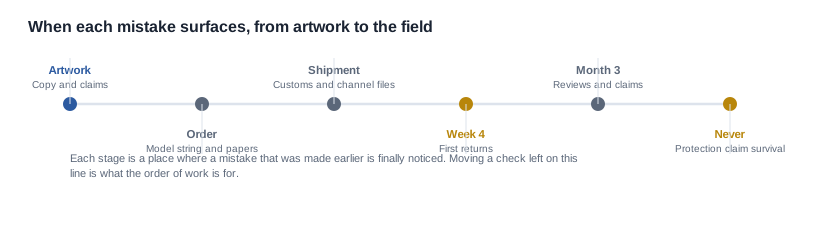
The costs are structured, and they escalate in a predictable order. An artwork rework costs one round per affected asset — the product page, the packaging, the instructions, the quick-start guide, the marketplace metadata — and each round is a week of the schedule. A documentation rework costs the reissue of every document that named the product, which in this category means a document that names a model string that may not exist. A held shipment costs the inventory in the customs queue and the launch date behind it. A returns season costs freight, handling, refunds and a support load, and it is usually attributed to a product fault rather than to a description, which means it repeats. A market withdrawal costs the inventory in that market and the credibility of the claim in the other markets.
What can be negotiated around those costs is the structure that reduces them. A claim freeze at an agreed stage as a condition of the tooling release. Packaging printed from an approved sentence rather than from a range-wide copy block, so it cannot drift. A pilot quantity sized so that a first finding arrives before the production commitment. The sample supplied or sold at cost, and the measurement unit bought rather than returned, which is the cheapest insurance available in this category. The artwork round count, since every round is a week. And the acceptance clause that ties the first shipment to criteria and to the approved wording, so that a divergence is a documented non-conformance rather than a judgement call.
What cannot be negotiated is the laboratory cost and queue, the marking of a radio product on the product itself, the nature of tooling, which is a one-off cost normally amortised over the first order, and the market determination, which belongs to your organisation. A supplier that offers to make that determination for you is offering something it is not positioned to give.
One more item belongs in the commercial conversation rather than in the mistake list, and it is the question that decides whether you should be running any of these checks at all. The criteria for choosing between the two audio routes in this range are not acoustic, they are documentary: if your channel can carry a general audio product with published model designations, published runtime conditions and published ingress markings, then the open-ear class answers the same need with a lower cost of entry, and the only reason to look at this entry is a requirement that the open-ear class cannot meet. The clearest such requirement is privacy, where the absence of radiated sound is the feature itself, and where nobody nearby hears what the wearer is listening to. If you cannot name a requirement that the open-ear class fails, the honest answer to which route to choose is the open-ear class, and no amount of careful checking on this entry will change that.
A worked scenario: a launch with one week of margin left
What follows is hypothetical. It is not a client project, and it is here to show the order of the steps rather than a result.
Assume a brand launching a private-listening product into two markets, with artwork approved and a container already booked. The buyer has six weeks. The supplier has been helpful and has provided a product page the brand intends to adapt.
Mistake one, caught. The product page says "35 decibels of amplification" as a headline. The buyer asks for the conditions and receives a frequency, an input level and a statement that the published figure is a maximum. The buyer rewrites the line as an amplification gain with its conditions, which costs an hour and removes the most likely source of a customer dispute.
Mistake two, not caught, and it is caught late. The range sheet for the launch puts the open-ear models and this entry in one table, and the copy block inherited "surround sound" and "for music and calls" from the open-ear models. The buyer cannot see the problem because the table reads normally. It surfaces when the channel reviewer flags the call claim, which is after artwork approval, and the cost is a rewritten copy, a re-approval round and a slipped launch.
Mistake three, caught with a protocol. The buyer runs the fit test on three head shapes and writes a note on the contact position and on what changed after the fourth hour. The note is not a comfort claim, it is a record, and it becomes part of the acceptance criteria for the first lot.
Mistake four, caught by a decision. The buyer writes the sound expectation into the listing, the packaging and the support script in one pass, so the three documents cannot disagree.
Mistake five, caught late and expensively. The model string is requested in the same email as everything else, and the answer is that none can be issued. The buyer turns it into a development task with a date, which pushes the launch rather than the documentation, and that is the correct order of damage.
Mistake six, caught by a decision before launch. The buyer removes every protection-adjacent word from the assets and does not revisit the question, because a claim made later is the one that costs a market.
Five of the six were caught. The one that was not — the category merge — cost a round and a week. That is the ratio the article is about: the mistakes that are found early cost almost nothing, and the mistake that is not looked for costs a week and a re-approval.
What we publish, and what we will not let you discover late
We publish the 35 dB figure because it is in our catalogue, along with the battery, the charge time, the runtime and the interface. We do not publish the conditions behind the gain, a model string for the entry, comfort data, the frequency response, the leakage figure, the microphone specification, the weight, the ingress rating, the customisation capability, or any certification position. We will not describe the product as a hearing aid, as hearing protection, or as a treatment for anything, and we will not supply copy that does.
What we will do is tell you which of the six mistakes in this article your programme is most likely to make. Send us the copy, the range sheet, the claim and the market list, and we will mark the sentences and the rows that carry an exposure, in the same way we marked the table above. The boundary that makes mistakes two and six expensive is set out under medical device boundary, the published specification is described under bone conduction audio technology, and the alternative architecture is under open-ear audio specifications.
Three things to send before the artwork is approved
Send the headline claim and the range sheet. We will tell you whether the same sentence can cover both an open-ear model and this entry, and it usually cannot.
Send the questions you have not yet asked. We will tell you which of them our own documentation can answer and which we cannot, so that nobody spends a week waiting for an answer that was never going to arrive.
Send the copy before it is approved, not after. The pre-publication check is free, and after publication it is an artwork round. The range is under bone conduction glasses range and the evaluation route is under sample evaluation.
Related reading
- The procurement version of the same warnings: bone conduction glasses checklist for procurement.
- Why the two categories must stay apart: open ear audio glasses buying mistakes to avoid.
Tell us the market and the claim you intend to make and we will tell you honestly whether we can support it.


