

Bone conduction glasses technology: what a buyer actually approves
A bone conduction procurement review is not a price comparison, and treating it as one is how a buyer ends up owning a decision that was never theirs to make. What the team is actually approving is a description: a claim, in a market, attached to a product that a customer will pay for. The price is the smallest part of it.
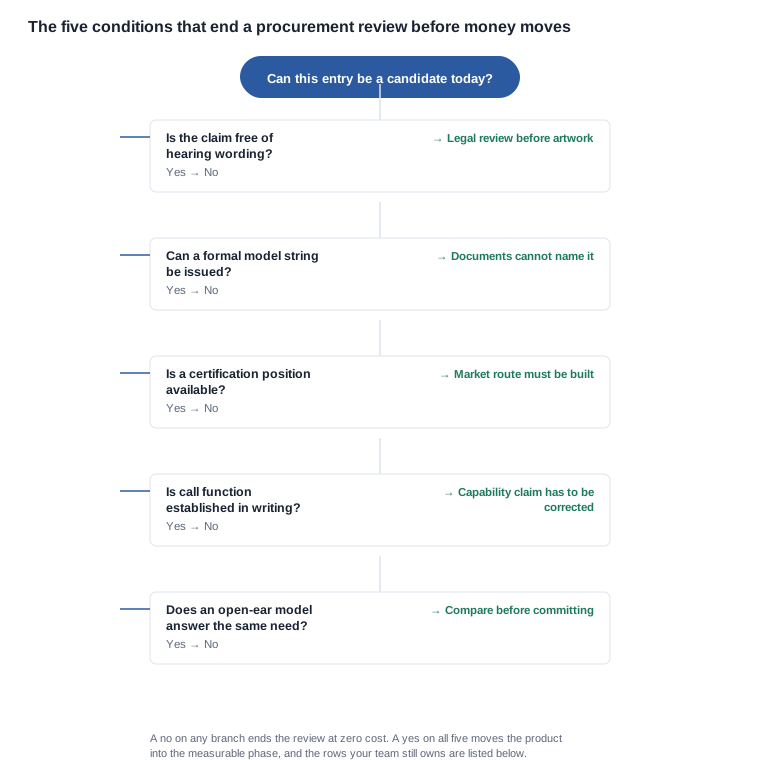
There are five conditions that end the review before any money moves, and three of them can be established with an email. If any one of them fails, the correct output of the review is a recorded no-go, not a conditional approval with a caveat attached to it. If all five clear, the entry is workable, and the published rows tell your team precisely which parts of it you will still have to measure yourself.
The five conditions are these. The claim must be free of hearing-related wording, or the legal function has to place the product in a medical route before anything else happens. A formal model string must be issuable, because a product without one cannot be named on a declaration of conformity, filed in a channel SKU list, or traced when a quality claim arrives. A certification position must exist for that string, or the route has to be built market by market. Call function must be established in writing, because a listing that implies calls and a product that does not take them is a returns event. And the open-ear models in our range must be compared against the same need, because in a lot of cases they answer it more cheaply and with better documentation.
The point of a checklist like this is not to produce a yes. It is to produce a decision record that survives the question "who approved this?" six months later.
The three roles in the room, and what each one can stop
Procurement is usually the convenor of this review, which is a bad place to be, because procurement is the role with the weakest veto and the longest exposure. The decision belongs across three functions — procurement, compliance, and the legal or regulatory function — with product and supplier quality contributing the two inputs that the other two cannot supply.
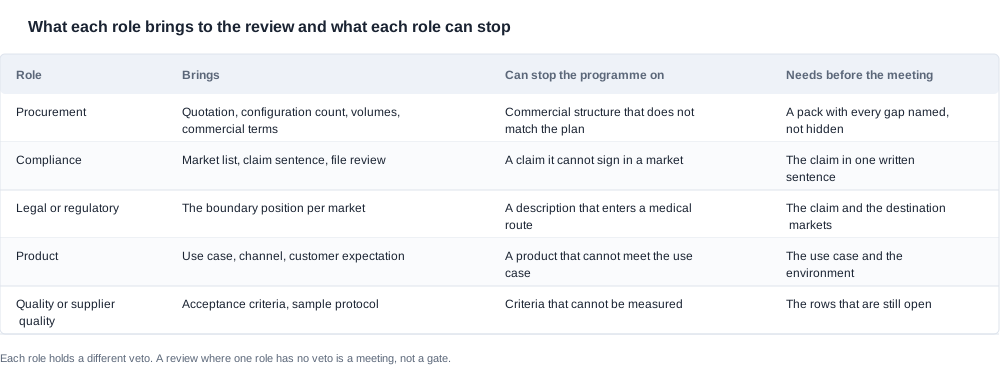
The internal approval chain mirrors the external supply chain, and that is not a coincidence. The factory holds material evidence: the radio test report references, the material declarations, the battery transport summary for the fitted cell, the radio qualification reference and the samples. The brand holds the market decision, the claim and the file. The gap between those two is where this review either succeeds or fails, and a review that does not assign every obligation to a named person leaves the gap open.
The commercial reality of this entry sharpens that. The catalogue publishes one bone conduction entry, and it publishes five rows for it: a 35 dB amplification gain, a 200 mAh cell, charging in two hours or less, roughly seven hours of rated runtime and Type-C charging. Everything else — the model string, the certification status, the transducer type and position, the frequency response, the leakage, the microphone specification, the frame weight, the ingress rating, the customisation capability and the runtime condition — is Not published. Compare that with the open-ear audio class in the same range, which publishes model designations, cells from 55 mAh paired units up to 100 mAh, Bluetooth V5.3 and V5.4 variants, roughly six to eight hours of rated runtime, and surround audio, with the IP54 marking published only on the V06 and the S7.
A procurement team reading that comparison should notice something important: the open-ear class arrives with its documentation attached and the bone conduction entry does not. The commercial consequence is that the open-ear option carries a lower total cost of entry, because the cost of documenting a product you cannot name is paid in your own team's time.

The five conditions, and the rows your team will still own
Condition one: the claim. Write it in one sentence and check it against the boundary. In the United States, over-the-counter hearing aids are defined under 21 CFR 800.30 in terms that centre on air conduction, so a bone conduction product sits outside that definition — which places it in a category each destination market has to name, rather than in an unregulated space. This is a matter for your legal function and it should be resolved before artwork exists, not before launch. The completion test: one written claim per market, with a named reviewer and a date.
Condition two: the model string. Ask for a formal designation. Our published position is that this entry carries none, and that is an administrative obstacle with real consequences: no declaration of conformity can name it, the range has a hole in it, and a quality claim in the field cannot be settled. The completion test: a model string on the quotation.
Condition three: the certification position. Ask for certificate numbers per model with the issuing body and the validity dates, and look them up. Where the answer is a gap — and for this entry the certification status is not published to us — the obligation to establish the route moves to your side of the line, and it should be put on the plan with a date rather than absorbed as a caveat. The completion test: a checkable number, or a written statement that none exists.
Condition four: call function. Establish it in writing, in either direction, before the listing is written. A smart glasses listing that groups the product with media and call bundles implies call capability by adjacency, and a customer who bought it for calls and cannot make them is a returns event and a support cost. The completion test: a written yes or no, on the record, before the copy is drafted.
Condition five: the comparison against the open-ear class. Ask what the requirement actually is before you assume bone conduction is the only answer. If the requirement is privacy — nobody nearby should hear the audio — then this is the design that answers it, because the output is a mechanical vibration rather than a sound wave. If the requirement is music quality, long-session use in an open environment, or the lowest landed cost, the open-ear class in the same range is the better buy, and a buyer who has not compared them is choosing on a demonstration rather than on a product. The completion test: a shortlist with both architectures on it and a reason for each.
Beyond the five conditions, these are the rows your team will own whether or not they are on the supplier's list. Gain conditions: the frequency range, the input level, the weighting, the measurement point, and whether the published 35 dB is typical or maximum. A gain figure without conditions is not a specification, and it cannot be used in a comparison table. Leakage: the figure, the distance and the gain setting, because leakage decides both whether the wearer can perceive the environment and whether people nearby are exposed. Runtime under load: the load, the gain setting and the radio state, because the published figure of roughly seven hours carries no stated condition. Contact geometry: where the transducer sits and whether the coupling is repeatable across head shapes, because in this technology the contact is part of the acoustic specification rather than a comfort issue. Ingress rating: read the marking and ask which configuration it covers, so that a sport model's IP54 is not inherited by a product that has none.
Building the pack that the review actually needs
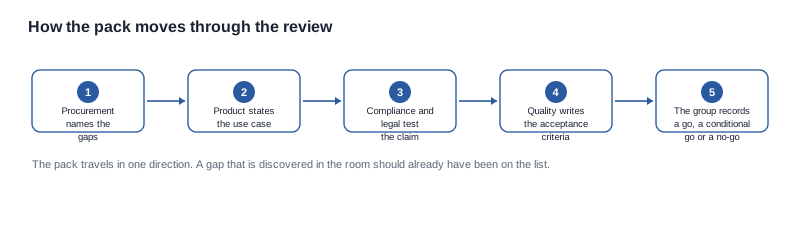
The review fails on preparation more often than on substance. The pack that works has one rule: every gap is named in the pack rather than discovered in the room. A gap that arrives as a surprise in the meeting is a gap that stops the meeting, and a meeting that stops for the wrong reason loses its authority for the next one.
The pack has four parts. The published position, quoted exactly, with the rows that are Not published listed as explicitly as the rows that are published — including the model string and the certification status, because their absence is the two most consequential facts in the pack. The five-condition assessment, with a yes or a no and a named owner for each condition, so that a no has a name attached to it. The claim sentence and the market list, written by the product team and tested by compliance, so that the review does not discuss adjectives. The acceptance criteria and the sample protocol, written by supplier quality before the sample is ordered, so that the measurement has pass criteria attached to it rather than an opinion attached to it.
Two things to ask the supplier before the review, in writing, and their answers will do most of the work: what is the model designation and what is the certification status for it, and what are the conditions behind the published gain and runtime figures. If the answers are complete, the review becomes a comparison of requirements against a documented product. If the answers are partial, the pack says so, and the review can decide on a partial answer instead of discovering the gap by surprise.
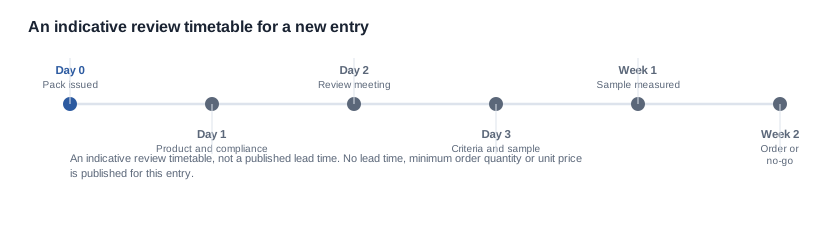
The timetable above is the review's own schedule, and it is worth noticing how much of it sits in front of the sample. The pack, the claim test, the five-condition assessment and the acceptance criteria all happen before anything is bought, because each of them can end the programme and each of them costs less than a sample does.
What a no-go costs, and what a conditional go requires
A pack assembled by one person gets challenged by one person. The symptom is a review that ends with the question "who checked the acoustic conditions?" and no answer. The root cause is that preparation was assigned to procurement as a task rather than distributed as an input. The prevention is a pack with a named contributor per section, and a review where each role reads its own section aloud.
Compliance is invited late. The symptom is a sign-off that arrives as a question about a sentence that is already on the packaging. The root cause is that the review was scheduled as a commercial meeting with compliance as an attendee. The prevention is to test the claim before the meeting, in writing, and to bring the answer rather than the question.
The price decides the meeting. The symptom is a recommendation that a product with no model string and no published certification status is good value. The root cause is that the comparison was between two unit prices for products with different documentation burdens. The prevention is to compare the total cost of entry, which includes the documentation work your own organisation has to do.
A no-go is not recorded. The symptom is the same programme returning to the next review with the same question. The root cause is that a no-go feels like a failed meeting rather than a successful one. The prevention is to record the no, the five conditions, the evidence and the date, and to send it to the supplier. A recorded no is an asset; an unrecorded no is a repeated cost.
A conditional go has no date on it. The symptom is a programme that stays conditional until it cannot move. The root cause is that a condition without an owner and a date is a wish. The prevention is to write every condition as a dated, owned action, and to re-review on a fixed date rather than when someone remembers.
What can be negotiated while the pack is being built
The programme lines are where the value is, and the pack is where you find them. Negotiate the number of configurations and the per-configuration minimum, because a product with no model string will need more of them. Negotiate whether documentation is issued per configuration rather than per family. Negotiate whether the sample is supplied, sold at cost, or included against the first order, and whether the measurement unit can be bought rather than returned. Negotiate the split between a pilot delivery and a production delivery with separate payment nodes, and whether the second node is tied to the documentation pack. Negotiate the artwork round count, and whether a claim freeze is a condition of the tooling release. Negotiate the acceptance window, so that a lot can be refused at inspection against written criteria rather than argued about after launch.
What cannot be negotiated is the laboratory cost and queue, the marking of a radio product on the product itself, the nature of tooling, which is a one-off cost normally amortised over the first order, and the market determination, which belongs to your organisation. A supplier offering to make that determination for you is offering something it is not positioned to give, and the document you end up with will not survive the question.
The clauses to write into the purchase order: the exact model designation on every document and on the packaging; a notice obligation and a reissue obligation before any change of transducer, housing geometry, cell or firmware; the acceptance criteria with their measurement method as an annex; a warranty set against an agreed failure criterion rather than a time period; and a statement of which party carries the market determination in each destination market.
A worked gate review
The sequence below is a constructed example rather than a client project, and it is written to show the order of the checks, not an outcome.
Assume a procurement team at a brand that sells audio products into three markets, evaluating a bone conduction entry alongside an open-ear model from the same range. The trigger is a channel request for a private-listening product, and the deadline is a buying season rather than a trade show, so the review has time to be thorough but not unlimited.
The pack. Procurement issues a pack with the published position, the ten open rows named, and the five conditions with an owner against each. Product writes the claim sentence and the use case: amplified listening for people who cannot use an earbud at work. Compliance tests the claim against the boundary and returns it with one condition — the description may not change without re-review. That condition becomes a clause in the order.
The five conditions. The claim clears. The model string comes back as available, which is the first surprise and it changes the schedule favourably. The certification position comes back as a written gap, so the market route goes onto the buyer's own plan with a date. Call function comes back as not established, which removes the media-and-calls bundle from the launch copy and saves a returns category. And the comparison against the open-ear class resolves to a genuine split: the open-ear model answers the workplace use case, and this entry answers the private-listening use case, so both stay on the shortlist with different channels.
The acceptance criteria. Supplier quality writes the criteria and the sample protocol before the sample is ordered: leakage at a stated distance, runtime at the shipping gain setting with the radio connected, contact position across three head shapes, and a pass criterion for each. Those criteria are attached to the purchase order as an annex, so the first lot can be refused at inspection.
The commercial step. The team negotiates a pilot delivery separate from the production delivery, ties the second payment node to the documentation pack, and sets the acceptance window on the pilot rather than on the whole order.
The record. The review outputs a conditional go with three dated actions, all of them owned by named people, and a review date. The record is circulated to the supplier, which removes the most common failure in the next cycle: the same programme arriving again with the same unresolved question.
The point of the walk-through is that the review did not decide anything about the product on the day. It decided what had to be established, by whom, and by when — and every one of those was cheap to establish.
What we will tell your team
We publish the 35 dB gain because it is in our catalogue, and we do not publish the conditions behind it, a model string for this entry, or any certification position for it. We will not describe the product as a hearing aid, and we will say plainly that the entry as it stands is not documented to the standard the rest of the range is.
What we will do for a procurement team is specific. We will say which of the five conditions our own documentation can answer today and which it cannot, and we will not estimate the ones we cannot. We will tell you which rows of the published specification can be cited in an RFQ without qualification, and which ones have to be qualified with a condition or left out. And we will tell you when the open-ear class is the better buy, because a shortlist that contains a comparison is worth more to you than a shortlist that contains a single entry with an attractive number on it.
The boundary that makes the first condition a condition is set out under medical device boundary, the published specification is described under bone conduction audio technology, and the alternative architecture is under open-ear audio specifications.
Three things to send your team
Send the five conditions with the open rows marked. We will tell you which are answerable from published material, which need a sample measurement, and which need a legal answer we cannot give on your behalf.
Send the claim sentence and the market list. We will tell you how many markets the same sentence can travel to without a separate review.
Send the use case in one line. If the requirement is privacy, this entry has a genuine role. If it is music, long-session open use, or the lowest landed cost, the open-ear class is the better buy and we will say so. The range is under bone conduction glasses range, and the evaluation route is under sample evaluation.
Related reading
- Why this category must not be merged with open-ear audio: open ear audio glasses buying mistakes to avoid.
- The two rows on this page that are genuinely documented: LC-105-1 against G07.
Tell us the market and the intended claim and we will tell you honestly whether this entry is something we can support.


