

A mixed order is not one order. It is several orders that happen to share a shipment, a packing list and a payment, and the price of the thing you receive is governed by the number of production setups inside it rather than by the number of units. That single distinction explains most of what follows, including the reason a mixed order is often more expensive than the single-configuration order it was meant to replace.
Buyers ask this for three different reasons, and the three have different answers. A brand assembling a retail range wants several models to arrive together so that one freight booking, one customs entry and one warehouse delivery cover the whole launch. A distributor trying to meet a supplier's minimum wants to add a second model to reach the threshold rather than order more of one. An e-commerce seller testing whether a category has legs wants a small, diverse first order rather than a large, repetitive one.
All three are legitimate. None of them is answered by the minimum order quantity alone, and all three of them run into the same mechanism: a configuration is a setup.
can i mix models in one order: the direct answer
Yes — a mixed order is a normal thing for a factory to run, and the constraint is not whether it can be done but what the mix does to the cost and to the paperwork. Three numbers govern it.
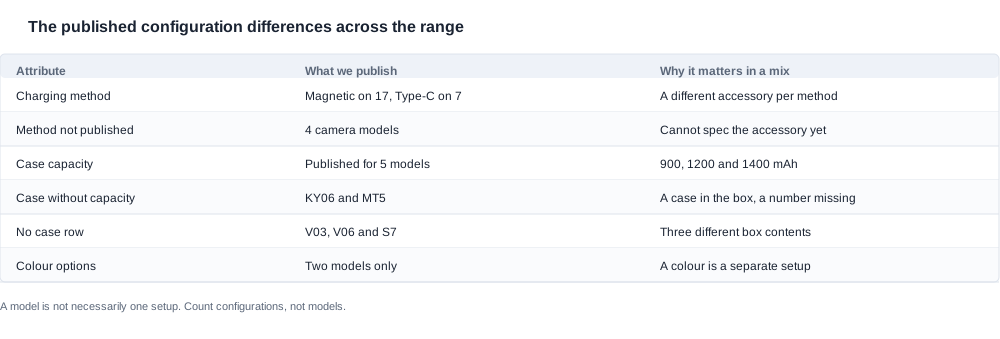
The configuration count. A model is not necessarily one setup. Our published data shows how much the setup space varies across the range we build: the charging method is magnetic on 17 models and Type-C on 7, and it is not published at all for the L1 Pro and the CY03, and the MT6 and the CY05. Charging case capacity is published for five models — the CY03 and the L1 Pro, and the CY05 — each at 1400 mAh, the L2 Utral at 900 or 1400 mAh, and the MT6 at 1200 mAh in a foldable case — while the KY06 and the MT5 have a case with no published capacity, the S7 and the V06, and the V03 have no case row at all, and the V03 Pro is explicitly a product with no case. Colour options are published for two models only: three on the V03 Pro and four on the V06. A buyer who thinks they are mixing five models may be running eight setups, and the eight is the number that sets the price.
The changeover count. Production runs one configuration to completion before the next begins. Each changeover costs time on the line and a verification step against the variant specification, and the risk that has to be managed is a mixed shipment — a box containing the wrong variant — which is the single most expensive failure in this business and the one a brand will pay for out of its own margin.
The file count. Every model in the mix needs its own documentation. Our catalogue publishes no per-model certification row, so the conformity evidence for each model has to be requested in writing, and a mix multiplies the number of files, the number of model designations that appear on the documents, and the number of configurations the packaging artwork has to distinguish.
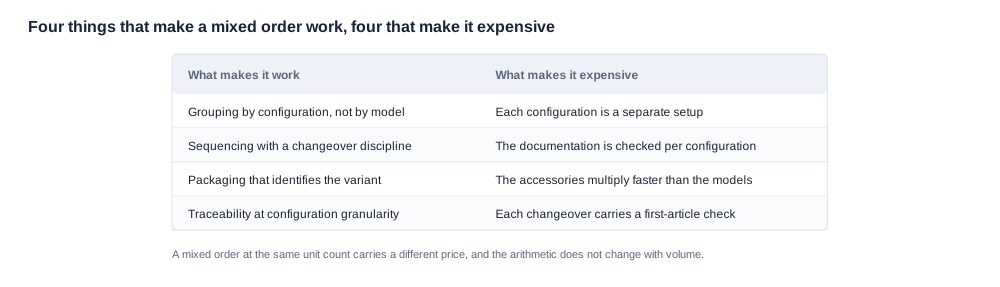
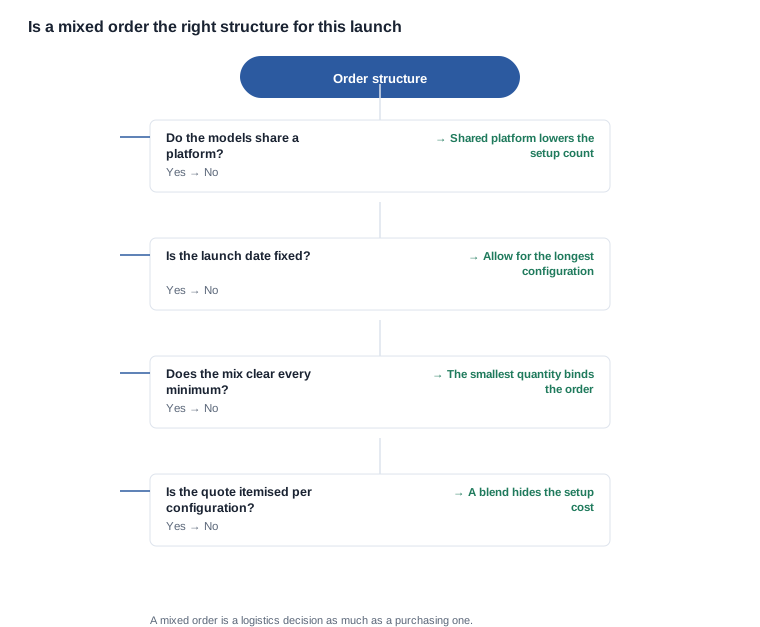
The short version for a buyer: a mixed order works when the models share a platform, when the sequence is planned rather than improvised, when the packaging identifies the variant unambiguously, and when traceability is recorded per configuration rather than per shipment. Each of those four is a precondition, not a nice-to-have, and a supplier that cannot describe how they meet them is a supplier that has not run one recently.
It is worth being precise about what "one order" means, because buyers use the phrase to mean three different things and the factory hears only one of them. It can mean one purchase order and one payment — administrative convenience. It can mean one shipment, one packing list and one customs entry — which is the version most distributors actually want, because it collapses freight, duty and handling. And it can mean one production run, which is the version nobody gets, because a run that changes configuration is a changeover and a changeover is a cost. A good supplier will ask which of the three you mean before quoting, and a buyer who has not decided will get a quote built on the wrong one.
There is a fourth possibility worth naming for anyone building a range: the models may share a shipment without sharing a purchase order. Some brands place one order per model with a distributor and consolidate at the distributor's warehouse. That arrangement removes the production risk of a mixed order from the factory's side entirely, and moves the variant-identification problem to the distributor, where the goods have to be received, stored and picked separately anyway. It is a legitimate structure, and it is often the better one for a first launch, because the failure modes it removes are the ones that cost money at the worst possible moment.

What has to be true before a mixed order works
A shared platform and shared components. The models in the mix should share a chassis family, a battery approach, a charging approach where possible, and a packaging shell. Our own range makes this a real constraint rather than a stylistic preference: the audio range alone carries eight models — the D11 and the K02, the LC-105-1 and the LC-105-2, the G07 and the K01, and the D12 and the YK12 — while the camera range carries eleven with 8 megapixel sensors on eight of them and 13 megapixel on three, the L1 Pro and the L2 Utral, and the S7. Mixing across those ranges means mixing charge circuits, battery formats and case designs in the same shipment, which is possible and which multiplies the number of checks.
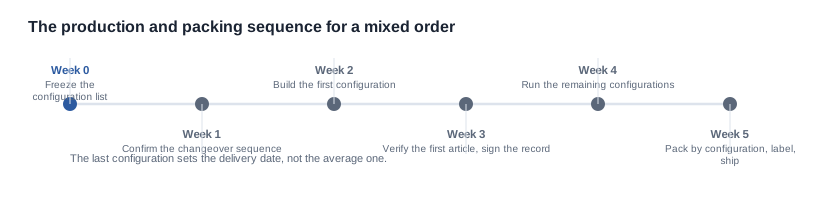
A planned sequence with a discipline attached. One configuration to completion, then a changeover, then the next. At each changeover a first-article verification against the variant specification, and a signed changeover record. The record is the part that matters commercially, because it is what lets a factory and a buyer agree later that a specific shipment did not mix variants.
Packaging that identifies the variant without ambiguity. The box, the insert, the label and the barcode all have to point at the same variant. The catalogue is a good illustration of why naming discipline matters here: within a single range we publish a model designation that reads as an abbreviation, and a buyer who assumes the short form is the long form will end up with documentation for a model that does not exist. Naming in a mixed order is a document-control problem, not a naming problem.
Traceability at configuration granularity. A batch identifier per configuration rather than per shipment, so that a claim on one variant traces back to the run that produced it. With eleven camera models sharing battery configurations in the 220 to 290 mAh range, and with most of them sharing a published runtime band of about five to eight hours, a shipment-level batch record is not enough to tell you which units to pull.
One shipping plan, one documentation set, one point of contact. A mixed order with two packing lists and two sets of papers is two orders, and it will be handled as two orders no matter how it was intended.
Component supply that can actually cover the mix. A mixed order pulls more component formats into one purchase than a concentrated order does, and the formats are not close to each other. Batteries published for the camera models run from 220 to 290 mAh, while the sport range includes a model built around a pair of 70 mAh cells — the YKC02, which is a sport model and not an audio one, and which is exactly the kind of mix-up that happens when a buyer works from a model name rather than from the range structure. The charging method also splits: 17 models magnetic, 7 over Type-C, and 4 where it is not published at all. A factory can only quote a delivery date for a mix if it can say how many component formats it is holding and where the constraint sits, and that question is answered at the quotation stage rather than at the production stage.
A sampling plan that matches the mix. Quality sampling in a mixed order is not proportional to the units. Each configuration needs a first article, and each configuration carries its own risk of a variant mismatch, even though the configuration with the smallest quantity is usually the one that gets less attention. Ask how many checks the plan contains and what happens when a check fails, because a failure discovered at the changeover costs a line stop while a failure discovered at the packing table costs a shipment.
Where the cost of a mixed order actually moves
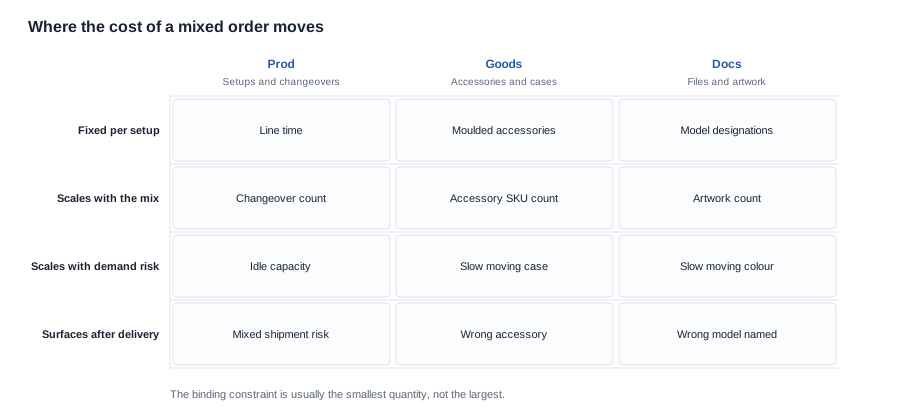
Setup, spread across fewer units. This is the arithmetic that decides most mixed-order quotes. A setup has a fixed cost and a fixed time, and when it is shared across 200 units it is nearly invisible; when it is shared across 60, it is not. A buyer who compares a mixed order against a single-configuration order at the same total unit count is comparing different setup counts and should expect the unit price of the mix to be higher. The question to ask is not whether the mixed price is lower, but what the setup cost is and how it is distributed.
Accessories, which multiply faster than the models. A magnetic-charging model needs a pad, a Type-C model needs a cable, and a model whose charging method is not published needs an answer before its accessory can be specified at all. On top of that, the case options are separate moulded components: our published case capacities run at 900, 1200 and 1400 mAh, the KY06 and the MT5 have a case of unstated capacity, three camera models have no case row, and one camera model is explicitly a no-case product. A mix therefore carries an accessory count that a buyer who counted models would not have predicted.
Documentation, per configuration. Each variant named in the mix needs its own file, its own model designation on the documents and its own answer to the conformity question, which for us means a written request rather than a catalogue lookup.
Packaging and artwork, per model and per market. A retail launch for four models in two markets is eight artworks, and the operator details on the packaging have to be right for each market rather than copied across.
Forecasting error, multiplied. A single-model order has one forecast. A mix has one per configuration, and the configuration with the least demand is the one that sits. Sitting stock is not a neutral cost: it is cash, it is warehouse space, and at the end of a season it becomes a discount or a write-down.
After-sales, at a different granularity. A defect traced to a component — a cell, a charging contact, a hinge — has to be pulled from the pool of units that share that configuration, and the pool is the mix. If the fault is a battery issue in a camera model, you are looking at eleven models, and only two of them publish an ingress marking at all, so a water-related claim has to be assessed against models whose ingress position is simply not published.
The effective minimum, which is not the same as the minimum. Minimum order quantity, unit price, lead time, warranty and tooling cost are all not published on our side and are quoted per project, per configuration. A mix does not have one effective minimum; it has one per configuration, and the binding constraint is the largest of them. A buyer who treats a mixed order as a way of "reaching the minimum" is often finding that the mixed order reaches a higher effective minimum than the concentrated order would have done.
The aftersales tail, which starts after the invoice. Every model in the mix is a product you will still be supporting in eighteen months. A model that sells slowly in the mix is the model that will be discontinued first, and the discontinuation does not end the support obligation — it converts it into a spares question, with a case size, a cell format and a firmware version to hold. That is an inventory decision disguised as a purchasing decision, and it is the one people most often forget when the mix looks attractive on the quotation.
The reorder problem. A mixed order is usually followed by a reorder, and the reorder has to reproduce the same configurations. If any part of the mix was built to a one-off — a bespoke colour, a special packaging run, a configuration that happens to be near a minimum — then the second order is not the first order with different quantities, it is a new order with new economics. Ask whether the configuration is repeatable, and ask what changes about the price and the lead time on the second run. The due diligence question here is not "can this be made" but "can this be made again, the same way, at the same terms".


The questions to ask before you commit to a mixed order
- How many distinct configurations are in this order, and how many changeovers does it take? The configuration count, not the model count.
- What is the unit price for this mix at this quantity, itemised per configuration? A single blended figure hides exactly the number you need to see.
- What is the effective minimum per configuration, and which one binds the order?
- Which model designations appear on the documents for each configuration, and are they the designations that will be printed on the product?
- What is the traceability granularity — per configuration or per shipment — and what does the changeover record contain?
- How many accessory SKUs does this mix carry, and which models have a case, and which do not?
- What is the production lead time for the mix, and does the longest configuration set the date for the whole shipment?
- Which conformity documents exist per model in the mix, and which of them do you still need to request?
The eighth question is the one that catches people, because it is the only one whose answer is genuinely open before you ask. Our catalogue publishes no per-model certification row at all, and the export certification page is a picture page showing ten patent certificate images with no conformity mapping attached to them. So for a mixed order, the file count is a real cost in time and money, and it should be scoped before the purchase order rather than discovered during it.
The shortlist criteria that come out of these questions are about transparency of the quote. A supplier who can produce a configuration count, a changeover count, an itemised price and a document list without going back to engineering is a supplier who has run mixed orders and priced them. A supplier who responds to "how many setups is this" with a unit price is a supplier who has not counted.

When a mixed order is being proposed as a cheaper option
Sometimes a mix really is cheaper, and the reason is worth finding out before you accept it. The legitimate reasons are usually logistical: one shipment instead of several, one customs entry instead of several, one warehouse delivery and one set of handling charges, and a consolidation of packaging materials. Those savings are real and they are the reason a distributor will tell you a mix is better value.
The illegitimate reason is usually arithmetic. A blended unit price given before the split exists is not a price; it is an average of prices that have not been calculated. If you cannot get the mix itemised per configuration, you cannot tell whether it is cheaper, and you cannot tell whether the binding constraint is the configuration with the smallest quantity in it.
There are three specific checks worth making when a mixed order is presented as the economical option.
Compare landed cost, not unit price. Freight, duty, customs handling and inventory carrying are per shipment and per SKU, not per unit. A mix can carry a higher unit price and a lower total landed cost, or the reverse. Both are legitimate outcomes and only one of them is visible from the unit price.
Check the effective minimum against the concentrated alternative. If the mix has five configurations and the minimum applies to each, the order has to clear five thresholds. Sometimes a concentrated order clears one threshold comfortably and a mix has to be padded with units nobody wants. That is the most common way a proposed saving turns into a loss.
Check the changeover cost as a schedule risk. A mix takes longer on the line than a concentrated order of the same unit count, and the binding date is the last configuration, not the average one. If the launch date is fixed, that delay is usually worth more than the freight saving.
A worked example makes the arithmetic concrete, and it is worth doing this yourself before accepting anybody's version of it. Take a concentrated order of 1,000 units of a single configuration, and a mixed order of 500 units of that same configuration plus 250 of a second and 250 of a third. The mixed order carries three setups rather than one, spread across 1,000 units rather than 1,000 units in one setup, and it carries three document sets, three accessory groups and at least two changeovers. Against that, it collapses one shipment into one shipment — which, if you were only buying one model anyway, saves nothing at all. The mixed order wins when the alternative was two or three separate shipments with separate freight, duty and handling, and it loses when the alternative was one shipment of a single configuration. Most buyers who assume a mix is cheaper are actually comparing against the first case and pricing the second one.
That is the whole trade-off in one line, and it is the line to write down before you talk to anyone: a mixed order is a consolidation decision. It is worth making when you were going to ship more than once anyway, and it is rarely worth making when you were going to ship once.
What we can quote, and what we will not
We will quote a mixed order with the configurations itemised separately, so that the setup cost is visible rather than buried inside a blended unit price. We will say plainly when a mixed order carries a higher cost than a concentrated one, since the setup work is charged to each configuration and that arithmetic does not change with the size of the order.
To be concrete about what appears on a quotation: a unit price, an effective minimum and a production lead time each appear per configuration, once the split exists. A blended figure offered before the split exists would be arithmetic with no basis, so we do not offer one. The same applies to the published-versus-unpublished distinction: the charging method, the charging case, the charge time, the camera resolution and the ingress marking are all published for some models and not for others, and a mixed order makes that variation more visible rather than less.
The platforms a mix is built from are described under smart glasses OEM ready platforms, the wholesale treatment of mixed orders is under wholesale mixed orders, the question of whether the minimum applies per model or per order is answered in is MOQ per model or per order, and the scope of the OEM service is set out under smart glasses OEM service scope.
Send the models, the configurations, the quantities per configuration and the destination, and we will come back with an itemised figure, the configuration count and the changeover count.
Related reading
- Smart Glasses OEM ready platforms
- Wholesale mixed orders
- Is MOQ per model or per order
- Smart Glasses OEM service scope
Send the models, configurations, quantities and destination and we will itemise it.


