

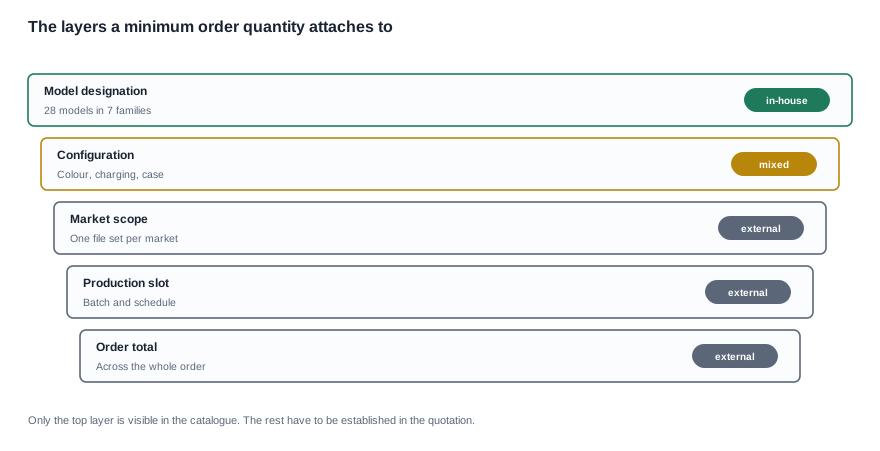
"Is MOQ per model or per order" is a question that gets answered with a number, and the number is almost never the thing the buyer needed. A minimum order quantity in this category is not one figure. It is the product of four separate thresholds that happen to be discussed together: the threshold on a model designation, the threshold on a configuration of that model, the threshold on the market the units will be shipped into, and the threshold on the production slot those units occupy. A supplier quoting a single number has usually quoted one of the four and has left the other three implied. The useful answer to this question is therefore structural rather than numerical, and it consists of knowing which threshold a given figure belongs to before it is used in a comparison.
There is a second reason the question needs decomposing rather than answering. The catalogue for this range publishes no minimum order quantity at all, and no unit price, no lead time, no production capacity figure and no warranty period either. Those omissions are deliberate and they are consistent with how a first production run works, but they mean the buyer cannot build a total cost model from published data before a quotation is requested. What the catalogue does publish is the range structure — twenty-eight models across seven families, three charging methods, three charging-case states, colour options on two models — and that structure is what determines how many thresholds an order is actually clearing.
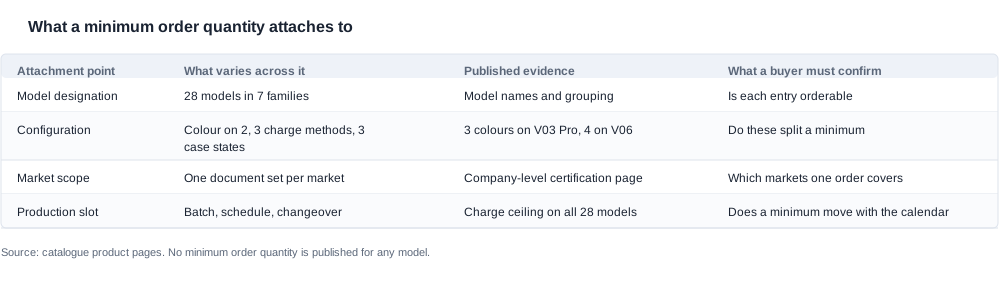
is moq per model or per order: what the minimum actually attaches to
The four attachment points each behave differently, and it is worth stating them one at a time because they are frequently conflated.
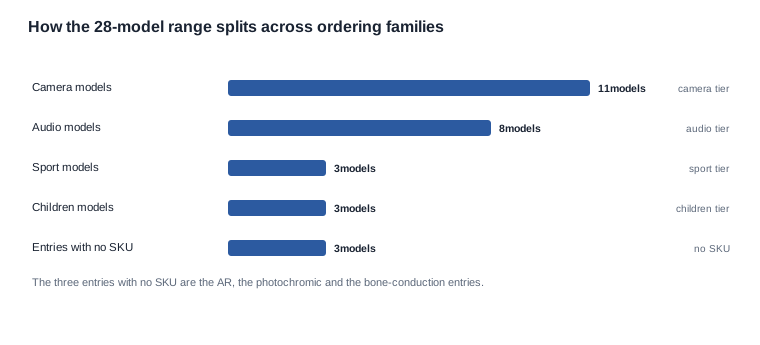
The model designation. This is the first threshold and usually the largest, because a model designation carries its own tooling, its own firmware build, its own packaging artwork, its own accessory set and its own document set. Twenty-eight models are published across seven families: eleven camera models, eight audio models, three sport models, three children's models, and three entries that carry no stock keeping unit at all — the AR entry, the photochromic entry and the bone-conduction entry. That last group is worth pausing on, because an entry without a stock keeping unit cannot be ordered as a model in the way the others can, and a buyer who includes one in an order discussion is asking a question the catalogue cannot answer.
The configuration. This is the threshold that most often turns out to be the binding one, because it multiplies. Colour is published for two models only, with three options on the V03 Pro and four on the V06, and the absence of a published colour count for the other twenty-six is not an absence of colour variants — it is an absence of information about them. The charging method splits the range three ways, with magnetic on seventeen models, Type-C on seven and no charging method row on four, which are the L1 Pro and the MT6, and the CY03 and the CY05. The charging case splits it three ways again: a published capacity on five camera models at 1400 mAh for the CY05, the CY03 and the L1 Pro, at 900 and 1400 mAh for the L2 Utral, and at 1200 mAh for the folding case on the MT6; a case shown without a figure on the KY06 and the MT5; and no charging-case row at all for the V06, the V03 Pro and the V03, and the S7. Whether a colour, a charging method or a case counts as a separate configuration is exactly the kind of thing a buyer must put in writing rather than infer.
The market scope. This is the threshold that is easiest to overlook because it does not appear on the model at all. Conformity documentation is issued against a product and a market, and the catalogue carries a company-level export certification page whose content is images rather than text — ten patent certificate images, eight appearance-design patents and two utility-model patents — while the catalogue text contains no reference to CE, FCC or RoHS and no per-model certification row anywhere. So a single model shipped to two destinations carries two document scopes, and the scope is part of what the minimum has to cover.
The production slot. This is the threshold that moves with the calendar rather than with the product, and it is the one most often mistaken for a capacity statement. The catalogue publishes a charge time for all twenty-eight models — two hours or less on twenty-six, about one hour on the D17 and the ZH12 — and a runtime band for all twenty-eight, but it publishes no lead time and no capacity. A minimum that is really a slot constraint will move between two quotations in the same quarter, and the number a buyer remembers from the first quotation will not be the number in the second.
The four attachment points side by side
| Attachment point | What varies across it | Published evidence | What a buyer must confirm |
|---|---|---|---|
| Model designation | 28 models in 7 families | Model names and family grouping | Whether each entry is separately orderable |
| Configuration | Colour on 2 models, 3 charging methods, 3 case states | 3 colours on V03 Pro, 4 on V06 | Whether colour, charging and case split a minimum |
| Market scope | One document set per destination market | Company-level export certification image page | Which markets one order covers |
| Production slot | Batch, schedule and changeover | Charge ceiling on all 28 models | Whether a minimum moves with the calendar |
The third row of that table is the one where a buyer is most likely to be working from incomplete information, and the incompleteness is structural. Three of the range entries carry no stock keeping unit, so they have no configuration set in the ordinary sense. The L2 Utral publishes two variant names and two case capacities without stating which capacity belongs to which name, so the configuration count for that model cannot be derived from the page. The A05 and the A06 publish identical rows, and the internal product record lists the difference between those two as an open item, which means a buyer cannot assume that two separately named models are two separately orderable configurations either.
What the catalogue does not publish, and why that matters
Four commercial figures are absent from the range entirely: minimum order quantity, unit price, production lead time and warranty period. Two more absences are easy to overlook. The catalogue publishes no production capacity figure, so a buyer cannot convert a minimum into a share of anything. And it publishes no per-model certification row, no certificate number and no test report number, which means the document scope attached to any order has to be established in conversation before it can be counted.
The reason these figures are absent is worth understanding, because it changes what a buyer should expect from a supplier and what a supplier should expect to be asked for. A minimum is a function of configuration, tooling, packaging treatment and destination market, which means more than one figure is internally in circulation for different scenarios. Publishing one of them without the scenario attached would be publishing a number that could not be honoured in the case it was most needed. The same applies to a lead time, which is a function of the order size and of the current schedule, and to a warranty period, which is a function of the market and of the aftersales model the supplier is running.
The practical consequence is that a buyer comparing two quotations in this category is very often comparing two different objects. A minimum quoted for the standard configuration of a model against an existing tooling set is not comparable with a minimum quoted for a new configuration with new packaging artwork. A minimum quoted for one destination market is not comparable with a minimum quoted for three, because the document scope changes with it. And a minimum quoted as an opening production run is not comparable with a restock threshold for a build that already exists. When two numbers differ, the first question is not which is lower. It is what each one assumes, and the assumptions are not written on the quotation.
It is worth adding what a buyer can do with the structural information the catalogue does publish, because there is more of it than the four absences suggest. The range publishes twenty-eight models across seven families, which is a structure a buyer can navigate: eleven camera models with published resolution classes, eight audio models with published Bluetooth versions, three sport models, three children's models, and three entries without a stock keeping unit. Each family carries a different configuration surface, and therefore a different number of likely configurations per model. The camera family is the widest, because colour, charging method and charging case each vary inside it. The audio family is narrower on colour and wider on cell format, with published cells of 55 mAh × 2 on the LC-105-1 and the G07, and the YK12 and the LC-105-2, 90 mAh × 2 on the K01 and the K02, and 100 mAh on the D11 and the D12. The three entries with no stock keeping unit are the widest of all, because nothing about their orderability is published. A buyer who builds a shortlist by family first, and then counts configurations inside each family, arrives at a much better estimate of how many thresholds an order is clearing than a buyer working model by model.
Reading a quotation through the decision tree
A quotation that carries a single minimum figure can be read properly if the buyer asks four questions in order and treats the answers as the actual content of the quote. The tree below is the order that works, because each answer narrows the next.
- Is this figure per model or per order? The question is deliberately blunt, and it is asked first because the answer may be "per configuration per market per slot", which is a third thing that both readings in the original question fail to capture. A supplier who answers with a configuration rather than a unit is giving a more precise answer, not a more evasive one.
- Does changing colour, charging method or case split this figure? If the answer is yes, then the minimum is per configuration and the buyer's real order has to be constructed in configurations rather than in units. The published rows in this range show how easily that happens: the V03 Pro alone carries three published colours, and the V06 carries four.
- Does adding a second destination market split this figure? If the answer is yes, the second market's document scope has to be counted and the first market's does not carry over. This is where a buyer discovers that the order was priced for one market and is being deployed into three.
- What does this figure assume about the schedule? A minimum that assumes an open production slot and a minimum that assumes a booked one are the same number with different consequences. This is the question that reveals whether the quoted figure is a product threshold or a calendar threshold, and the two behave very differently when the second quotation arrives.
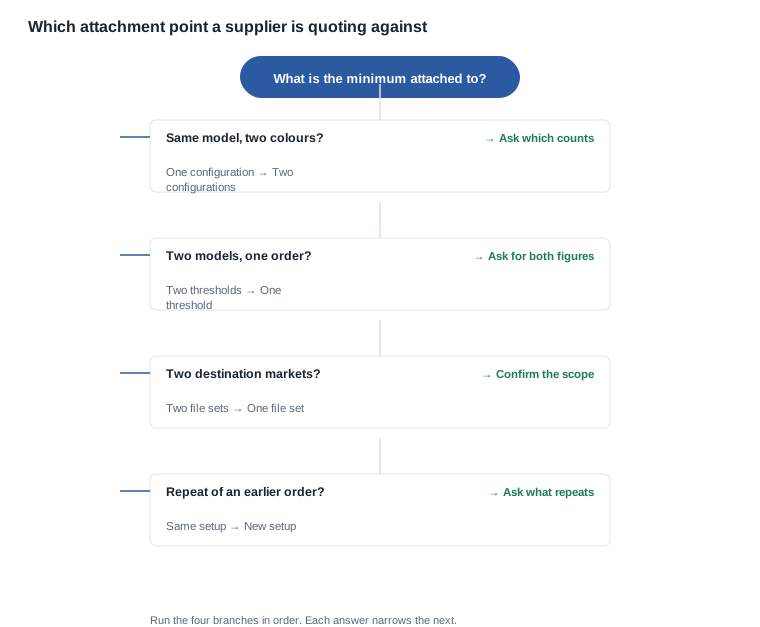
The tree is worth running against a real quotation because it exposes a common failure mode: a buyer asks question one, receives a number, and stops. The number is then used in a comparison against another supplier's number, and the comparison is meaningless because the second number was an answer to question four. Running the four questions takes minutes and converts a number into a specification.

The four questions that turn a minimum into a written term
There is a difference between a minimum that has been asked about and a minimum that has been agreed, and the difference is entirely in what appears in the contract. A term is written when it names the object it attaches to, the market it covers, the schedule it assumes, and what happens when it is not met. In practice that is four sentences.
The first sentence fixes the object: the minimum applies to the listed configuration of the named model, in the named colour, with the named charging method and case. The second fixes the market: the minimum applies to the named destination or destinations, and the document scope for each is stated separately. The third fixes the schedule assumption: the minimum applies to the quoted production window, and the buyer is told whether a change in that window changes the figure. The fourth fixes the remedy: what happens to the unit price, the lead time and the terms if the order is placed below the minimum, if a colour is dropped, if a market is added, or if the order is split across two production windows.
Each of those four sentences closes a specific ambiguity that the catalogue itself cannot close. The first closes the configuration multiplicity created by three charging methods, three case states and unpublished colour counts on twenty-six models. The second closes the document-scope gap created by a company-level certification page with no per-model row. The third closes the schedule gap created by the absence of any published lead time. The fourth closes the arithmetic gap created by the absence of any published unit price, because without a stated remedy the buyer cannot price the risk of being below the threshold.
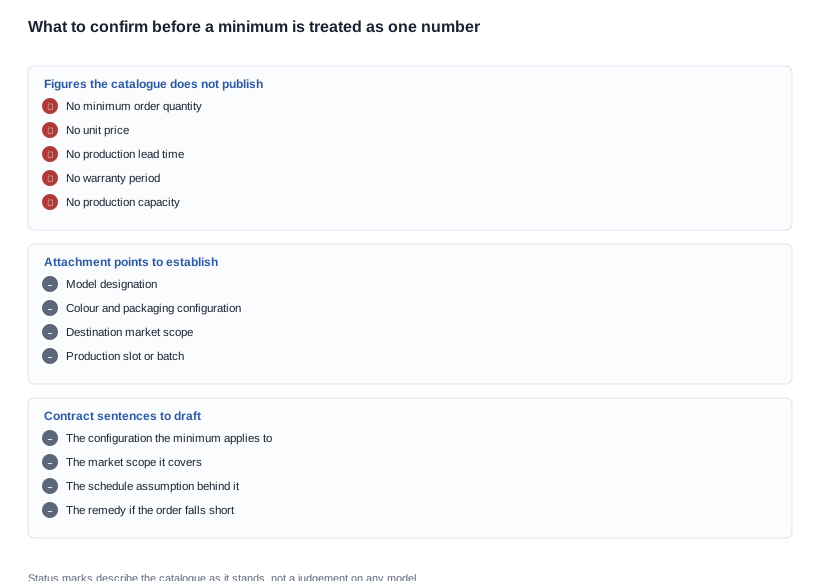
There is a checklist version of the four contract sentences, and it is the form most procurement teams actually use. For each threshold, the buyer needs the object it applies to, the market scope it covers, the schedule assumption behind it, and the remedy when it is not met. For the model threshold, that means the named model and the named configuration. For the configuration threshold, it means the colour, the charging method and the case, with the V03 Pro and the V06 offering the published options and the other twenty-six requiring a question. For the market threshold, it means the destination list and the document scope attached to each one. For the schedule threshold, it means the production window and what happens to the figure when the window moves. A due diligence review that works through this checklist will usually discover that one of the four thresholds was never quoted at all, which is a considerably better outcome than discovering it after the first purchase order has been placed.
is moq per model or per order: how to close it in the contract
The written answer has three parts.
What the catalogue publishes is the range structure: twenty-eight models across seven families, three charging methods across the range with four models carrying no charging method row, three charging-case states among the eleven camera models, colour options on two models only, a company-level export certification page carrying ten patent certificate images with no per-model certification row, and AI feature entries on twenty of the twenty-eight models.
What it does not publish is a minimum order quantity, a unit price, a lead time, a production capacity figure, a warranty period, a certificate number or a test report number. We do not publish a minimum order quantity for any model, and the reason is that the figure in circulation internally depends on configuration, tooling, packaging treatment and destination market — publishing one without those conditions attached would be publishing a number we could not honour in the case it mattered.
What to ask is the four-question sequence above, followed by the four contract sentences. For a buyer who wants the mechanics of a mixed order rather than a single model, can I mix models to meet MOQ works through what changes when a second configuration enters the order. The MOQ and lead time page carries the general mechanics, customisation and MOQ impact covers the effect of customisation on the threshold, how long until the sample arrives covers the sample stage that precedes the decision, and does certification add to lead time covers the market-scope question specifically.
The total cost of getting this wrong is worth stating plainly, because it is the number that decides whether the negotiation is worth the effort. A buyer who treats a minimum as a single figure and is wrong about its attachment point commits to an order below a threshold, accepts a configuration surcharge at the point of production rather than at the point of quotation, discovers at the document stage that the market scope was never included, or takes a slot that cannot be met. Any one of those four outcomes is recoverable and none of them is cheap. A buyer who treats the minimum as four conditions and asks for all four has spent perhaps an hour of correspondence and has removed the risk entirely. That is the comparison worth making, and it is the reason the questions to ask are worth more than the numbers they return.
The position worth holding throughout the negotiation is that the minimum is not a number but a set of conditions, and that a quotation which states its conditions is more useful than one which states a lower figure without them. A buyer who can reproduce the conditions can predict the threshold for a configuration they have not ordered yet. A buyer who has only the figure cannot, and will meet the same threshold as an obstacle at every reorder.
Related reading
- What changes when a second configuration enters an order: can I mix models to meet MOQ.
- How customisation moves the threshold: customisation and MOQ impact.
- The stage before the order is placed: how long until the sample arrives.
- Market scope and the schedule: does certification add to lead time.
- Building the requirement brief the quotation will be measured against: smart glasses OEM requirements checklist.
Ask which of the four thresholds a figure belongs to, and the number stops being an obstacle and becomes a condition.


