

A mixed order is the normal case in smart glasses wholesale, and it is the case most often quoted badly. Two quotations can describe the same basket of models and differ so much that neither can be compared, because one quotes the basket as a bundle and the other quotes it as a set of lines. How mixed orders are costed depends on which of those two the supplier chose to write down, and a buyer reading the document often cannot tell which one they are holding. What a buyer can do is force the quotation into a structure that separates the costs belonging to the whole order from the costs belonging to a single model, and then compare two suppliers on the same structure.
Every number in this article is a structure rather than a figure. CYNRIN does not publish unit rates, minimum order quantities or lead times for this range, so nothing here quotes them; what follows is how a mixed order should be decomposed, what each part of the decomposition depends on, and the questions that force a supplier to expose the same structure. The point is to produce a basket whose cost can be explained line by line, because an unexplainable basket cannot be re-quoted, cannot be re-ordered and cannot be defended to a channel partner.
A mixed order also changes who does the work inside the quotation. A single-model order can be quoted from a rate card, because every line in the order has the same structure and the only variable is quantity. A mixed order cannot, and so somebody has to construct the basket line by line, usually inside the supplier's commercial team, where the assumptions live. Those assumptions are rarely visible from the outside. A buyer who wants them has to ask for the basket to be built in the open with each assumption attached to a line, because the alternative is accepting a number whose construction nobody can explain, including to the people who built it.
The catalogue gives the decomposition its vocabulary. It carries 28 models, and they are not one pool but four families of very different sizes: the camera family holds eleven, the audio family eight, the sport family three and the children's family three, and three further entries without one — an AR model, a photochromic model and a bone-conduction model — carry no formal SKU at all. That last group matters to mixed orders more than anything else on this page: an entry without a SKU cannot be ordered by name, cannot be repeated on a reorder and cannot be counted in a minimum. Any mixed basket that includes one of those three is a basket with an unresolved line in it.
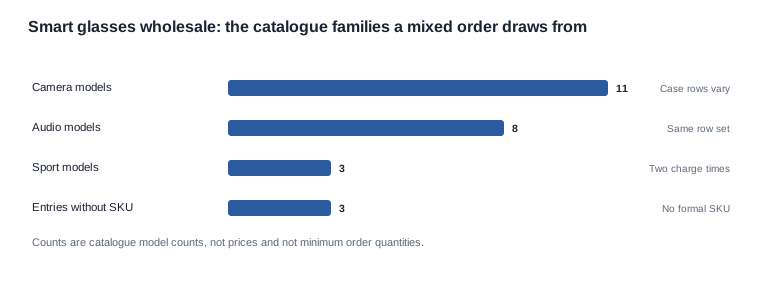
Smart glasses wholesale: what a mixed order actually contains
A mixed order is three kinds of cost wearing the same clothes. The first kind is the per-model component: each model in the basket carries its own unit, its own case configuration, its own colour split and its own packaging components. The second kind is the shared component: setup work that happens once for the whole basket, such as artwork, documentation preparation, inspection arrangements and freight consolidation. The third kind is the basket-level component: the things that attach to the consignment as a whole rather than to any line inside it.
Most mixed quotations fail at the first junction, because they put all three into a single figure or a single unit rate. A buyer who then asks which part is which gets an answer that describes the composition of the basket rather than the price of it, and the comparison with a second supplier becomes a comparison of two documents rather than two offers. The remedy is not clever negotiation. It is a request for a quotation format: one page of lines, one page of shared items, one page of basket-level items.

The reason this matters commercially is that shared and per-model costs scale in completely different ways. A shared block does not shrink when the basket shrinks; it usually grows less than the basket does, which means the per-unit figure a buyer was quoted for a large basket is not the per-unit figure available for a small one. A per-model block behaves the opposite way: it is flat for each line regardless of how many units that line contains, which means adding units to one line of an existing basket is usually a smaller decision than adding a new line. That asymmetry is the single most useful thing a buyer can extract from a mixed quotation, and it is invisible unless the quotation separates the blocks.
The two ways a supplier presents a basket make the difference concrete. A bundled presentation gives a single basket figure with a short summary, which is fast to produce and pleasant to read; it also hides the shared block, the per-model floors and the assumptions behind both. A line-by-line presentation gives one line per configuration with the shared items itemised separately, which takes longer to produce and requires the commercial team to commit to a structure. Buyers who have spent time comparing a bundled quotation with a line-by-line quotation will recognise the pattern: the bundled version usually looks tidier and usually carries more risk. The right response is not to distrust the tidier document, but to require the same decomposition from every supplier before comparing anything at all.

Smart glasses wholesale: the shared block and the per-model block
The shared block is the set of costs that a mixed order incurs once. It typically contains artwork preparation and print setup, packaging design and tooling for the outer pack, documentation preparation for the destination market, inspection arrangements, and the freight consolidation of several model lines into one consignment. None of these belongs to a model, and none of them scales with the number of units inside a line. Each of them does, however, repeat on every new order if the buyer treats it as one-off and the supplier treats it as per-order — which is the single most common point of disagreement in a mixed quote.
The per-model block is the set of costs that attach to one line of the basket. A line in a mixed order is not a model name; it is a model plus a configuration, and in this catalogue the configuration is where the variation lives. The camera range alone contains five different case descriptions inside eleven models: a 1400 mAh case published for three models, a 900 and 1400 mAh case published for one, a 1200 mAh foldable case published for one, a case published as existing but with no capacity given for two, and no case row at all for four — the V06 and the V03 Pro, and the V03 and the S7. The charging arrangement splits the same range three ways: magnetic, Type-C, and four camera models that publish no charging-method row whatsoever.
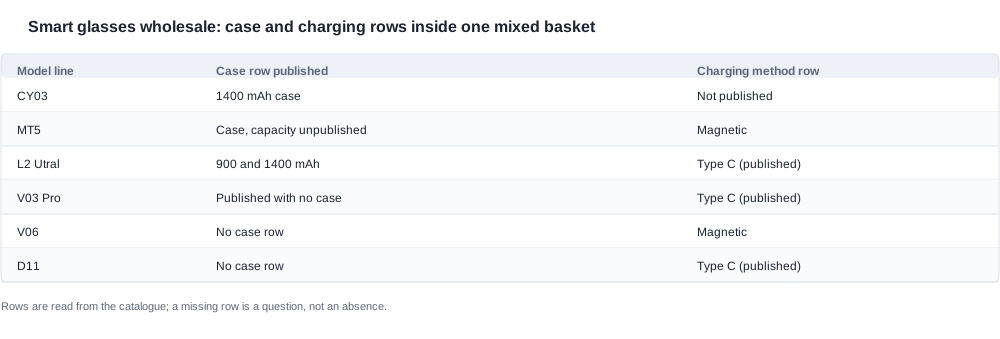
That is the practical meaning of the phrase "mixed order" in this category. It is not that a basket contains several models; it is that a basket contains several models with several published rows each, and that the rows are not uniform. A supplier who quotes one line per model has not quoted one line per configuration. Two lines can carry the same model name and require different packaging, different documentation and a different handling treatment, and the buyer who spots that difference before the purchase order saves the entire cost of the difference.
The catalogue's own row set gives a buyer a reliable way to write the configuration question. For every line, ask what the catalogue publishes about the case, about the charging method, about the colour split and about the runtime, then ask the supplier to confirm each of those for that line. Where the catalogue publishes a row, the confirmation is a formality. Where it does not — and it does not for a great deal — the confirmation is the whole substance of the question, and it belongs in writing on the quotation.
A shared block without a recurrence basis is the most expensive ambiguity in the whole document. Artwork preparation, packaging design and documentation preparation are the three items most often quoted as one-off charges, and they are also the three that most often turn out to be charged again on the next order, at a price the supplier sets rather than the price the buyer was quoted. Ask for each shared item to carry one of three labels: one-off and never repeated, per order and therefore recurring, or per version and therefore recurring only when the artwork changes. Those three labels turn an assumption into a commitment, and they are the labels a buyer should be able to point to when the second order arrives.
Smart glasses wholesale: the four line types that behave differently
Not every line in a mixed basket behaves the same way, and the four types below behave differently enough that they should never be quoted together without separating them.
The first type is a model with a uniform published row set. The audio range is the clearest example: eight models that all publish a charging method, a cell configuration, a rated runtime and a charge time, with the values varying but the fields present. Lines of this type are the simplest to compare and the easiest to reorder, because the same row set comes back on the repeat.
The second type is a model whose case configuration is published unevenly. This is where the camera range concentrates. A line with a 1400 mAh case, a line with a foldable 1200 mAh case and a line with no published case row are three different supply problems, and a quotation that treats them as one line is hiding at least two of them.
The third type is a model with a published colour split. Only two models in the whole catalogue publish colours — one with three colour options and one with four — so a colour-led basket is a narrow construction and the split should be treated as a configuration decision with its own consequences for stock, packaging and artwork. For every other model, the colour split is something to ask about rather than something to read.
The fourth type is an entry with no formal SKU at all, covering an AR model, a photochromic model and a bone-conduction model. These three cannot be ordered by name, cannot be repeated, and cannot be included in a minimum that the buyer can plan against. A mixed basket that contains one is not a mixed order; it is a mixed order with an open item, and the open item should be separated on the quotation so that the rest of the basket can proceed while the open item is resolved.

Smart glasses wholesale: putting two mixed quotations on one basis
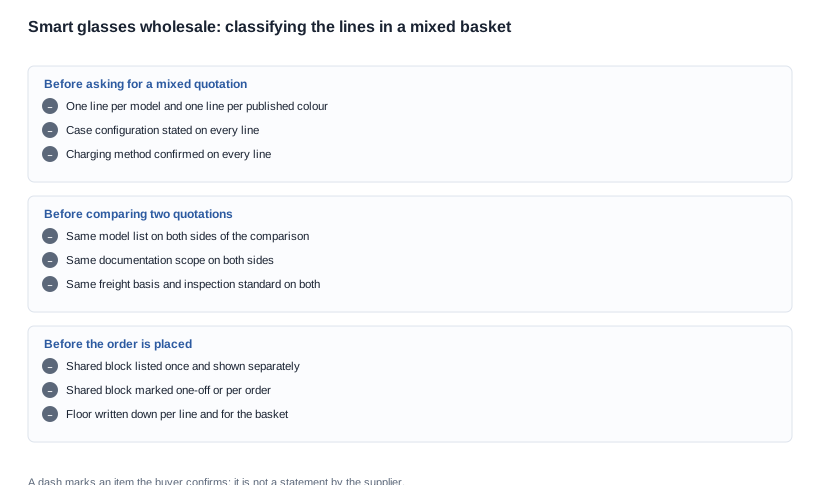
A mixed quotation cannot be compared with another mixed quotation until both are restated on the same basis. The comparison procedure is mechanical, and it is worth doing before the commercial conversation rather than during it.
First, align the model list. Two quotations with different model lists are not two prices for the same basket; they are two different baskets. Where the model lists differ, the right move is to issue one basket to both suppliers and ask each to quote against it, rather than trying to reconcile two documents after the fact.
Second, align the configuration of each line. Same case configuration, same charging method, same colour split on both sides, because a quote against a 1400 mAh case and a quote against an unpublished case position are different products.
Third, align the documentation scope. If one quotation includes destination-market documentation and the other excludes it, the difference belongs in a separate column rather than inside the unit rate.
Fourth, align the freight and inspection basis. Whether a quotation is stated ex-works, delivered to a named place or otherwise is not a detail; it decides which costs are inside the comparison and which are still open. Ask for the basis to be named on the document.
Fifth, align the validity and the payment triggers. A quotation that expires before the buyer's own decision cycle completes is not a comparable quotation, and a quotation with different payment triggers is not a comparable quotation either.
There is one behaviour during this procedure that deserves to be treated as a red flag in its own right. A supplier who cannot, or will not, decompose a basket into lines and a shared block is not necessarily wrong about the numbers, but the buyer has no way to test them. Without a decomposition, a comparison rests entirely on the supplier's own summary of its own basket, and the buyer has no independent check on any of the assumptions inside it. The practical response is not to abandon the comparison but to make the decomposition a condition of receiving a binding offer, and to treat a refusal as information about how the relationship will behave later, when a claim has to be settled rather than a price agreed.
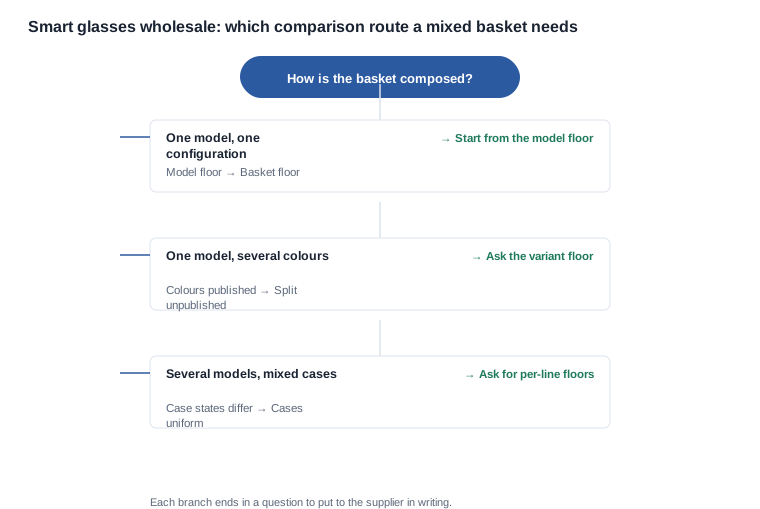
With those five aligned, the comparison becomes arithmetic: the per-model block, the shared block and the basket-level block, each read separately. The result is usually less dramatic than the difference between two headline unit rates suggested, and the buyer can see exactly where the remaining difference sits — usually in the shared block or in a documentation scope that was never the same.

Smart glasses wholesale: the four mistakes that make a mixed order expensive
The first mistake is treating the basket minimum as a single number. A mixed order can carry a floor that applies to the basket as a whole and separate floors inside each line, and the effective requirement is the combination of both. A buyer who has only the basket figure has only half of what is needed to plan.
The second mistake is splitting one model across several colour lines in order to move under a threshold. Whether that helps depends entirely on how the supplier treats colour lines: if a colour line carries its own setup, splitting a model into three lines creates three setups where one existed. Ask the supplier how a colour line is treated before deciding to split.
The third mistake is assuming the case configuration is uniform across a camera basket. Six case states sit inside eleven camera models, and a basket that mixes them inherits handling, packaging and after-sales consequences that a single-case basket never has.
The fourth mistake is comparing two quotations whose shared blocks describe different scopes. One supplier may treat artwork preparation as a per-order item and the other as a one-off, and that difference is invisible until the second order arrives and the buyer learns which one was right.
A fifth pattern is worth watching for as well: treating the shared block as disposable. Shared setup is what makes the second order carry less production cost than the first. When a buyer pushes every per-order cost to the supplier's own account, the supplier has every reason to quote the shared block high in order to recover it, and the buyer loses exactly the thing that makes a mixed programme worth running.
A sixth error belongs in this list because it appears at the end of a successful programme rather than at the beginning. Treating the reorder as a fresh quotation. Once a mixed basket has been built, the specification, the shared block and the acceptance criteria all exist, and re-quoting from scratch discards them for no reason at all. The reorder that should be an administrative event is the one most often turned into a negotiation, and the negotiation is usually about items that were never in dispute the first time round.
Smart glasses wholesale: what a mixed quotation should itemise
A mixed quotation that a procurement team can act on contains five groups of information, and a buyer is entitled to ask for all five before the order is placed.
- Model lines: one line per model and configuration, with the case configuration, the charging method and the colour split stated on the line itself.
- Shared block: artwork, packaging design, documentation preparation and inspection arrangements, listed once with the basis on which they recur.
- Basket block: freight basis, insurance, consolidation and any consignment-level charge, named separately.
- Terms: payment triggers, inspection standard and acceptance threshold, lead-time basis and quotation validity.
- Open items: any line that cannot yet be quoted, with the reason and the condition on which it will be quoted.
On this, our position is straightforward. We will decompose a mixed order against the published rows of the catalogue and state which parts of the decomposition are settled by those rows and which parts require a supplier confirmation, and we will not publish unit rates or minimum order quantities for this range, because nothing here is a published value and a buyer who plans against an unverified figure ends up planning against the wrong one. If the same structure is applied to two suppliers, the comparison becomes a comparison of offers rather than of document formats, and that is the only version of this comparison worth doing.
Two further readings help with the same problem from different angles: how a wholesale case approach handles the packaging line inside a mixed basket and the packaging options a mixed basket has to choose between both sit upstream of this article, and what a full-range minimum involves when the basket is wide covers the floor question that the mixed basket inherits. The wholesale programme entry point is where a first enquiry starts, with a model list rather than a basket.
A mixed order is costed by its structure, and the structure is visible in the rows the catalogue publishes: which models carry a case, which publish a charging method, which publish a colour split, and which cannot be ordered by name at all. Ask for those four things per line, and the cost of the basket stops being a single unexplained figure and becomes something a procurement team can actually plan a reorder around.


