

The payment method is agreed per enquiry rather than published, and the reason is not that it is a secret. It is that the available method depends on the buyer, the currency, the amount, and the freight arrangement, and all four of those can be different in the next enquiry from the last one. A card is usually acceptable. So is a bank transfer. What a supplier cannot do, for good reasons, is publish one method and hold every request to it.
The useful answer to this question is therefore about the transaction rather than the method, because the method is the small half of it. A sample fee is a small, simple payment. The freight for a battery-containing product travelling across a border is a larger, more conditional number, it is frequently the larger cost of the two, and it is where the requests that go wrong actually go wrong. A buyer who treats the payment method as the question and the shipping as a detail will sign a fee, discover the freight, and then discover that the freight was never included in the fee.
There is a third element that catches people out, and it is a documentation one. We publish no per-model certification row, so the conformity evidence for a specific model is requested rather than looked up — and if you want that evidence assessed against the sample, the request belongs in the first message, not in a follow-up after the sample has already arrived.
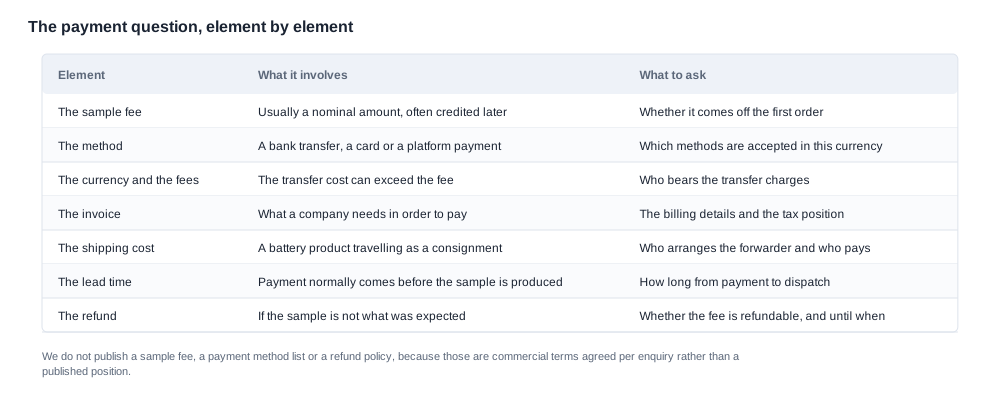
can i pay the sample fee by card: what has to be true first
Four conditions have to hold before any method can be agreed, and they are worth stating because a buyer who has only thought about one of them will get a slow answer.
The company has to exist in the supplier's records. Almost every supplier needs a company name, a registration or tax number, a billing address and a contact before a payment can be processed. If the buyer is an individual, or a brand that has not yet registered its entity, the payment method question is premature: the supplier cannot invoice them, so the method does not arise. This is the most common reason a first enquiry goes nowhere, and it is a ten-minute fix.
The amount has to be known. A card surcharge, a transfer fee and a courier bill are all percentages or flat charges, and whether they are material depends entirely on the amount. A sample fee large enough that a 2.5% card surcharge is a rounding error is a different transaction from a nominal fee where the surcharge is a third of the total. Asking for the number before asking about the method is the right order of operations.
The freight arrangement has to be decided. Who arranges the courier, who pays the freight, who is the importer of record, and what happens to the shipment if it is held. These four answers change the total cost and they change it by more than the payment method ever will.
The purpose of the sample has to be stated. A sample for a visual check, a sample for a technical test script, and a sample for a buyer who intends to place a production order are three different requests, and the third one is usually the one that gets the most useful reply — including an answer on whether the fee is credited against that order.
None of these conditions is difficult. They simply have to be satisfied, and the buyer who satisfies them in the first message gets a complete commercial reply in one round trip rather than a question back.
There is one case where the order of these conditions is different, and it is common enough to be worth flagging: the enquiry from a buyer who is not yet a company. An individual, or an agency testing a category before committing to a brand, does not have the billing details that a supplier needs in order to invoice, and a supplier that offers a card payment will happily take the money from an individual and then has no way to issue an invoice at all. If you are in that position, say so in the first message and ask what the supplier needs from you to invoice. Some will invoice an individual, some will invoice a registered entity only, and some will treat a small sample as a retail transaction with different terms. All three are workable; none of them is worth discovering after the sample is built.
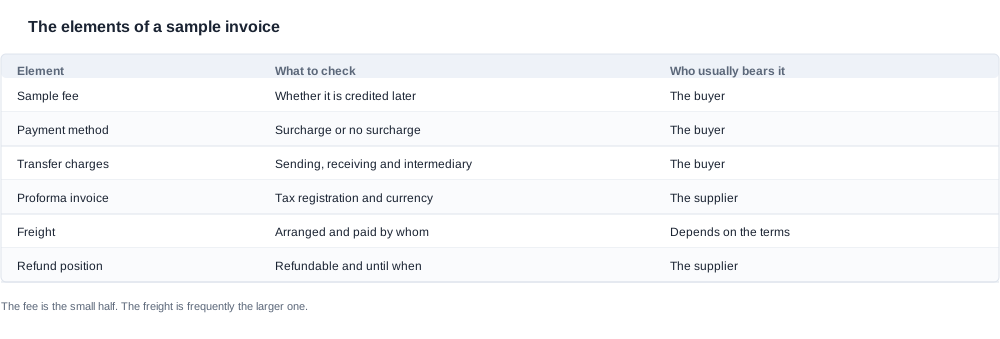

The elements of a sample invoice, and which ones catch people out
The sample fee itself. It is usually a nominal amount, and it is frequently credited against a first production order. Ask for that in writing before you pay, because a credited fee is a commercial concession and an uncredited one is a cost, and the difference is worth more than the fee. Suppliers differ on this: some credit the sample against an order placed within a stated window, some credit only the unit value and not the freight, and some do not credit at all. All three are reasonable positions, and only the first one is likely to be the buyer's default assumption.
The method, and the surcharge. Card, bank transfer and platform payment are all normal in this industry. A card is convenient and usually carries either a percentage surcharge or a flat processing fee, sometimes both. In some jurisdictions a card payment on a small cross-border transaction attracts a fee larger than the fee being paid. Ask what the surcharge is, whether it is a percentage or an amount, and whether it is refundable if the sample never arrives.
The currency and the transfer charges. A cross-border bank transfer usually carries charges on both sides, plus an intermediary bank's fee, and on a small amount the sum of those charges can exceed the amount being transferred. Ask who bears them. A transfer fee larger than the sample fee is a poor way to run a first evaluation, and it is entirely avoidable if the supplier can take a card for that size of transaction.
The invoice, or the proforma invoice. A company paying needs billing details and a tax position, and something its own finance function can book against. Ask specifically whether the supplier will issue a proforma invoice, what tax registration the invoice will carry, and what the currency of the invoice will be. A buyer whose finance function processes invoices in a particular format will lose days to a supplier that only sends a payment request.
The freight, which is listed separately and is often the larger number. See the next section. The important thing here is that the freight is not part of the sample fee, and it should not be confused with it.
The lead time to the sample, which is not the lead time to the unit. Payment normally comes before the sample is produced, and production then has its own queue, and the transport preparation then has its own queue. A buyer expecting a sample within a week is usually waiting on two things — the unit and the documentation — and the second is the one that surprises people.
The refund position. If the sample is not what the brief described, is the fee refundable, and until when? Asking this is entirely reasonable and it is not an accusation; a supplier with a clear answer has a process, and a supplier without one has never had the question.
The sample specification. Which model, which configuration, and what is in the box. This is the row that ends up in a dispute, because "the sample" and "the order" are often different things unless the specification is written down. Our catalogue publishes the rows a sample should be judged against — the model designation, the charging method, the charging case and its contents, the published charge time — and where a row is not published, such as the charging method for the L1 Pro, the CY05 and the MT6, and the CY03, the sample is the only way to establish it.
Whether the sample is the production unit. Some suppliers ship a display unit that is not the production configuration, some ship the first production unit, and some build a sample specifically. The difference matters more than the price of the sample: a display unit may not carry the final firmware, the final packaging or the final accessories, and a buyer who tests it and then places an order has tested something else. Ask what the sample is and what it is not, and ask whether the approved sample becomes the golden sample for the production run. If it does, the sample fee has bought the buyer something that survives into the order.
The tax position. Ask what tax registration the invoice carries and whether the invoice is issued net or gross. A buyer in the European Union will want to see the treatment of a reverse charge or a VAT number, and a buyer outside it will want to know whether the supplier is registered for the relevant local regime. This is not a difficult question, but it is one that gets asked late if the buyer did not think of it, and it stops an accounts payable process dead.

Why the shipping arrangement is the larger half of the transaction
A smart glasses sample is a small, low-value object containing a lithium cell, travelling to a recipient who may be on another continent. That combination is awkward in a way that an ordinary product sample is not, and the awkwardness is entirely to do with the cell.
The transport rules apply to one unit exactly as they apply to ten thousand. A lithium battery consignment needs a classification for the cell, packing that meets the applicable requirements, documentation, a forwarder who is set up to handle it, and a route that the forwarder is allowed to use. The test summary that supports the cell's classification is prepared once per cell type and then reused; a factory that has that documentation ready ships a sample quickly, and a factory that assembles the paperwork each time adds days to every sample. The delay is in the documentation, not in the unit, and the buyer's supplier is the one who knows which case they are in.
The importer of record matters even for a sample. A sample crossing a border is an import in most jurisdictions, and the importer of record for the sample should be the same entity that will be the importer of record for the commercial order. Deciding it later is a small problem now and a bigger one later, when the commercial shipment arrives and the paperwork does not match the sample's. The documents that a battery shipment needs are set out under battery transport.
Who arranges and who pays is a commercial decision, not a formality. Three arrangements are common: the supplier ships on their own account and includes the freight in the invoice; the supplier books a courier and lets the buyer pay the courier directly; or the buyer nominates its own forwarder and collects from the factory. The first is simplest for the buyer and usually the most expensive. The third is usually the cheapest and puts the most work on the buyer, including the classification paperwork and the customs entry. The second is a middle ground that works well when the buyer already has a freight account.
The declared value is a real question for a sample. A commercial sample crossing a border is declared, and the declared value affects the duty treatment, the courier's insurance and the paperwork the forwarder asks for. Some buyers prefer a low declaration for a sample because the duty on a nominal amount can exceed the amount; others need a declared value that matches the invoice for their own accounting. Both are legitimate, but the buyer and the supplier have to agree before the shipment leaves, and the courier will ask.
Insurance and the loss case. A sample is a small value, so insurance is rarely the point. The point is what happens when the shipment is held, damaged in transit, or arrives with a dead battery. Ask what the courier's terms are for a battery consignment, and whether the supplier will replace a sample that arrives faulty rather than only refunding the fee. A replacement is worth more than a refund at this stage, because the buyer's schedule is the thing at risk.
Courier against forwarder, for one unit. A single unit does not justify a freight forwarder's minimum, so most sample shipments move on an express courier. That is usually the right choice and it is usually expensive, with a minimum bill that a single small object does not fill. Two consequences follow. First, ask for the total freight cost to the destination rather than the base rate, because a single-unit consignment is charged at the same minimum as a thirty-unit one. Second, if the buyer already has a freight account with a forwarder, the alternative is often materially cheaper, and the trade-off is the buyer's time: the classification paperwork, the customs entry and the collection from the factory all move to the buyer.
The delivery window, and what it is competing with. A sample that has to arrive before a trade show, a marketplace onboarding deadline or a customer review is on a schedule that the supplier does not control. Ask for the expected dispatch date and the expected transit time as two separate numbers, because they have different causes, and ask what happens if the transit time runs long. A buyer with a hard deadline should also ask whether a second sample can be prepared in parallel, and whether the fee is charged once or per unit.
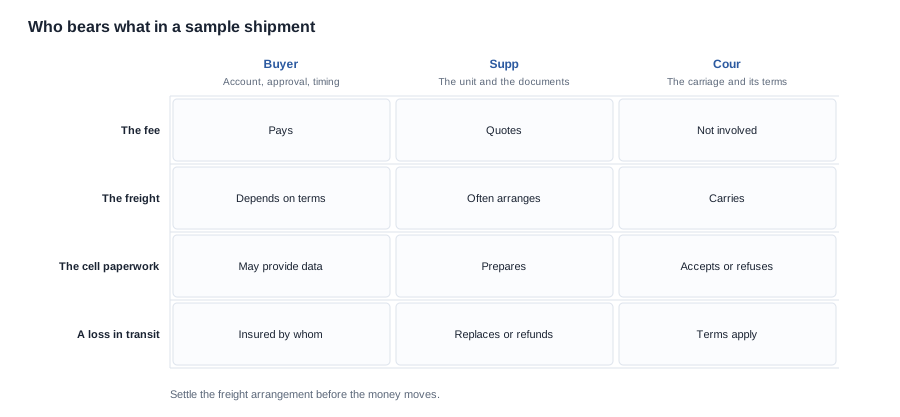

Card, transfer, and the cost of getting the method wrong
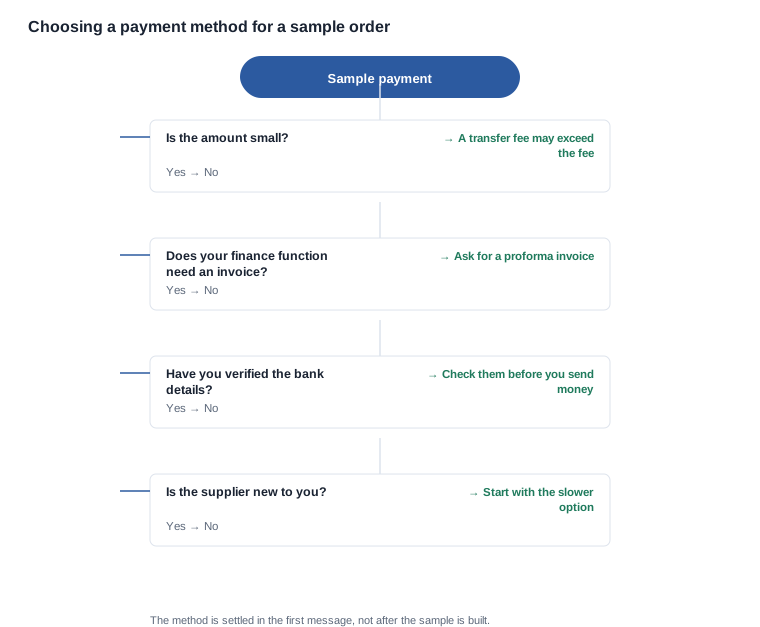
The three methods are not interchangeable in practice, and the differences are worth knowing before the money moves.
A card is fast, it is familiar to the finance function, and it may be the only option above a certain amount because a supplier's card processing has a limit. Its costs are a surcharge, a currency conversion applied by the card issuer, and a chargeback mechanism that sits behind the transaction. The chargeback is the one buyers underestimate: if a supplier's card terminal does not support a card issued in your country, the payment can be held, queried and eventually reversed, and the reversal takes weeks.
A bank transfer is cheap, it is what most suppliers prefer, and it is slower for a small amount because the money has to actually move. The costs are the sending bank's fee, the receiving bank's fee, any intermediary fee, and the currency conversion on the way. It also has a practical advantage for a first transaction with a new supplier: it makes the supplier's bank details part of the record, and it gives the buyer a moment to check them against the company details in the first reply, which is a simple check against a common fraud pattern.
A platform payment sits in between, and it is worth asking about because it is sometimes the cheapest route for a small cross-border amount. The constraint is that it may not be available for your country, and it may have its own ceiling.
The cost of getting the method wrong is rarely the surcharge. It is the delay, and the delay lands on the evaluation. A sample that arrives after the buyer's decision meeting has already happened does not get tested; it gets filed. That is the real reason to settle the payment method in the first message rather than after the sample has been built.
Currency is a small decision with a small tail. A supplier will normally invoice in its own currency or in United States dollars, and a buyer paying a different currency carries the conversion cost and the conversion risk. On a sample fee the absolute number is trivial; the tail is that the currency on the invoice and the currency on the production quotation should be the same, because a buyer who has agreed a price in one currency for a sample and then sees a production price in another has no way to tell whether the product got more expensive or the currency moved. Ask what currency the production quotation will be in when you ask what currency the sample invoice is in, and keep the two answers on the same page.
What a complete first message contains
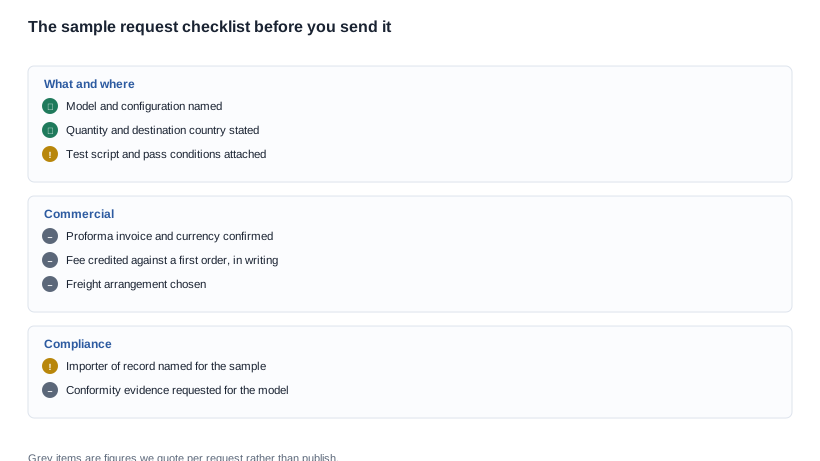
Seven items, and a message that contains all seven gets a complete commercial reply in one round trip. A message that contains the first three gets a question back.
- The model and configuration, and why you want that one. If your choice depends on a published row — a charging method, a case, a charge time, a camera resolution — say which row, because it makes the request answerable rather than open-ended.
- The quantity and the destination country, with the city if the freight is quoted by destination.
- The test script, with the pass conditions. A sample without a script produces an impression, and impressions do not survive a shortlist meeting.
- The payment arrangement you need, including whether a proforma invoice is required and in what currency, and whether the fee is credited against a first order.
- Who the importer of record will be for the sample, so it matches the commercial order.
- The freight arrangement — supplier-courier, buyer-nominated forwarder, or your own account — and whether the sample fee includes it.
- The conformity evidence you need for this model, requested at the same time as the sample, because we publish no per-model certification row and because a file reviewed after the sample arrives is a file reviewed too late to change the order.
That last item is worth a word. Our export certification page is a picture page — ten patent certificate images, eight design patents and two utility models — with no per-model conformity mapping attached to it, and the catalogue body does not mention CE, FCC, RoHS, RED or EN 18031 at all. That request is made in writing, with the model designation on it, and it belongs in the sample enquiry itself if you want the sample assessed against a file rather than against a description.
What we can and cannot do about sample payments
We will set out the commercial terms for a sample in the reply, plainly, rather than publish a policy that applies to only some requests. That is a deliberate choice: a published payment method list would be wrong for some buyers, some currencies and some amounts, and a supplier that changes its published policy to match the enquiry is a supplier whose published policy means nothing.
Here is what we do not publish: the sample fee, the payment method list, the surcharge structure, the refund policy, the freight rate, the sample lead time, the minimum order quantity, the production capacity and the production lead time. All of them are quoted per project, and all of them are quoted with their conditions attached rather than as a number on their own.
What we do publish is the product data a sample is judged against: the model list and the specification for each configuration, the charging method where it is published, the charging case and its contents where they are published, the published charge time, the camera resolution on the camera models, the ingress marking on the two models that carry one, and the transport documentation for the cell once the company details are confirmed.
The practical instruction is short. Send the seven items above — through the quotation request page, which is also where the mixed-order and configuration questions get answered — and we will reply with the complete commercial terms for the sample: the fee, the method and its surcharge, the freight arrangement, the lead time and the refund position. If the answer to any of them is that it depends on your company and your destination, we will tell you that too, rather than giving you a figure that applies to nobody.
The protocol a sample is judged under is on sample evaluation, and the documents a battery consignment needs are under battery transport.
Related reading
- The sample request itself — one model or a mix
- The documents a battery shipment needs — battery transport
- The protocol the sample is judged under — sample evaluation
Send the seven items above and we will reply with the complete commercial terms for the sample.


