

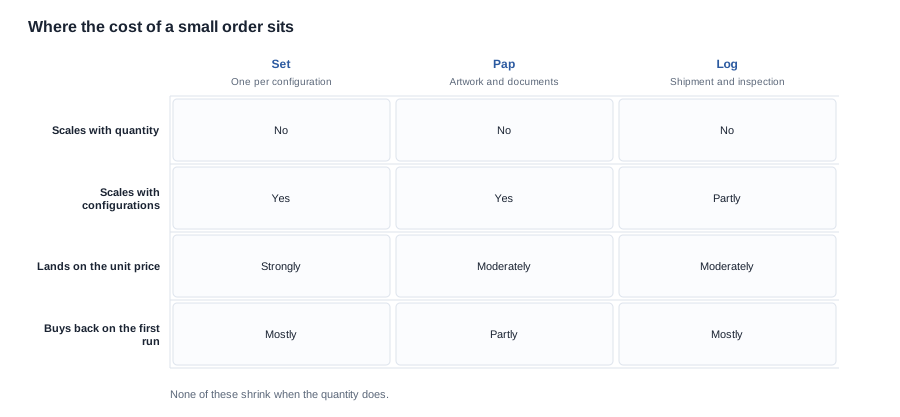
A small test order is usually the sensible first step in a smart glasses programme, and it is also the step where the economics of this category are least friendly. The reason is structural rather than commercial: the fixed costs of a programme — the setup, the packaging artwork, the documentation, the inspection, the shipment preparation — do not shrink with the quantity, so a small order carries a materially higher effective unit cost than a large one, and the difference is usually larger than buyers expect.
That does not make a test order a mistake. It makes it a decision with a specific purpose, and the purpose decides whether the premium is worth paying. A test order that answers one well-chosen question about the finished product is cheap evidence. A test order that is used to find out what the product will cost at volume has bought nothing, because the answer is a different number by construction.
What constrains what can be said about quantities is straightforward: minimum order quantities, production lead times and unit prices are not published on this site and are confirmed per enquiry, because each depends on the configuration, the quantity, the packaging, the documentation scope and the current schedule. Any figure quoted without those conditions attached is a figure you cannot plan against, whichever supplier gives it to you.
One framing point that changes how the money is approved internally. A test order is not a purchase; it is an evaluation cost, and it should sit in a budget line that is judged on the evidence it produces rather than on the units it delivers. The moment it is judged as a purchase, every objection sounds like an obstacle: the unit price is too high, the quantity is too small, the discount is not competitive. Judged as an evaluation, the questions are entirely different — what will it prove, how quickly, and what will we do with the answer — and those are the questions a small order is designed to answer.
can i start with a small test order: what it buys and what it costs
The premium is the price of evidence, and it is worth being clear about what a buyer is paying for it.
What the small order costs. Every fixed element is spread across fewer units. The setup runs once, the packaging artwork is designed once, the documentation scope is defined once, the inspection is booked once, and the shipment is prepared once. If a large order spreads those across ten thousand units and a small order spreads them across two hundred, the difference per unit is not marginal — it can be the difference between a viable product and an unviable one. That is why a small order should be costed as an evaluation budget rather than as a purchase.
What the small order buys. It buys the first real units rather than a sample: units built in the production configuration, packed with your artwork, labelled for your market, shipped under real transport documentation and delivered into your warehouse. It buys the evidence that the whole chain works — the artwork, the labelling, the operator details on the packaging, the accessories in the box, the customs entry, the carton count, the arrival condition. It buys the first instance of an aftersales question answered by a real claim.
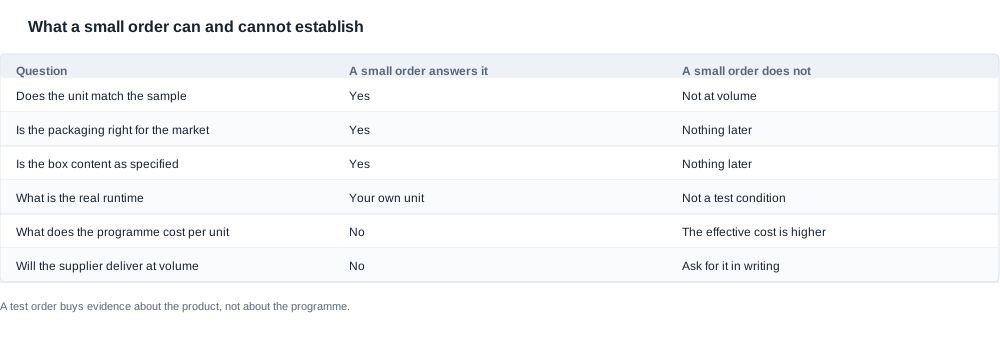
What the small order cannot buy. Almost everything about scale: the unit economics, the yield, the lead time under load, the supplier's behaviour when it is prioritising a larger customer, the defect rate that only appears in the ten-thousandth unit. A test order tells you whether the product is right. It does not tell you whether the programme is profitable.
The decision this depends on. Whether your programme is a single product or a range. For a single product with a known demand estimate, the test order is usually worth it. For a range, the cost of the test order multiplies by the number of configurations, and the evidence it produces is diluted across models rather than concentrated on one.
The questions a small order can actually answer
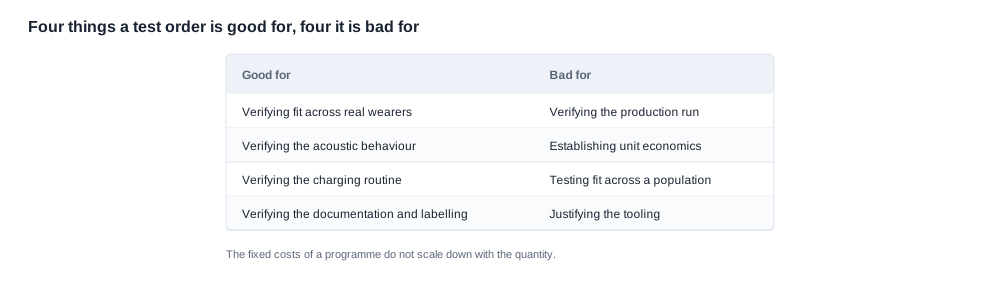
Does the finished unit match the approved sample? The sample is one unit, often built or configured separately. The production unit is built on the line with your artwork and your firmware. A test order is where the difference shows up: a slightly different accessory, a label with the wrong model designation, a packaging insert from a superseded artwork file. Comparing the first production units against the retained sample is the single most valuable use of a small order.
Does the packaging work for the destination market? Artwork errors are invisible on a spec sheet and expensive at the shelf. A test order is where you find out whether the operator details are legible on the box, whether the barcode scans, whether the insert fits, whether the language is right, and whether the carton quantity is what your warehouse assumed. The cost of finding that out on two hundred units is a reprint; the cost of finding out on ten thousand units is a recall.
Does the box contain what it should? This sounds trivial and it is not, because the box contents differ across our range. Our published case data shows five models with a case capacity published — the CY05 and the CY03, and the L1 Pro — each at 1400 mAh, the L2 Utral at 900 or 1400 mAh, and the MT6 at 1200 mAh in a foldable case — the KY06 and the MT5 with a case whose capacity is not published, the V03 and the V06, and the S7 and the V03 Pro with no case row at all, and a small order is the cheapest place to close that question. Add a charging method that is magnetic on 17 models, Type-C on 7 and not published for the CY05 and the CY03, and the MT6 and the L1 Pro, and you have four different box contents in the same range. A small order is where you confirm that the box you receive is the box you specified.
Does the unit behave as published? The published figures are a starting point, not a measurement of your unit. A camera model's rated runtime is about five to eight hours on a 220 to 290 mAh battery, and no test condition is stated for it, so a test order is where you find out what your own unit actually does. Twenty-six models publish a charge time of two hours or less, with only the D17 and the ZH12 publishing about one hour, so the charging routine is worth checking on the real units rather than inferred from the ceiling. And the frame weight is published for exactly one model, the MT6 at 158 grams for the glasses alone, so a test order is where the weight of any other model becomes a number you own.
Does the documentation arrive complete? Our catalogue publishes no per-model certification row, and the export certification page is a picture page showing ten patent certificate images with no conformity mapping attached, so the file for a specific model has to be requested in writing. A test order is the moment to ask for that file, alongside the batch records, the test records and the shipping documents.
Does the whole chain work for this market? The packaging has to carry the economic operator details for the destination market, which is a different set of requirements per market and a common place for a launch to stall; the rules behind it are set out under compliance for the European Union. The carton has to hold the quantity your warehouse assumed, the barcode has to scan at receiving, and the customs entry has to clear. A test order is where all of that happens for real, and the alternative is finding out at the first commercial shipment.
Does the unit survive the journey? Delivery condition is a logistics question with an aftersales tail, and the claims route is described under shipping damage claims. A test order that arrives with a damaged unit gives you the evidence you need to work out whether the packaging is at fault, and it gives you that evidence before a commercial quantity is on the water.
Does the customer-facing material hold up? This is the part buyers most often forget to put in the test order, and it is where the money is saved. The product page, the printed manual, the quick-start card and the support script are all drafted in parallel with the hardware, and they are all things you can only verify against a real unit in your hands. Whether the box contents match the manual, whether the pairing instructions work for a first-time user, whether the charging instructions match the charging method the model actually uses, whether the published runtime band is what your own unit does — none of it can be checked from a spec sheet.
Where a small order is the wrong instrument
Four situations where spending the premium on a small order buys the wrong evidence.
When you need a unit price for a plan. The effective unit cost of a small order is not the unit cost of the programme, and a business plan built on the small order's price will be wrong in the direction that hurts — usually by a lot. If the number you need is a cost per unit at volume, get it quoted per volume, and treat the small order as an expense against the evaluation budget.
When the risk is in the volume run. Yield, consistency and defect rates appear at scale. A test order of two hundred units tells you about two hundred units; the question you are usually asking is about ten thousand, and the answer will not transfer.
When the real question is the supplier's capacity. If the programme depends on the supplier being able to deliver your volume in your window, the way to find that out is a written capacity figure with its conditions attached, and then a check of how that capacity is protected when other customers are in the queue. A small order does not test capacity; it is scheduled around it.
When the schedule is what you need to know. A small order is scheduled differently from a production run, and it is scheduled faster: it is smaller, it is often slotted into an existing run, and it skips the line-planning exercise that a production order requires. The date a small order arrives therefore tells you very little about the date a production run will arrive, and production lead times are not published on our side for exactly that reason. If your risk is a launch date, the answer is a written lead time for the production configuration with its conditions attached, not a test order.
When the small order becomes an expectation. A test order at a high unit price can create an unhelpful reference point. If a channel partner sees the test quantity at that price, and if a buyer internalises it as the price of the product, then the production price becomes a negotiation against the wrong anchor. Agree internally what the test order's units are worth, and keep the two numbers apart.
When the units will have to be sold. A test order that ends up in a discount channel is a price problem the buyer created, and it is common because the units look like stock. Decide before the order what happens to them: sold at full price, retained as evaluation units, given away, or scrapped. If they will be sold, the small order should be a configuration you actually intend to sell, because the packaging, the labelling and the documentation all have to be right for the market you sell into.
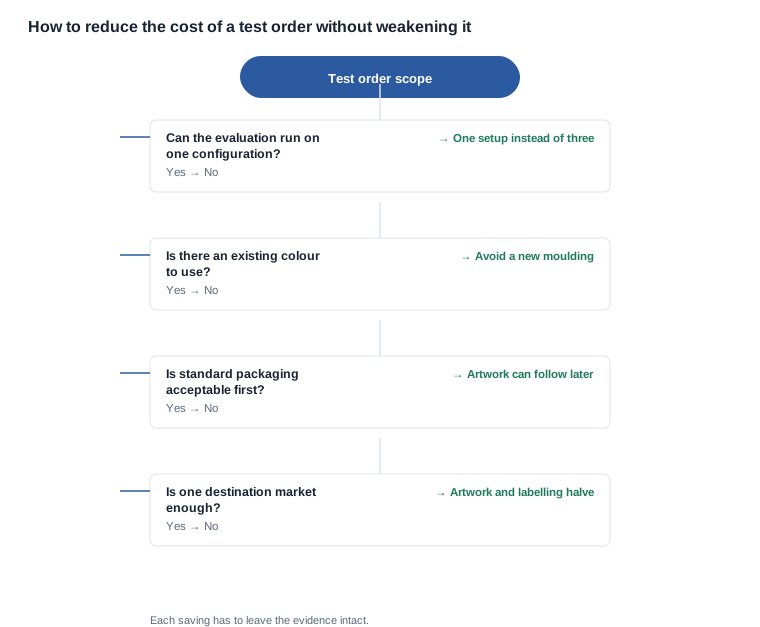

How to make a test order cheaper without weakening it
One configuration. The setup cost is per configuration, and a small order spread across three configurations is three setups on a small quantity. If the evaluation can be run on one configuration, it should be.
A colour that already exists. Our catalogue publishes colour options for two models only — three on the V03 Pro and four on the V06 — and the absence of a published colour count elsewhere is not the absence of colour variants. Where a colour exists inside an existing mould it is a finish decision; a new colour is a new moulding, a new minimum and a new lead time. For a test order, take a colour from the existing set.
Standard packaging for the first order. Custom artwork carries a print minimum and an artwork cycle. Standard packaging gets you to the point where you can test the product, the packing and the freight. The artwork can follow, once you know the design you want.
One destination market. Each market means its own packaging artwork, its own labelling and its own document scope. A test order into two markets doubles the artwork work and splits the volume; a test order into one market, followed by a second order into the next, is usually cheaper and gives cleaner evidence.
One accessory scope. The accessories are set by the model's charging method and its case row, so narrowing the test to a single configuration also narrows the accessory list to one set. It also makes the result legible: when a customer reports a problem, there is one charging method and one case in the population rather than four.
Combine the test with the first production run where the volumes allow. The evaluation units are normally the same units as the first production run. Buying them separately means paying for the setup twice and receiving two batches of the same thing.
Agree the inspection scope rather than accepting the default. Inspection is one of the fixed costs that does not shrink with the quantity, and a default inspection on a small order can cost a meaningful share of the order. Ask what is inspected, to what criteria, and with what sampling level, and agree a level that matches the risk of the test order rather than the risk of a full production run. For a test order the purpose is to confirm the configuration, not to generate a statistical quality record.
Negotiate the packaging print run, not the artwork. Custom artwork has a design cycle and a print minimum, and those are different costs. The artwork can be designed once and printed in a small run if the printer will accept it, which usually can be arranged, whereas a design cycle cannot be compressed by asking.
Decide the accessory scope in advance. Because the charging method differs across the range and is unpublished for four camera models, the accessory that ships with a test unit is a question to settle before the order rather than after the box is opened.
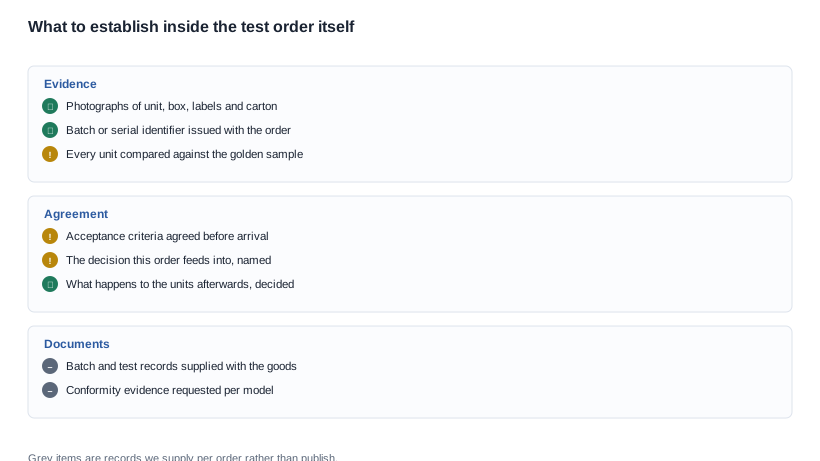

What to establish inside the test order itself
A small order should be treated as a measured exercise rather than a delivery, and there are five things to capture that are hard to capture later.
- The traceability. Whether a batch or serial identifier is issued with the order, and whether it resolves to a production date and a configuration. This is the document that makes a claim work in six months, and it is the thing that is missing when it is needed.
- The photographs, before anything is used. The unit, the box, the labels, the insert, the accessories, the documents, the carton. This is the evidence set for a shipping damage claim, and it is described under shipping damage claims. Photographing on arrival takes ten minutes and saves an argument later.
- The written acceptance criteria, agreed before the units arrive. What is being tested, against which published row or agreed specification, and what result counts as a pass. Criteria written after the result are not criteria.
- The decision the order feeds into. One decision, named in advance, with the action for each outcome defined in advance. A test order that informs three decisions informs none of them.
- The comparison against the sample. Every unit compared against the retained golden sample: dimensions, weight, finish, firmware version, box artwork, box contents. The drift this catches is invisible on a spec sheet and expensive after a listing goes live.

The questions to settle before you place one
- What is this order for? One specific question, with the units as the evidence. If the answer is general reassurance, the order is the wrong purchase.
- Is the unit the production configuration? The exact model designation, the charging method, the case, the colour, the firmware version. A difference in any of those invalidates the evaluation, and the difference is usually invisible until someone weighs the box.
- Is this a configuration you would actually sell? Evaluating a configuration that will not be in the programme is a common and expensive error.
- What is the destination and who is the importer of record? One market for the first order, and an importer of record that will be the same for the production shipments.
- What happens to the units afterwards? Sold, retained, given away or scrapped — decided before the order, not after.
- Is the fee credited against a production order? Worth asking in writing, including the window in which the credit applies.
- What documents will arrive with the units? The batch records, the test records and the conformity evidence requested per model.
The shortlist criteria for a supplier who handles small orders well are consistent: they ask what the order is for before quoting it, they say plainly that the effective unit cost is higher, they confirm the configuration in writing, and they ship the records with the goods. A supplier who quotes a small order at the same price as a large one, without explaining, is either absorbing a cost you will pay for later or has not worked out which order you are.
One thing to decide before the order, while the outcome is still unknown: what the production order will be allowed to change. A test order that passed is an argument for repeating it, not for assuming it. If the result is negative on one item — the packaging artwork, the accessories, the runtime band — the production order should either fix that item and leave everything else untouched, or restart. Restarting a whole programme because one element failed is the expensive version of a test order, and the test order is the cheapest possible place to find out which of the two you are going to do.
Our own position is that a small test order is a sensible step when it is aimed at a specific question, and we will discuss it honestly, including the fact that the effective unit cost of a small order is higher than that of a larger one. We will not publish a minimum order quantity or a unit price on this site, because both depend on configuration, quantity, packaging, documentation scope and the current schedule.
The mechanics of the minimum are on the procurement minimum order quantity page, the request itself goes through requesting samples, and the full sequence from first contact to first order is in how to get started with smart glasses OEM.
Send the configuration, the quantity, the destination and the question the order is meant to answer, and we will come back with what is possible, what it costs, and what the units will prove.
Related reading
- Procurement minimum order quantity
- Requesting samples
- Smart Glasses OEM: how to get started
- Shipping damage claims process
Send the configuration, the quantity, the destination and the question the order is meant to answer.


