

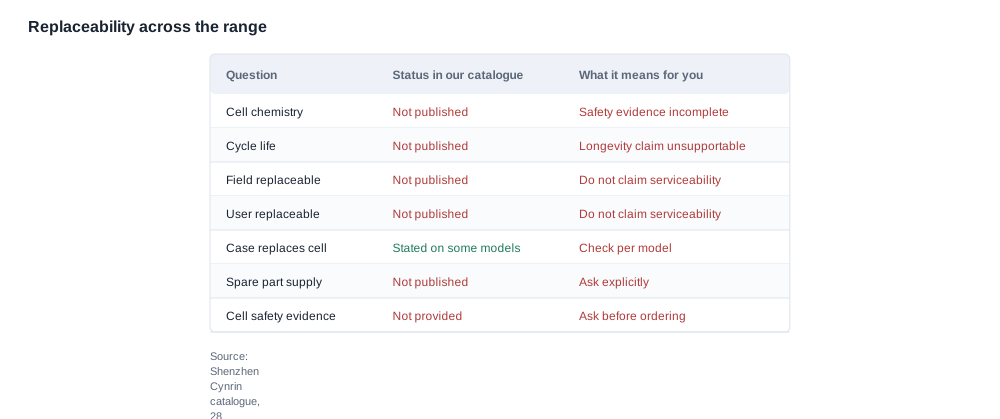
The direct answer is that our own documentation cannot tell you, and the reason is not commercial sensitivity. It is that our catalogue contains no battery chemistry, no cycle life, no cell voltage and no replaceability statement for any of the 28 models we list. Every model in the range is battery-powered; not one of them carries a published serviceability position. That is a documentation gap on our side, and it is worth understanding before you build a product proposition that depends on it.
The question is worth unpacking, because "can I swap the battery" covers three different operations, and our catalogue happens to publish something relevant to one of them — the charging case — which is frequently mistaken for a statement about the cell inside the glasses.
It appears in buyer briefs for three different reasons, and each reason has a different consequence. It appears in an aftersales plan, where the question is whether a two-year-old unit can be revived for a customer rather than replaced. It appears in a channel conversation, where the question is whether the product has a long enough life to support a resale or refurbishment story. And it appears in listing copy, where the question is whether the phrase "replaceable battery" can be written at all. The first two are supply chain questions. The third is a substantiation question, and it is the one with a legal edge.
can i swap the battery: three different questions
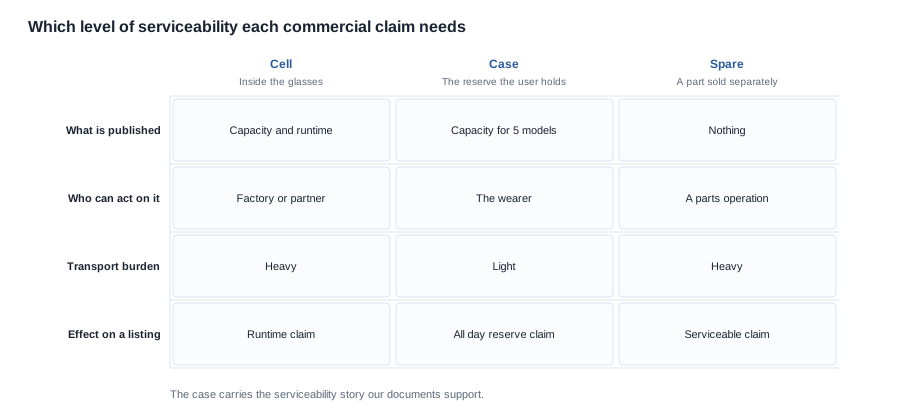
Can the wearer replace the cell themselves? This is the strict meaning of the question: a cell in a housing that a user can open, with a cell that can be bought separately and fitted without tools. In this category it is rare, and for a reason that is structural rather than accidental — the frame is sealed, the battery sits inside it, and the sealing that keeps a pair of glasses comfortable and safe to wear in a pocket is the same sealing that makes the cell awkward to reach. Where a product does publish an ingress marking at all it is a demonstration of the trade-off: our catalogue carries one for only two models, the V06 and the S7, both at IP54, which means a sealed frame and a cell that stays where it is.
Can the cell be replaced by the factory or a service partner? This is the commercially relevant meaning for most buyers, and it is much more achievable than user replacement. It requires that the part exists, that it is identified by a part number, that it can be sourced consistently, and that the replacement does not destroy the product's conformity position. It is an engineering and supply chain question rather than a design question, and it is settled by a written answer rather than by a marketing claim.
Can the wearer swap the "battery" in the practical sense? For a lot of users, the thing that runs out is the reserve in the charging case, not the cell in the glasses. Here our catalogue does publish figures: charging case capacity is published for five models — the L1 Pro and the CY03, and the CY05 — each at 1400 mAh, the L2 Utral at 900 or 1400 mAh, and the MT6 at 1200 mAh in a foldable case. A user whose glasses die mid-day swaps the case. That is a genuine, published serviceability route, and it is a different question from the cell inside the glasses.
So the honest answer has three parts: the cell inside the glasses is not documented as user-replaceable in our catalogue; factory-level replacement is a question to ask in writing; and the case is the part of the system that already swaps.
There is a fourth question that buyers rarely state but always mean, and it is a commercial rather than a technical one: can we sell a spare battery to our customer as an accessory? That is a different proposition from replacing a cell, because it can be satisfied by an accessory that is a completely separate product — a case, a power bank, a second pair of glasses, a charging dock. It is also the version of the question that can be answered today, and for a buyer with a retail range it is often the more valuable one, because accessories carry margin, attach at the point of need, and do not require the factory to open a frame.

What we publish about batteries, and what that is not
Here is the published position in full.
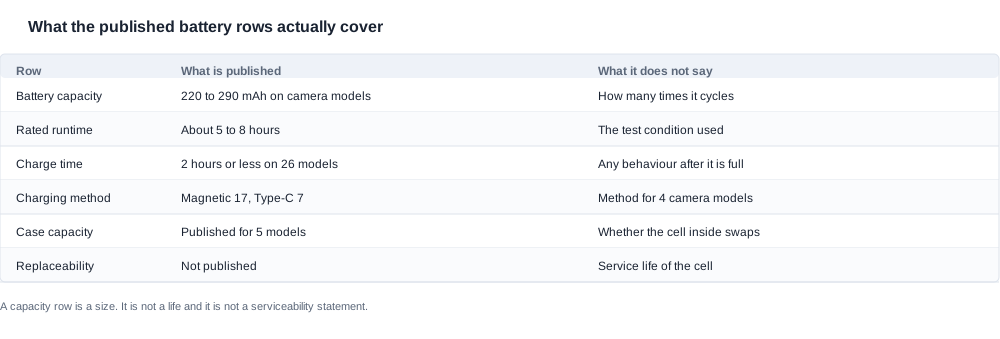
What we publish. Battery capacity on the camera models, in the 220 to 290 mAh range. A rated runtime of about five to eight hours on those models. A charge time of two hours or less on 26 of the models in the range, with only the D17 and the ZH12 publishing a shorter figure of about one hour. The charging method: magnetic on 17 models, Type-C on 7, and not published for the CY05 and the CY03, and the MT6 and the L1 Pro. Charging case capacity for five models, a case of unstated capacity for the KY06 and the MT5, no case row for the S7 and the V03, and the V03 Pro and the V06 explicitly documented as a product with no case. And, for the sport range, the YKC02 with a pair of 70 mAh cells — a two-cell configuration that is worth noting when a buyer is thinking about what a battery swap would mean.
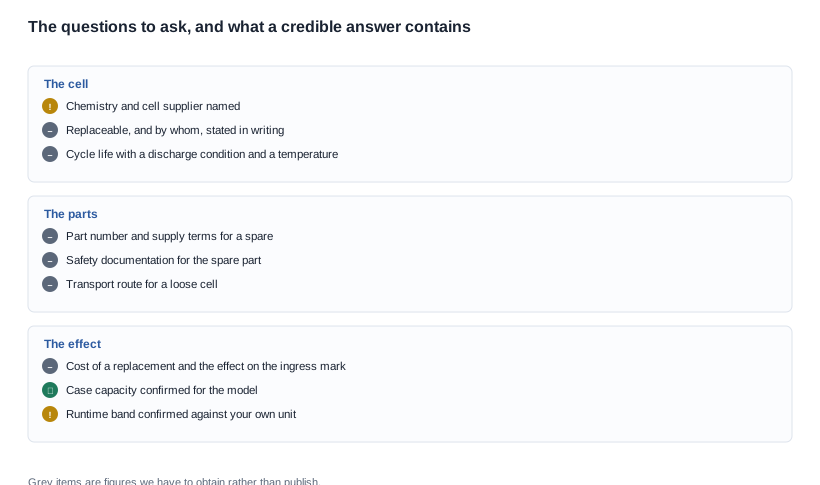
What we do not publish, for any model. The cell chemistry. The cell voltage. The cycle life, in any form, and therefore also the calendar life. Whether the cell is field-replaceable. Whether the cell is user-replaceable. Whether spare parts are supplied at all, and on what terms. The cell safety evidence that a transport obligation or a market obligation would need. And the mass of the cell, which matters for the balance of the frame.
What that means in practice. A published capacity figure is a size, not a life. "220 mAh" and "about five to eight hours" together describe a cell that is expected to deliver a particular experience under conditions the catalogue does not state. They do not tell you how many times the cell can be cycled, whether it degrades faster in a hot car, whether a two-year-old unit still holds a full day, or whether the cell can be replaced at all. Anyone who reads a capacity row as a serviceability statement has misread it, and the most common way that misreading reaches a customer is through a listing that says "long-lasting battery" when the underlying document says only "220 mAh".
Two published details are worth adding to that, because they change what a swap would involve. The first is the YKC02 in the sport range, which is built around a pair of 70 mAh cells rather than a single larger cell. A two-cell configuration is a different service proposition from a one-cell configuration: a swap involves two cells rather than one, and the cells have to be matched as a pair rather than as a single item. The second is the charging method distribution — magnetic on 17 models and Type-C on 7 — because magnetic charging is normally implemented through the case, which means that on those models the case is not merely an accessory but part of the charging circuit. That is another reason the case is the object a user can meaningfully swap, and another reason a "swap the battery" claim needs to name which object it means.

Why the answer matters commercially before it matters technically
If you are going to claim it, you have to substantiate it. A listing that says "user-replaceable battery" is a claim that a consumer protection regulator, a marketplace reviewer or a customer can test. Our published documentation cannot support that claim for any model, and a claim that cannot be substantiated from the supplier's file is a claim that will eventually be tested by the first customer who opens the frame. The wider treatment of how the electrical rows interact with consumer rules is in battery life and how regulations affect this, and it is worth reading before the copy is written rather than after.
If you want a spare-parts programme, there is a supply chain behind it. A spare cell is not a cell in a box. It is a part number, a supplier relationship, a safety file for that part, a transport classification so the spare can be shipped to a customer or a service centre, a warranty position on the fitted part, and a stock of the part held for as long as you support the product. The documents a loose lithium cell needs in transit are set out under battery transport, and that is the easy half of it — the hard half is that the part has to exist as a consistently identifiable thing for years.
If you are building a channel story, this row is load-bearing. Any argument about a long product life, a refurbishment route, a resale market or a total-cost-of-ownership advantage assumes that the thing can be opened at some point. If it cannot, the argument is about a different product, and it is better to make the argument about the case — which does swap, and which we do publish.
And if you sell a range, the mixing creates a support problem. A catalogue of 28 models spanning the audio, sport, camera and kids ranges contains a mix of cases and no-cases, magnetic and Type-C charging, and four camera models where the charging method is not published at all. If your channel treats "the battery" as one thing across the range, the support scripts will be wrong for some of the models, and the wrongness will surface as a customer complaint rather than as a data question.
From the retailer's side, the question becomes a returns problem. A retailer who is told the battery is replaceable will accept a return against the battery category rather than the device category, and a returns counter that can swap a part converts a device return into an accessory sale. That is a good outcome for the retailer and a bad outcome for the brand if the part does not exist, because the return still has to be honoured by replacing the device. Which means the accessory story has to be real before it is told, and on our published data the only accessory story the range supports today is the case, and only for the models that publish one.
What a supplier can legitimately answer, in the order that costs least
These questions converge on the same answer, and they are ordered by how little effort the supplier has to make to respond.
- What is the cell chemistry, and who supplies the cell? A manufacturer that cannot name its cell supplier is telling you something about the depth of its own documentation.
- Is the cell replaceable, and by whom — the factory, a service partner, or not at all? This single answer usually settles the commercial question, because the difference between factory replacement and no replacement is the difference between a spare-parts programme and a replace-the-product programme.
- Are spare parts supplied, and on what terms? Including whether a spare part carries the same safety documentation as the original, whether it is supplied as a part or only as a warranty replacement, and what the lead time on it is.
- What is the stated cycle life, and at what depth of discharge and temperature? A cycle life figure without a discharge condition and a temperature is not a cycle life figure. It is a marketing number, and the buyer should ask for the condition the way they would ask for a test condition on a runtime figure.
- What does a cell replacement cost, and what does it do to the ingress position? If a model carries an ingress marking — and only the V06 and the S7 in our range do, both at IP54 — then opening the frame is an event with consequences for that marking, and the supplier is the only party who can say what happens.
- How would a spare cell be transported and sold? The classification, the packaging and the paperwork for a loose cell are a real operational question, and the answers determine whether a spare-parts programme is even possible in your market.
A supplier who answers all six has a serviceable product and a documentation system behind it. A supplier who answers none of them has a product that is replaced rather than repaired — which is entirely normal in consumer electronics and perfectly viable commercially. The failure mode is not a sealed battery; it is a sealed battery described as a replaceable one.
Two practical notes on where these answers come from, because they affect how much weight to put on them. The first is that the useful documents are not marketing documents. The cell's own datasheet from the cell supplier, the transport documentation for the cell, and the safety test evidence are where the chemistry, the cycle life and the replaceability decision actually live; a product specification sheet is a summary of them and is where a friendly summary is most likely to go wrong. The second is that a cell figure quoted without the model it belongs to is not an answer — cells of the same nominal capacity differ between suppliers, and a buyer comparing a quoted 2000 mAh cell for a different model against a 2000 mAh cell for this one is comparing two products, not two documents. Always ask for the figure against the model designation.
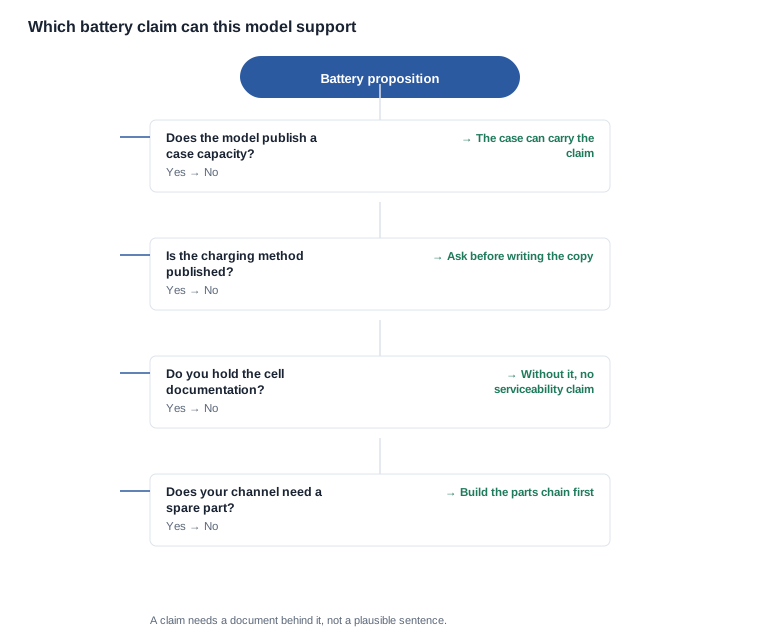
The shortlist criteria for a supplier who claims serviceability are short enough to apply in a single meeting. The claim must be model-specific rather than range-wide. The answer must name who performs the work — the factory, a service partner, or nobody. The cycle life must carry a discharge condition and a temperature. The spare part must have an identifier and a safety file. And the answer must survive the question "which document says this", because a claim with a document behind it and a claim without one look identical in a quotation and behave completely differently in a returns department. A supplier that passes those five criteria can be shortlisted for a serviceable proposition; one that fails them can still be shortlisted for a product that is simply replaced when it fails, which is a perfectly good proposition as long as the listing says so.
The trade-off underneath all of this is worth naming, because it is a real commercial choice rather than a technical failure. A sealed battery is cheaper to build, better to weatherproof, lighter and simpler to support. A serviceable battery costs more in the first unit and gives back a second life, a wider resale market and a better returns margin for the channel. Both are legitimate products. The mistake is choosing one and selling the other.

The case is the part of the system that already swaps
The published case data deserves more attention than it usually gets, because it is the one piece of serviceability the catalogue does document.
The figures. Case capacity is published for five models: 1400 mAh for the L1 Pro and the CY05, and the CY03; 900 or 1400 mAh for the L2 Utral; and 1200 mAh in a foldable case for the MT6. The KY06 and the MT5 have a case with no published capacity. No case row appears for the V03, the V06 or the S7, and the V03 Pro is explicitly documented as having no case.
Why the case is the practical answer. For a user, the case is the object that runs out. The case is also a separate physical item with its own mass — our published weight for the MT6, 158 grams, is for the glasses alone and explicitly excludes its 1200 mAh foldable case — which means swapping it is a mechanical action, not a soldering exercise. And because the case is a normal consumer electronic accessory rather than a loose cell, it ships, sells and is replaced through ordinary channels.
The models where it does not apply. Three camera models have no case row, and one is documented as a no-case product. For those models there is no published reserve in a case, and the only endurance the customer has is the cell in the glasses against the published runtime band of about five to eight hours. A buyer building a range with a "all-day reserve" story has to check the case row per model rather than generalise across the camera tier.
The accessory opportunity, stated honestly. A case is a genuine accessory: it has a published capacity on five models, it is a separate physical item with its own mass, and it is replaceable by the owner without any technical skill. For a brand with a retail range that is an attach-rate story and a margin line, and it is the one serviceability proposition our published data actually supports today. The constraint is that it only exists for the models with a case — including two models where a case exists but its capacity is not published, which is a documentation question rather than an existence question, and worth asking about if you are planning an accessory line for those models.
The question the case does not answer. A case swap restores endurance; it does not restore a cell that has worn out. If the cell in the glasses has degraded, the case cannot help, and the product is finished. Whether that matters commercially depends entirely on the cycle life and calendar life, which is exactly the figure that is not published.
What we can tell you today, and what we will not invent
We are not going to tell you the batteries are replaceable, because our documentation does not say that. We are equally not going to tell you they are sealed forever, because our documentation does not say that either. The gap between those two statements is where your product claim has to live, and filling it with an assumption is the one thing we will not help you do.
What we will do is this. Give us a specific model and we will tell you which of the six questions above our published rows already answer — the charging method, the case, the charge time and the runtime band are published for many models, and the cell documentation is not published for any of them — and we will route the cell question to the people who hold that documentation and come back with a written answer rather than an inference.
If your product depends on serviceability, say so at the specification stage rather than after the tooling is done. It changes what you need to obtain before you order, it may change the model you choose, and it is far cheaper to establish than to retrofit into a product that has already been tooled and packaged. That is a commercial argument, not a technical one, and it is the argument to have early.
The list of things to obtain is short enough to be practical. For each model in your range: the cell datasheet with its chemistry and cycle life condition; the supplier's written position on field replacement and on spare part supply; the transport documentation for the cell, which you need for the shipment itself regardless of any accessory plan; the case row for that model; and the charging method, which is published for most models and needs to be asked for on four. Collect those before the order and the serviceability proposition can be written accurately. Collect them afterwards and you are rewriting copy you have already printed.
There is a decision to make at this point, and it has three branches. If your programme depends on a replaceable cell, then the cell documentation is a gating item: no order should be placed until the answers exist in writing, because the claim is part of the product and the product is the thing being tooled. If your programme depends on a spare accessory instead — a case, a dock, a second unit — then the accessory list is the gating item, and it can be built from the published case rows without waiting on the cell file. And if your programme makes no serviceability claim at all, then the cell documentation is still worth obtaining before launch, because the first customer who asks how long the battery lasts deserves an answer that is not a capacity figure.
Whichever branch you are in, the due diligence work is the same shape: a short list of documents, requested by model designation, before the order rather than after it. That is the whole discipline, and it is much cheaper than discovering the gap during a listing review.
The wider treatment of the electrical rows is under smart glasses battery life and power. The platforms where we can describe the full electrical picture are on the bluetooth audio glasses range page, and the camera range — where the capacity and runtime rows are published — is on AI camera glasses.
Tell us whether your product depends on serviceability, and we will tell you what you need to obtain before ordering.
Related reading
- Why the runtime figure is a separate question — battery spec sheet explained
- Documentation the cell specification unlocks — battery life and regulations
- Choosing a platform before asking about cells — smart glasses model comparison
Tell us whether your product depends on serviceability, and we will tell you what you need to obtain before ordering.


