

Battery regulation in this category is not one thing. It is at least five separate obligations, and they attach at different points to different parties, with different evidence, different costs and different lead times. Two of them attach to the shipment itself and follow every unit that crosses a border, including a single sample pair. The other three attach to whoever places the product on the market, which in a B2B supply chain is normally you and not the factory.
The practical effect on a purchase is narrower than the topic sounds and considerably more useful. A regulation does not change the product. It changes which configurations you can lawfully buy, which markets you can ship them into, and what set of documents has to exist before the first order. Get the five perimeters wrong and the discovery arrives at the wrong moment: a carrier refusing a consignment, a marketplace suspending a listing, or a compliance reviewer asking for a cell document that was never collected.
Our own catalogue makes the problem unusually concrete. Across all 28 models we publish no battery cell chemistry, no cycle life and no field replaceability. Those are exactly the rows that cell safety evidence, waste handling and any replaceability claim are built on. So three of the five obligations currently rest on data we do not hold. That does not mean a product in this range cannot be sold into a regulated market. It means the burden of obtaining the evidence moves to the buyer, and the time to obtain it has to be planned before the purchase order rather than after the compliance review asks.
Smart glasses battery life: five regulatory perimeters and what each closes
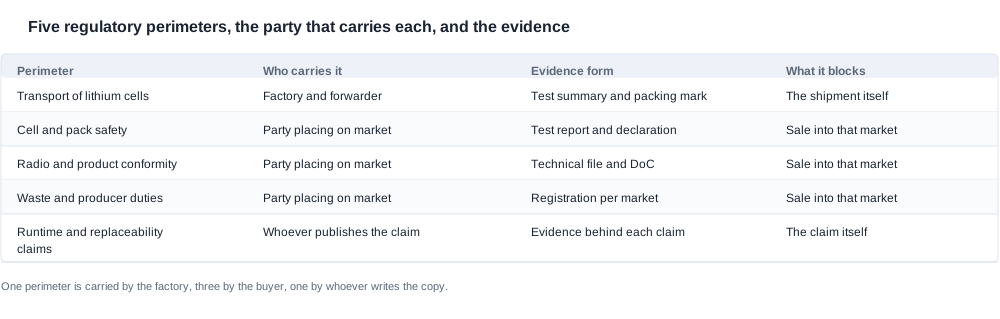
A perimeter is best understood as a question: what does this rule prevent me from doing? The five below are ordered by how directly they constrain a purchase, not by how much they cost to discharge.
Transport of lithium cells stops a shipment. It applies to every consignment that contains a cell, whatever the commercial terms, the quantity or the destination, and it is the least flexible of the five because the obligation follows the goods rather than the contract.
Cell and battery safety evidence stops a sale into a market. It attaches to the party placing the product on the market, and the evidence required is defined by that market, which is why a single product can be compliant in one country and unsellable in another.
Radio and product conformity stops a sale into a market. It is the perimeter most buyers already know, but it intersects with the battery because the radio and the battery share a technical file, a model list and a declaration.
Waste and producer duties stop a sale into a market. In the European Union, electrical and electronic equipment placed on the market carries producer responsibility obligations, including registration and marking, and they sit with the party placing the product rather than with the factory that built it.
Runtime and replaceability claims stop a claim rather than a sale. A runtime published without a condition and a battery described as user replaceable are both liabilities for whoever publishes them, and in a B2B channel that is the brand, the distributor and the retailer, each with their own copy to review.
The important consequence is that a regulation narrows the purchasable set. A buyer serving three markets does not have one purchasable catalogue; they have three, each with its own configuration rules, its own documentation and its own timeline. A supplier who says the product is compliant has answered a question about one perimeter on one market, and the useful question is always which perimeter, on which market, evidenced by which document.
The three failure patterns in compliance purchasing
The first failure pattern is treating a company-level statement as a model-level one. Our catalogue's front page carries a company-level export certification page whose content is images rather than text, so the catalogue body states no certification claim at all. There is no per-model certification row for any of the 28 models, so a model-level claim cannot be derived from it, and a buyer who treats the front page as a 28-model certificate list is relying on an inference the document does not support.
The second failure pattern is a supplier answering in the language of the perimeter rather than in the language of the document. "We have all the certificates" identifies no issuer, no scope and no number. The question that closes it is the same every time: which document, issued by whom, naming which model, valid until when.
The third failure pattern is timing. Compliance work sits on the critical path of a launch because it is a queue rather than a decision, and the artwork sits at the end of it. A marketing decision made in week three becomes a packaging reprint in week twelve, and the reprint is the visible cost while the schedule is the real one.
Two of these are general purchasing pitfalls rather than battery-specific ones, and the third is the reason the sequence in this article matters more than the list of documents.

Transport: the one perimeter that applies to a single sample order
Because every model in this range is battery-powered, transport obligations apply to every order including a sample order, and they apply before the goods move rather than after. Four consequences surprise a buyer who has never shipped a lithium cell in a finished product.
The documentation has to exist before production, not before dispatch. A transport file is produced from the cell documentation and the pack configuration, both of which are settled at design stage. A buyer who discovers the gap at booking time is discovering it late, and the fix is not a phone call.
The packaging carries a mark. Lithium consignments are marked and packed to a defined instruction, and the carton design is affected rather than merely the paperwork. A private-label artwork change after the packing instruction is fixed is not a free change.
The charge state constrains the mode. A restricted state of charge rules out some routes, which changes the cost, the transit time and the insurance treatment of the consignment. A programme that leaves the mode undecided until the goods are finished has a transport delay waiting for it.
A carrier can decline the consignment. A refusal at the forwarder is a worse outcome than a delay, because it is discovered by the factory rather than by the buyer and it consumes the schedule while the paperwork is being fixed.
The cell documentation is also the most fragile document in the pack. A transport test summary is written against a specific cell. If the factory substitutes the cell for availability, the summary on file no longer describes what is in the unit, and the document a buyer was relying on becomes worthless while still looking valid. This is the strongest reason to write a change-control clause on the cell, and it costs nothing to include.
What to request on the cell before the first order
- The transport test summary, with the cell part number on it. Not a family statement. The part number is the only thing that ties the document to a physical cell.
- The pack configuration the summary covers, including whether the summary is for the cell alone or for the assembled pack.
- The packing instruction and the mark that will appear on the carton for the configuration being ordered.
- The cell maker and the maker's own contact for the summary, so that a question about the document does not have to travel through the factory's sales team.
- A change-control undertaking stating that any cell substitution will be notified in writing before the change is made, and that the documentation will be reissued.
None of these are commercial levers in the usual sense. They are conditions of the purchase, and they belong in the contract rather than in an email, because a contract is a thing a carrier and a compliance reviewer can be shown. The wider logistics structure is set out under shipping and logistics, and the transport side of the cost is covered at battery life and power.
Market access: what a cell and a radio bring into the conformity file
The conformity work for a connected product is assembled from several frameworks, and the battery is part of it whether the supplier mentions it or not. A buyer does not need to become the expert. A buyer does need to know which document each framework produces, who issues it, and what it has to name, because those three facts are what a supplier is judged on when the answer arrives.
The radio framework produces an assessment and a declaration of conformity, with a technical file kept behind them. In the European Union that is the radio equipment framework; in the United States it is the equipment authorisation route; and separately, the Bluetooth trademark and the licence terms require a qualification listing that names the product and the qualified design. The radio framework intersects with the battery because both live in the same technical file and both are listed on the same declaration.
The cell and battery safety framework produces a test report against a cell safety standard, plus the transport summary described above. The standard that a compliance adviser will apply for portable secondary cells is the IEC 62133 series, and a national route such as the UL certification route in the United States adds its own document set. Which standard applies to a given destination is a question for the buyer's own compliance adviser, and the answer is not something a catalogue can supply.
The European battery framework adds obligations layered on top of the general product safety rules. Regulation 2023/1542 introduces requirements around battery passport data, collection and labelling for batteries placed on that market, and the application of its provisions is phased rather than immediate. A buyer with products in the European Union should take the phased timetable from their own adviser rather than from a supplier, because the timetable determines whether a given unit can be placed on the market in a given quarter.
The substance frameworks produce a declaration covering restricted substances, and that declaration is a per-part-number document rather than a per-product one, which means the same declaration cannot be assumed to cover a cell that has been swapped.
The practical point for a battery buyer is narrow. Every one of these frameworks ends in a document that names a model, and a model list is the document that decides whether a branded unit is covered. A report on the factory's own item number is not a report on yours, and a family declaration that omits your colourway or your branded configuration does not cover it.
Where the catalogue cannot help you scope the file
Our catalogue publishes the radio version for fourteen of the 28 models. The eleven camera models, the two children's protection models and the bone-conduction entry publish no radio version at all. For those models, the radio part of the conformity file cannot be scoped from the catalogue, and the questions to ask are about the radio module, the band and the qualified design rather than about the battery.
That gap matters for a battery purchase in a specific way. The radio version determines the module, and the module determines the power budget, and the power budget determines what the published runtime is measuring. A buyer who has scoped a battery requirement without knowing the radio will find that the runtime target and the radio requirement were never compatible. How to evaluate a supplier's answer on this is a separate exercise, and the questions to ask are the same in both cases: which document, issued by whom, naming which model, valid until when.

Producer registration, market labelling, and the obligations that sit with you
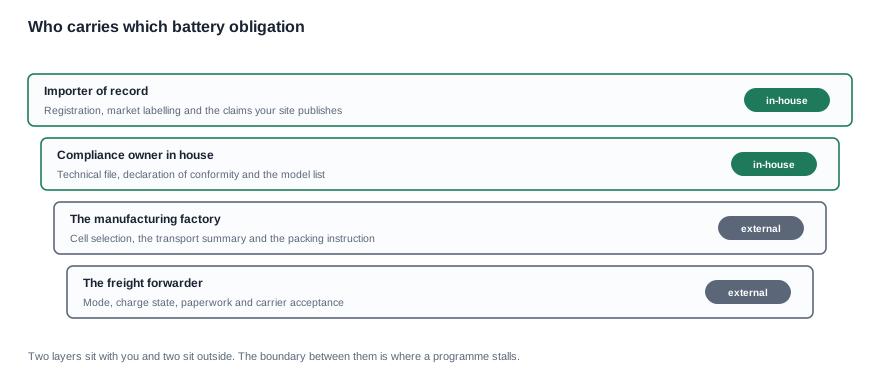
Three of the five perimeters sit with the party placing the product on the market. In a B2B supply chain this is usually the brand owner or the importer of record, and occasionally the distributor who takes title in their own market. The distinction is not academic: the registration obligation attaches to a legal entity, and a group selling into several markets through one entity will find that the entity's registrations do not travel with the goods.
The practical shape of this work is consistent across markets. There is a registration, and there is a number or an identifier that has to appear on the product, on the packaging, or on the documentation that travels with it. The registration is per legal entity, and often per category. The marking is per model and per market. The first is a cost and a queue; the second is an artwork item, and artwork is where schedules are lost.
Two commercial consequences follow, and both are worth stating early in a programme.
First, the cost of a producer obligation is essentially fixed per market and per entity, and it does not scale down with volume. A small launch order does not make the registration cheaper. This is why the market list is a decision to make before the quotation rather than after it: a channel served only from markets where the registrations already exist is worth a materially better price than one that needs new registrations opened.
Second, the scope of the obligation is negotiable in a way the fee is not. The number of markets, the number of legal entities, the number of product categories and the number of label variants are all things a buyer decides, and each of them multiplies the work. Consolidating the entities and dropping a market label set is a negotiation about scope, not about price.
The third consequence is a claim perimeter, and it is the one that reaches the copy rather than the carton. A runtime published on a product page is a performance claim, and the evidence for it is the condition behind the number. Our catalogue publishes rated runtimes from roughly six hours on some audio platforms through roughly seven and roughly eight hours on others to roughly twenty hours on the children's models, with no test condition stated for any of them. A brand that republishes one of those figures as a performance claim is publishing an unconditioned measurement, and the defensive version is straightforward: state the figure and the condition together, or state the condition and let the figure follow from the buyer's own measurement.
A replaceability claim is the second one to watch. No model in this range should be described as having a user replaceable, serviceable or long-lived battery, because the catalogue publishes no data supporting any of those statements and a claim that cannot be substantiated is a liability rather than a feature.

The published rows that do not cover these obligations, and what to request instead
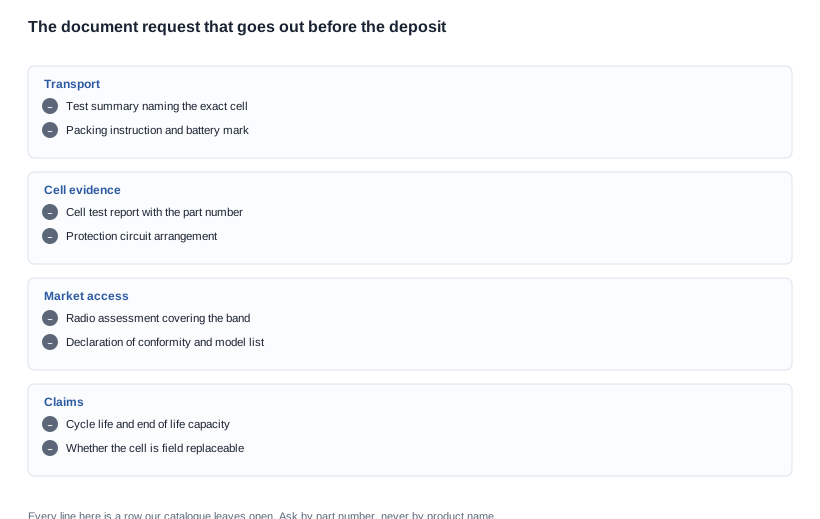
The most useful thing a buyer can take from this page is a document request, because it converts an abstract compliance problem into a list of files with names on them. Ours has four groups.
Transport. The test summary naming the exact cell, and the packing instruction with the mark that goes on the carton for the configuration ordered.
Cell evidence. The cell test report with its part number, and the protection arrangement description. The second of these is not a compliance document in the formal sense, but it is the one that tells a reviewer whether the unit will behave as described, and it is routinely absent.
Market access. The radio assessment covering the band in question, and the declaration of conformity with the model list attached.
Claims. The cycle life figure or a stated test plan, and a written statement on whether the cell is field replaceable. Both are rows we do not publish, and both are answerable by the factory.
The important part is how the request is made. Ask by part number rather than by product name, because a supplier who answers with a part number has identified a cell and a document, and a supplier who answers with a product name has answered with marketing. Ask for the same four groups for every model on the shortlist, because the answer for one model says nothing about the next, and asking the same way makes a partial answer visible.
Two red flags are worth naming. The first is a supplier who offers a single document for the whole range, which means the document is not scoped to a cell and therefore not scoped to a model either. The second is a supplier who treats the question as an obstacle rather than as a request, and answers with a promise to follow up. The follow-up becomes a schedule item, and schedule items in compliance are the expensive kind.
Clearing the battery obligations before the first purchase order

The sequence below is the order in which the work actually runs, and it is not the order the obligations appear in most catalogues. Running it in this order means the two long queues, the transport file and the market access documents, start first, because they are the ones that cannot be compressed by paying more.
Step one is the market list. Name the destinations per order rather than per product. The answer determines which frameworks apply, which registrations are open and which label sets are in scope. A programme that names a market later will open a registration later, and will reopen it for every additional market.
Step two is the cell. Fix the part number and the maker. Almost everything downstream, from the transport summary to the safety report to the substance declaration, is written against a part number, and a cell that is still provisional makes every document provisional.
Step three is the transport file. Collect the summary and the packing instruction. This is the queue that starts earliest and is the one that stops a shipment rather than a sale.
Step four is the cell and pack safety evidence. Collect the report that a market will ask for, in the form your compliance adviser specified.
Step five is the technical file and the declaration. This is the buyer's own work, in the buyer's own name, and it is the step that most often gets left until the artwork is approved.
Step six is registration and labelling. The registrations open, the marks go onto the artwork, and the artwork goes to print.
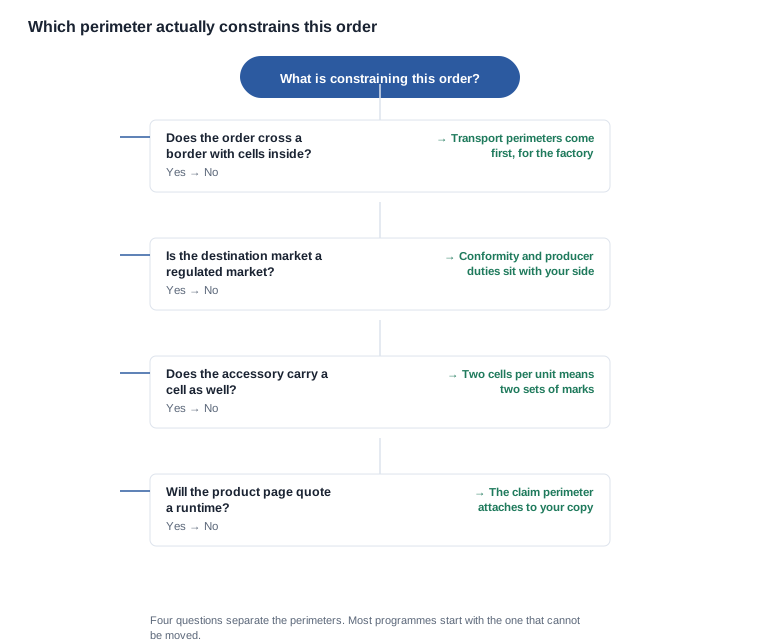
The decision chart above exists because the order of the six steps is not always the right one for a given order. A single sample order to a designer carries only the transport perimeter, and clearing steps three and six in parallel is enough. A production order into a regulated market carries all five, and the sequence above is the only version that works.
What we will do is tell you, for a specific destination market and volume band, which of the five obligations apply to the configurations you are considering, which documents we can source directly, and which ones your side has to obtain. We will also say plainly where the answer is that the evidence does not exist yet in our documentation, which is the case for the cell chemistry, the cycle life and the field replaceability rows across the whole range.
The broader compliance framework sits under product compliance, the recurring errors this obligation surfaces early are covered at battery life buying mistakes, and the measurement side of the runtime obligation is at smart glasses battery life and power.
Related reading
- What a rated figure does not tell you — battery spec sheet explained
- Mistakes this obligation surfaces early — battery life buying mistakes
- The broader compliance framework — product compliance
Tell us your destination market and we will map these five obligations against your specific order.


