

Two answers to the question, and the second one is ours specifically.
In general terms: a conformity certificate is model-specific, it does not transfer with the goods, and it does not transfer the obligation to place a conforming product on a market to the party placing it. In our case: we publish no certificate numbers at all, so there is nothing for you to use. That is the honest answer, and we would rather give it to you before you build a plan around it.
There is a second point that is worth stating early, because it is where buyers most often get the category wrong before they even ask us. The only certificates we publish are patent certificates — an export-certification page that carries ten patent certificate images, eight design patents and two utility models. A patent is a right over an invention or a design. It is not conformity evidence, it says nothing about electromagnetic behaviour, it does not make a product legal in any market, and it is not transferable to a new brand owner in any case. So even the documents we do hold would not answer the question being asked here.
That is not a way of avoiding the question. It is the reason the question needs a precise answer: the buyer who is planning a branded programme needs to know who carries the obligation, what evidence has to exist, and who pays for producing it. Getting that wrong is expensive and it is usually discovered late.
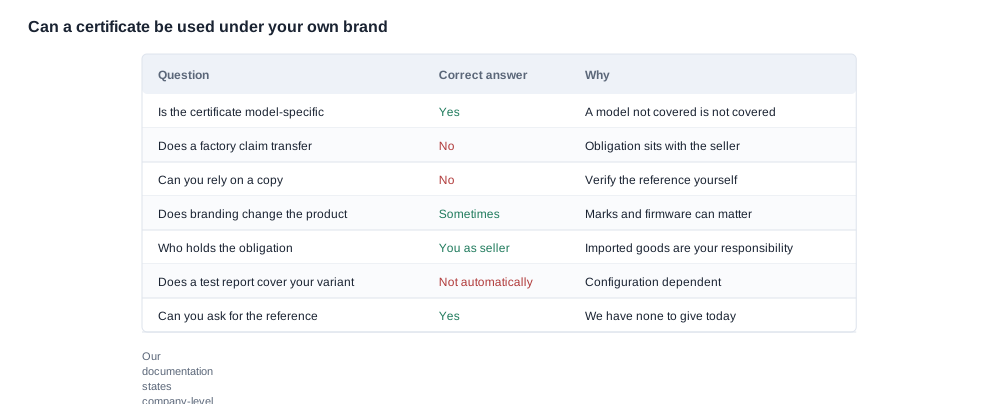
Can I use your certificate for my brand: the short answer first
The short answer, in the order a buyer usually needs it.
No, a supplier's certificate does not become your evidence simply because you buy from that supplier. The obligation to place a conforming product on a market sits with the economic operator doing the placing, which in an import programme is your company. A supplier's certificate evidences what the supplier declared about its own product; it does not discharge your obligation for a product you sell under your own brand.
In our case there is no certificate to inherit. Our catalogue body does not mention CE, FCC, RoHS, RED or EN 18031 at all, and there is no per-model certification row anywhere in the range. We publish a patent picture page, and that is the whole of the documentary position.
This is not fatal to your programme, but it does change who does the work. If your channel requires conformity evidence, that evidence has to be obtained for your brand, against your model list, in your destination market, and the cost and the lead time belong in your plan rather than in a footnote.
And in some channels, our products are simply not a candidate today. That is the commercially useful part of the answer. A channel that will not accept a product without a per-model conformity reference is a channel we cannot enter without a certification programme, and the honest way to handle that is to say so before the listing work starts rather than after it.
We recognise this makes us a weaker supplier to some buyers than one who hands over a folder of documents on the first call. It is a real trade-off and it was made deliberately, because publishing a reference we cannot stand behind would be worse for you than publishing nothing: you would build your technical file on it, and the exposure would surface in a market where your company, not our factory, is the operator on the hook.
What we can do instead is tell you which obligations attach to your product in your market, what evidence you will need to assemble yourself, where the obtaining effort is significant, and which parts of the programme are cheap to change and which are not. That is genuinely useful even when we cannot fill the file ourselves.

Four misconceptions, and can I show where each one breaks
"The factory has it, so I am covered." This is the most common version and the most expensive. The reasoning assumes that conformity is a property of the product, when in the structure of most regimes it is an obligation attached to a party and to a specific placed product. The supplier's evidence describes the supplier's declaration about the supplier's product. The moment you relabel it with your brand, you are the one making the declaration, and the file has to reflect that. The precise allocation of responsibility differs between frameworks and between market-access arrangements, so a buyer planning an import programme should confirm the structure with its own adviser — but the principle that "the certificate follows the brand" is the one to design around.
"A certificate covers the whole product range." A conformity document normally names the models it covers, and a model list is one of the first things to read. If a buyer orders four models and the document names two, the other two are not covered by it, and this is not a technicality: it is the difference between a compliant product and a non-compliant one on a shelf in a market that enforces it. The check that catches this takes five minutes — match the model list against the purchase order line by line — and it is the check that most often gets skipped because the document arrived with the samples and looked complete.
"A test report means my configuration is fine." A test report normally covers one configuration: one hardware build, one firmware version, one set of materials, one set of accessories. If the temple shape, the colourway, the lens type or the software changed after the test, the report may not describe what is in your box. This is where branding genuinely bites, and it is why the four lines below matter more than the certificate itself.
"A copy is enough." It is not, and this is the misconception that causes the most difficulty during an audit. The entire purpose of a certificate with a reference number is that the number can be entered into a registry and checked. A copy of a document whose reference cannot be verified is an assertion with a logo on it. Ask any supplier for the reference number, the issuing body and the validity period, and then check the reference independently — the check takes minutes and it is the only test of the document that means anything.
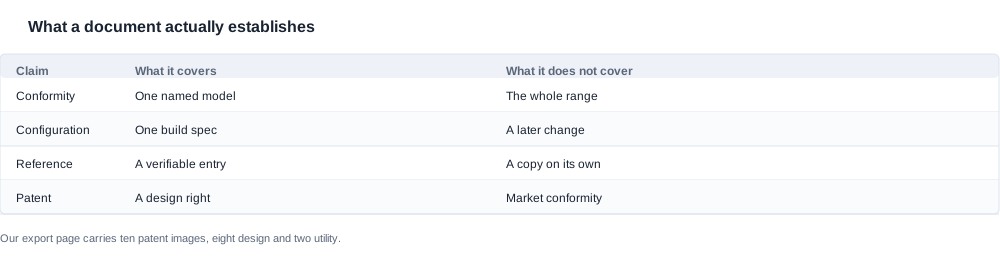
There is a fifth assumption worth naming because it does not appear in the list above and it is the one that shapes a programme: that the supplier's catalogue position is a certification position. It is not. The catalogue tells you what a product is. It does not tell you what a product is permitted to do in a market. The two are maintained by different disciplines inside a factory, and a catalogue that is silent on compliance is telling you nothing either way.
A sixth assumption is more technical but it turns up in exactly the same conversations, so it is worth separating as well: that a published Bluetooth version is a Bluetooth listing. It is not. The Bluetooth version in a catalogue row is a technical parameter — the catalogue publishes one for fourteen of the twenty-eight models, and not for the eleven camera models, the A05, the A06 or the bone conduction products. A listing under the Bluetooth trademark programme is a separate administrative act with its own applicant, its own declaration and its own reference, and holding one does not imply the other. A buyer who treats the version number as evidence of a listing will find that the version number supports no such claim.

The two cases where branding matters, and can I build around them
There are two categories of change where a branded product can genuinely fall outside what an existing document described. They are worth isolating because they are the cases where a buyer's instinct — "it is only a logo" — is wrong.
Marks, labels and model designations. Adding a logo, a model designation or a market-specific label changes the finished product. Sometimes the change is genuinely cosmetic. Sometimes it changes what the documentation describes: the model designation appears in the test report, the label carries the importer's identity, the packaging carries the declared ratings, and the declared ratings are part of what was assessed. This is the same problem that a buyer faces whenever it changes a configuration for any other reason, and it is why the cost of a modification has to be assessed as well as the cost of a modification. The customization cost factors page covers what a change actually costs in tooling, in new parts and in re-qualification, and the point for this article is that a branded version is not automatically the cheap version.
Firmware and software. A product that declares a radio or that runs software transmitting identifiers has a declared behaviour that a branding change can alter. Most factories do not think of this unless the buyer asks, because the firmware is built for the OEM's own application and the rebranding happens in the packaging and the app. Ask explicitly: what identifiers does the shipped software transmit, what does the firmware say about itself, and does anything in the software carry the OEM's name in a way that the documentation would need to reflect. In a category where the app is the product for many buyers, this is not a corner case.
Two further categories are worth a note because they are cheap to get wrong. Colourways and materials frequently appear in a document as a described variant, and if the buyer changes the finish after the test the correspondence between the document and the box weakens. Accessories and charging matter for the same reason: a charging case, a cable or a mount that ships in the box may be described in the documentation, and the catalogue rows for the camera models illustrate how easily a bundle changes — the V03 Pro is published explicitly as having no case, the S7 and the V03, and the V06 have no case row, and the KY06 and the MT5 have a case whose capacity is not published. A bundle difference is a documentation difference.
What can be built around all of this is a rule: fix the configuration first, then obtain the evidence, and treat any later change as a re-check. The re-check is the step that gets skipped, and it is the step that creates the exposure, because the product in the box is no longer the product in the file.

What evidence can I give you, and what can I not give you today
What we can give: the product specification as published, per model. The charge methods, the charge times, the battery cells, the resolution tiers, the colour lists, the ingress markings where they exist, and the weight where it is published. All of these are checkable against the physical units and all of them are the input a conformity file is built from. The certification checklist sets out how to assemble that input and what to do with it.
What we cannot give: a certificate number, a test report reference, a laboratory name, a standard edition, a sample size, a validity period, a Bluetooth SIG listing reference, or a conformity document of any kind. The catalogue body mentions no conformity regime at all, and there is no per-model certification row in the range, so there is nothing to hand over that would satisfy a file built on those references.
What we can publish that is often mistaken for conformity evidence: ten patent certificate images on the export-certification page, eight design patents and two utility models. These protect the appearance and the construction of the product. They are genuinely valuable — they are the reason a competitor cannot copy the design — and they are worth understanding precisely, because a buyer who believes a patent certificate is a conformity certificate will build a file that does not hold.
The honest position, stated without hedging, is that we will not supply a certificate reference we do not hold and we will not describe our claims as verified when they are not documented. If a channel you need requires that evidence and we cannot produce it, the answer is that our products are not a candidate for that channel today, which is a much cheaper thing to hear now than after a listing has been prepared, artwork printed and inventory shipped.
There is one more thing we can do, and it is the most useful thing in this article. We can tell you what the conformity programme would involve for your specific model list in your specific market, what the realistic effort and lead time look like, and whether the configuration you want is stable enough that the evidence, once obtained, will still describe the product a year later. That last point is worth more than it sounds, because a programme that has to be repeated after every cosmetic change is not a programme a small brand can carry.
The second thing we can do is tell you when not to run the programme at all. Some channels turn out not to need per-model conformity evidence, some products turn out to be outside the scope of the requirement, and some configurations turn out to be simple enough that the file is a day of work rather than a month. Deciding early that a programme is not required is worth as much as deciding that it is, because a buyer who has committed the budget and the timeline to a compliance programme that the channel never asked for has lost the channel launch to a compliance launch.
And a third, which is practical rather than regulatory: we can tell you which of our models are stable. A model with a fixed configuration, a stable bill of materials and no ongoing firmware divergence is a much better candidate for a documentary file than one that is being revised every quarter, and the difference shows up in the retest cost two years later rather than on day one.
What can I build for you instead: the file and what it costs
If your channel needs certification evidence, the workable plan is to obtain it directly rather than to inherit it, and to sequence it so that the cheap changes happen first.
- Identify the exact models you will ship, including every variant: colourway, lens type, packaging, cable and case. This list is the scope of the programme and getting it wrong at the start is the expensive way to learn that a document covers half of what you ordered.
- Fix the destination market and the channel, because the obligations attach to the destination and differ from one market to another. Two markets in the same shipment can be two different programmes.
- Decide who the applicant is. If your company owns the branding, the risk assessment and the market-access decisions, the applicant is usually your company, with the factory's bill of materials and test evidence as input. If you are reselling under someone else's brand, the arrangement differs. Ask the factory whether it can act as a supporting party on your application — many will, because the hardware is theirs — and whether it will provide the bill of materials, the component specifications and the test evidence it holds.
- Establish who pays and when. This is the negotiable item in the whole programme, and it belongs in the first quotation rather than in a discussion after the test has been booked. Ask for the testing cost, the retest cost if the configuration changes, the cost of the factory's supporting documentation, and what happens to the cost if the programme fails or if you decide not to launch.
- Obtain and verify independently. Obtain the evidence from a body you choose, then check each reference yourself, in the registry, before the goods are produced.
- Keep the technical file — the risk assessment, the traceability record, the batch identification, the test conditions and the model correspondence. This is the artefact an inspector asks for, and it is the one that gets lost.
- Re-check whenever the configuration changes, because the evidence describes one configuration. Put a written notice obligation into the supply agreement so that a change is not silent.

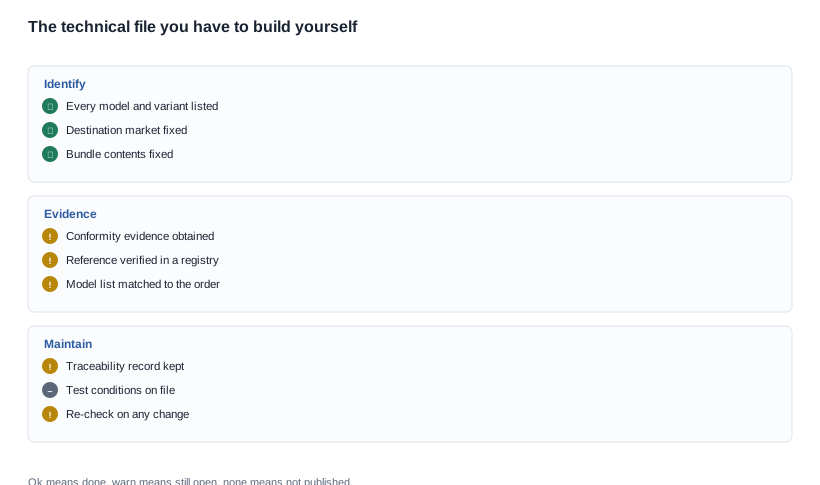
The file itself is shorter than it sounds, and the supplier verification page sets out how to check what you are being given during an audit or a video walk-through — which is also where you can check whether the factory's documentary practice matches its verbal claims. The OEM risk factors page covers the wider set of risks that sit around a branded programme, of which the certification question is one of the more manageable.
One last point about the file is worth making, because it is the difference between a file that helps and a file that is ignored. A technical file that lives in one folder on one laptop is a file that will be out of date the first time the person who built it leaves. A file that names the configuration it describes, the date it was last reviewed and the trigger for the next review is a file that survives. Write those three things on the front page of it, and the document half of a branded programme stops being a compliance chore and becomes a working tool.
The commercial framing for the negotiation is straightforward. The conformity programme is a cost and a lead time, and like every other cost in a first order it is best fixed in the quotation and in the agreement rather than discovered afterwards. Two questions are worth asking early and are rarely asked: what happens to the timeline if the configuration changes after the test, and who carries the cost of the retest? A supplier who answers the first question with "that depends" and the second with "we would discuss it" has told you where the programme's risk will land.
There is a third question worth adding, and it is the one that decides whether the programme scales. Ask what the factory's documentary practice looks like at scale rather than for one model: whether the bill of materials is version-controlled, whether the test evidence is indexed by configuration, whether there is a written change procedure that fires when a component is substituted. These are not certification requirements. They are the ordinary working practices of a factory that can support a branded programme, and a factory that answers them confidently is a factory whose documentary position will still be true in a year. A factory that does not have those practices is telling you that the retest risk will be yours.
Finally, the timeline is worth putting in the plan explicitly rather than treating as an external constraint. A conformity programme, an artwork programme and a packaging programme all compete for the same calendar, and the one that is not planned is the one that delays the launch. Ask for a lead time for each, put them side by side, and decide which one is on the critical path before the purchase order is signed rather than after the artwork is approved and the shelf date has already been promised to the retailer.
And the honest assessment of the channel is worth making explicit before the money moves. If your channel tolerates a product without a published per-model conformity reference — which some distributor and some e-commerce channels do — then this is a cost you have chosen and can plan for. If your channel does not tolerate it, then the product, the programme and the timeline are all decided by the compliance work, and the smart move is to find out that before the purchase order rather than after it.
Tell us your destination market, your channel and the models you intend to ship, and we will map what you need to obtain yourself, where the effort is significant, and which of our models are stable enough for a document to describe them without constant re-checking.
Related reading
- Gathering evidence for your own models — certification checklist
- Why a modification invalidates a claim — customization cost factors
- Checking what you are given — supplier verification
- The wider risk picture — smart glasses OEM risk factors
Tell us your destination market and channel, and we will map what you need to obtain yourself.


