
Children's product compliance is a scoping decision that has to be made before a single test is ordered, and the two ways it is usually got wrong are mirror images of each other. It is used too widely to mean "all the rules for products for children", which overstates it and pushes buyers into testing they do not need, and too narrowly to mean "the toy testing rules", which understates it badly and leaves buyers with a toy file for a product that is not a toy. The honest definition is narrower and wider than either.
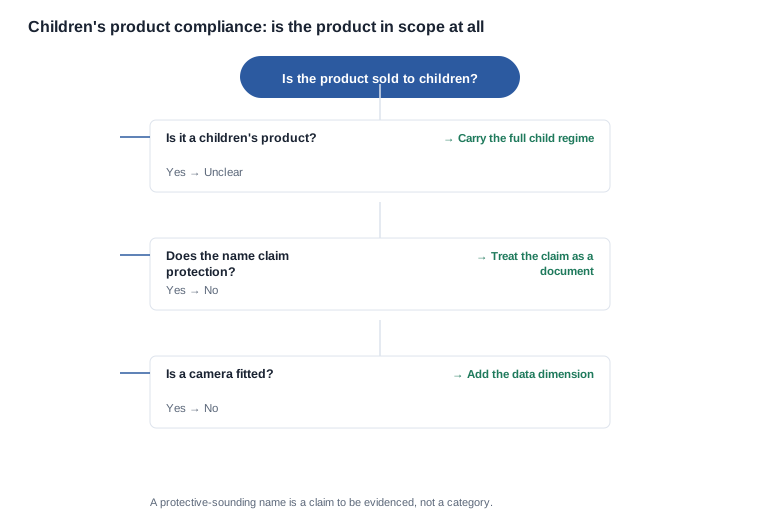
The scoping decision turns on three questions that a buyer can answer before contacting anyone: who the product is intended for, whether the product makes a performance claim about protecting the user, and whether it carries a radio or a camera. Those three questions determine which regime applies, and the regime determines the evidence set, the label content and the recall obligations that follow.
Children's product compliance: the scoping decision comes before the testing
The scope answer that has to be settled first
Three conclusions will save a buyer a great deal of money in this category. First, the name of a product does not determine its regime; the intended user and the claims attached to it do. A model called "children's smart audio glasses" and a model sold to the same channel with a different label can end up in the same regime, and a model with the word "protective" in its name can end up outside it. Second, the protective-sounding word in a product name is a claim, and a claim is something you either have a test report for or do not use. Third, the chemical and radio evidence does not change with the audience, which means one chemical file can usually cover a range that spans several audience variants, and the audience-specific work is concentrated in the mechanical and labelling evidence.
Before you order anything, the red flags worth naming are a model whose protective wording has no report behind it, a colourway outside the existing evidence, and a function added after the file was written. The single most expensive mistake in this category is commissioning the wrong test set. That happens when the buyer treats a product name as a regime. It is avoidable by answering the three scoping questions first, in writing, and having the supplier answer them again against the specific configuration in the order.
The reader of a children's file, and the exposure they carry
The reader is a brand-side compliance lead, a procurement manager, a channel buyer or an importer who is deciding whether a model can be sold into a channel where children will encounter it. Some of them are opening a new line and have to choose between a model the supplier built for children and an adult model they would re-badge. Others already have a product in the channel and have been asked by a retailer or a marketplace for age-related evidence they cannot produce.
The question underneath is not whether the product is safe in the abstract. It is whether the evidence set matches the configuration and the audience, and whether the supplier can produce that evidence for the units that will actually ship. What such a reader is managing is not a test fee. It is a relabelling exercise, a reprint of the packaging, and a delay to a launch window, all three of which follow from a scoping error that was cheap to avoid at the start and expensive to unwind later.
A buyer who wants to know how to evaluate a model against these three questions should ask them before the specification is written rather than after the artwork is locked. There is a second asymmetry worth naming. In most categories, a documentation failure costs a shipment. In this one, a documentation failure is discovered by the party least able to absorb it and most able to publicise it, because the end customer of a children's product is a parent, and parents compare notes. A buyer who has a launch window in a retail calendar has a strong commercial reason to treat the evidence set as a gating item rather than a compliance item.
Three regimes, three different questions, and the one that catches buyers
Why the same product can need three different files
In the European Union, a product aimed at children engages a specific regime whose evidence set is about mechanical safety, flammability and chemistry for an age band. A product that is not a toy but is likely to be used by children sits under the general product safety regime, which adds obligations around traceability, the information that travels with the product, the economic operator responsible for it and the handling of incidents. A product with a radio engages the radio regime as well, whichever of the other two applies to it. In the United States, the children's product rules add a certificate that must be issued on the basis of testing by an accredited third party, which is a different kind of evidence from a supplier declaration.
The distinction that catches buyers is the difference between a product intended for children and a product likely to be used by children. A model marketed to adults, sold through a general retail channel, and picked up by a seven-year-old is not thereby a children's product, but the general regime still expects the producer to consider foreseeable use. That is a much softer test than an age band, and it is exactly where the evidence a buyer demands should differ: a general product still needs the chemistry and radio file, and it needs the instruction and information set to be written for a reader who may be a child.
The second distinction is between a toy and a general product, and it is decided by function rather than by audience. A wearable that plays audio through an open-ear speaker, or that senses posture and fogging and responds to it, is an electronic product with a function. A toy is judged on its play value and its ability to be used by a child for play. A product that is electronic, has a battery, has firmware and may have a camera is almost never a toy, and treating it as one produces a file for the wrong regime.
Our own catalogue names three children's models and evidences none of them
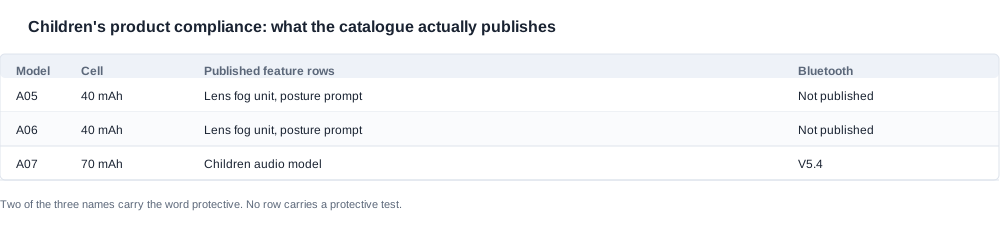
Our catalogue carries three models with children's names and no certification row for any of them. The A05 and the A06 are published as children's smart protective glasses with a 40 mAh cell, magnetic charging, a charging time of two hours or less and a published runtime of about twenty hours; their feature rows describe a lens-type electronic fog unit, with published states for a clear lens and a fogged lens and prompts distinguishing correct posture and distance from poor posture and distance. The A07 is published as a children's smart audio glasses model with a 70 mAh cell, magnetic charging, a charging time of two hours or less, a runtime of about twenty hours and a published Bluetooth version of V5.4.
Two things follow, and they need to be held together rather than separately. The first is that the catalogue names these products with the word protective, and that word is a claim about what the product does for the user. The second is that the published feature rows are what they are: a lens fog unit with posture and distance prompts on the A05 and the A06, and an audio model on the A07. The catalogue publishes no age band, no mechanical test report, no chemistry declaration, no small-parts assessment, no flammability result and no statement of an intended age range for any of the three.
The catalogue also publishes no reference to the children's safety standards at all, and it carries a company-level export certification page with images rather than text on it — ten patent certificates, eight appearance-design patents and two utility-model patents. A company-level page cannot be read across to a per-model conclusion about what a specific model has been assessed against. That inference is exactly the one the evidence does not support, and a buyer who makes it will be relying on a page that says nothing about the product.
The lines that decide whether a children's model is in scope
The scope and evidence criteria, and what a weak answer looks like
Scope is settled before evidence is ordered, and the criteria below are arranged so that you can see which rows decide the scope and which rows settle the evidence. Each line carries how it is measured, the line it has to meet and the shape a weak answer takes, in a form a supplier can answer without a second request. The first four rows should be settled before a single test is commissioned, because their answers determine which tests are even relevant.
| Line to test | How it is measured | The line it has to meet | How a weak answer shows up |
|---|---|---|---|
| Intended user as declared | Read the target user on the packaging artwork and the listing copy. | The declared audience matches the audience the product is sold into. | A model described to the trade as a family model and sold to a child-focused channel. |
| Foreseeable child use | Ask whether the product is likely to be used by a child in the intended channel. | The answer is recorded and the evidence set reflects it. | An assertion that no child will use it, with no channel reasoning. |
| Toy or general product | Assess the primary function against the play-value test. | The regime follows the function, not the audience label. | A toy file commissioned for an electronic wearable with firmware. |
| Protective wording in the name | Identify every claim attached to protection, comfort or sight. | Each claim is either evidenced or removed from the name and the copy. | A protective word in the name with no test report behind it. |
| Age band assessed | Read the age range the test report covers. | The age range covers the intended and foreseeable users. | A report for an age band that excludes the youngest likely user. |
| Mechanical and impact report | Ask for the report for the shipped configuration. | The report names the configuration and the standard applied. | A report for a housing variant that is no longer shipped. |
| Small parts assessment | Ask how removable elements were assessed. | Every removable element is covered by the assessment. | An assertion that the parts are too large to swallow, made without a test. |
| Chemistry across the model | Ask for restricted substances for the whole assembled product. | The declaration covers coatings, adhesives and prints as well as the base material. | A declaration covering one component rather than the assembly. |
| Report across the colour range | Ask whether the reports cover every colourway shipped. | Each shipped colour is covered by a report or an extension. | One report for the black colourway and a second colourway added later. |
| Radio file for the chipset | Ask for the radio regime evidence for the fitted module. | The evidence names the module in the shipped configuration. | A radio file for a different module version. |
| Camera and data handling | Ask how imaging, storage and pairing are handled. | A written policy exists and is consistent with the audience. | A camera added to a child-facing model with no data assessment. |
| Traceability to batch | Ask how a finished unit is traced to a production batch. | The route reaches the individual unit, not only the carton. | Traceability that ends at the packing list. |
| Instruction and label language | Read the instructions against the market they ship into. | The instructions and safety information are in the market's language. | A single English instruction set for several markets. |
| Economic operator on the packaging | Look for the responsible party's name and address. | An operator is identified and reachable in the market of sale. | No named party in the market where the product is sold. |
Two of these rows cannot be compared between suppliers without care, and comparing them anyway is what manufactures a false specification gap. A chemistry declaration that covers one component is not comparable with one that covers the assembled model, and a mechanical report for one colourway is not comparable with a report that has been extended to others. In both cases the difference is scope, not quality, and a buyer should ask which scope is being offered before drawing a conclusion about which supplier is better.
Where the catalogue leaves the children's models specifically
Three published gaps sit on these models and they are worth naming separately because each one is a request rather than a defect. There is no Bluetooth version row for the A05 or the A06, which means the radio position of those two models is an open question in the specification as well as in the file. There is no age band, no mechanical report and no chemistry declaration for any of the three. And there is no protective-performance claim evidenced for the two models whose names carry the word, which is the gap that a buyer should close before the name goes on a carton.
The absence of a Bluetooth row on the A05 and the A06 is worth a second sentence. It is not evidence that those models have no radio. It is evidence that the specification sheet does not record it, which means the request has to name the configuration and ask for the position directly. The A07, by contrast, publishes a Bluetooth version of V5.4, so a buyer can at least establish the protocol level from published material for that model and ask for a declaration covering it.

Turning the scoping decision into a request the supplier can answer
The sequence that turns a scope question into a file
The order of work matters more than the volume of it, and a buyer who wants a checklist rather than a narrative should read the six steps as the six gates. Scoping first, evidence second, and only then a request for documents that the supplier can actually produce, because a request that arrives before the scoping is settled tends to come back as a package for the wrong regime.

-
Record the intended user from the packaging artwork and the listing copy, in a sentence, and have it confirmed against the channel the product will actually sell into.
-
Decide whether the protective wording in the name is a performance claim, and if it is, treat it as a document request rather than as marketing.
-
Ask for the test report behind every protective-sounding statement, naming the statement. A supplier who cannot attach a report to a specific sentence has told you the answer about that sentence.
-
Check the mechanical and chemical evidence against the age band you have determined applies, and check whether the report covers the configuration as it will ship.
-
Add the radio file when a wireless function is fitted, and add the data and imaging assessment when a camera is fitted, because the two questions are separate from the product safety regime.
-
Fix the traceability route that can identify an individual unit later, because a recall in this category is only workable if the unit can be identified.
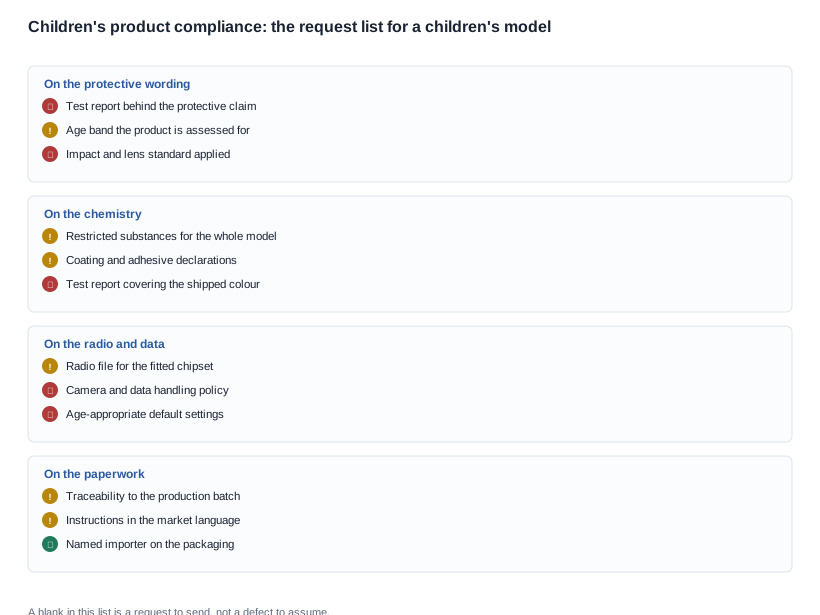
The list above is grouped by the kind of evidence rather than by supplier, because the groups fail independently. A claim group fails when the wording outruns the report. A chemistry group fails on scope. A radio and data group fails when the product grew a function after the file was written. A paperwork group fails when the market changed after the artwork was locked.
The check that prevents a relabelling exercise
If only one check gets made before the packaging is locked, make it a read-through of every performance claim on the packaging against the reports in hand, with a column for the report reference. Claims that cannot be filled in are removed at artwork stage, where the cost is a reprint. The same claims found after the product is in the channel cost a withdrawal, a notification, and the recall of every unit already shipped.

Where children's products fail commercially, and what can still be negotiated
Five ways a children's programme goes wrong
The protective-sounding name read as a certified claim. The model is described to the trade as protective, and the trade describes it to buyers as certified protective eyewear. The symptom is a claim the supplier cannot substantiate, sitting on the outer packaging. The cause is a word in a product name being treated as a performance statement. The prevention is the read-through described above, with the word removed from the copy if the report does not exist.
The evidence that covers the sample but not the shipped colour. A report is commissioned for the launch colourway, and a second colourway is added for the following season without an extension to the report. The symptom appears when a marketplace or a retailer samples the second colourway specifically, which is the behaviour that makes the gap visible. The cause is a colour decision taken in the commercial plan rather than in the compliance plan. The prevention is a controlled colour list on the specification, with the report named against each colour.
The adults' product scaled down rather than assessed. The buyer takes an existing model, changes the colourway and the packaging, and assumes the evidence follows the hardware. The symptom is a file that exists for a configuration nobody is shipping. The cause is the assumption that the only change was cosmetic. The prevention is to treat any change to the housing, the cell, the materials or the firmware as a configuration change and to ask whether the reports cover it.
The function added after the file was written. A camera or an application function is added to a model that was scoped as an audio product. The symptom is that the radio file covers the radio and nothing covers the imaging. The cause is a feature decision taken downstream of the compliance plan. The prevention is to make the function list a controlled item, so that a change to it reopens the file.
The battery that a child can reach. The cell is behind a sealed compartment in the sample, and the production variant exposes a charge port. The symptom is a product whose safety evidence was written for a configuration that was not shipped. The cause is a cost decision on the enclosure. The prevention is to inspect the production unit rather than the sample, and to record what was inspected.
Configuration changes of that kind arrive after the safety file has been signed. They are reasons to freeze the configuration earlier and to write it down.
What the packaging decision is worth
The commercial conversation in this category has a short list of movable items and a longer list of fixed ones. The packaging wording is movable, and it is worth more than it looks: removing one unsupported adjective can avoid a test, a report and the delay attached to it. The age band printed on the packaging is movable in the sense that narrowing it narrows the evidence required, though a band narrower than the foreseeable user is a decision that will be revisited. The colour range is movable and interacts directly with the reports, so a controlled colour list is worth more than a palette. The accessory bundle is movable and worth checking carefully, because a bundled item can bring its own age band with it.
What is not movable is the testing itself, the accredited laboratory, and the time the standard takes against a specification that the supplier does not control. Arguing hard about those is the wrong place to spend the relationship. The total cost of the programme is driven by the number of configurations you create, the number of colours you run and the number of markets you enter, and by how early you freeze each of them.
The scope conversation is where the buyer has real leverage. A supplier who has tested one configuration will quote the incremental cost of a second, and will usually quote it lower than the first. A buyer who fixes the range early gets that quotation; a buyer who leaves it open gets the full cost every time.
A children's programme worked through, and the limit of our catalogue
A hypothetical shortlist, step by step
The scenario set out below is hypothetical, and is used to show the sequence rather than to describe a programme that happened. The model, the channel and the audience are assumed, no client is described and no figures are claimed.
The scenario. A buyer is sourcing for a channel where the end purchaser is a parent, and has two options: a model the supplier has built and named for children, and an adult model the buyer could re-badge for the same channel.
Step one, the scoping question. The intended user is written down from the packaging of each option. The supplier-named model declares children as the intended user on the artwork, which puts it into the children's regime with its full evidence set. The adult model does not declare children, but it will be sold in a channel where a child will encounter it, which puts it under the general regime with the foreseeable-use question attached.
Step two, the claim question. The supplier-named model carries the word protective in its name, and the published feature rows for it describe a lens fog unit with posture and distance prompts. The buyer asks for the report behind the protective wording and receives none. The decision that follows is to use the product under a name that does not make the claim, or to leave the option.
Step three, the evidence comparison. The adult model, with a general-product file, has a chemistry declaration and a radio file that the supplier already holds for other markets. The children's model needs the mechanical and age-band evidence that is not in the catalogue for any of the three children's models, and the supplier has to compile it. The comparison is now between a documented adult product and an undocumented one.
Step four, the decision. The buyer takes the adult model, because the evidence exists and the claims can be controlled by the packaging, and because the model's published specification rows — cell, charge time, runtime, charging method — are already in a form that can be written into the purchase order without a request.
What we publish, and the claims we will not support
Two things are true about what this catalogue does and does not say, and a buyer is better served by both than by one. We publish what the range's own documentation supports, which for the three children's models is the cell capacity, the charging time, the runtime, the charging method, the Bluetooth version where a row exists, and the feature descriptions exactly as the catalogue states them. We publish no age band, no mechanical report, no chemistry declaration and no certification status, because we do not hold them to publish and we would rather leave the space empty than fill it with a plausible sentence.
We will also say plainly that we will not support a protective-performance claim for a model without a test report behind it, and we will not help position a product for a child audience in a way that implies a medical or developmental benefit. Those are not commercial positions; they are the line between a product and a claim we cannot defend. A buyer who needs a protective claim should ask the supplier for the report first, and if the report does not exist, the claim should come off the artwork rather than the product being dropped.
The scope questions to send this week
If you are working on this now, the next step is short and specific. Send the model, the intended user, the channel and the target markets, and ask for the scoping answer first and the evidence list second. We will tell you which published rows exist for that model, which claims in its name are not evidenced, and where the file has to come from.
The children's product compliance applicability check article works through the scope question in detail, when children's product compliance took effect puts the dates against the sequence, and who needs children's product compliance and when it applies to them separates the regimes. The children's product compliance pillar holds the requirement set.
Tell us the model and the audience, and we will tell you which way the scope question should fall before you commit to a test programme.


