

The words "consumer grade" and "industrial grade" carry more weight in a purchasing decision than almost anything else on a connected-device specification sheet, and they carry no information at all on their own. A grade is not a performance attribute; it is a promise that some set of conditions has been tested and survived. When the sheet states the grade without naming the standard, the version, the configuration and the test condition, it has stated an intention rather than a fact, and the buyer has been handed a marketing adjective dressed as a specification. The Consumer vs Industrial Grade page sets out the two ends of the category; this article is about the specific omissions that make a grade claim unverifiable, and about what a buyer should require instead.
Consumer vs industrial: what a grade word asserts and what it withholds
The short answer on consumer vs industrial grade claims
A grade word on a sheet asserts four things at once, and a sheet that states only the word has asserted none of them in a form anyone can check. It asserts that a defined set of conditions was tested. It asserts that the unit tested was the unit being sold, in the configuration it will ship in. It asserts that the result meets a published threshold from a named standard at a named revision. And it asserts that somebody is accountable if any of those turn out to be untrue.
Those four assertions are what a buyer actually relies on, and each of them can fail independently while the sheet still says "industrial grade" in the same typeface as the product name. This is the central problem with grade claims: they are compound statements presented in a form that reads as atomic. A single word cannot be decomposed into its four parts, so a buyer who reads it as a single fact has no way to know which part is missing.
The procurement rule that follows is short. Treat a grade claim as an unanswered question until the supplier produces a document that identifies a standard, a revision, a configuration and a test condition. Until then, the grade is a description of the supplier's intent, and it carries no more weight in a shortlist than the colour of the housing does. Where the claim cannot be substantiated, the practical response is not to walk away but to convert the claim into a line in the order: the buyer then specifies the test itself, and the supplier prices it.
That last point is the one most buyers miss. A grade claim that cannot be substantiated is not necessarily a bad product. It is frequently an untested product with a good design, and in a niche industrial programme it may be entirely sensible for the buyer to define the test and pay for it. The failure is in leaving the requirement implicit, because then nobody has any obligation to meet it.
The reader, and the decision they are actually facing
The reader is a procurement manager, a channel buyer or an importer who has quotations in hand and has to choose between them, or who is opening a programme and has to write a requirement before anyone quotes. The question underneath is never whether the device is "industrial". It is whether the device will survive the environment it has been specified for, and whether the supplier will stand behind that claim when it does not.
What is being managed is not a specification gap. It is a risk that is mispriced. Two quotations for a consumer-positioned product and a consumer-positioned product can differ by a wide margin, and the gap is often a difference in what each supplier believes has been tested. A buyer who accepts the grade word at face value will conclude that the cheaper unit is a specification compromise, when in fact the two units may have been tested against entirely different requirements and neither has been tested against the buyer's.
The other thing being managed is time. A grade that turns out not to hold at the sample stage costs a sample cycle. A grade that holds at the sample stage and fails in the field costs a recall conversation with a channel partner. Getting the right documents before the deposit is the cheapest way to avoid both, and it is why the certification rules and the key specifications articles sit on either side of this one.
The commercial backdrop behind a grade claim
Grade claims are cheap to make and expensive to verify, which is exactly the balance that produces them. A label on a datasheet costs nothing. A test programme covering temperature extremes, drop cycles, ingress, vibration and chemical exposure across a specific configuration costs real money and real weeks. Most suppliers have run some subset of those tests, often on a sample, often on an earlier revision of the hardware, and often under conditions chosen to suit the product rather than the use case.
This produces a quotation market with a hidden structure. Some suppliers quote a tested product and price the test in. Some quote a designed-for-the-environment product and price the test out. Some quote a product with a strong component selection and no programme behind it at all. All three arrive with a grade word on the sheet, and from the sheet alone they are indistinguishable. The only way to tell them apart is to ask what was tested, on what, and under which conditions — which is the supplier question set.
The second feature of this market is the asymmetry of the failure. An over-stated grade discovered before production costs a documentation task. The same over-statement discovered in a channel costs the units, the reverse logistics and the relationship. Because the second outcome is so much more expensive, the rational negotiating position for a buyer is to require the evidence before the order rather than to rely on a warranty afterwards, and to make the evidence a deliverable with a date attached.

The four attributes a grade claim has to attach to something
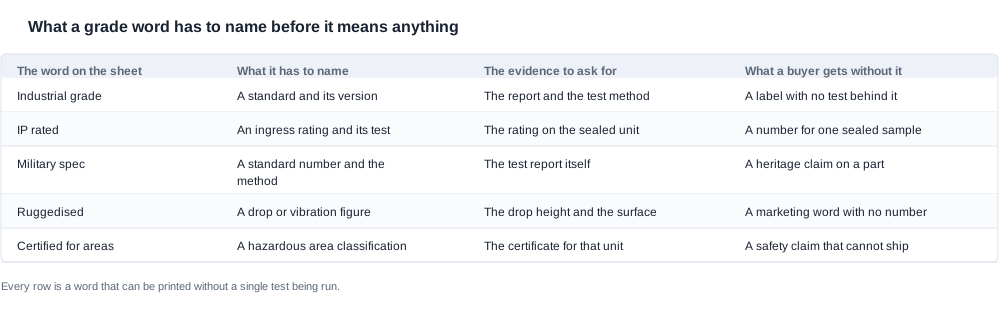
The table below takes the words that appear on grade claims and lists what each one has to name before it means anything. The right-hand column is the practical consequence of leaving it unnamed, which is the part that matters when a claim has to be defended.
| The word on the sheet | What it has to name | The evidence to ask for | What a buyer gets without it |
|---|---|---|---|
| Industrial grade | A standard and its version | The report and the test method | A label with no test behind it |
| IP rated | An ingress rating and its test | The rating on the sealed unit | A number for one sealed sample |
| Military spec | A standard number and the method | The test report itself | A heritage claim on a part |
| Ruggedised | A drop or vibration figure | The drop height and the surface | A marketing word with no number |
| Certified for areas | A hazardous area classification | The certificate for that unit | A safety claim that cannot ship |
Every row in that table can be printed without a single test having been run, and that is the point. The grade vocabulary of this category is unusually rich and unusually cheap to use, which is why a buyer cannot treat it as evidence at all. It has to be converted into evidence or discarded.
The other half of the problem is configuration drift. A report is written for a specific build: a specific housing material, a specific cell, a specific seal, a specific firmware branch. A product that ships with a different seal is a different product for the purposes of that report, even though nothing on the datasheet changed. This is why the reading a datasheet exercise has to be done against the bill of materials rather than against the brochure.
What has to be attached to the unit itself
There are three things that belong on the physical product or in its packaging rather than in a file, and they are the ones a buyer can verify at the sample stage with a magnifying glass and a camera.
The first is the marking on the housing. A rating marked on the unit, in the place a marking belongs, is the physical evidence that somebody committed to the rating being a property of the product rather than of the development phase. Its absence is not proof of anything, but its presence is useful, because it means somebody decided that the unit should carry the claim.
The second is a serial number that maps to a file. Most suppliers can produce a serial number. Far fewer can produce a record that says what that serial number was built with, which cell it went out with and which test programme covered it. The distinction matters at the moment a claim is questioned in the field, because at that point the serial number is the only thread that connects a returned unit to a document.
The third is the configuration as built. Not the configuration as designed and not the configuration as advertised, but the configuration that went out on the production run. This is the row that catches most of the real cases, because the gap between design and build is where material substitutions, alternative seals and revised cell suppliers live.
The measurement conditions that separate the two grades in practice
Grades are usually described in the language of the environment. The comparison work that matters happens one level down, where each environmental claim depends on a measurement condition that has to be stated for the claim to mean anything.
Ingress protection is the clearest example. A rating is a statement about a specific test: how long water was applied, from what direction, at what level, with the unit assembled in its shipping configuration or with it open, and with what tolerance in the enclosure. The number is meaningful precisely because the condition is prescribed by the standard. Quote the number without the standard and the condition, and it becomes a marketing phrase with digits in it.
Temperature is the second. A stated operating range without a dwell time is an aspiration, because an electronics assembly that functions at a temperature for five minutes is not a unit that functions for a shift. The dwell time, the ramp rate and the state the unit is in during the test are the conditions that turn the range into a specification.
Mechanical shock and drop resistance are the third, and the conditions are unusually decisive. The drop height, the surface material, the number of cycles and the orientation of the unit at each impact decide the result. The same unit dropped onto a steel plate from a table height behaves differently from one dropped onto a hard floor from a shoulder height, and a sheet that says "passed drop test" without the four conditions has told the buyer nothing about the environment it will survive.
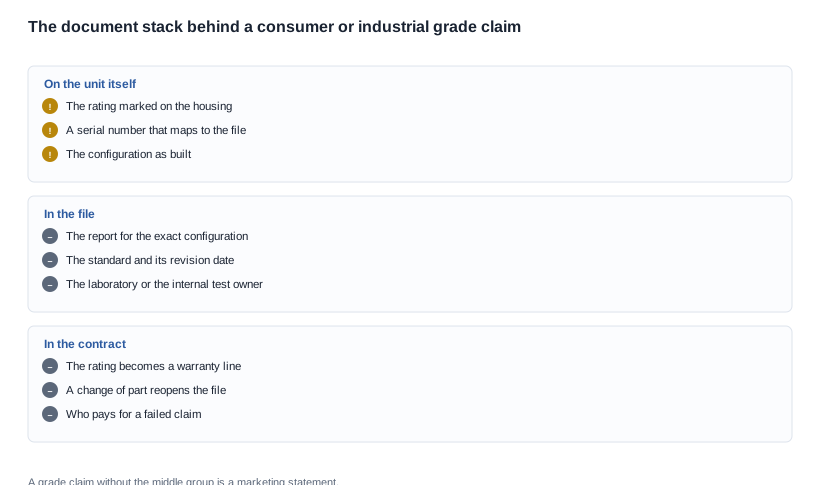
The checklist above is the document stack a grade claim has to come with. Read it as a stack because it is one: the marks on the unit sit on top of the file, the file sits on top of the contract, and a claim that is missing the lower layer is unsupported no matter how good the upper layer is. Most buyers collect the top layer and stop, which is why a grade claim is usually not verifiable at the point where it would have mattered.

The regulatory file behind a grade, and where it usually stops
There is a second document stack behind every grade claim, and it is the one that decides whether the product can be sold rather than whether it can be deployed. A device that survives a workshop is still a device that has to be shipped, and shipping has its own file: the transport documentation for the cell, the radio conformity assessment for the market, and the material declarations for anything that could be regulated.
The usual failure here is not a missing document but a document that covers a different thing. A transport file written for an earlier cell. A conformity assessment written for a radio module rather than for the finished product. A material declaration that covers a sub-assembly the factory substituted. Each of these is a document that exists, which is why the failure survives a first review and is caught at a customs gate or in a channel audit.
The commercial point is that these documents are per configuration and per market, which is what makes them a procurement cost rather than an administrative one. A product variant that changes a cell, a seal or a radio module can require a new file, and the supplier's willingness to absorb that cost is a genuine differentiator between suppliers. It is worth asking directly: when a component changes, who pays for the documentation that has to be reissued?
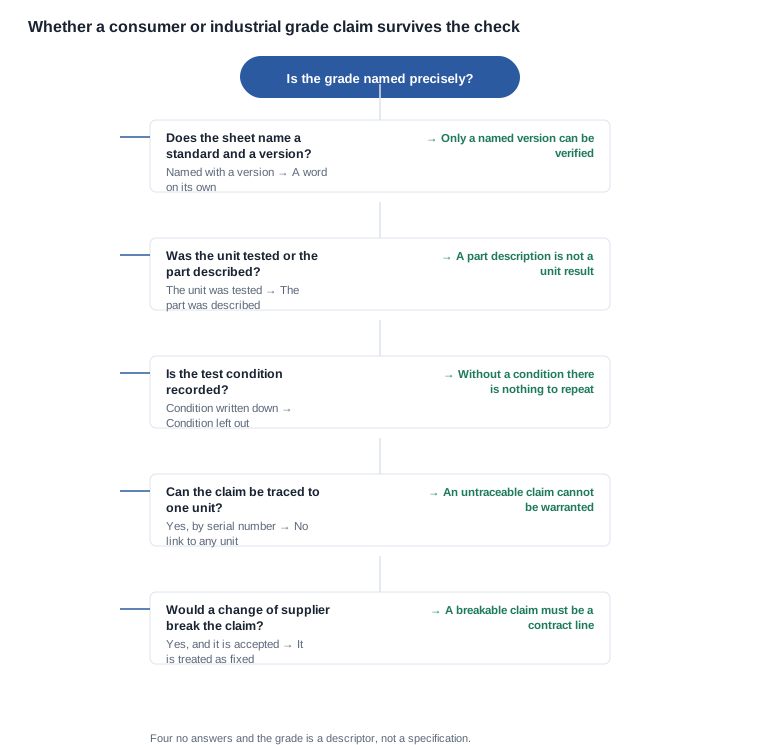
The decision tree above reduces a grade claim to a sequence of questions that a buyer can run in fifteen minutes against a supplier's documentation. Four no answers and the grade is a descriptor rather than a specification, and the programme has to be run on a different basis — either the buyer specifies the test and the supplier quotes it, or the grade is dropped and the environmental requirements are written as separate, checkable lines.
The commercial difference between the two grades, and how to price it
The difference between a consumer product and an industrial product is not mainly a difference in component quality. It is a difference in how much evidence stands behind the product, how quickly a fault is diagnosed in the field, and what happens commercially when something goes wrong. Those three things have prices, and the prices are not always visible.
The evidence cost is visible and is usually small relative to the programme. A test programme covering the specified environments for one configuration is a project with a fixed cost that does not scale with volume. The reason to negotiate it is not to argue the fee down but to fix the scope, because an unnecessary test in the scope is a cost the buyer chose, and a missing test in the scope is a cost the buyer will pay later in returns.
The diagnostic cost is usually invisible and is the larger of the two. A consumer product is diagnosed by the end user, who either returns it or does not. An industrial product is diagnosed by a supervisor or a technician, who files a report against a reference number, and that report is the only signal the supplier receives about a systematic problem. Building the reporting path into the programme costs nothing and is what turns a warranty into a feedback loop. Suppliers that cannot describe their own field reporting path have not thought about the industrial channel.
The commercial exposure is the third item. In a consumer channel the loss is the returned units. In an industrial channel the loss is the returned units plus the relationship with the operator's employer, and the second is larger. This is the argument for writing the grade into the order rather than accepting it on a datasheet, and it is also the argument for making the documentation a deliverable with a date, because a document that arrives late is worth exactly as much as a document that arrives never.
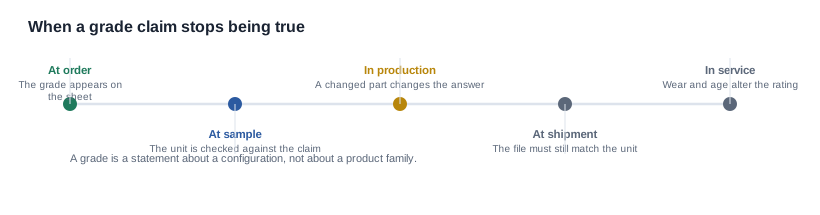
The timeline shows where a grade claim expires. It is true at the moment of order, it has to be rechecked at the sample, it can be invalidated in production by a part change, it has to still match at shipment, and it starts to change as soon as the unit is in service. Only the first of those five points is under the buyer's control at the point where the claim is made, which is the argument for moving the verification earlier.
The clauses that make a grade enforceable
Five lines are worth having in the purchase order for an industrial programme, and each of them is a sentence rather than a paragraph:
- Write the grade with its referent. State the grade together with the standard, the revision and the configuration it refers to, so that the claim has something it can be checked against.
- Make a part change reopen the report. State that any change to the components named in the report reopens it, and that the supplier tells the buyer before the change ships rather than after.
- Put the report reference on the production documentation. A document that travels with the goods can be produced at a customs gate or in a channel audit. A document that stays in a filing cabinet cannot.
- Define the acceptance test in advance. Give the buyer a defined period to test production units against the quoted figures, with the method agreed in advance rather than improvised at the factory gate.
- Put the reporting path into the warranty. Field data has to have somewhere to go, or it arrives as an anecdote from a distributor rather than as a pattern the supplier can act on.
The point at which a consumer vs industrial claim should be rejected
There is a version of this article that ends with a shortlist of good suppliers. That would be dishonest, because the sourcing decision belongs to the buyer and the evidence belongs to the supplier, and neither is ours to rank. What we can do is be clear about our own position and about the criteria a buyer should apply to us, because the criteria are the same ones we would want applied to anybody we buy from.
Our catalogue publishes electrical rows for every model: cell configuration, runtime, charge time, charging method and radio version. It publishes an ingress rating on two models only, the V06 and the S7, and it does not publish an ingress rating for anything else. It carries a company-level export certification page whose content is images rather than readable text, and the catalogue text itself contains no reference to CE, FCC or RoHS, so we do not present those marks as evidence of anything. There is no per-model certification row anywhere in it, and we are not going to describe a grade that the catalogue does not state.
What that means concretely is that a buyer asking us to support an industrial grade claim will get a specific answer rather than a general one. We will tell them which rows exist for a given model and which do not, we will tell them that the absence of a certification row means the evidence has to be obtained from the component and laboratory suppliers and confirmed in writing, and we will tell them what to ask for and in what order. The certification checklist exists for that purpose, and the measurement guide covers how to take a reading that a supplier can actually repeat.
The criterion we would apply to a supplier is the one this article describes: does the party quoting the grade name a standard, a revision, a configuration and a test condition, and does somebody sign it. A supplier who can do that is usually more expensive and almost always less trouble. A supplier who cannot is not necessarily dishonest, but the buyer is carrying the risk, and the quote should reflect that.
The line we would draw is this. Do not reject a product for lacking an industrial label. Do reject a programme in which the environmental requirement has never been written down by anyone, because at that point nobody is accountable for the environment at all, and the label was never going to do that work.


