

App branding is the option that most often looks like the smallest decision in a programme and turns out to have the longest tail, because a brand on the box is a one-off and a brand inside an app is a permanent relationship with a third party. The decision is rarely made as a decision at all: it arrives as an assumption that the product will ship with the manufacturer's app and the buyer's name will appear in it, and it is discovered as a problem the first time a customer asks something the manufacturer's app cannot answer.
Our published position sets the boundaries before the discussion starts. Across the range, the AI features are described as an AI voice assistant for the camera tier, with AI translation noted for the K01 and the evidence recorded as observed from an independent site rather than as a published specification. The details that would let a buyer evaluate an app position — which models are supported, whether processing happens on the device or in a service, whether a subscription is required and where data is stored — are Not published. The product record counts seven customisation lines for the camera range, five for the audio range and two for the children's range, so app work sits among the recorded options for some categories while its scope remains undefined.
That is what makes customization options app branding best understood as a set of questions about what is actually being bought, rather than as a single line in a quotation.
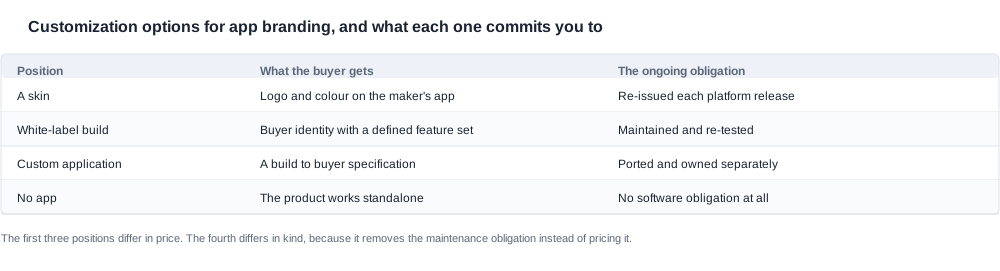
Customization options for app branding: four positions, not one
1. A skin. The manufacturer's app with the buyer's logo, colour and name applied. Low effort, low cost, and it delivers exactly what it says: the app is still the manufacturer's, the manufacturer's roadmap still applies, and the buyer has no ability to add a function. This position is genuinely appropriate when the app is a convenience rather than the product.
2. A white-label build. The manufacturer's app with the buyer's identity throughout and a defined feature set. The one-off cost is design work, translation, the store listing and the support material. The ongoing cost is maintenance against every platform release, and that ongoing cost is what determines whether the branding was worth doing.
3. A custom application. A separate build to the buyer's own specification, integrated with the buyer's systems. This is a full software project with its own team, its own roadmap and its own maintenance obligation, and it is the position that most often surprises a buyer in scope rather than in price.
4. No app at all. The product works standalone through physical controls and the app is optional. This is a real and increasingly common position for a product whose value is the camera or the audio, and it is worth considering seriously because it removes an entire maintenance obligation rather than deferring it.
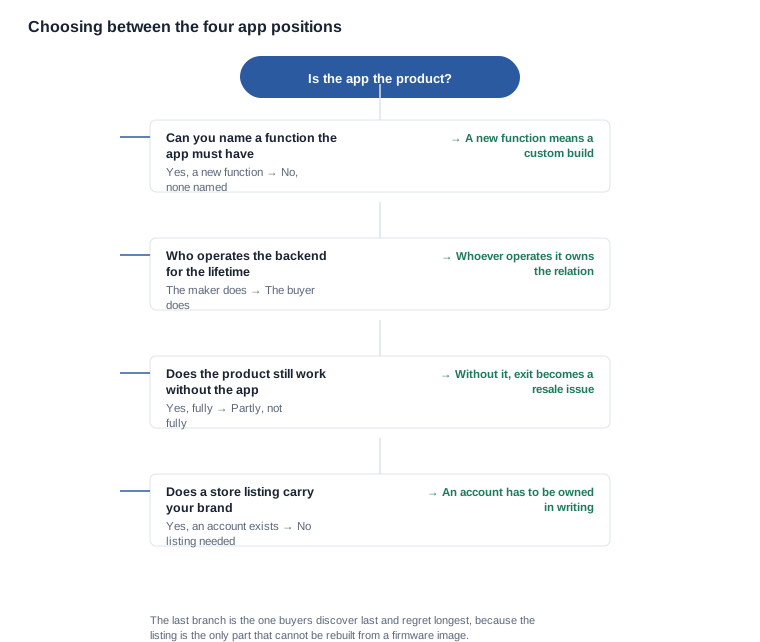
The distinction between positions two and three is the one buyers most often get wrong, and the test is simple. If the buyer could describe a function the app must have that the manufacturer does not already offer, the project is a custom application, whatever it is called in the quotation. If the buyer cannot describe such a function, it is a white-label build, and the price should reflect that.
A fifth position exists in practice and is worth naming because it is often chosen by accident. A buyer-operated integration is where the manufacturer's app stays unbranded and the buyer builds their own layer on top of it. It resembles a way to avoid the branding cost and is usually the most expensive option, because the buyer now owns the entire customer-facing layer, the store listing, the update cycle and the support, while still depending on an interface the manufacturer controls. It is the right choice only when the buyer's channel genuinely requires their own software layer for reasons unrelated to the glasses. A buyer-operated integration is where the manufacturer's app stays unbranded and the buyer builds their own layer on top of it. It looks like a way to avoid the branding cost and is usually the most expensive option, because the buyer now owns the entire customer-facing layer, the store listing, the update cycle and the support, while still depending on an interface the manufacturer controls. It is the right choice only when the buyer's channel genuinely requires their own software layer for reasons unrelated to the glasses.

The four questions that determine which position applies
1. Who operates the backend, and for how long? If the manufacturer does, then the buyer's customer is in a service relationship with the manufacturer, and the manufacturer has to keep that relationship alive for the product's lifetime. Our range publishes a 10-year to 20-year battery claim for the bone conduction model and roughly 20 hours for the children's models, which is a reminder that the product may well be in service considerably longer than any individual app arrangement.
2. What happens when the platform version changes? A skin has to be re-issued for every platform release. A white-label build has to be maintained and re-tested. A custom application has to be ported. None of that is in the one-off figure, and all of it recurs on a schedule the buyer does not control.
3. Who answers the customer's support questions about the app? If the app displays the buyer's brand, the customer will ask the buyer, whatever the contract says about who operates the backend. In practice this means the buyer needs at least the diagnostic information the factory has, or the customer will be escalated to the factory and told to wait.
4. What data does the app collect, and where does it go? For a product with a camera and a microphone this is a legal question before it is a technical one, and the published position in our range is that the data location is Not published. It has to be established before an app carrying the buyer's brand reaches a customer.
There is a fifth question that gets asked late and should be asked early: what does the customer experience when the app is unavailable? An app that requires a network round trip to change a setting is a different product from one that works offline, and the difference determines how many support calls arrive on a poor connection day. Ask whether the core functions work without connectivity, because that answer changes the support obligation entirely.

What the published range does and does not settle
The published customisation list is a useful starting point precisely because it is short and it is bounded. The recorded set differs by category rather than being one list across this range — the camera entries carry seven of them and the audio entries five — and each of those lines is published as an available option. What is not listed is the scope of each option, the tooling behind it, the effect on lead time, the effect on minimum order quantity, and the cost of changing it later.
Three of those five gaps matter more than the others. Lead time and minimum order quantity are commercial terms that belong in the quotation; a buyer who learns that a UI change adds to the production cycle after the launch date is fixed has no remedy. The cost of change is the third, because a decision taken as reversible at pilot volume is frequently irreversible at programme volume, and the point at which it becomes irreversible is usually earlier than the buyer expects.
The Bluetooth naming row is worth reading carefully, because it is the one customisation that appears trivial and behaves like a firmware change. A custom device name is baked into a firmware build, and every subsequent build has to carry it. That makes it a chain rather than a value: the register of customisations in this category is a chain of dependencies, and a firmware update that drops one link will not be noticed until a customer reports it.
This is why a customisation register is worth more than the individual entries in it. Each entry is a small fact — a colour, a name, a temple shape, a packaging print — and the value of the register is that it records which firmware build carries which entry. A register organized by option tells you what was customised. A register organized by build tells you what a given unit in the field actually contains, which is the question that matters when a customer reports a mismatch.
The criteria for deciding whether an option should be in the register are simple and worth stating: if changing it requires a firmware build or a tooling change, it goes in, and if it does not, it can live in the artwork files. The first category has a lead-time and a compatibility consequence; the second does not.
One practical consequence follows from that rule. The register should record not only what was customised but when it was last confirmed against a shipped build, because an entry confirmed once and never re-confirmed is indistinguishable from an entry that has silently reverted. A quarterly check against one unit is enough to keep the register honest, and it costs less than the first customer report that discovers a mismatch.
A shortlist in this category should be evaluated on one axis only: how much software the buyer is buying without knowing. A supplier who quotes a skin at one price and a white-label build at another is telling you something useful about how they scope the work, and a supplier who quotes the same price for both has not yet done the analysis. The negotiation question to put to either of them is the same: what changes between the two positions beyond the logo, and what happens to the recurring cost in each.
Two risks are worth carrying into the evaluation rather than discovering afterwards. The first is dependency: once a branded app exists, the product's setup path runs through software the buyer does not own, and removing it later is a product decision rather than a technical one. The second is evidence: the data position, the backend operator and the maintenance commitment are all things a supplier can state precisely or vaguely, and the precision of the answer is a reasonable proxy for whether anyone has actually planned the maintenance.
Where a supplier answers these questions with a generic policy statement, treat it as undecided rather than as agreed. The difference matters because a generic answer will be replaced by a real position at some point, and the moment it is replaced is the moment the buyer's customer-facing commitments start moving without notice.

The four clauses that belong in the agreement
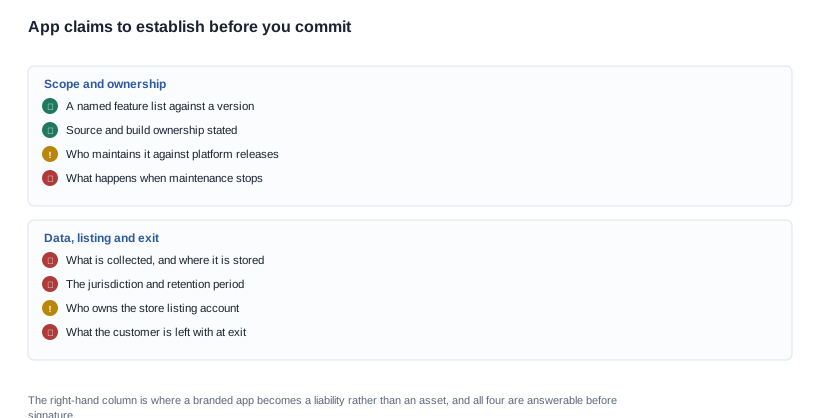
1. The app's scope, written down, with a version number, and with source and build ownership stated explicitly. "The buyer's app" is not a scope; a named feature list attached to a version is.
2. The maintenance obligation — who updates it, who tests it against platform releases, and what happens when they stop. The third part is the one that is left out and the one that determines the exit.
3. The data position — what is collected, where processing happens, where it is stored, how long it is retained and under which jurisdiction. For a product with a camera and a microphone this is not optional detail.
4. The exit position — what happens to the app and the backend if the relationship ends, and what the customer is left holding. This is the question that is never asked during procurement and the one that matters most at year three.
Add a fifth where the app touches a store listing: who owns the listing, and what happens to it. An account that belongs to a supplier is an account the buyer does not control, and recovering a customer base from a store account is slower than the engineering work that preceded it.
A sixth clause is worth adding in any programme that ships to more than one market: who is responsible for the app's compliance in each jurisdiction, and what evidence the brand owner is expected to hold. The obligation sits with the party whose name appears on the listing, which is normally the buyer, even when the software was written by someone else.
A seventh, and the one that determines whether the other six are worth writing: the version of the arrangement. Every clause above is dated to a specific app version and a specific firmware baseline. An undated app clause is not a commitment, because there is nothing for the supplier to have failed to maintain — only a description of a moment that has already passed.
Four ways this goes wrong after launch
1. Assuming the app is included because the customisation list mentions it. The list is a set of options, and the scope of each is a separate question that has not been answered.
2. Pricing the app as a one-off. The recurring maintenance is the real cost, and it is the recurring cost that determines whether the branding was worth doing. A one-off price is a signal that the recurring cost has not been modelled.
3. Putting the buyer's brand on an app that collects the buyer's customer's data, without a data position. The regulatory risk arrives with the brand rather than without it, which is why it cannot be added later.
4. Not asking what the customer is left with if the app goes away. A product that records without an app is a resaleable product. A product whose only function lives inside the app is not, and the value of the brand drops with the availability of the app.
The trade-off behind the fourth mistake is worth naming, because it is the one decision in this article that can save a programme money. Removing the app does not make the product worse if the hardware functions are reachable through physical controls, and it removes the store listing, the update cycle, the data position and the support layer in a single move. The cost of that decision is that configuration becomes a manual procedure, and the benefit is that no future platform change can strand the customer.
Ask the question during evaluation rather than at the end: which functions currently require the app, and would a printed guide plus firmware be an acceptable substitute? Where the answer is that only two functions need the app and both have hardware equivalents, the fourth position is worth a serious quotation of its own.
It is worth noting what does not change between the positions. The unit, the battery, the radio, the enclosure and the accessories are the same hardware in all four cases, and the published figures for any given model describe that hardware rather than the software around it. A buyer comparing two quotations is therefore comparing a software difference while assuming a hardware difference, and the assumption is what distorts the comparison. Ask for the hardware line to be identical in both quotations so the software difference is visible on its own.
A fifth pattern is quieter and appears in customised firmware: a branding change requested mid-programme is implemented as a firmware change, and the register is updated for the firmware but not for the brand assets. Six months later nobody can establish which icon or name is current, and the answer has to be reconstructed from release notes.
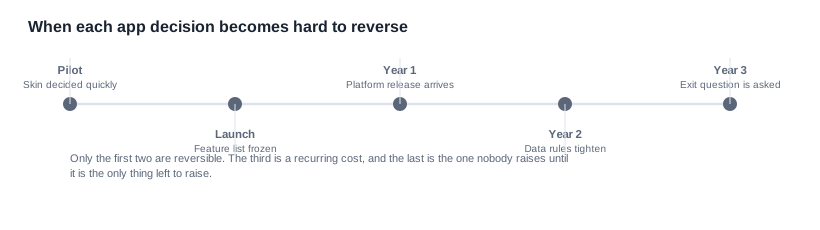
The third point on that timeline is where most of the cost hides. By the first platform release, a skin has consumed the entire advantage it was chosen for: it now needs the same maintenance as a white-label build, at a fraction of the functionality and a similar cost. This is the moment to evaluate whether to upgrade the position or to accept it, and the moment is passed silently unless somebody has put a date on it.
The fifth point is not a date at all. It is the question that gets asked when the relationship ends, and the reason it is placed at year three is that the useful information to answer it — how many customers depend on the app, how many have reinstalled it, how many have never paired it once — only becomes available once real usage exists. Ask for that data as a contractual right rather than hoping to be told.
What we can tell you today, and what stays open
We will tell you which of the four positions is available for your product and what each one involves, and we will not describe app branding as a cosmetic change when it is a software relationship with a lifecycle.
We will also be direct about the gap. The AI feature details, the data location and the subscription position are Not published for the models in our range, so the app's data position has to be established as part of the programme rather than read off a specification sheet. A figure that is Not published will be reported as Not published rather than turned into an arrangement we cannot evidence, and whatever we can evidence goes into the agreement on the same terms as any other commercial commitment.
If you tell us the channel, the markets and how long you expect to carry the product, we will tell you which app position fits. The longer the expected carrying period, the more the maintenance obligation dominates the decision, and the more the fourth position becomes worth a serious look.
Two questions we would ask before we answer. The first is what the buyer expects the app to do that the hardware cannot, because that answer collapses four positions into one. The second is how long the product is expected to be carried after the last unit ships, because that number is what turns a maintenance question into a lifecycle question.
If the answer to the second question is long, the honest position is that the app arrangement needs a defined end date and an exit clause, not a longer verbal commitment. A programme that has planned its exit in year four is a programme that can negotiate its renewal in year three from a position of strength rather than of dependency.
For the wider option set, see customisation options and smart glasses OEM ready platforms; for the feature position behind the app, see AI features technology; and for what happens to the support obligation once a product reaches the end of its life, see lifecycle support commitments.
Related reading
- The hardware side of a branded programme: customization options color matching.
- What the changes cost: customization options cost factors.
- The compliance consequence of a changed product: customization options certification impact.
Tell us the channel, the markets and how long you expect to carry the product, and we will tell you which app position fits.


