

A case review in this category is worth doing for a reason that is not usually stated: the case is the component a customer touches most, the component whose failure is most often misdiagnosed as a product fault, and the component that carries the most of the retail proposition while appearing in no technical specification. It is also the part of the box most likely to be replaced, returned or complained about, and the part nobody puts on the acceptance criteria.
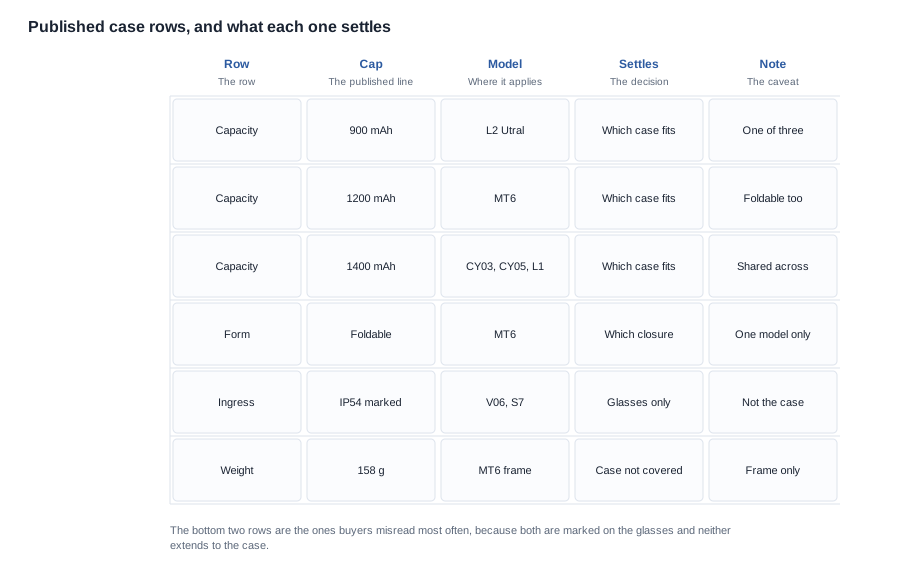
Our published range gives the facts a review has to work from. Case capacities of 900 mAh, 1200 mAh and 1400 mAh appear across the range — 1400 mAh on CY05 and the CY03, and L1 Pro, 1200 mAh on the MT6, and 900 or 1400 mAh on the L2 Utral. The MT6 case is also described as foldable. Charging interfaces are magnetic across the audio, camera and sport tiers, and Type-C on the D11, D12, D17, ZH12 and V03 Pro. And the IP54 catalogue markings on the V06 and S7 carry no third-party test report number, which is a case question as much as a glasses question, because the case is a separate enclosure.
That makes customization options case review a checklist for the object that does the most work in the box, and the review below is written to be run against a physical unit rather than read as a specification comparison.
One framing decision shapes the rest of this article. A case review is usually treated as an accessory check, and it is better treated as an acceptance test for a second product. The case has its own cell, its own charging cycle, its own enclosure, its own ingress position and its own replacement logic, and a customer who has been given two products will form two opinions. Most of the failures described below come from reviewing one product and shipping two.
The consequence for how a review is run is specific. The case should be reviewed against its own acceptance criteria rather than against the glasses' criteria, and the two should not share a sign-off line. Sharing the sign-off is how a case passes a review conducted with a checklist written for a different object, and how a programme discovers after launch that nobody ever confirmed the case independently of the unit.
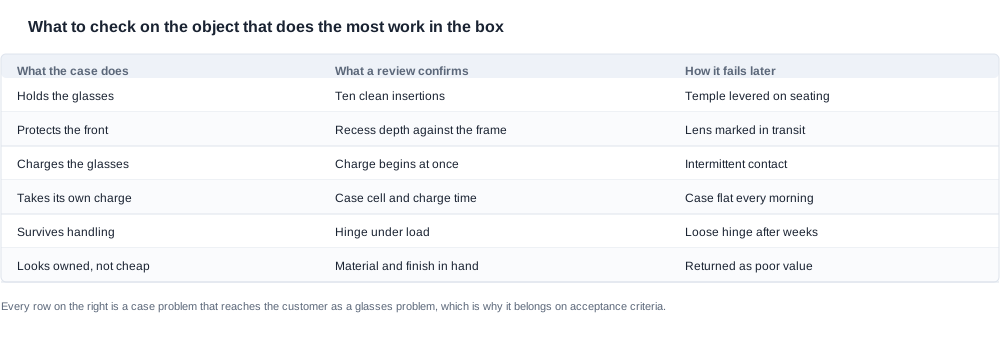
Customization options case review: the five jobs the case has to do
1. Hold the glasses safely, including the temple. The charging contact sits in the temple, and the case has to present the glasses to it in the correct orientation. A case that accepts them only one way up produces returns; a case that accepts them upside down and charges intermittently is worse, because it fails occasionally and therefore gets reported as unreliable.
Orientation is the part of this that is rarely specified and always felt. A customer who seats the glasses incorrectly once will usually correct themselves, and a customer who cannot tell whether they are seated correctly will try several times before deciding the product is faulty. Either way the case has produced a support contact that the glasses never deserved.
2. Protect the front of the frame. The lens and, in the camera tier, the camera module are the most exposed parts of the product, and the case is where they land every night. A case with a shallow recess protects less than it appears to.
The check that matters here is not the recess depth in isolation but the clearance to the frame when the case is closed on a unit that has been worn. Glasses that have been adjusted, or that sit slightly differently after a repair, need more clearance than a new pair, and a case tuned to the factory sample may not have it.
3. Charge, and charge the glasses properly. A case that charges the glasses but not itself fails at the routine level, and a case that charges them too slowly to be useful overnight fails at the same level in a different way.
The quick-start guide decides this more often than the hardware does. A case with a second cell and no instruction telling the customer to charge both will produce a product that appears to have a weak battery, and the customer has no way to distinguish between a weak battery and an uncharged case from the outside.
4. Survive the customer's handling. A case is dropped, sat on, put in a bag and left in a car. Its exposure profile is completely different from the glasses', and it is the case that carries the drop risk rather than the frame.
5. Present well enough that the channel still works. In a retail channel the case is a visible object carried in public, and a low-cost case presented next to a premium product damages the whole proposition more than any specification can repair.
There is a sixth job that only applies to a branded programme, and it is the one most often skipped: the case has to survive being personalised. If a logo, a name or a colour is applied to the case, that application is an abrasion surface and it will abrade, peel or scratch before the enclosure does. The question to ask is where the mark sits — in a recess, on a flat face, or wrapped — and whether removal of the mark is even possible without damaging the case.
That question decides more than appearance. A mark that has to be sanded off to remove branding is a mark that cannot be reused on a second programme, which turns a cosmetic option into a tooling commitment.

The order matters more than the list. Running the alignment and retention checks first means the later checks are being performed on a unit that is seated correctly, which sounds obvious and is rarely true of a review run casually. Running the thermal check last also makes sense, because it takes the longest and it leaves the case in a state where the cell is at its warmest.
Where a programme runs review units through a checklist, it is worth recording the case result in a separate column from the unit result. Shared columns are the mechanism by which a case fault gets recorded against the glasses, and once the two are combined the data cannot be split back out without physical re-testing.
The same separation applies to the failure codes themselves. A code for an accessory contact fault and a code for a unit charging fault describe the same customer symptom and completely different corrective actions, and a support desk working from one code will keep sending units back for a repair that finds nothing.
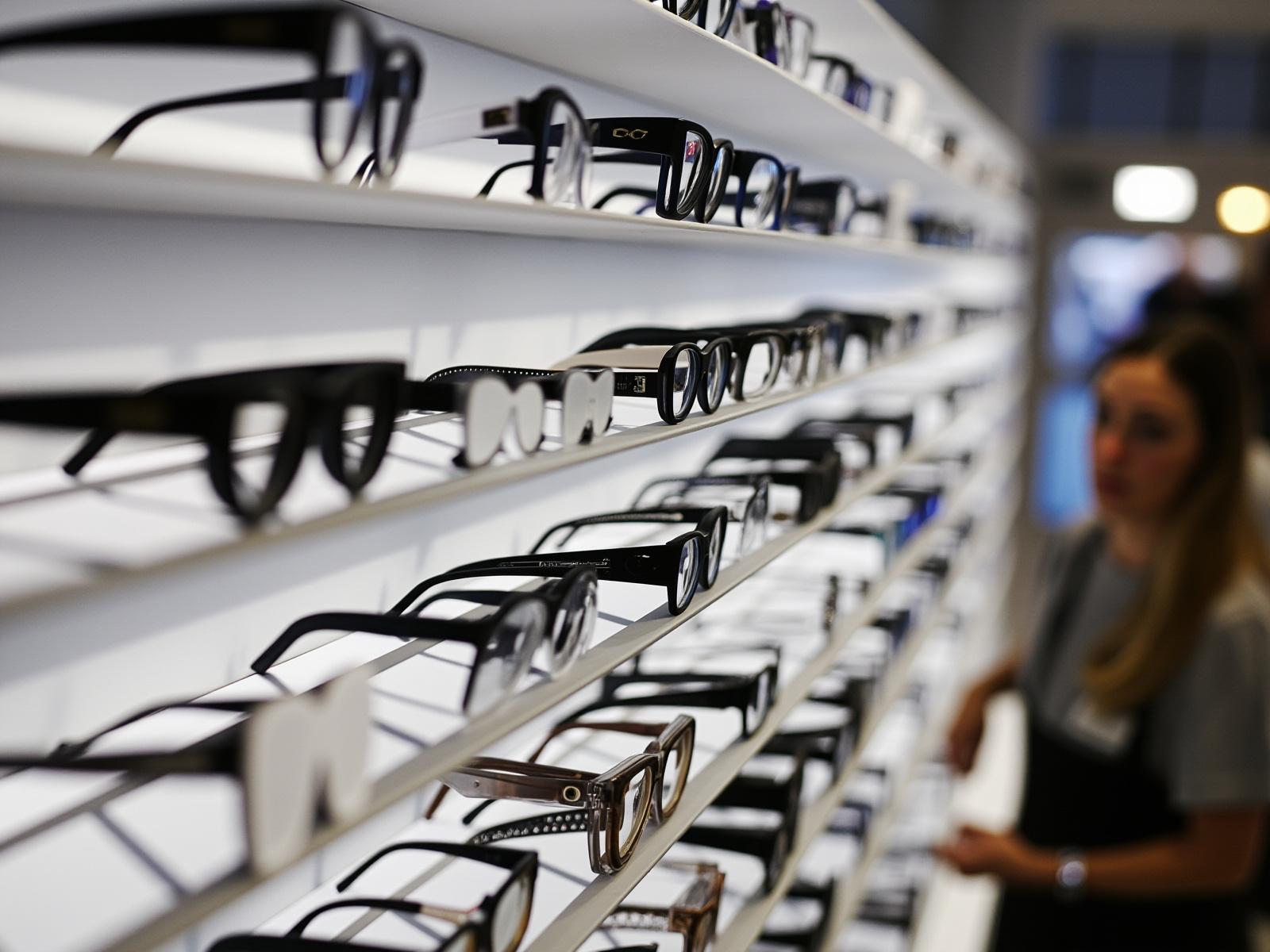
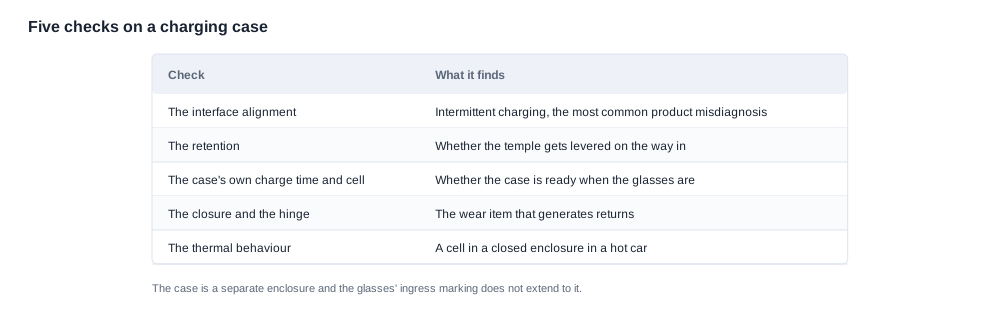
What to check on a physical unit
1. Interface alignment. Insert the glasses and confirm that the contact is free of dust and that charging begins immediately and consistently. Ten insertions is a reasonable test, and it is the single most useful check on the whole object because it catches alignment, contact condition and tolerance stack-up in one motion.
2. Retention. Tipping the case, moving it in a bag, and picking it up one-handed are the three tests that matter. A case that does not hold the glasses will damage them, and the damage will present as a product fault rather than an accessory fault.
Retention is worth testing at the point where the failure actually occurs, which is rarely the first week. A case whose tolerance depends on a magnet holding a lid closed behaves differently after two hundred cycles than it does on day one, and a case whose tolerance depends on friction behaves differently once the contact surfaces have been handled a few thousand times. Where the supplier has cycle data for the closure, ask for it; where they do not, the review can only establish the starting point.
3. The case's own cell and charge time. The published capacities are 900, 1200 and 1400 mAh, and the case's own charging time is not published anywhere in our range. A case that takes six hours to charge is a case that is not ready when the glasses are, and the customer experiences that as poor battery rather than as a slow accessory.
There is a second-order question here that determines whether the figure matters to you at all: how often the customer is expected to charge the case. If the intended use pattern is overnight charging alongside the glasses, the case's own charge time only needs to be shorter than the glasses' charge time. If the intended pattern is two or three days of travel without a cable, the case's own capacity and its charge method become the specification, and the figure should be negotiated rather than accepted.
4. Closure and hinge. These are the cycle-life items, and a case with a loose hinge is a case that will be returned as though the product were faulty. Check the hinge under load rather than by eye, since the failure appears after weeks of use and not on day one.
A closure that has to be forced shut is a closure that will be damaged at the contact point first, and a damaged contact point is what turns a secure case into an intermittent-charging case without anything visibly having broken.
5. Thermal behaviour. A case in a car in summer is a lithium cell in a closed enclosure. A case in a customer's pocket during a run is a different condition again, and a case that is acceptable in a room may be unacceptable in direct sun.
Thermal behaviour is the check most likely to be skipped, because it does not fail in a meeting room. It fails in July, in a car, at a customer's location, and it fails as a return rather than as a laboratory result — which means the evidence arrives through the returns channel rather than through quality control.
What to ask a supplier about the case
- What is the case's own capacity, its own charge time, and its own charge method? And does it charge from the same cable as the glasses?
- What is the case's own ingress position? No case in our range carries a published ingress marking, and the glasses' marking does not extend to the case.
- What is the case weight, and what is the total weight with the glasses inside? The frame weight in our range is published for one model only, 158 g for the MT6, and the case weight is a separate question that a customer will add up.
- Is the case user-replaceable, and what does a replacement cost?
- What is the case colour and material, and how many variants exist? Our published colour options are three for the V03 Pro and four for the V06, and a case in a matching colour is a separate moulding.
Add a sixth for any retail channel: what is the case's own packaging and drop specification, and is it tested as an accessory or only as part of the set. A case tested only inside the master carton behaves very differently from a case tested as the thing a customer actually carries.
Two more questions belong in the same list for a branded programme. First, what happens to the case when the glasses are replaced under warranty — is a case supplied with the replacement unit, and does that count as a new warranty period? Second, what is the case's own stock position, given that it is usually a separate moulding and therefore the more likely of the two to be short during a production spike.
Where a supplier cannot answer the charge-time question because it is not published, that is a legitimate answer provided the confirmed value is written into the purchase order for your specific configuration. The figure exists; it simply is not on the public page.
The published rows behind those decisions are set out below. The bottom two are the ones buyers misread most often, because both appear on the glasses and neither extends to the case.
The five case problems that return as product faults
1. Intermittent charging. The contact is dirty, misaligned or corroded, and the customer reports that the glasses sometimes do not charge. The symptom presents as a battery fault and is triaged as one, which sends a healthy unit back for a repair that finds nothing.
2. The case is not charged. The case is a second device with its own routine, and a customer who has never charged the case has a product that behaves as though the battery is poor. This is an instruction problem more than a hardware problem, and it is resolved by a line in the quick-start guide.
3. The temple is levered on insertion. The case accepts the glasses but not in the right orientation, and the temple takes the load. It presents as a cracked temple, which is expensive to argue about because the crack reads like a drop.
4. The case is not interchangeable with the product. A case built for the 900 mAh configuration does not seat the 1400 mAh one, and a case built for the magnetic charging models does not seat the Type-C ones. Both the published case capacities and the interface split matter here, and both are published, so this is a mismatch that can be designed out.
5. The case reads as low value. The most common reason a customer returns the case rather than the product, and the one that damages the brand rather than the batch.
The general pattern across all five is worth naming: a case problem presents to the customer as a glasses problem. That is why a case review belongs on the acceptance criteria rather than in a shipping box, and why the return data should be split by accessory cause before any action is taken on it.
Two of the five are cheap to design out and are usually missed for the same reason. Intermittent contact is an alignment tolerance that was set for cost rather than for the customer's ten-thousandth insertion. And a temple being levered on seating is a recess depth decision taken before anyone tested the assembly rather than after. Neither is visible in a rendering, and both are visible in under a minute on a physical unit.
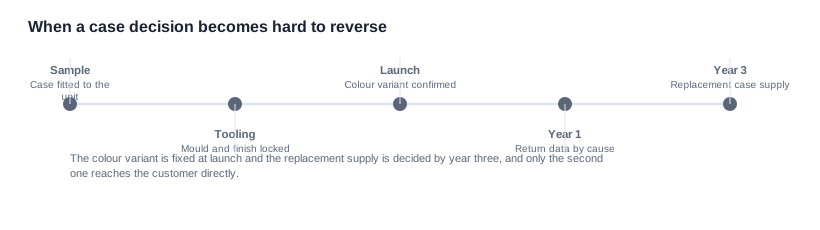
A sixth problem appears only at scale and is worth planning for rather than discovering. Where a case is a separate moulding in a matched colour, a colour that sells well will exhaust its case stock ahead of the glasses, because the glasses have more configurations behind them. The result is a programme that has glasses and no case — the worst possible state, since the product is unusable in the way it was designed to be used.
That failure has a straightforward mitigation and it is a purchasing decision rather than an engineering one: hold case stock for the fastest-moving colours, in a quantity derived from the accessory return rate you will measure, rather than holding an even split across every variant. Even splits feel tidy and age badly.
What we can publish today, and what stays open
We publish the case capacities accurately — 900, 1200 and 1400 mAh across the range, and the foldable case on the MT6 — and we will not publish a case weight, a case charge time, a case ingress rating or a case cycle life, because none of those is published to us and we will not put a figure in place that turns out to be wrong later.
We will also say plainly that the case is a separate enclosure with its own requirements, and that the glasses' IP marking does not extend to it. The IP rating and the charging case discussion sets out why in full, and it is the reference to read before a marketing team promises splash resistance that the specification does not support.
The same discipline applies to the colour question. A case in a matched colour is a separate moulding rather than a paint change, which means it has its own minimum quantity and its own lead time, and both are confirmed per configuration rather than published. The published colour counts for the glasses — three for the V03 Pro and four for the V06 — describe the frames, not the cases.
The commercial consequence is straightforward and worth stating before a quotation arrives: the more colour variants a programme runs, the more case mouldings it commits to, and the case is usually the component with the fewer configurations behind it. Fewer colour variants in the case than in the frame is a legitimate strategy, and it should be a decision rather than an accident.
Where the answer on any of the figures above is that it is not published, that is a normal answer in this category and it is not a red flag. What matters is whether the supplier will commit the confirmed value for your configuration inside the purchase order, because that is the difference between a figure you can rely on and a figure you have to re-ask for every time the product mix changes.
We will make that commitment for the case capacities and the foldable form because both are published, and we will confirm the rest per enquiry rather than publishing a number that belongs to a configuration rather than to a product.
If you tell us the models and the channel, we will tell you which case configurations exist and what the published rows say about each. For the broader set of options, see the customisation pillar and the OEM-ready platform range; for the colour question specifically, see standard OEM colour options.
Related reading
- Matching the case to the rest of the product: customization options color matching.
- What a branded case changes commercially: customization options cost factors.
- Running the review against a sample rather than a rendering: what to check when a sample arrives.
Tell us the models and the channel and we will tell you which case configurations exist and what is published about each.


