

No. An ingress rating applies to one enclosure, and a charging case is a separate enclosure with its own openings, its own materials, its own exposure profile and its own failure modes. The instinct to generalise here is one of the most expensive in this category, because it usually shows up as a listing claim rather than as a technical error, and it is discovered by a customer in the rain rather than by a reviewer in an office.
Our published position makes this concrete. This catalogue carries an ingress marking on exactly two models, the V06 and the S7, both of them camera models, both marked IP54, and no third-party test report number is published for either. No case in the range carries an ingress marking of any kind. The case configurations that do exist are published with their capacities: 1400 mAh on CY05 and L1 Pro, and CY03, 900 or 1400 mAh on L2 Utral, and a foldable 1200 mAh case on MT6, with a case present but no published capacity on KY06 and MT5.
There is one partial exception, and it is worth knowing precisely because it is easy to get wrong in the other direction. Where the product is docked in the case, the glasses are inside the case during that period, so whatever protection the case's construction gives is the protection the glasses have at that moment. A case with no rating provides whatever its construction happens to provide. That is a construction characteristic, not a rating, and it must not be presented as one.
The practical rule that follows is simple and it governs everything else in this article: a rating travels with the enclosure it was issued for, and not one step further. Our IP ratings page sets out what each digit covers, and the two-digit reading is what makes the claim wording in a listing precise.
There is a second reason the question is worth answering carefully before the order is placed rather than before the listing is written. The wording of a product page is cheap to change; the wording of packaging tooling, printed inserts and shipped cartons is not. If the copy has to say that the case carries no rating, and the packaging was printed on the assumption that the badge covered the package, then the change lands on printed matter, and the cost of that change is a reprint rather than an edit. Getting the position right before the artwork is locked is the cheapest sequencing available.
Does ip rating cover the charging case: the short answer
A rating describes a specific enclosure, in a specific configuration, on the day it was tested. The moment you have two enclosures in one package, you have two protection statements, and each needs its own evidence or its own silence.
In this catalogue that produces a slightly unusual and very useful table of combinations. Let us walk it:
- Models with a case and a published capacity: L1 Pro and CY03, and CY05 — each at 1400 mAh, L2 Utral at 900 or 1400 mAh, and MT6 with a foldable 1200 mAh case. None of these five models carries a published ingress marking, so for all five the question of what the case's rating covers is moot — there is no rating on the glasses either.
- Models with a case but no published capacity: KY06 and MT5. These are the ones where the configuration is real and the figures are missing, and the due diligence action is to ask specifically for both the capacity and whether any marking exists.
- Models with no case row at all: V03 and V06, and S7. For a buyer this is the single most consequential line in the table, because both models that do carry a published ingress marking, V06 and S7, are on this line. In this catalogue the two products with an IP54 marking are also the two with no published case configuration. The question "does the case rating come with the glasses rating" therefore never arises for the IP54 models — it arises for the other models, none of which has a rating at all.
- The explicit absence: V03 Pro is published as having no case. That is a fact you can state on a listing without hedging.
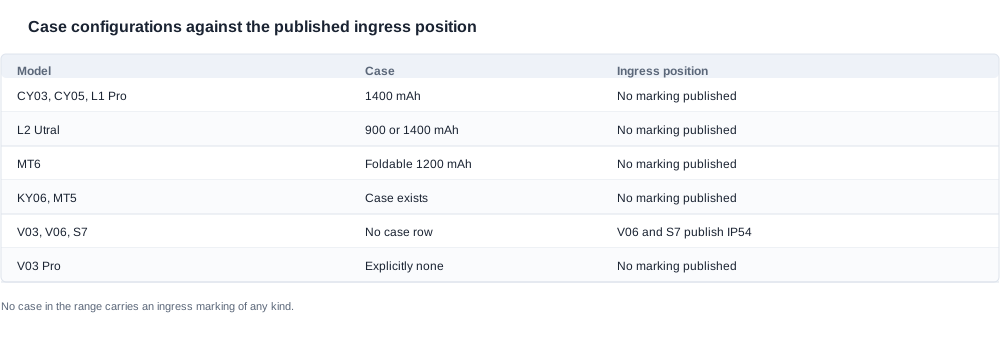
So the direct answer to the buyer's question is: in this range, there is no case that carries an ingress marking, and the two models that carry a glasses marking do not publish a case. Every commercial consequence follows from those two sentences.

Four reasons does ip rating cover the charging case as its own question
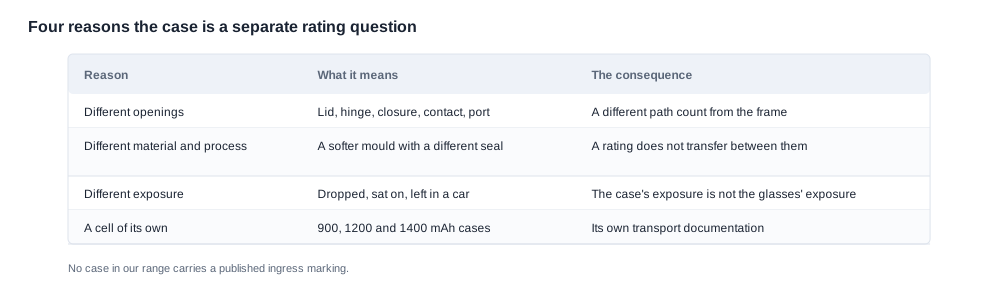
Even in a catalogue where a case did carry a rating, the answer would still be that it covers the case and not the glasses. Four structural reasons make the case a genuinely separate question.
One: it is a different enclosure with a different set of openings. A case has a lid, a hinge, a closure, a charging contact and a port, and each of them is a potential path. The count of paths in a case is not lower than the count in a glasses frame, and a closure that seals a frame does not necessarily seal a lid with a hinge.
Two: it is usually made by a different process, with different materials. A case is frequently a softer material, moulded differently, with a different seal material and a different tolerance approach. An ingress rating on the glasses tells you nothing about the materials or the seals in the case, and the two are often designed by different people in different processes.
Three: it is exposed differently. A case is dropped, sat on, put in a bag and left in a car. A pair of glasses is worn. The exposure profiles are not comparable, and a rating derived from one does not transfer to the other, because a rating is a statement about a specific assembly under specific conditions.
Four: it carries a cell of its own. The published case capacities of 900 mAh, 1200 mAh and 1400 mAh mean a case is a second lithium cell in the customer's hand, and it brings its own transport documentation, its own charging behaviour and its own end-of-life handling. The battery transport position is set out on our battery transport page, and it is a separate consideration from the ingress question even though both are triggered by the case existing.
The commercial reading of those four reasons is this: if you are building a listing that mentions water resistance anywhere in the package, the case needs its own sentence, its own evidence and its own warranty position. Reusing the glasses' marking for the case is not a shortcut, it is a claim you cannot support.
What to ask a supplier when does ip rating cover the charging case is unclear
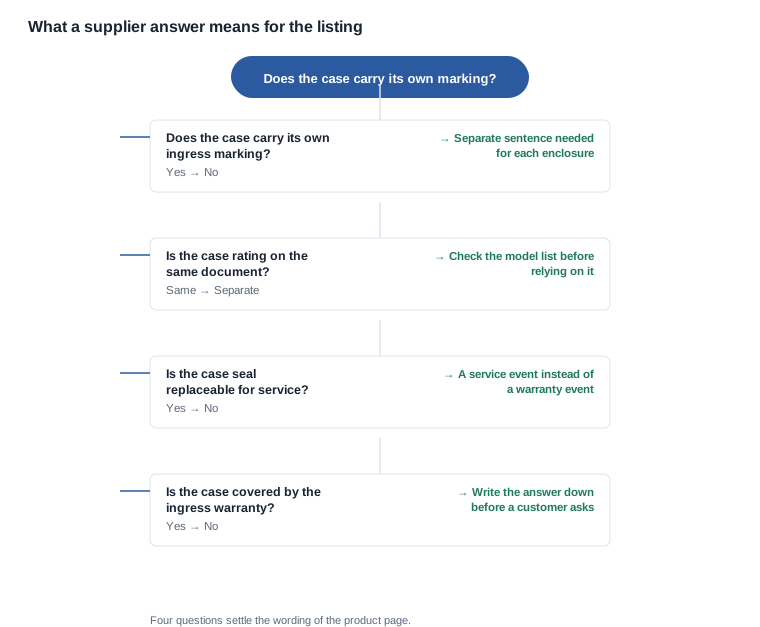
Five questions, in this order. They are designed so that the answers settle the listing wording rather than just sounding reassuring.
- Does the case carry its own ingress marking, and is there a test report for it? If the answer is that there is no marking, then no claim may be made about the case — not in the product page, not in the packaging copy, and not in the retail conversation. That answer is a perfectly good outcome, because it tells you what to write.
- If the case has a rating, is it on the same document as the glasses' rating or on a separate one? A single document covering both enclosures deserves careful reading, because it may have been issued for a different configuration, and because a document covering a family rather than a model is the most common way a rating turns out not to apply.
- What is the case's seal material, and is the seal replaceable? A replaceable seal turns a warranty event into a service event, and it is a design decision that a buyer can negotiate rather than discover.
- Is the case covered by the ingress-related part of the warranty? This is the policy question that produces the argument, because a customer who leaves their glasses in a case in the rain and then finds a fault will point at the case. Write the answer down while nobody is upset.
- What is the case's own charge time and charging interface? Neither is published for any model in this range, and the question matters here because a case with a cell that charges slowly in cold conditions is a support issue that will arrive labelled as a case fault.

In a shortlist, these five questions are worth more than the marking, because every credible supplier can show you a marking and only some of them will answer the case questions accurately. Which one of two suppliers you choose should turn on the answers to these five and on the case's role in the pack, not on which product page uses more impressive language. A supplier who volunteers that the case is unrated, and helps you write the listing around that fact, is giving you a better partner for a warranty dispute than one who answers loosely.
Two of the five questions are really negotiation questions dressed as technical ones. The replaceable seal is a design and tooling decision, and a buyer who wants it should be willing to pay for it in the quotation and to commit to a volume that makes it sensible for the supplier. The warranty coverage of the case is a policy line that can be negotiated, and it should be, because the alternative is a support cost that arrives asynchronously and uncategorised. Both belong in the same conversation as the unit price rather than in a separate compliance exchange that nobody owns.
How to write a listing when does ip rating cover the charging case is not true
Four things a listing must not do, and one thing it should do instead.
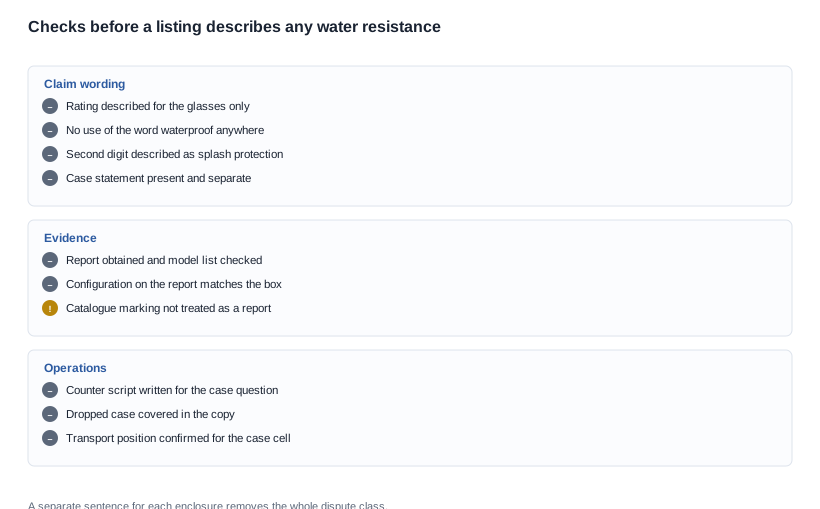
It must not present the glasses' IP54 marking as if it described the whole package. The marking applies to the enclosure that was tested, in the configuration that was tested. A customer reading a product page where a rating badge sits next to a picture of a case will read the badge as covering the case.
It must not say "waterproof" for either the glasses or the case. The second digit of an IP rating describes protection against water at a stated level. A 4 is protection against splashing water in any direction; it is not protection against immersion, a shower, a hose or a jet. Our IP ratings page sets out what each digit permits, and the difference between "splash resistant" and "waterproof" is the difference between a defensible claim and a recall.
It must not treat a catalogue marking as a report. For the two models in this range that carry IP54, no third-party test report number is published. A marking in a catalogue is a statement of position; a report is evidence. If your listing or your due diligence file needs evidence, the report has to be obtained from the manufacturer and the model list on it checked against your configuration.
It must not imply a protection level for a case that has no marking. The absence of a rating on the case is the honest position, and stating it plainly is better than having a customer discover it in the rain.
What the listing should do is separate the two statements explicitly. Something along the lines of: the glasses carry an IP54 rating for protection against dust ingress and protection against splashing water in any direction, in the tested configuration; the charging case is a separate enclosure and carries no ingress rating. That single sentence removes the entire class of dispute, and it is the kind of clarity that a customer service team will thank you for in month nine.
Where does ip rating cover the charging case leave a retail conversation and a freight model
In a retail channel the case is in the customer's hand and the question gets asked at the counter, usually by someone who has just seen the rating badge. So the answer has to exist in the training, not just in the product page.
What can the customer be told about the case? Exactly one thing: that the rating applies to the glasses. If the customer asks whether the case is waterproof, the honest answer is that the case carries no rating, and the practical advice is to keep it dry and to dry the glasses before docking them.
What happens if the case is dropped? A cracked lid or a broken hinge means the glasses inside are unprotected, whatever the glasses' rating says. That is a mechanical fact and it belongs in the copy about the case.
Is the case sold separately or in the box? A separately sold case is a product in its own right, with its own specification, its own listing and its own answer to this question. If it ships in the box, the two statements still have to be separated on the page.
Does the case need its own transport documentation? A case with a cell does, and whether it travels in the same carton as the glasses or in a separate consignment changes the paperwork and, on some freight terms, the cost. Our battery transport page sets out the position.
For the sport channel the question is largely moot, because this catalogue publishes no case configuration at all for YKC02, D17 and ZH12. Our sport smart glasses range page sets out that range as it stands, and the absence of a case is part of the published position rather than a gap in it.
One practical point for a buyer planning a retail programme: put the case question into the buying checklist rather than leaving it to the listing stage. Our IP rating buying checklist is the document to use across a shortlist, and the case lines in it are the ones that decide whether the product page will need rewriting after the first packaging review.
And the same question has a freight answer. The case question stops being a copy problem and becomes a commercial one when you decide how the case travels. Four decisions sit behind it, and each one has a cost attached.
Is the case in the box or sold separately? A case in the box is part of the product's identity, and the two protection statements sit side by side on the same shelf. A case sold separately is a second SKU with its own listing, its own stock and its own specification, and the buyer who takes it will read the product page of the glasses as though it described the case they just bought. Either way the wording has to separate them, but the effort is different, and the second route needs a second product page written.
What does the case do to the freight? A case adds volume and, in most designs, weight, and both change the packed dimensions that your fulfilment partner and your forwarder work from. On a DDP or FOB basis that is a per-unit freight change, and on a packed-volume basis it can move the order into a different size tier. The packed dimensions and the packed weight should be requested per configuration, not per product, because the two case configurations of a model such as the L2 Utral do not pack the same.
What does the case do to the packaging artwork? If the packaging carries a rating badge, and the case is in the box, then the badge is ambiguous by design. Deciding what the artwork says is a pre-production decision, and it should be made alongside the listing copy rather than after it.
What is the sample you approving? A golden sample that includes the case in its shipped state answers the question; a bare product unit does not. If the sample policy in your supply agreement covers only the glasses, say so in the order, and treat the case sample as a separate item with its own terms.
One last line for the commercial file. Certification cost and lead time follow the testing process and are not really negotiable, and the same is true of any test that would be needed to put a rating on the case. Tooling is often amortised across the first order while certification is charged per product family, and those two get bundled into a single line in many quotations. Ask which one you are being quoted, because the difference decides whether the cost scales with your first order or with your catalogue.
What we publish about does ip rating cover the charging case today
Published: the ingress marking IP54 for the V06 and the S7, and no ingress marking for any other model in the range. The case configurations and their published capacities — 1400 mAh on CY03 and L1 Pro, and CY05, 900 or 1400 mAh on L2 Utral, the foldable 1200 mAh case on MT6, the existence of a case without a published capacity on KY06 and MT5, the absence of a case row for S7 and V06, and V03, and the explicit absence of a case for V03 Pro.
Not published, for any model: an ingress marking for any case, a third-party test report number for either glasses marking, the case's seal material, the case's own charge time, the case's charging interface, and any warranty term.
We will not extend a marking from the glasses to the case, because they are different enclosures with different conditions and different evidence. We will also not imply a protection level for a case that has none, and we would rather you wrote the sentence that says so than have a customer write it for you.
What we will do is work the five supplier questions against a named model and a named pack configuration: which cases exist for that model, whether any marking applies to the case, and what the correct wording is for the listing and the packaging. Where a claim is wanted, the report has to be obtained from the manufacturer and the model list on it checked against the configuration you are actually shipping.
Send us the model, whether the case is in the box or sold separately, the channel and the destination markets, and we will tell you what is published, what a claim can rest on, and which part of your listing copy has to change.


