

OEM ready platforms are sold with certification language far more often than they are sold with certification documentation, and the gap between those two things is where compliance failures actually happen. This piece explains what certification coverage can and cannot mean when a supplier's published material is the only document you have, why a certification page is not a certification claim, why an organisation-level document cannot be read down to an individual model, and how to structure a compliance request that produces evidence rather than assurances. It is written for the person who will eventually have to answer a customs question, a retailer questionnaire or a market surveillance enquiry — which is to say, for whoever owns the risk after the order is placed.
OEM ready platforms and what "certification coverage" can honestly mean
Coverage is a claim about scope. To make it honestly, three things have to be true at once: the document exists, the document applies to the specific product you are shipping, and the document was issued for the destination market you are shipping into. Most certification language fails on the second and third.
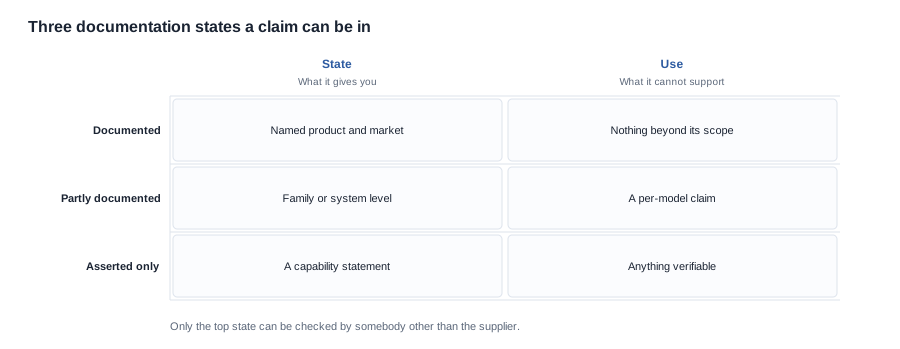
When a supplier describes certification coverage, the useful thing to establish first is which of three states the material is in.
Documented. There is a certificate or declaration, it names a product or a product family, it names an issuing body, and it carries a date and an identifier. This is the only state in which the claim can be verified by someone other than the supplier.
Partially documented. There is a document but it covers a family, a component, a factory or a management system rather than your specific model and market. This is common, and it is not useless — it tells you what testing has been done somewhere in the chain — but it cannot support a per-model claim without a link.
Asserted. The capability is described in words without an attached document. This is the state most product pages are in, and it is where the risk concentrates.
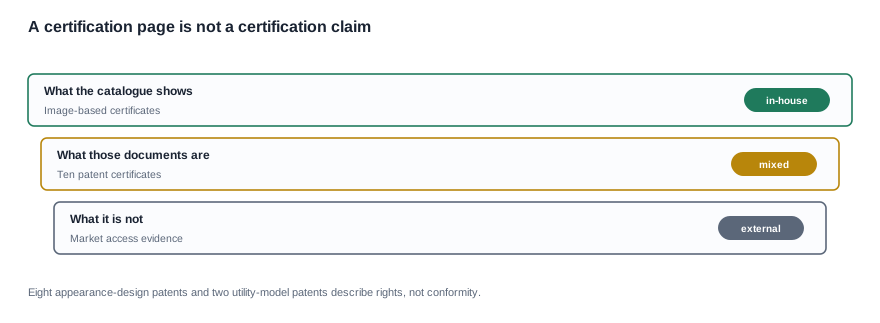
The catalogue material this business publishes sits in a specific position within those three states, and it is worth stating it precisely rather than approximately. The catalogue carries a single company-level export certification page and it holds images rather than text, and the catalogue text names neither CE nor FCC nor RoHS. There is no per-model certification row for any model in the range, and no per-model certification identifier is recorded anywhere either — there is no row marked as pending confirmation, and no document that could be read as a promise awaiting completion.
That is the honest position: what is published is a page of images at the company level, and the text layer contains no market-access claim to interpret. This is not a statement that the products are uncertified, and it is not a statement that they hold certificates. It is a statement about what a buyer can verify from the material available.

The distinction between a certification page and a certification claim
The most consequential confusion in this area is the treatment of a document's presence as evidence of its content.
An export certification page in a product catalogue is a page. It can contain certificates, it can contain marketing material, and it can contain something else entirely. Determining which requires looking at it. In this catalogue, the page in question holds ten patent certificates, eight of them appearance-design grants and two utility-model grants. Those are intellectual property documents. They describe the design of products and the utility of an invention; they do not describe market access, radio conformity or material safety.
Reading them as conformity evidence is a category error rather than an oversight, and it has a specific failure mode: the error is invisible in a document review, because a reviewer's eye goes to a page titled with the word certification and stops. The page is titled as an export certification page. Its contents are patents. Both statements are true and they do not combine into a compliance claim.
Three questions separate a certification claim from a certification page in any supplier's material, and they are worth applying to every document you receive.
What does the document actually attest to? Read the scope. A design patent attests to the ornamental design of a product. A utility patent attests to an invention's technical features. A conformity certificate attests that a product meets named requirements for a named market. A management system certificate attests that a factory has a process. None of these substitutes for another, and a document collection containing only the first two tells you nothing about the third.
Which product does it name? A document that names a model, a variant and a configuration can be checked. A document that names a family or a holder tells you the holder has done work, and leaves you to establish which product that work covers. The gap between those two is where a compliance file becomes a guess.
Which market and which issue date? Conformity expectations are market-specific and time-specific. A document that satisfies one market's requirements tells you nothing about another's, and a document whose validity has lapsed is worse than none because it invites reliance.
The failure pattern that follows from skipping these three questions is consistent: a compliance file is assembled from documents that individually do not attest to what the file claims to attest to, the file is signed off internally, and the problem surfaces at the border or in a market surveillance enquiry. The cost at that point is a shipment delay rather than a document correction.
Why a company-level page cannot be read down to a model
There is a structural reason why organisation-level material cannot substitute for model-level evidence, and it is worth understanding rather than memorising.
Conformity depends on the product configuration, not on the organisation. A radio-equipped product is assessed on its radio behaviour; a product with a lithium battery is assessed partly on its battery and its transport documentation; a product sold to children may be subject to additional requirements that do not apply to an adult product. Two models from the same factory, from the same product family, with the same corporate quality system, can hold entirely different conformity positions — because the radio configuration differs, because the battery differs, because the intended user differs, because the variant sold differs.
This range is a good illustration of how much variation sits behind one corporate document. It contains camera models, audio models, sport models, children's models, an AR model, a bone-conduction model and a photochromic model, all from one producer. The battery configurations alone vary widely — from a 40 mAh cell in the children's models through several 220 mAh and 260 mAh and 265 mAh configurations to 290 mAh cells, with two of the camera models at the higher figure and one publishing two case capacities and another publishing none at all. The charging methods divide into three states. Ingress protection is published on exactly two models. Nothing about that spread can be inferred from a company-level page.
The operational rule that follows is simple and is the one most often skipped: build the compliance file per model and per destination market, and treat any document that names only the organisation as context rather than as coverage. Where a supplier offers a family-level document, the follow-up question is which models and which variants that document was issued against, and whether each of your intended configurations falls inside it.
There is a second, subtler reason, which is that a corporate page can be perfectly accurate and still be irrelevant to you. The documents it holds are the holder's, and they describe the holder's rights. They do not state anything about your obligations, your declared party status or your destination market requirements. A buyer who assembles a compliance file from corporate material ends up with evidence about the supplier and none about the product.

Building a compliance request that produces evidence
The request is where a compliance position is actually created, and its structure determines whether you get documents or assurances.
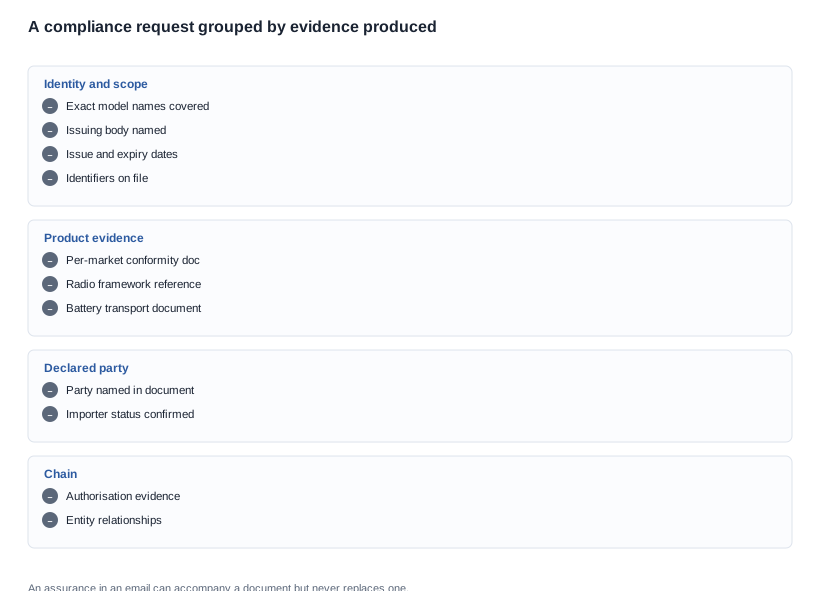
Group one: identity and scope. Ask for the exact model or variant names the documents were issued against, the factory or legal entity that holds them, the issuing body, the issue and expiry dates, and the identifiers. Ask the question in a form that forces precision: not "do you have CE certificates" but "which document covers which model, issued by which body, valid until when". A supplier who cannot answer that question for a given model has just told you something you needed to know before ordering.
Group two: product-specific evidence. For each destination market on your list, ask what conformity evidence applies to that specific configuration, and ask for the document. Where the product contains a radio, the relevant framework in the European Union is the Radio Equipment Directive, (EU) 2014/53/EU — worth being precise here, because a different directive number in the same family is frequently confused with it in correspondence, and an incorrect reference in a document is a finding in an audit. Where the product contains a lithium battery, ask separately about the transport documentation the battery configuration requires, since that applies to shipment rather than to sale and is therefore easy to omit from a product file.
Group three: declarations and the declared party. Establish who is the declared party in each market — you, the importer, or the manufacturer — and make sure the document names the correct party. This is the single most common defect in assembled files, because documents are frequently issued to the factory and then used by a brand that is not named on them.
Group four: the chain. Ask for the relationship between the manufacturer and any other entity whose name appears on the documents, and keep the authorisation evidence with the file. Where the documents reference a holder that is not the factory, the authorisation is part of the evidence, not an administrative detail.
Then set the acceptance rule before you start: what makes a document acceptable to you. Minimum content, valid dates, named party, named model, and a rule about what you will not accept. The most useful single rule in practice is that an assurance in an email is not a document, and an email can only ever accompany a document, never replace one.

What published product attributes do and do not tell you about compliance scope
Product documentation is not compliance documentation, but some published attributes bear on compliance scope, and it is worth knowing which do.
An ingress protection rating is the clearest case. Two models in this range publish IP54, and it appears as a product feature rather than as a certification row. It tells you the manufacturer states a water and dust resistance class for those configurations. It does not tell you which standard or method was used, whether it was tested or declared, or whether any conformity document exists for the market you are shipping into. It is a product attribute with compliance relevance, and it should inform your question rather than answer it.
Battery configuration is the second. Published cell capacities, endurance figures and charge times describe the product; they do not describe the battery's transport classification or documentation status. Since almost every configuration in this range contains a lithium cell, the transport documentation question applies broadly and is worth raising at the start of a programme rather than at the first shipment.
Camera configuration is the third, in a narrower sense. A product with a radio and a product with a camera are assessed differently in some jurisdictions, and eleven models in this range carry a camera while the audio models publish their radio version openly. The absence of a radio version row on a camera model's page is not evidence of anything; it simply means the row is not published. Do not read technical silence as a regulatory position.
What none of the published attributes can do is substitute for a conformity document, a declaration or an authorisation. That is the boundary to hold, and holding it is what makes a compliance file defensible when someone asks why it contains what it contains.
Running the due diligence review before you commit
Assembling a file and reviewing a file are different activities, and the second one is where most programmes discover they have a gap rather than a file.
The review has four criteria, and they should be applied per document rather than per file, because a file inherits the weakest document it contains.
Attribution. Does the document attest to what you are shipping, or to something adjacent to it? Read the scope line rather than the title. A document issued to a legal entity that is not the manufacturer tells you about that entity's rights, not about your product's conformity.
Currency. Is it in date, and was it issued against the configuration you are ordering? The second question is the one that catches people, because a valid certificate for a previous variant looks exactly as valid on paper as one for the current one.
Coverage. Does the destination market in the document match the market in the shipment? A file that satisfies one market's requirements is not a partial file for another market — it is not a file for that market at all.
Traceability. Can somebody in your organisation find the document, name its holder and its date, and say which order it supports? A file that exists only in a supplier's inbox is not evidence you control.
Apply the criteria in a single pass and record the result per document. The outcome is normally a small number of findings rather than a long list: documents that are current but cover the wrong party, documents that cover the model but not the market, and documents that are neither current nor model-specific. Each finding then gets one of three dispositions — accept as context, request a replacement, or change the configuration or the market. Teams stall when a finding has no disposition, and the stall usually looks like diligence while it is actually indecision.
The commercial consequence is worth stating plainly, because it changes how this work should be prioritised. A compliance gap discovered during due diligence costs a document request or a supplier conversation. The same gap discovered at a border costs a shipment delay, storage and a customs relationship. The gap discovered in a market surveillance enquiry costs considerably more than both. This is the clearest trade-off in the whole subject area, and it is why the compliance request should go out before the artwork approval rather than after it.
One further criterion belongs on the list for private-label programmes specifically: declared party consistency. Check that every document names the same declared party, and that this party is the one who actually carries the obligation in each market. Files assembled from mixed sources frequently contain documents issued to the factory and a declaration issued to the importer, with neither acknowledging the other, and that inconsistency is visible to anyone who checks for it.
Then run the whole review again against the configurations you will actually ship, not against the catalogue. A range of this size carries configurations that differ in battery, case, variant naming and finish, and the review is only valid if it has been applied to the configuration on the purchase order.
Sequencing compliance work against your launch timeline
Compliance work has a natural order, and the order is driven by lead time rather than by importance.
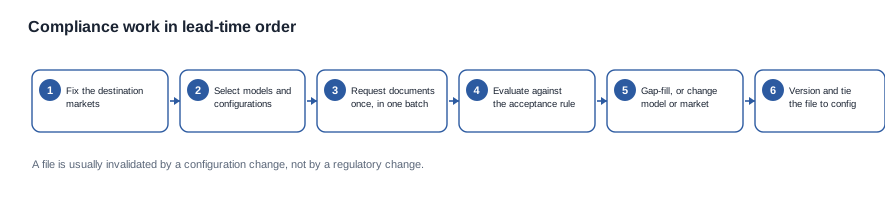
First, identify the markets. The set of destinations determines which frameworks apply, and nothing else can be scoped before it is fixed. Do this before any model selection, because a model that suits one market may be unsuitable for another.
Second, select models and configurations. With the market set, shortlist against the configurations each market can accept — and hold the unresolved items in view, such as the model whose case configuration is published as two values without a stated correspondence to its two variant names.
Third, request documents. One request, all models, all markets, one deadline. Split requests produce partial files, and partial files are what create the sense of coverage without the substance of it.
Fourth, evaluate and gap-fill. Classify each document against the acceptance rule, identify the gaps, and decide per gap whether it is a request, a paid activity, or a reason to change the model or the market. The third option is the one teams avoid, and it is often the cheapest.
Fifth, freeze and review. Keep the file versioned and tied to the configuration it covers. A file is invalidated by a configuration change far more often than by a regulatory change, and the trigger is usually something small — a different case capacity, a different colour variant, a different market.
The brand-side counterpart of this work — the artwork, packaging content and declaration ownership that sit alongside the certificates — is covered in brand guidelines that actually work and in the customisation scope discussion in how deep customisation goes.
The position to hold is narrow and durable: this range publishes product structure, a company-level page of image-based patent certificates, and no per-model certification row and nothing in its text that names a conformity framework. Treat a per-model conformity position as material to be requested, verified and filed — not as a capability described in a catalogue, and not as something to be inferred from the existence of a page.
Related reading
- Documentation discipline for a programme — OEM ready platforms brand guidelines
- Customisation scope and its compliance surface — OEM ready platforms customization depth
Tell us the destination markets and the configurations you intend to ship, and we will tell you which conformity documents have to be requested per model, which can be covered at range level, and where a configuration change would invalidate a file you have already assembled.


