

A lead time quoted without a configuration attached is not a date, it is a mood. And a lead time quoted for a customised programme is usually the production lead time, which is the shortest part of the chain and the easiest part to quote. The number a buyer actually needs is the date on which the first sellable unit is in their warehouse, and the distance between the two is where the customization options earn their reputation, for better or worse.
No production lead time is published for any model in our catalogue, and no tooling lead time, no sample lead time and no development lead time is published either. What the catalogue does publish is the configuration structure that the schedule hangs on: the seven customisation routes, and the product rows that say which configurations exist at all — charging published as magnetic on seventeen models and Type-C on seven with four models publishing neither, case capacities on five models at 900, 1200 and 1400 mAh, "2 hours or less" is the published charge time on twenty-six models, and only the D17 and ZH12 go further, at approximately one hour, camera resolution published as 8 MP on eight models and 13 MP on three, IP54 on the V06 and the S7 only, a frame weight of 158 g published for the MT6 alone, and colour options on two models.
Every one of those rows is either a configuration that already exists or a development that has to be scheduled.
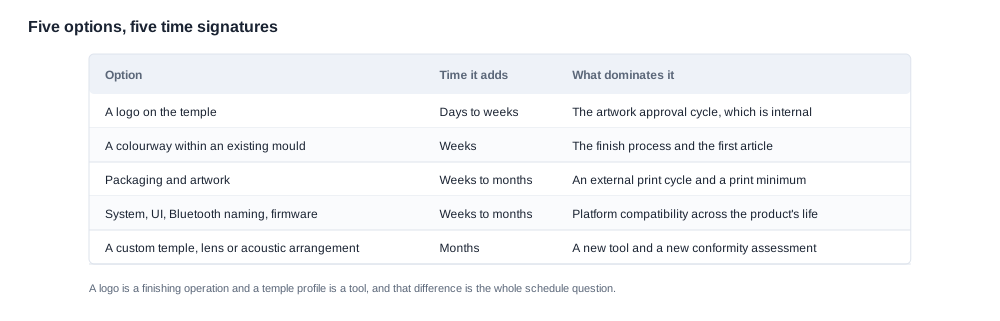
Customization options and the schedule they actually create
A customised programme is a chain, and the chain has two halves that belong to different companies.
The supplier's half runs: requirements freeze, engineering, tooling, sample build, pre-production sample, golden sample approval, production, documentation, packing, shipment. Its length is decided by the requirements and by the queues in front of the supplier.
The buyer's half runs: artwork preparation, internal approval, sample review, golden sample sign-off, market documentation, listing preparation, channel briefing. Its length is decided by how many people have to look at something and how quickly they do it.
Most slipped programmes are not failed programmes; they are programmes where one half was planned as if it were the other. A buyer who gives eight weeks for artwork approval and receives a production date that assumes three has not been given a bad lead time — they have been given a lead time for a different organisation.
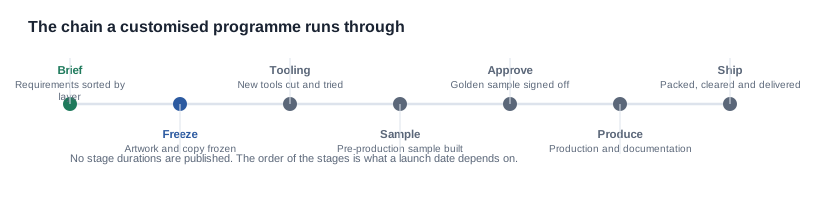
The chain above carries no dates, because none are published. It is drawn for one reason: to show where a launch date is actually decided. A date is lost at a convergence point or at an approval, and nowhere else in the sequence. That is a useful thing to know, because it says which conversations matter and which ones are noise.
The second structural point is that the schedule is a chain, so the longest element dominates. Adding a week to a step that is not on the critical path costs nothing in delivery. Adding a week to the step that is on it costs a week. The practical consequence is that a requirement should be judged by whether it lands on the critical path, not by how big it is.
That is also why customisation requirements interact. A new colour and a new packaging language both need artwork approval, and they both wait for the same person. Run them serially and each one costs its own cycle; run them in parallel and they share a cycle. The same applies to the sample reviews: a pre-production sample that is reviewed once for everything is one cycle, and a sample that is reviewed three times for three reasons is three cycles.

The flow above is the practical version of the chain. Hardware, firmware, packaging and documentation can run alongside each other for most of the programme. They converge at the pre-production sample, they converge again at the golden sample, and they converge a third time at the shipping documentation. Those three convergence points are where a programme actually slips, and each of them is a point where a buyer can either give a date or ask for one.

Customization options ranked by schedule weight
1. A new frame or temple geometry. The heaviest item in the menu, because it is a tooling event: a new tool has to be designed, cut, tried, corrected and accepted, and until it is accepted there is no production. The standard OEM tooling requirements page sets out what the tooling decision involves and who owns the tool afterwards. Nothing else in the customisation list comes close to this on schedule weight, and the practical rule is that geometry decisions have to be made before anything else is committed.
2. A new software surface. A branded app, a custom interface, a renamed Bluetooth stack, a modified firmware build. The engineering is weeks; the validation is longer; and the release obligation is permanent, because every subsequent firmware release has to carry the customisation forward. The app branding article sets out the levels and what each one commits you to, and it is the right place to find out whether the requirement you are holding is a configuration or a platform.
3. A lens or tint configuration. New lens material has to be sourced, and the sourcing sits with a supplier who is not the factory. On top of the sourcing comes the mount and fit work, and the approval of a sample that has to be judged in two states — the frame and the lens together. The customization options overview explains where a lens requirement sits in the layer structure.
4. Packaging and market sets. The work itself is short, but the queue is external: a printer, a proof, a market-by-market review of marks and documents. Packaging is usually the cheapest thing in the programme and the most common cause of a missed shelf date, because the artwork approval cycle sits with the buyer and the print slot sits with somebody else.
5. A logo. The lightest item, and the one most often underpriced in schedule terms. The mark itself takes days; the artwork approval cycle takes as long as your organisation takes, and it is the only cycle in the programme that nobody in the factory can speed up.
Two items sit outside this ranking because they are not customisation lines at all: certification work and transport documentation. A change of component can reopen a document review, and a document review is a queue with a laboratory in it. The catalogue itself carries no per-model certification row and does not name CE, FCC, RoHS, RED or EN 18031, so the documentation a programme needs has to be requested per model and per market rather than inherited from a catalogue page.
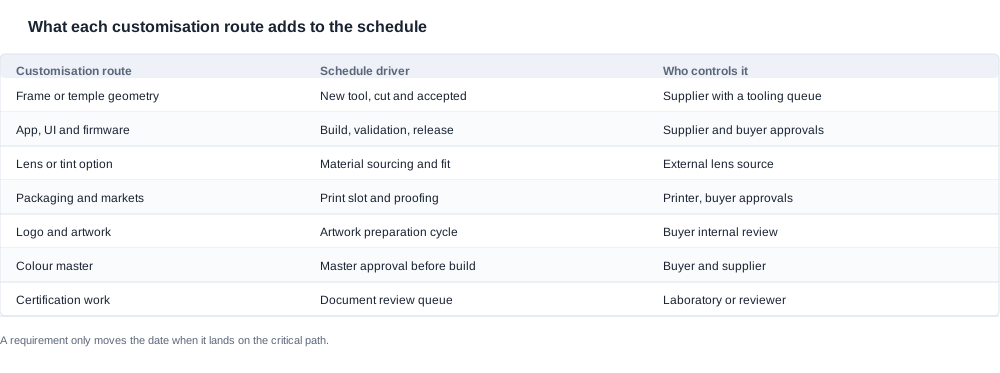
Read the table by the third column rather than the first. Two of the seven rows are controlled by the buyer, one is controlled by an outside source, and the rest sit with the supplier — and that distribution is the honest reason a customised programme cannot be scheduled from a catalogue page. The schedule is only knowable once the requirements are sorted by layer and each one has been assigned an owner, which is the same exercise described in the customization options overview.

Customization options and the questions that size a date
Five questions decide whether a requirement moves the date. Asking them before the quotation is what turns a schedule into a plan.
- Does it change the tool? A new tool is the single largest schedule item in this category, and the question belongs at the design stage rather than at the quotation stage, because after the first article it is a new programme.
- Does it change the bill of materials? Swapping the cell, the charging method or the case changes what the shipment contains, which reopens the transport documentation and the configuration records. The published rows show how many configurations exist: twenty-one of the twenty-five named models publish a charging method, case capacity for five, resolution for eleven, ingress for two.
- Is there an external queue? A printer, a laboratory, a tooling shop, a lens supplier, a customs broker. External queues are where the uncertainty lives, and a lead time given without a constraint named is a number rather than a commitment.
- Is the change inside our own approval cycle? Artwork, colour references, manual text, insert text and listing copy. This is the half of the programme the factory cannot compress, and it is the half that slips quietly.
- Does it reopen a document? If a requirement changes what the product is, the conformity and transport documents have to be reviewed against it, and the review is a queue.
A sixth question is worth asking because it changes how the date is read: is this date committed or estimated? A committed date is against a named configuration, with the paperwork complete and the artwork frozen. An estimate is against a configuration that is still being agreed, and it moves when the paperwork moves.
There is a seventh, for buyers who ship by sea and sell into a seasonal window: how much of the date is in front of you and how much is behind you? The production date and the arrival date are two different commitments, and the second one contains a leg that nobody in the factory controls. A launch planned from the production date alone will miss its shelf date in a way that looks like a factory delay and is not one.
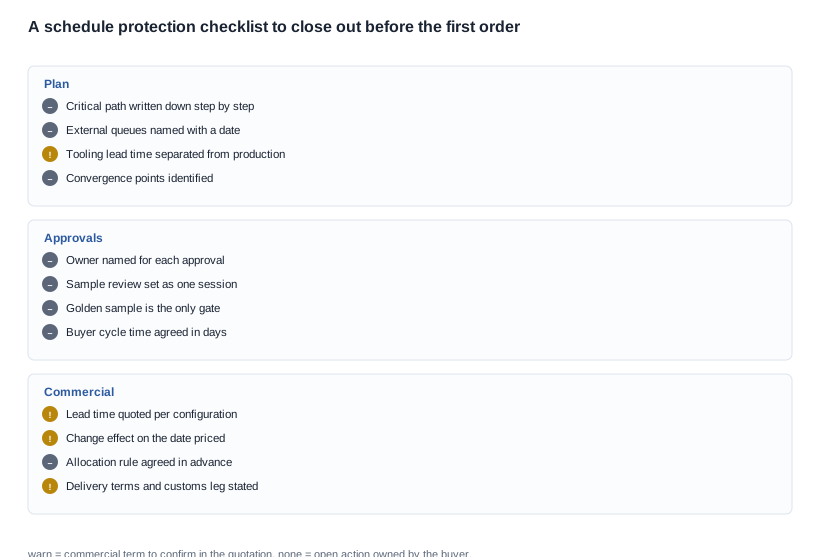

Customization options: how to protect a launch date
1. Freeze by layer, and freeze the cheap layers first. The logo, the colour, the packaging artwork and the copy are cheap to change in the first weeks and expensive to change after the first article. Freezing them early costs nothing and removes a category of slip entirely. The freeze should carry a date and a change fee, so that a late change is a decision rather than an argument.
2. Identify the critical path explicitly. Write down the steps the date depends on and the steps that are merely happening. The second list can be relaxed; the first cannot. A programme that has not decided which is which protects everything equally, which is the same as protecting nothing.
3. Put the external queues in the plan, by name. If the packaging print is the constraint, then the plan contains a print slot with a date, not a line that says "packaging". A named queue can be chased; an unnamed one can only be discovered.
4. Review the sample once, for everything. A pre-production sample review that covers the hardware, the firmware, the packaging, the manual and the insert in a single session is one cycle. Five separate reviews of five subjects is five cycles, and each one is a chance to find a new problem late.
5. Treat the golden sample as the single acceptance gate. Once the golden sample is approved, the criteria are fixed and everything after it is execution. Programmes that keep a second and third approval layer open "just in case" do not get safer; they get later.
6. Buy the long-lead items separately where the supplier allows it. Lens material, printed packaging and special components often have their own queues. Ordering them outside the main production order moves their wait off the critical path and converts it into inventory — which is a cash decision, not a free one, and should be made knowingly.
7. Plan the second order before the first one ships. The repeat order inherits every decision from the first, including the ones nobody re-examined. A programme that has never been re-quoted often discovers at the second order that the artwork, the packaging run and the configuration mix have all changed, and that the price of the second order is not the price of the first.
8. Agree the allocation rule before you need it. If a queue slips, what happens to the order? A partial shipment, an allocation across orders, a priority rule by deposit — these are agreements that are easy to make calmly in advance and expensive to make during a delay.
Customization options and the commercial questions behind a date
A date is a commercial term like any other, and it should be quoted with the same care as a price.
- Quote the lead time per configuration. Ask for the date against a named configuration with its paperwork complete, rather than for "the" lead time of a model. The ODM development timeline overview sets out the phase structure we work to, which makes it easier to ask which phase a given requirement sits in.
- Separate tooling lead time from production lead time. They are different numbers with different owners, and adding them together produces a figure that cannot be planned against.
- State what is on the critical path. A date with the constraint named is a commitment; a date without it is a hope.
- State the terms. Incoterms and the ship-to split — DDP or FOB — change the door date as much as the cost, because customs and duty sit between the factory and your warehouse. Freight time is part of the lead time for a launch, even though it is not part of the production lead time.
- Ask about service and spares. The lead time for a spare unit, a replacement case or a warranty replacement is a different number from the production lead time, and it is the one that matters when a channel partner calls.
- Ask what happens to the date if the artwork changes. A change after the freeze can move the date, and the fee should be quoted alongside the effect on the date.
The questions to ask a supplier about a customised programme's schedule:
- Which of our requirements need a new tool, and which do not?
- What is the lead time for the tooling, separate from the production lead time?
- What is on the critical path, and what is the queue at each external step?
- Which streams run in parallel, and where do they converge?
- What is the artwork and approval path, who signs each approval, and what is the lead time for each?
- What is the lead time per configuration, and does it differ between a standard configuration and a developed one?
- What happens to the date if the artwork or the specification changes after the freeze?
- What is the shipment split if only part of the order can be completed, and how is that decided?
- What is the lead time for spares and warranty replacements?
- What are the delivery terms, and which leg of the journey is on our side?
Questions 5, 7 and 8 are the ones buyers tend to leave out, and they are the three that decide whether a delay becomes a crisis. A programme with a named approval owner, a priced change effect and a written allocation rule can absorb a delay. A programme without them converts any delay into an escalation.
One more method deserves a place here, because it is the one that removes the most risk for the least effort: work backwards from the launch date. Take the date the product has to be in your warehouse, subtract the transit leg and the customs leg, subtract the production and documentation stages, subtract the golden sample approval, subtract the pre-production sample, and then subtract the tooling if there is any. Whatever is left is the engineering and artwork window. If that window is negative, the launch date is not a negotiation with the supplier — it is a fact about the programme you have described, and the options are to remove a requirement, to remove an approval cycle, or to move the date.
Working backwards also exposes the least visible risk in this category, which is the approval cycle that nobody owns. A buyer who assumes the artwork review takes three days, when it has historically taken two weeks, has a schedule that is wrong by a fortnight and does not know it. The number of days your own organisation actually takes to approve a print-ready file is a measurable figure, and it should be measured rather than assumed — the same way a supplier's lead time should be asked for rather than inferred from a catalogue.
The pitfalls: quoting the date from the first sample rather than from the frozen specification, treating packaging as in-house because the artwork is, forgetting that a new colour needs its own master approval before it can be produced, and planning a launch date that assumes the second order will repeat the first one exactly.
Two red flags to watch for in a supplier's answer. The first is a lead time quoted for a model without a configuration, which cannot be acted on because it does not identify what will be built. The second is a programme where the factory's approval cycle and the buyer's approval cycle are assumed to be the same cycle — that assumption is where most missed dates actually live, and it is invisible until the first sample comes back with two revisions nobody had budgeted for.
The honest answer to the question in the title is that no lead time is published, and a quoted one is always specific to a configuration, a paperwork state and a queue. What we can do is take a requirement list, sort it by the layer it sits in, separate the tooling path from the production path, name the external queues and the approval owners, and give you a date for each configuration with its conditions stated. Send the requirement list and we will tell you which part of the chain each item sits in and what it adds to the date.
Related reading


