
Tooling is the one line on a standard oem quotation that gets decided before anybody orders anything, and it gets decided by a drawing rather than by a quantity. Two programmes with an identical specification can sit on opposite sides of it: one inherits a tool that already exists, the other opens a new one, and the difference between them has nothing to do with how many units are involved. That is why tooling belongs in a requirements conversation rather than a price negotiation, and why these requirements are worth settling ahead of a quotation rather than once it has been handed over.
What follows treats tooling as a design decision with a commercial tail. It works from the physical changes a tooling request can involve, and for each one it sets out the published evidence behind it, the criteria for deciding whether a new tool is involved, and what has to reach the quotation and the agreement once an answer arrives.
Two things this page will not do, and the omissions are deliberate. It will not put a figure against a mould: no tooling fee, no cavity count, no shot count, no place of origin and no delivery date, because the catalogue publishes none of those and this page will not invent them. It will also not declare which of those changes can be tooled, because that answer depends on the configuration in front of you and belongs in a written answer against a named configuration rather than in a general paragraph.
The evidence base is narrow, and the narrowness is the point. The catalogue carries twenty-eight entries in seven groups, and the rows that bear on a tooling question appear on a small minority of them: three published removable parts, two published colour rows, a charging-case capacity on five of the eleven camera models, a case shown without a figure on two more, and no case row at all on the remaining four. Everywhere else on this subject, the honest output is a question.
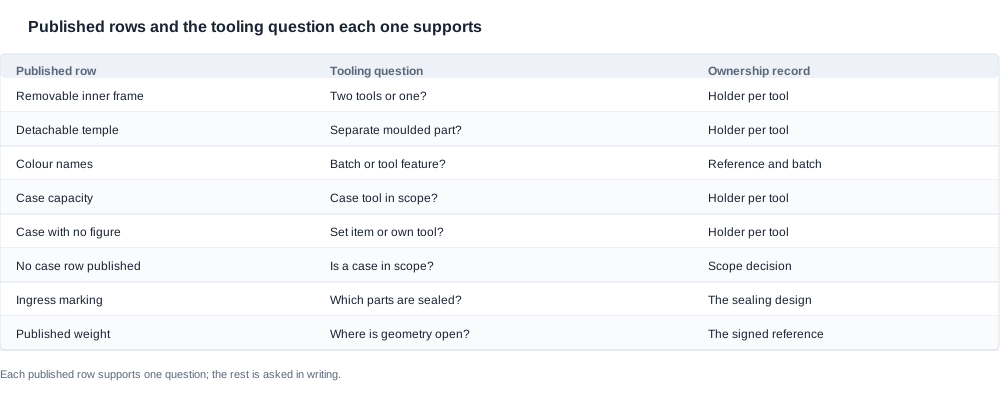
The table above is the working structure for the whole article. Each row is something the catalogue actually publishes, and each row carries the same two follow-ups: whether the change opens a new tool, and who holds that tool afterwards. Those two follow-ups are the subject of the last two sections, and they are the part of the tooling conversation that a specification cannot settle on its own.
What tooling is in this product category
In this category, tooling means the physical means of making the physical part: the precision tools that hold the geometry of a moulded component, and the fixtures that let a line repeat that component without drifting. It is not the electronics and it is not the software. A camera module, a cell, a board and a software build are purchased or written items, so changing them is a component change or an engineering change rather than a tooling event, and they are committed against a different budget.
What separates tooling from everything else is that a tool outlives the programme that paid for it. A mould is a specific piece of steel cut to one geometry, and it stays in a building after the order is finished, in a condition that changes every time it is used. That single fact is why tooling has to be discussed twice — once as a cost at the start and once as an asset at the end — and why a document that covers only the first conversation leaves the more expensive half open.
The published record tells you where a tool can exist at all. Across the twenty-eight entries, the catalogue publishes three removable parts and two colour rows, and those rows are the whole of the published evidence about components that can be separated from a body or ordered again in a different colour. The V06 and the S7 publish a removable inner frame. The G07 publishes a detachable temple. The V03 Pro publishes three colour names and the V06 publishes four. No other entry in the range publishes a removable part or a colour name.
That thin record has a direct consequence, and it is the first criterion for how to evaluate a configuration. An entry with no removable part is, as far as the published evidence goes, a one-piece body, and a one-piece body concentrates the geometry and the surface in a single tool. An entry with a removable part splits those decisions across two tools and creates a joint, and the joint is where tolerance and servicing live. A buyer who knows which category an entry falls into can already tell whether the programme is a single-tool programme or a two-tool programme before anyone quotes.
Where the catalogue publishes a separable part
The temple is where the tool cost usually sits in this category, because the temple is the part that has to carry everything else. In the camera models the cell, the board and the module all live along the temple, so a change in what the temple has to hold is a change in the shape of the tool. The catalogue publishes two temple rows that bear on this and no more: the V03 Pro publishes flexible temples, and the G07 publishes an ultra-thin temple together with a detachable one.
A detachable temple is the most consequential published row in the range for a tooling conversation, and it is easy to miss because it is phrased as a product feature rather than as a manufacturing fact. A detachable temple means the temple is a separate moulded component with its own tool, joined to the front by a joint that has to hold an alignment, take an assembly force and survive repeated handling. The front tool and the temple tool are then two assets rather than one, with two condition records, two servicing histories and — the point that matters commercially — two ownership positions that can diverge if one party holds only one of them.
The question this raises is specific, and it is the question to put in writing: is the detachable temple cut from a tool dedicated to it, and is that tool held under the same arrangement as the front, or is it a shared tool the programme borrows? A shared temple tool can be the most valuable asset in the arrangement and the one with the weakest claim, because it is used by programmes that did not pay for it and is serviced according to the needs of all of them.
Where the catalogue publishes a colour
Colour is published on two entries only, and both are camera models: the V03 Pro with three colour names and the V06 with four. That is the entire published colour position for twenty-eight entries, and the tooling consequence is more interesting than the count.
Colour is usually a material question rather than a tool question, because a pigment or a masterbatch changes what the surface is rather than what the tool is. It becomes a tool question in a narrower set of circumstances: a colour carried by a surface texture, a colour achieved by a two-shot or over-moulded feature, or a colour that has to be matched against a second moulded surface. Each of those puts the colour decision inside the tool rather than beside it, and each of them converts a batch question into a tool question.
The second consequence follows from a structural row rather than from the colour row itself. On the V06, the published removable inner frame gives the colour decision two surfaces to land on, and a decision about whether the inner frame matches the front or contrasts with it has to be taken before the tooling conversation, because it decides which tool carries the colour and which one carries only a surface finish.
The third consequence concerns what happens after launch, and it is the one a buyer usually forgets. A colour is a batch with a specification and a physical reference, and a later order in the same colour depends on the batch record and the reference surviving somewhere. Who holds the colour specification, the reference sample and the batch history is an ownership question that has nothing to do with steel but is settled in the same document as the steel question, and it is far cheaper to settle at the start than to reconstruct later.
Where the catalogue publishes a charging case
No entry in the range publishes a packaging row, so packaging has to be separated into its parts before it can be asked about. Printed material is artwork and print assets, and it is not a tool in the physical sense. A moulded insert is a tool. A charging case is a moulded component and therefore a tool.
The charging case is the one place where the catalogue lets a packaging question be asked against published evidence, and it does so in three states across the eleven camera models. Five of them publish a case capacity. The CY03, the CY05 and the L1 Pro carry 1400 mAh. The L2 Utral prints two capacities in a single row without stating which belongs to which of its two variant names. The MT6 has a 1200 mAh folding case. Two more, the KY06 and the MT5, publish a case with no capacity against it. Four of them — the V06 and the V03, and the V03 Pro and the S7 — print no case row at all.
Three states, three different tooling conversations. A published capacity means a case tool exists in the programme or in a set the programme can draw on. A case with no published capacity means a tool question the catalogue cannot help with. And no case row at all means the case is not established as part of the configuration, so whether it belongs in the programme has to be asked about rather than assumed in either direction.
Where the catalogue publishes nothing at all
The lens is the specification most often assumed to be free, and the assumption is worth taking apart because the catalogue does not support it either way. No entry in the range publishes a lens material, a base curve or a lens source. The photochromic entry publishes no optical performance figure at all, the V03 Pro publishes a photochromic lens as a feature row without publishing the material or the performance behind it, and the bone-conduction entry publishes an amplification gain of 35 dB without publishing a lens material.
That leaves one question with two legitimate answers, and no published row tells a buyer which applies: is the lens a separate moulded component with a lens tool of its own, or is it a sourced item produced to a catalogue specification? The two answers behave completely differently. A lens tool is a second tool for the programme, carrying the same ownership, servicing and exit questions as any other, and it may also be a tool that could be shared with a different programme on the same base curve. A sourced lens has no tool in the programme at all, and the question moves to supply continuity and to the reference the buyer approves.
Where the catalogue publishes no marking row
The catalogue publishes no marking row for any entry, and that is worth stating plainly because a mark is the change most often assumed to be free and most often is not.
A mark can be applied in several ways, and only some of them touch a tool. An in-mould marking or an in-mould texture is carried by the tool itself, which means the mark is part of the geometry and the tool has to be cut for it. A pad print, a screen print or a laser mark is applied downstream on the line, which means it needs an artwork file, a fixture or a plate and a station on the line, but no new tool for the part. A separate medallion, insert or badge is a component with a tool of its own.
The difference between those cases is not a matter of degree. In the first case the marking decision is frozen into a physical asset and changing the mark later means changing the tool. In the second it is a production setting that can be revisited without touching the tool. A buyer who has not established which of the two applies before quoting has committed to the first by default, because the first is the one that leaves a one-off line on the invoice.
Fixtures, jigs, packing equipment and inspection aids belong in the same conversation but not in the same category. They are equipment rather than geometry-specific tooling, they are often recovered differently, and they are the items most frequently omitted from a tooling quote and then discovered during pre-production, usually when a specific measurement has to be repeated on every unit. None of this needs a figure to be managed properly. It needs a description: what the item is, which part it belongs to, who holds it and who services it. That is the same four-part description a tool needs, which is why the two are usually easier to handle together than separately.
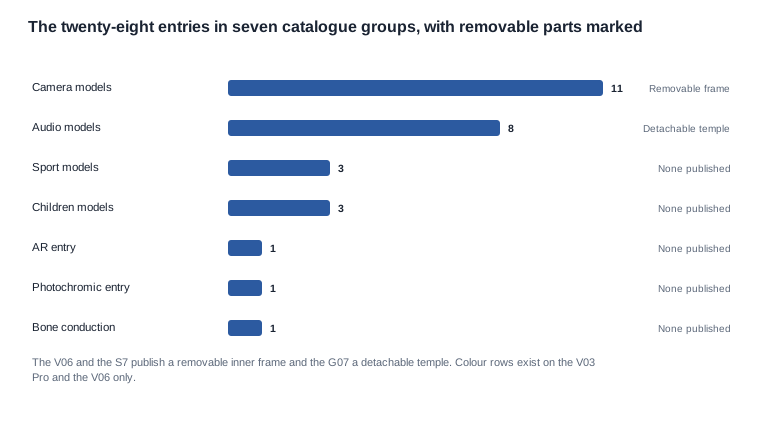
The chart above is the published structure of the range, grouped the way the catalogue groups it: eleven camera entries, eight audio entries, three sport entries, three children's entries and three items listed without a model code. The memo column marks where a removable part is published, and it is a short list. The camera group publishes a removable inner frame on the V06 and the S7. The audio group publishes a detachable temple on the G07. The remaining twenty-six entries publish neither a removable part nor a colour name.
The practical reading of that chart concerns tool count rather than product range. A programme built on one of the three entries with a published removable part carries more than one tool and, more importantly, more than one ownership position. A programme built on an entry with no published removable part carries a single tool for the body, which usually means a single ownership question rather than several. The buyer who can name which of the two situations applies has already removed one variable from the quotation.

When a design decision becomes a tooling cost
The cause of a tooling cost is never the order and never the customer. It is a decision somebody made about a part, taken at a moment when nobody was watching a quotation. A temple cross-section that changed to give a cell more room, a lens profile that was matched to an appearance reference rather than to an existing curve, a colour that was achieved through a texture because a screen sample read better, a case that was folded rather than moulded, a mark that was moulded in because a printed one read weak on a dark surface — each of those is a design decision, and each can be made in a way that keeps an existing tool or in a way that cannot.
The sequence below is the one that most programmes walk, and it is worth walking it explicitly because the point at which the cost becomes unavoidable is earlier than buyers expect.
- The requirement is written as a description rather than as a drawing. A sentence describing what the product must do leaves the geometry open, and an open geometry is an open tool. Nothing is wrong with the description; it is simply not the document that settles the question.
- The geometry is settled later, usually against a physical unit. The catalogue publishes no frame dimensions and no temple lengths, and it publishes a weight for exactly one entry — the MT6, at 158 g for the glasses body including the cell and the camera and excluding the folding case. With that little published detail, a geometry decision has to be made against a sample rather than against a catalogue page, which is why the sample process sits earlier in a programme than the quotation does.
- The settled geometry is compared with the tools that already exist. This is the step that decides whether a new tool is needed, and it is the one step a buyer cannot perform alone. Only the supplier knows which tools exist, what they are cut for and what condition they are in.
- The comparison produces a number. The number is a one-off commitment, and the buyer meets it as a line on a quotation rather than as the consequence of step two.
- The number is recovered across an order. That order is what the buyer wanted, and it is now carrying the cost of a decision taken months earlier.
- The programme ends, and the tool stays where it is. The ownership question arrives here, usually later than anyone expected, and usually at the moment when the answer is worth the most.
The three decisions that arrive too late
A temple geometry change after the first article has been approved is the most expensive of the three, because the tool has been cut and the sample was built to a shape that is now in question. A colour added after the launch plan is fixed is the second, because a colour that needs a surface feature cannot be added without the tool, and a colour that needs a batch cannot be added without a batch minimum. A marking relocation after the artwork has been approved is the third, and it is cheap if the mark was never inside the tool and expensive if it was.
The reason all three arrive late is the same: each of them is triggered by something outside the geometry — a channel request, a brand refresh, a packaging decision, a regulatory label — and each is treated as a small change because it presents as a small change. A change to the specification can be bought with money and a schedule. A change to the geometry cannot, because a tool shop works in sequences and a tool inserted into a full queue moves everything behind it.
Why the figure you are shown is not the figure you can model
The number a supplier quotes for tooling arrives as a total, and a total is the least useful form it can arrive in. A total tells a buyer nothing about what it is recovered over, what it is recovered from, or what happens to it when the second order is placed. Those three things separate a number you can model from a number you can only report upward, and they are the criteria that matter when you evaluate two quotations against each other.
So the question to ask is not what the tooling costs but what the basis is. How many units the recovery is spread across, whether it is a single recovery or a staged one, whether the recovery sits inside the quoted unit price or beside it, and whether the second order carries the same line or a different one. A supplier who answers the basis has given a model; a supplier who answers the total has given a figure.
Red flags in a tooling line
- A tool line with no part attached to it. No component name, no drawing reference and no indication of which requirement it serves. A tooling line that cannot be traced to a part cannot be checked against a requirement either.
- A recurring cost presented as a one-off, or the reverse. Soft tooling, finishing, packing equipment and inspection aids recur on every unit while geometry tools do not. A quotation that mixes them produces a number that cannot be recovered and a second-order price that cannot be explained.
- A modification policy with no owner. A tool that only the holder may modify is not fully controlled by the owner, and a buyer who has bought an asset cannot modify is holding a document rather than a capability.
- A tool quoted while the design is still open. The quotation then prices a guess. Whatever the number says, the risk is not in the figure; it is in the assumption that the figure is a fact.

The published rows a tooling question can be built on
The rows below are the entire published evidence base for a tooling question in this category. Each appears on a small number of entries, and each supports a specific question. Everything a buyer wants to know about tooling that is not on this table is not on this table because the catalogue does not publish it, and the correct treatment of a gap is to convert it into a question with a name and a date attached rather than to fill it with an estimate.
| Published row | Where it appears | What it lets a tooling question ask |
|---|---|---|
| Removable inner frame | V06, S7 | Whether the programme carries a second tool and a joint |
| Detachable temple | G07 | Whether the temple is a separately held moulded part |
| Colour names | V03 Pro (three), V06 (four) | Whether colour is a batch, a surface feature, or both |
| Charging case capacity | CY03, CY05, L1 Pro, L2 Utral, MT6 | Whether a case tool exists for the configuration |
| Case with no capacity | KY06, MT5 | Whether the case is a separate tool or a set item |
| No case row published | V03, V03 Pro, V06, S7 | Whether a case belongs in the programme at all |
| Ingress marking | V06, S7 | Which entries already publish a sealed structure |
| Published weight | MT6 only | Where geometry had to be settled against a sample |
| Remote shutter | D17, ZH12 | Which entries already carry an accessory interface |
Three of those rows deserve a second reading, because they are the ones that let a buyer build a tooling question without asking the supplier anything at all.
The removable inner frame on the V06 and the S7 is the strongest published evidence in the range that a second tool can exist in this category at all. A removable inner frame is a separately moulded part held in place inside the front, which means the front tool and the inner frame tool are cut to two geometries that have to agree with each other, and the joint between them is a point where tolerance and servicing live, about which nothing has been published. The S7 is worth setting beside the V06 here, because the two are close on published structure — both publish an ingress marking and a removable inner frame — and the temptation to treat them as a pair is exactly the kind of shortcut that produces a mismatch between a quotation and a delivery.
The G07's detachable temple is the third of the three, and it sits in the audio group rather than the camera group, which means a buyer who has assumed the tooling structure of the camera models will not see it at all. The G07 publishes an ultra-thin temple and a detachable one in a single row, alongside a 55 mAh × 2 cell configuration and a runtime of about six hours — a different published structure from the camera models, and therefore a different tool conversation.
The two colour rows are published on different models with different structures, and neither is a complete colour programme. The V03 Pro publishes three colour names together with flexible temples, a photochromic lens and a Type-C charging port, and it prints no charging-case row at all. The V06 publishes four colour names together with an ergonomic design row, a long runtime row, a removable inner frame and an IP54 ingress marking. Read together, they show that colour and structure are tracked per product page rather than per family, which is why a colour question cannot be carried over to a sibling model without checking that model's own page. For a shortlist of configurations where the published rows are thin, that check is the whole of the pre-enquiry work.
What the catalogue does not publish at all
This is the longer half of the record and it governs what a buyer has to ask. The catalogue publishes no unit price and no price tier, no tooling fee, no sample fee, no customisation programme fee, no minimum order quantity, no lead time, no production capacity, no warranty period, no certificate numbers, no cavity counts, no tool life figures and no place of manufacture for any tool. It publishes no lens material and no base curve for any entry. It publishes no frame dimensions and no temple lengths, and one weight in the whole range.
The absence of a published row is not a prohibition and it is not a capability. The correct reading of every line in the table above is "the catalogue publishes this", and the correct reading of everything in this subsection is "the catalogue does not publish this". A programme that treats the first as a permission and the second as a refusal has made two errors in opposite directions, and both of them surface at the same point: the first-article stage, when the quotation has already been accepted and the sample has already been paid for.
The certification and patent position, stated exactly as it is
There is one more published area that a tooling conversation touches, and it needs precision because the temptation to overstate it is strong. The export certification page in the catalogue is a company-level page, and its content is images rather than text. Those images are ten patent certificates, and the split inside them matters: eight are appearance-design patents, two are utility-model patents. Nowhere in the catalogue text do the strings CE, FCC or RoHS appear, and not one entry carries a certification line of its own.
Two instruments normally give a market-access file its shape: the Radio Equipment Directive (EU) 2014/53/EU, together with the EMC Directive (EU) 2014/32/EU. Those two instruments name the structure of a technical file; they do not state an outcome for any model, and no part of this article should be read as asserting one.
The consequence for a tooling buyer is specific. The patents are held at company level, so they are not a per-model design protection and they are not a reason to believe that a particular temple or lens geometry in this range is protected against a third party. And because there is no per-model certification row, a change to a part that affects the radio path, the ingress structure or the charging path has to be assessed against a file the buyer has to request in writing for the exact model and configuration. That request is part of the tooling programme rather than a formality attached to it, because the assessment can produce a change to the part after the tool has been cut.
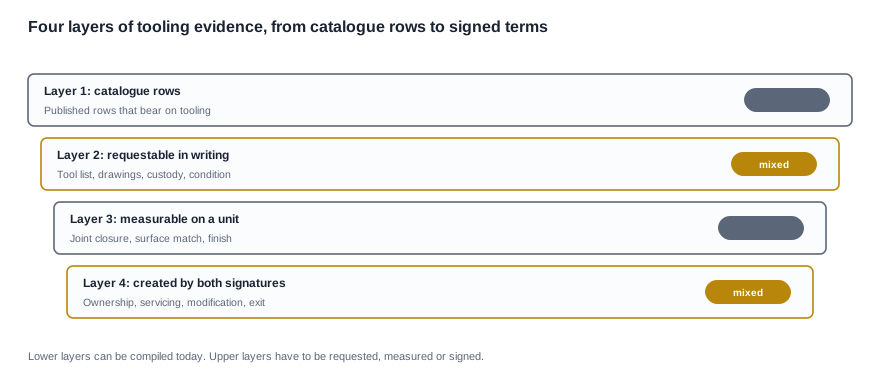
The four layers in that diagram are the practical structure of a tooling conversation, and the order matters because the layers are not equally easy to obtain. The bottom layer — the rows the catalogue publishes — can be assembled today, and everything a buyer builds on top of it is free to compile. The second layer exists but is not public: a list of the tools held against a configuration, the drawings they are cut to, where they are physically stored, and the record of their condition. It is released when a request names the exact model and the exact configuration.
The third layer can only be produced by a physical unit. How closely a joint closes after handling, whether a surface matches its reference, how a colour compares with the approved sample, whether a marking has moved — none of these are answerable from a document, and all of them are questions a buyer would otherwise be tempted to assume. The fourth layer only exists once two parties sign: who owns a tool, who may modify it, where it is kept, who services it, and what happens to it when the programme ends.
A tooling programme that skips a layer does not fail visibly. It fails at the moment when the programme runs a second time, and it fails quietly, because the missing layer turns into an assumption that everyone in the room had privately made differently.

The order to settle tooling ownership in
Ownership is not an administrative detail attached to a tooling cost, and treating it as one is the most expensive habit in this category. A mould is a physical asset that sits in somebody else's building, is specific to one geometry, and stays there after the order is finished. Who owns it decides whether a second programme can be built without a negotiation, whether a broken part can be replaced without a dispute, and whether a supplier's own commercial priorities stand between a buyer's order and the tool that makes it.
The order below is not a sequence of paperwork steps. It is the order in which the questions stop being answerable, because each step removes the possibility of answering the next one cheaply.
- Freeze the part before naming the tool. Until the geometry of a component is fixed, the question of which tool it belongs to has no answer, and asking a supplier to name a tool for an unfrozen part invites an answer about a different part.
- Classify each change in the programme as opening a new tool, using an existing one, or unresolved. The third category is the honest one on most programmes and it needs to be written down as a category rather than left implied.
- Name, for every tool in the programme, the party that owns it, the party that holds it, the party that services it and the record of its condition at handover. Four facts, one line each, and the fourth is the one nobody writes.
- Put the tool line and its ownership on the quotation, and put custody, modification and the end of the programme into the agreement. A tool line on a quotation without an owner is a price for something unidentified; an owner in an agreement without a tool line is a claim on nothing.
- Carry what is still open as an open item with a name and a date against it. An unresolved ownership position recorded as an open item is a manageable problem. The same position left implicit is the most expensive state in the whole arrangement, because it is the state in which both parties believe they hold a different answer.
The ownership question each published row raises
The ownership question is not the same for every asset in the programme, and a buyer who treats it as one generic question will get one generic answer.
- A moulded body. The tool is tied to the geometry of the part, and the geometry is tied to what the part has to carry. Where a separable part is published, the programme carries two tools and two ownership positions, and the specific question is whether that part is cut from a dedicated tool and, if it is shared, on what terms the sharing runs and who prioritises its servicing.
- A sourced component. A lens tool may be reusable across programmes, because two models built to the same base curve can in principle be cut from one tool. That possibility is exactly why it needs a written answer rather than an assumption: a shared tool changes what a second programme costs, and a tool held on the supplier's side of the arrangement is worth much less to a buyer than one it controls.
- A batch. A colour or a finish usually carries no tool at all, and what it carries instead is a specification, a reference sample and a batch record. Those are assets too, they are easier to lose than a mould, and a programme that owns its tools but not its reference still cannot reliably repeat the finish in a later order. The ownership question here is about the reference and the batch history rather than about steel.
- A case. A printed carton carries artwork rather than a tool, an insert carries a tool, and a charging case carries a tool that is often drawn from a set built for the wider range rather than cut for this configuration. The ownership question is therefore usually about which tools in a set belong to this programme and which are shared, and it is more often a multi-tool question than a single-tool one.
- An applied mark. An in-mould mark lives inside the tool that makes the part, so its ownership follows the part's tool and cannot be separated from it. A printed, screened or laser mark lives in an artwork file, a fixture or a plate and a production setting, and those can be held separately from the tool. Establishing which of the two applies before the artwork is approved is the difference between a changeable decision and a frozen one.
Four ownership positions, and what each one lets a buyer do
The states a buyer has to tell apart are not exotic, and they are worth naming because they behave very differently at the second order. A tool held by the buyer is an asset the buyer can move, modify and take to another factory, subject to whoever services it. A tool held by the supplier is an access arrangement, and access is a relationship rather than a property, which means it is exactly as durable as the relationship is. A tool whose ownership is genuinely shared is the state that produces disputes, because the document that says which is usually the quotation, and quotations are not contracts. And an unspecified tool is the most common state and the most expensive one, because the disagreement surfaces at the moment the tool is needed most and no one can act quickly.
The practical test that separates the first two is simple: ask whether the tool can be moved to another production line without the holder's consent, and ask who may modify it. Ownership without a modification policy is incomplete, and access without a location is not a plan. The trade-off between the two arrangements is a matter of money against control, and no amount of due diligence into a supplier's general reliability answers it — only the four facts in step three above do.
When ownership is not settled
The situation that arrives most often is not a disagreement. It is a programme that has moved forward with the tooling line agreed and the ownership still unmentioned, often because the two felt like separate conversations and neither conversation had an owner.
The handling of that situation matters more than the fact of it. The position should be recorded as an open item, with a named party responsible for closing it and a date by which it closes, in the same document that carries the order. In the meantime the programme should assume the weaker of the two arrangements, because assuming the stronger one is what turns a documentation gap into a commercial loss. A second source quotation for the same configuration, taken before the ownership question closes, is the cheapest insurance available in this category, because it establishes what the programme would cost if the answer went the other way.
The three questions that settle a tooling line
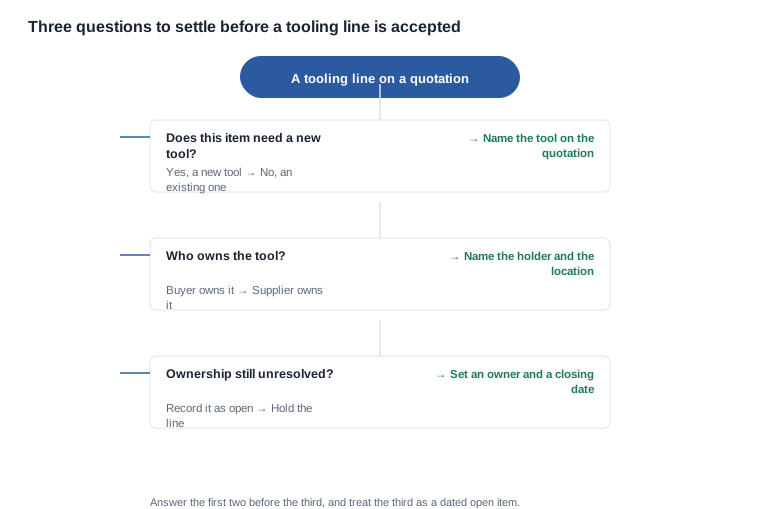
The three questions on that diagram are the ones that have to be answered before a tooling line can be accepted, and the order is the point. Whether an item needs a new tool is a factual question with a written answer. Who owns the tool is a commercial question with three possible answers. What happens when ownership is unresolved is a management question, and it is the one that decides whether a gap becomes a cost. A programme that has answered the first two has most of what it needs; a programme that has answered the third has the part that actually protects the programme. Before you order, those three answers are the shortest due diligence available on the single largest variable in the programme.
The standard oem tooling requirements
The material below is what a standard oem tooling requirement becomes when it is reduced to something a buyer can act on: the questions to ask, the lines to write, and the assumptions not to make. It is deliberately arranged as three lists rather than as a narrative, because the value of a tooling conversation is in the items that get written down, and a list is the only format in which a missing item stays visible.
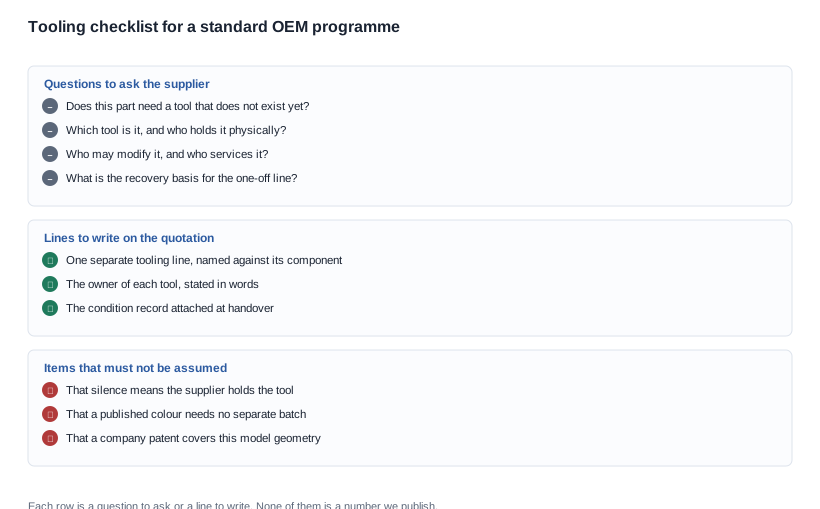
Tooling questions to ask before the quotation is signed
- Does this part need a tool that does not exist yet, and if so, is it cut for this programme alone?
- If it already exists, which tool is it, what is it cut for, and is it used by other programmes?
- Where is the tool physically held, and who controls the site it sits on?
- What is the record of its condition, and what is the servicing arrangement between production runs?
- Who may modify it, and how is a modification approved and recorded?
- What is the basis the tooling cost is recovered over, and what happens to that line at the second order?
- Which items in the programme recur per unit rather than arriving once, and which are the reverse?
- For any colour, is the colour carried by a material batch, by a surface feature in the tool, or by both?
- For any mark, is it applied by the tool, by a fixture, by a plate or by an insert, and who owns the artwork file?
- What is the position on a configuration change after the tool has been cut, and who bears the consequence of a change that is required?
The lines to write on the quotation
- One separate line for tooling, named against the component it serves, with the drawing or reference it is cut to.
- The owner of each tool, stated in words rather than implied by who paid.
- The basis the one-off is recovered over, and the volume it is recovered over.
- The recurring items listed separately from the one-off items, so that the unit price can be read on its own.
- The condition record for each tool at the point of handover, attached to the document rather than held in a file somewhere.
- The scope boundary in plain words, so that a later addition can be recognised as an addition rather than absorbed silently into the price.
The assumptions not to make
- That silence on ownership means the supplier holds the tool. It usually means nobody wrote it down.
- That a published colour name means a colour needs no separate batch, no separate reference and no separate record.
- That a published case capacity means the case is included. A capacity is a specification, not a scope statement.
- That a patent shown on a company-level export certification page protects the specific model or the specific geometry in this programme. It is company-level, and it is not a per-model design protection.
- That a detachable part makes the programme simpler. It raises the tool count and multiplies the ownership positions.
- That a per-unit finishing or packing cost is a one-off, or that a one-off tool line recurs on every order.
Where the commercial terms belong
The commercial conditions of a tooling programme are not published on this site and are not published in the catalogue. Unit prices, price tiers, tooling fees, sample fees, customisation programme fees, minimum order quantities, lead times, production capacity and warranty periods are all absent, and their absence is not a position on what they should be — it is simply the fact that they are commercial terms belonging to a quotation against a specific configuration.
The same is true of the numbers that sit inside the tooling conversation itself. No cavity count, no tool life figure, no place of origin and no delivery date appear in this article, and none of them should be read into it. A buyer who needs those figures needs them in writing from the supplier, attached to a configuration, and they belong on the quotation beside the tool line where they can be checked against it. This is the one area of the tooling conversation where an unanswered question is a real cost rather than an inconvenience, because the total cost of a programme cannot be modelled while its largest one-off line is unknown.
What can be said plainly is the position we take on how the answer is produced. Our position is that the physical changes are separated before anything is quoted, that each one is answered separately, and that a buyer who asks a supplier to name the tool, the holder and the arrangement in writing gets an answer that can be compared with another supplier's. We do not publish a tooling policy because the position varies with the configuration, and a published policy would be a general statement dressed as a specific one. What we will do with a named configuration is say which of those changes it touches and what has to be settled for each one, and what we will not do is answer a tooling question that has not been given a part, a geometry and a quantity.
The published rows are also where a buyer can start without waiting for anybody. Take the configuration in front of you, write down each physical change it involves, mark each one against the published rows in this article, and see which of them still has no published evidence behind it. That list is the agenda for the tooling conversation, and it is usually shorter than the buyer expects and more specific than the buyer assumed. The wider customisation scope sits alongside it, and the standard OEM engagement is what those changes are negotiated inside.
Related reading
- the customisation routes on the record and what each one covers
- where a mark goes on the part and why the method decides the cost
- the two published colour rows and the twenty-six entries without one
- what the unit cost is made of and what a quotation has to itemise
- the eight clauses an OEM agreement carries and the order they are drafted in
A standard oem tooling requirement is only settled when the part is frozen, the tool is named, the holder is written down, and the tool line sits on the quotation beside the unit price.


