
Lens color is the only customization in this category that changes what the product does to the world rather than what the world sees when it looks at the product. A frame color is a surface attribute. A lens tint is an optical filter with a transmission value, and it changes what your customer can see, how they feel in bright light, and what the camera in the temple is able to record. That difference is why a lens program needs a different kind of specification from a frame color program, and it is why the customization options for lens color are worth understanding before the brief is written.
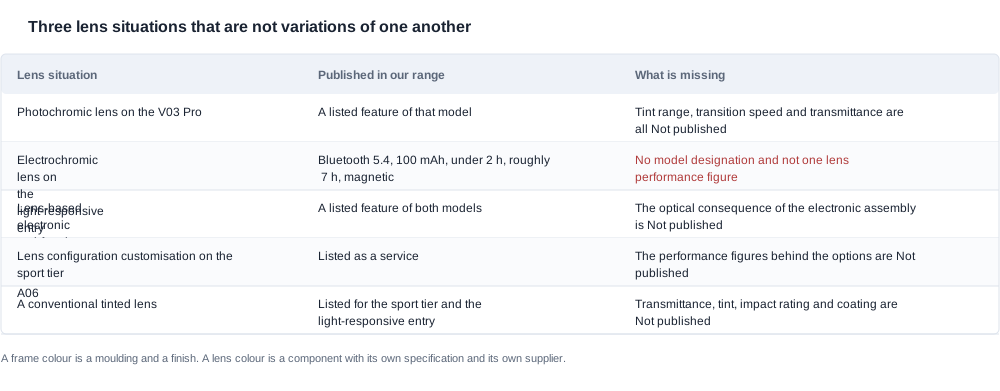
Our catalogue is explicit about this in the way it can be. One model in the range publishes photochromic lenses and three color options. The catalogue also carries an electrochromic entry with no model string attached. No model publishes a transmission figure, a tint depth, a UV figure or an optical performance figure. Those are not published, and the way to use that fact is to turn each missing row into a measurement you can specify rather than a number you hope matches a competitor.
Customization options for lens color: the published position
Let us be precise about the published position, because the difference between what a buyer imagines is available and what the catalogue actually says is where programs go wrong.
The V03 Pro is the only model in the range that publishes photochromic lenses. It is also the only camera model that publishes a color row at all, with three options. Both facts sit on the same row of the catalogue, which makes the V03 Pro the reference point for any lens color discussion in this range.
The electrochromic entry is the second relevant item. An electrochromic lens changes its transmission when a voltage is applied, which is a stronger claim than photochromic behaviour, because photochromic lenses respond to light while electrochromic lenses respond to a signal — and a signal implies electronics, a control path and a power budget. The entry carries no model string, so it cannot be ordered as a configuration of a named model. It has to be treated as a development subject, and the first question is which models it actually applies to.
Everything else is not published. Eight audio-tier models, three sport-tier models and three kids-tier models carry no lens color row, and neither do the remaining camera models, the AR entry or the bone conduction entry, there is no lens color row, no tint row, no transmission row and no UV row. The V06 publishes four colors, but that is a color row for the product, and no lens figure is published alongside it.
That gives a buyer a clean, if narrow, shortlist:
- The V03 Pro — the only model with a published photochromic lens and a published color row.
- The electrochromic entry — the only entry suggesting a switched lens, carrying no model string.
- Everything else — a development discussion, starting from an existing model in the range rather than from a blank sheet.
The published catalogue does carry a large amount of other information, and it is worth being clear about which parts of it bear on a lens program. Resolution in the camera tier splits into 8 MP on eight models and 13 MP on three, and the three at 13 MP are the L2 Utral and the S7, and the L1 Pro. The V06 and the S7 are the only models in the whole catalogue with an ingress rating, IP54. The MT6 is the only model with a published weight, 158 g for the glasses, excluding its 1200 mAh foldable case. Camera batteries sit in the 220–290 mAh band, and the runtime published for them is roughly five to eight hours — a figure the catalogue attaches no test condition to. Charge time is published as "2 hours or less" across twenty-six models, and just the D17 and the ZH12 go to approximately one hour.
None of those figures is a lens figure, and none of them substitutes for one. A buyer who has read the runtime row and assumed the camera sees through a specified lens is reasoning from the wrong table. A lens tint changes the light that reaches the sensor, and the catalogue publishes no transmission value with which to reason about the consequence.
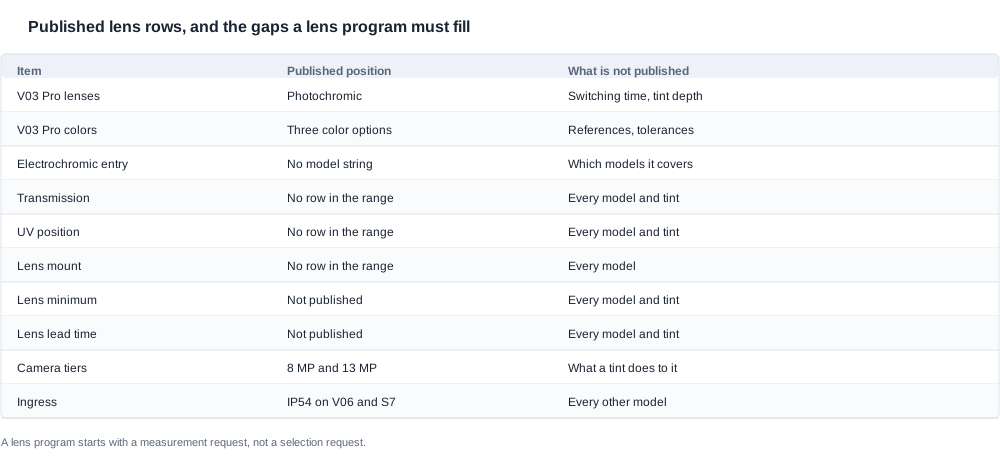
The practical reading is that a lens program starts with a measurement request rather than a selection request. Write down the optical properties you need, the measurement method for each, and the tolerance for each — then ask whether the supplier can meet them on an existing model or whether the requirement is new.
Customization options across three very different situations
Lens color requests arrive in three forms, and they are not versions of the same project. They differ in what controls the outcome, who owns the risk, and what has to be measured.
Situation one: a light-responsive lens
The buyer wants the lens to darken in sunlight. This is the photochromic case, and the V03 Pro is the only model in the range that publishes it. The photochromic smart glasses article covers the mechanism and the practical behaviour, and it is worth reading before a lens program is scoped, because photochromic lenses have two properties that a fixed tint does not: they take time to change, and they change with temperature as well as with light.
That gives a buyer three questions that a fixed tint program does not ask:
- How long does the lens take to darken, and how long does it take to return?
- At what temperature does the measurement apply, since a photochromic lens in a hot car behaves differently from the same lens outdoors?
- What is the darkest state, and what is the lightest state, and are those fixed across production units or within a tolerance?
None of those figures is published for the V03 Pro. The how to measure photochromic smart glasses article sets out a measurement approach that a buyer can specify and a supplier can repeat, which is the practical answer to an unpublished figure: define the method, then let the measurement establish the value.
This is also where a camera myth usually gets in the way. Buyers frequently assume that a tinted lens has to be tuned for shooting, and that a product with a camera in the temple needs a specific, usually darker, lens to behave well. The smart glasses camera technology myths article addresses that reasoning directly, and it is worth reading before a tint requirement is written, because an unnecessary tint constraint narrows the supplier's options for no benefit.
Situation two: the buyer's own prescription
The buyer is an eyewear brand, or a retailer selling to presbyopic customers, and wants the product to carry the wearer's own prescription lenses. This is the situation with the most moving parts, and the one where a shortlist of "does it support prescription" is not sufficient.
The structural question is how the lens is mounted. A frame with a standard lens mount can take a blank for an optician to edge and glaze; a frame with a proprietary mount cannot. The published catalogue does not describe the mount for any model, and that is a question with a large commercial consequence: a prescription program built on a proprietary mount needs the buyer to run an optical fitting operation, and one built on a standard mount can hand the blank to an existing optical partner.
Two further questions follow. Whether the electronics temple geometry is compatible with a standard lens format, and how the frame's front is cut for a prescription — because a lens thickness profile and the depth of the frame front are related, and a deep frame front that suits a fashion silhouette can be the wrong shape for a prescription lens.
The prescription lens options article works through how prescription and photochromic interact, which is the hardest combination in this category: the tint changes with light, so the wearer sees through a lens whose transmission is not constant, and the lens has to be made to a prescription rather than to a finished prescription.
Situation three: a fixed tint
The buyer wants a specific dark or colored tint, permanently, for a lifestyle, travel or sport program. This is the simplest optical program and the most often specified in the least precise way.
The criteria that make a fixed tint quotable are:
- the target transmission band, or the target color reference;
- the material the tint is applied to, because a tint in a substrate behaves differently from a tint on a surface;
- whether the tint is a coating, a laminate or an integral color;
- the required UV position, which is not published for any model in this range;
- the color rendering cost, because a strong tint shifts what the camera records as well as what the eye sees.
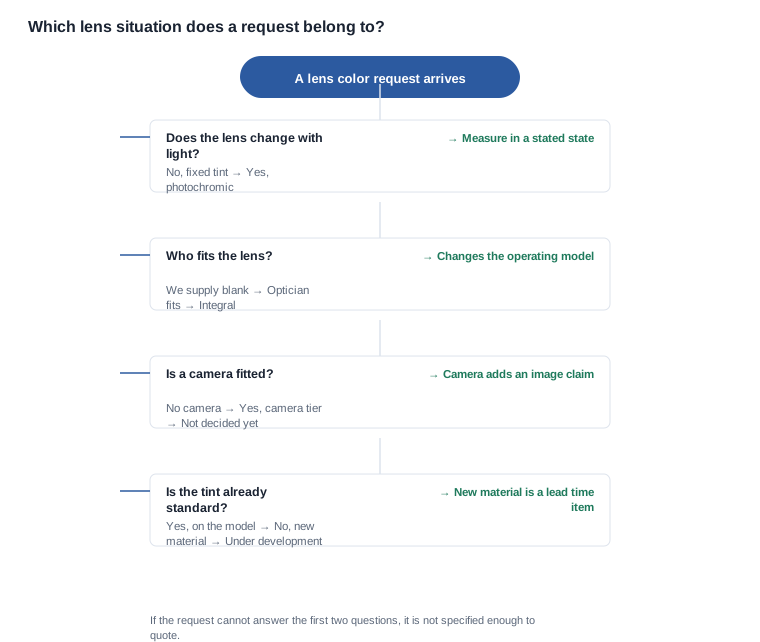
The decision chart above is the shortest version of the advice. If the buyer cannot answer "does the lens change with light?" and "who fits the lens — us or the wearer's optician?", then the lens program is not yet specified enough to quote, however precise the color description sounds.
Customization options and the questions a lens program must answer
A lens program becomes quotable when the following are answered in writing. The list is deliberately ordered by the cost of getting it wrong, not by convenience.
- Which model carries the lens? The published answer is the V03 Pro for photochromic. For a fixed tint on a camera model, for a tint on a sport model, or for a tint on the audio or kids tiers, the answer is a development discussion, and it should be described as one in the brief.
- Is the tint fixed or variable? Fixed tints are measured at a point. Variable lenses are measured in a state, with a light condition, a temperature and a response time stated.
- What is the measurement, and who performs it? Luminance transmission is measured with a spectrophotometer or a luminance meter, and the instrument and the method have to be named. A tint specification that names a color but no instrument is a description, not a specification.
- What is the tolerance, and what is its source? No transmission tolerance is published for any model, because a tolerance belongs to a specific material and process pairing. Write the tolerance into the acceptance criteria rather than expecting it in a catalogue.
- How is the lens fitted? Blank for optical fitting, pre-glazed, or integral to the frame. This determines whether an optician is involved, whether the buyer holds a fitting operation, and how returns are handled.
- What happens to the camera in variable light? On a photochromic lens, the transmission the sensor receives changes through the day. If the product makes any claim about image quality, the claim has to be written with that in mind, or the claim has to be removed.
- How is the lens replaced, and by whom? A cracked or scratched lens in a prescription program is an optical service, not a warranty replacement, and the two cost very different amounts.
- What is the sampling plan for inspection? How many units per lot, at what point, and by which method — this is the inspection criteria that turns a tint requirement into something a factory can actually ship.
The acceptance criteria for a lens are not the same as the acceptance criteria for a frame, and that is worth spelling out. For a frame, the criteria are visual and comparative: does the part look like the approved master, under the stated light. For a lens, the criteria are instrumental: does the transmission fall inside the band, measured by the stated method, on the stated number of units, at the stated point in the process.

The flow above matters because the measurement step usually sits where a buyer would prefer it to sit — at the end, as a final inspection — when in fact it has to sit at the start, as an incoming check on the lens material itself. A lens lot that arrives outside the transmission band cannot be recovered by adjusting the frame.
Customization options where tint and frame color meet
Two color decisions share one product and one approval, and they are usually reviewed in the wrong order.
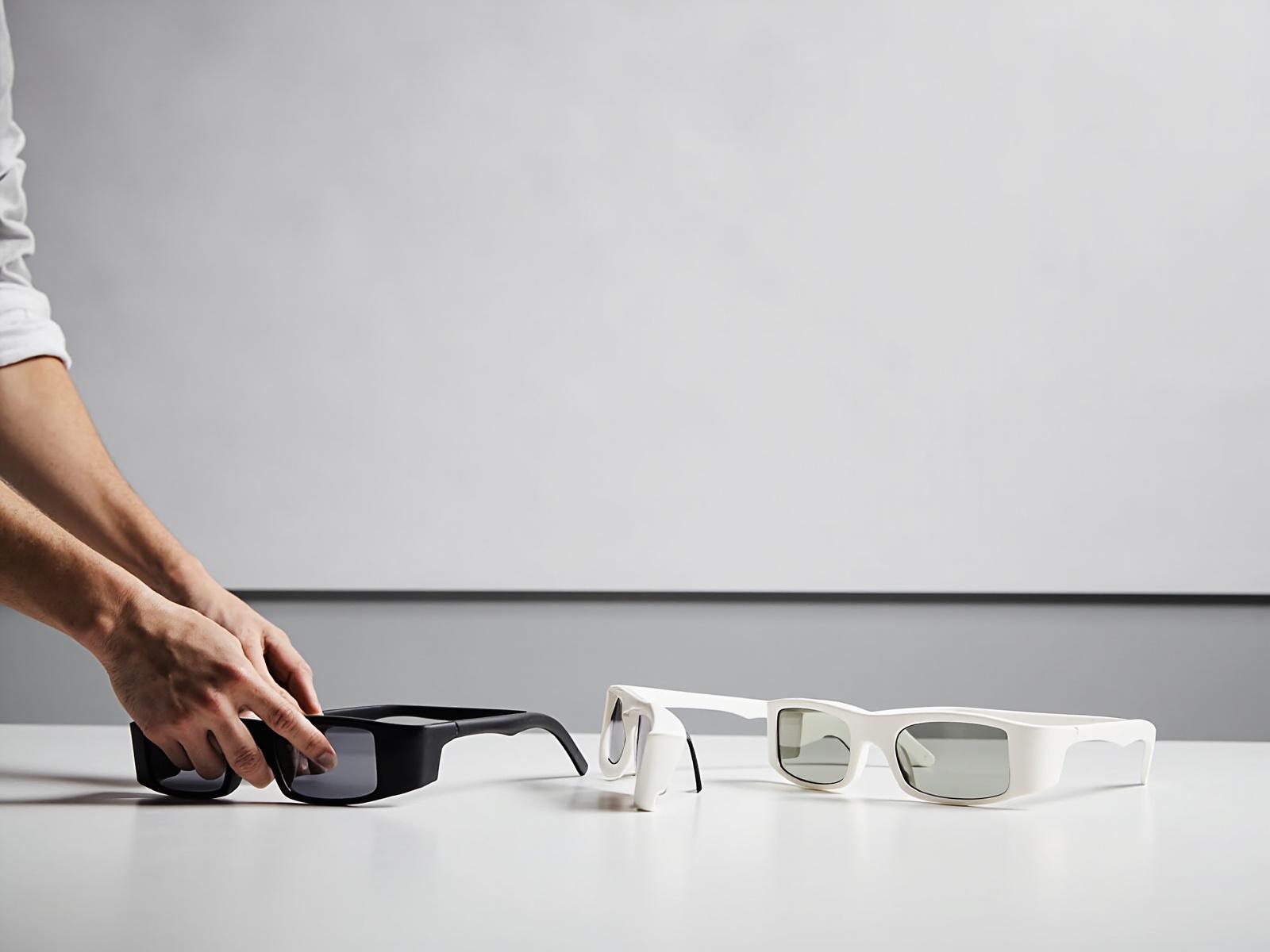
The frame color is a surface. The tint is a filter. When they are judged side by side, the frame color looks different through the tinted lens than it does next to it — warmer through a brown tint, colder through a grey one, and less saturated through a strong tint of any kind. So the frame color approval, for a tinted product, has to be made through the tint, not next to it.
The practical consequence is that the two approvals have to be scheduled together, with the same master set:
- Approve the frame color and the lens material in one pass, on physical parts, under the same light.
- Judge the frame color through the finished lens, not beside it.
- Record the lens state that the frame color was judged in — for a photochromic lens, that means a stated light condition and a stated temperature, because the frame color's appearance moves with the lens.
- Retain the approved pair, frame and lens, as the reference set for production.
This is where the color matching article earns its place: the matching problem is not only frame-to-frame, it is frame-to-lens, and a master set that omits the lens is not a master set.
For a buyer comparing a tinted camera product against a clear one, the honest comparison is not aesthetic. It is about three measurable things: what the customer can see, what the camera records, and what the lens does to the product's warranty and service life. A lens scratch on a clear lens is cosmetic. On a prescription lens in a range with an optical partner, it is a service event.
One more point on tint and camera: the camera tier's published specifications are the resolution tiers — 8 MP across eight models and 13 MP across the S7 and the L1 Pro, and the L2 Utral — and the two IP54 models, the V06 and the S7. Those figures describe the sensor and the housing. They do not describe what reaches the sensor through a tinted lens, and no figure in the catalogue makes that claim. If a buyer needs a statement about image quality under a specific tint, that statement has to be measured and written, which is a development task with a cost and a lead time attached to it.
Customization options in a lens program: sequencing and acceptance
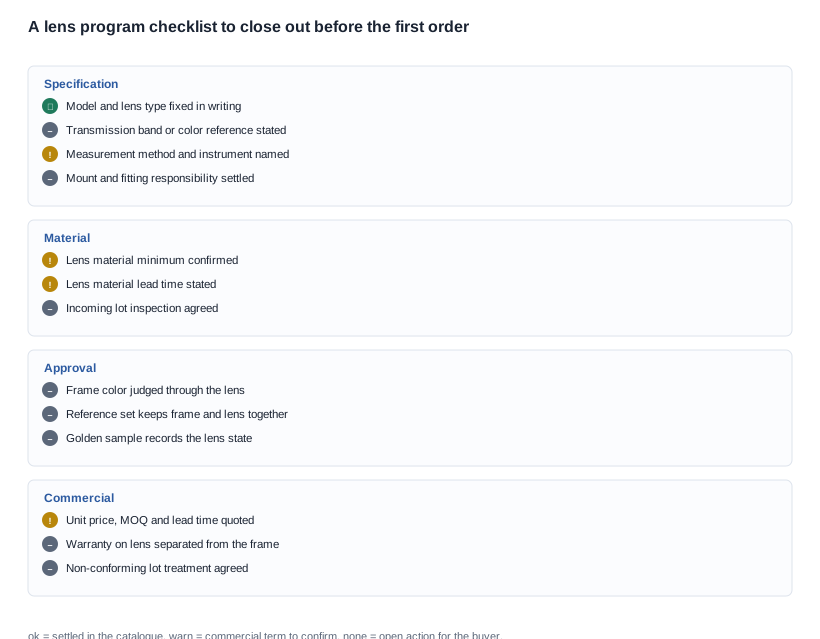
The order of work for a lens program is different from the order of work for a frame color program, because the lens material is a bought-in component with its own minimum and its own lead time.
Step one — fix the model and the lens type. Published anchor: the V03 Pro for photochromic. For anything else, confirm with the supplier whether an existing model can carry the lens, or whether a development path is needed, and get that answer in writing before any money moves.
Step two — agree the measurement method and the tolerance source. Method, instrument, light condition, temperature, and where the tolerance comes from. Write these as an acceptance criteria sheet that both sides sign, because a lens program that has no measurement method is a program with no acceptance.
Step three — source and inspect the lens material. The incoming lens lot is checked against the agreed criteria before it enters production, and the sample of units inspected per lot is agreed in advance.
Step four — build the pre-production sample. The sample proves the combination — lens, frame, fit, and the camera's behaviour through the lens if a camera is fitted.
Step five — approve the golden sample and the reference set. The golden sample is what production is judged against. For a tinted product it should include the frame, the lens and the declared lens state.
Step six — freeze and release. The lens specification, the reference set and the acceptance criteria are frozen together with a date, and every later change is a change request with a fee.
Step seven — settle the commercial position. Unit price, minimum order quantity, lead time, sample fee, warranty, and the treatment of a lens that arrives outside the criteria — replacement, credit or rework. All of these are not published.
The questions to ask the supplier are short enough to send with the brief:
- Which models can carry a lens, and which of those have a lens mounted as standard?
- For the V03 Pro, what are the published photochromic behaviour and what is not published?
- What is the mount — standard, blank for optical fitting, or integral?
- Which tint options exist today, for which models, and on which surfaces?
- What is the minimum order quantity for a lens material, separate from the product minimum?
- What is the lead time for a lens material, and does it sit in front of the production schedule?
- What instrument and method do you inspect transmission with, and how many units per lot?
- What tolerance do you work to, and where is it specified?
- How are scratched or out-of-criteria lenses handled — replacement, credit or rework?
- What is the warranty on the lens, and does it differ from the warranty on the frame and the electronics?
Three of these deserve a note.
Question 3 is the one that decides whether the program has an optical partner. A standard-mount program can go to an optician; an integral-mount program cannot, and that changes the buyer's operating model entirely.
Question 5 is the exposure question. Lens material minimums are frequently larger than the product minimum, because the supplier buys a lot of lens material to cover a spread of transmissions. In a multi-tint range this can dominate the working capital in the first order.
Question 8 is the enforceability question, again. A tolerance without an instrument and a method cannot be applied consistently, so the acceptance criteria will not survive a disputed shipment.
The negotiation levers here are fewer than in a frame color program and more valuable. The lens material minimum is the first. The volume ladder on a fixed tint is the second. The third is the warranty treatment of a non-conforming lens lot — whether the supplier takes the lot back, credits it, or reworks it, which changes the risk profile of the whole order. The fourth is the cost of a change after the lens order is placed, since a lens material order is the longest-lead item in the programme and the hardest to cancel.
The pitfalls worth naming are: specifying a tint without a transmission band, judging a photochromic lens only in indoor light, approving a frame color beside the lens instead of through it, treating a camera image specification as a lens specification, and letting a lens minimum appear in the purchase order without an owner in the launch plan. Each is a document problem.
Only one model in this range carries photochromic lenses, and that same model publishes three color options. The V06 publishes four colors. The electrochromic entry carries no model string. Transmission, tint depth, UV position, switching time, mounting, lens minimum and lens lead time are not published. We will answer every one of them in writing, with the measurement method attached to each, and we will not fill a lens row with a value taken from a comparable product.
Related reading


