
Branding is what a buyer asks for first, and it is the request most likely to turn into a tooling decision without anybody noticing. The logo application method, not the logo file, decides whether the mould carries the mark, whether the mark can be changed in year two, and how the mark looks after a year of being wiped, sweated on and put in a pocket. That is why the customization options for logo and branding should be settled before the first artwork is drawn rather than after the first sample lands.
Our published option space is narrower than a brand team usually expects. The published customisation list is not one list across the range: each category records its own set of routes, and the count changes with the category. Logo customisation is one of them, and it is named without a scope. Beyond that, the catalogue publishes color options for two models only, publishes a frame weight for one model only, and publishes no capacitive-touch row and no translation row anywhere in the range.
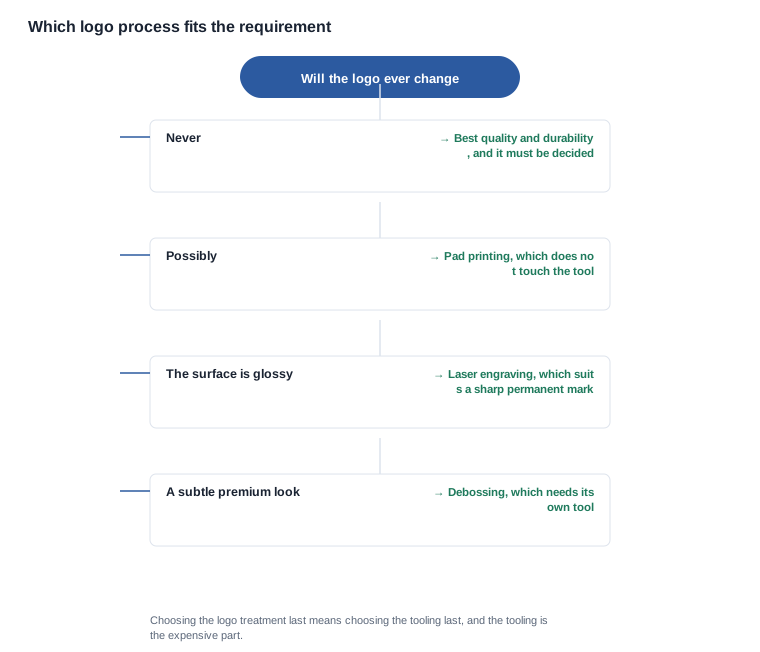
Customization options for logo and branding: the four processes
There are four ways a mark normally reaches a moulded frame surface, and they differ on exactly two dimensions that matter commercially: whether the tool has to change, and how the mark ages.
1. In-mould marking. The mark is formed as part of the moulding, so the tool carries the mark. Nothing is printed or machined afterwards, the result is the most durable option, and the surface quality is the best of the four because the mark is part of the surface rather than applied to it. The commercial consequence is absolute: the logo becomes a design-time decision, and changing it means a new tool. For a brand whose identity is settled for the life of the product, this is usually the right answer, and it has to be made before the tool is cut rather than after.
2. Pad printing. The mark is transferred from a silicone pad, which carries the ink to a flat or slightly curved surface. This is the most flexible process: the tool is untouched, the artwork can be changed, and several colors can be laid down in successive passes. The trade-offs are wear — a pad-printed mark is the first thing to disappear on a product that is handled hard — and setup, because each pad is a consumable and each new artwork or color means a new pad and a new setup. It is the right answer when the logo might change, or when the brand runs several identities across a range.
3. Laser engraving. The mark is removed from the surface rather than added to it. It cannot wear off, it does not change the tool, and it works well on metals and on coated or textured plastics. The appearance is the trade-off: an engraved mark reads very differently from a printed one, particularly on a glossy surface, where it exposes the substrate and can read as a smudge rather than as a mark. On a temple that is already visually busy with an electronics section, an engraved mark can look like a manufacturing fault rather than like a brand.
4. Debossing. The mark is pressed into the surface, which needs a tool of its own and works best on thicker sections. It reads as a quiet, considered treatment, and it is the option most often chosen by eyewear brands precisely because it does not shout. It costs a separate tool and a separate setup, and it constrains the mark to the geometry the tool can carry.
| Process | Tool change | Mark changes later | Wear |
|---|---|---|---|
| In-mould | Yes, the tool carries it | No, it is a new tool | Highest |
| Pad printing | No | Yes, new pad and setup | Lowest |
| Laser engraving | No | Yes, re-run only | Very high |
| Debossing | Yes, a separate tool | Yes, a separate tool | High |
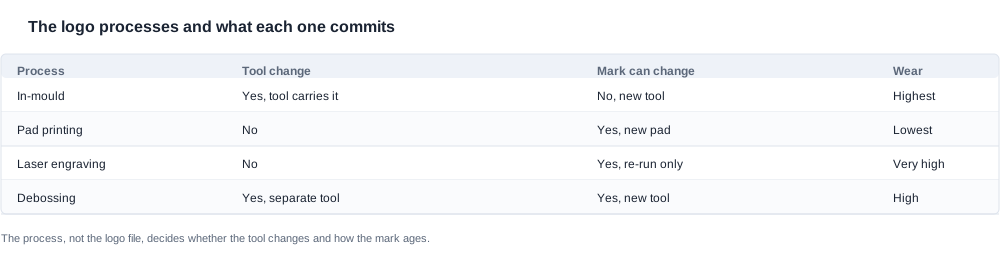
The published position on which of these is open for a given model is not published, and that is a question rather than a gap to complain about. The deciding factors are the permanence of the mark, the surface and section at the point of application, the exposure of that point, and the wear the product will see — and all four are known before a quotation is written.
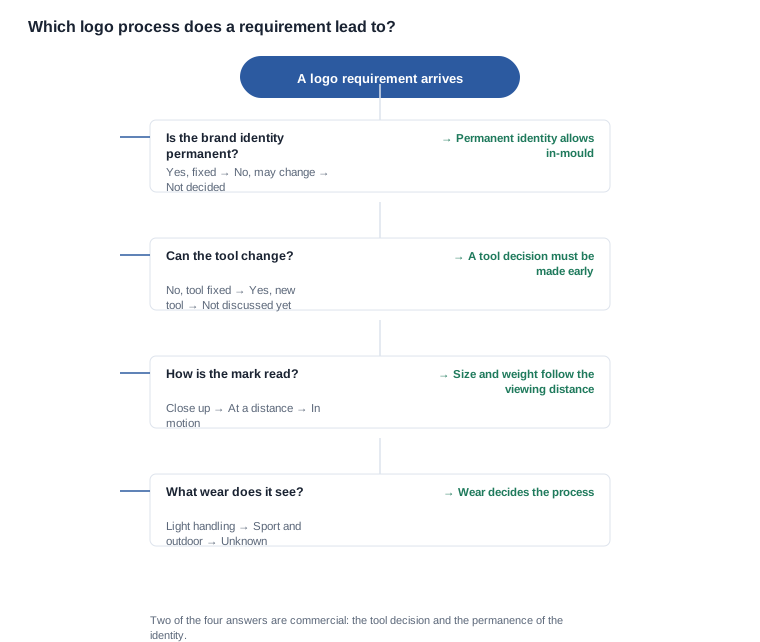

Customization options and the four decisions that fix the process
Decision one — how permanent is the mark? If the brand identity is fixed for the life of the product, in-mould marking or debossing become available and the decision should be made early, because both are tool decisions. If the mark may change with a rebrand, a season, a distributor or a market, pad printing keeps that door open at the cost of durability and setup. If the mark is a placeholder for a later artwork, say so explicitly at the outset; a placeholder that gets moulded in is the most expensive placeholder in the industry.
Decision two — what is the surface? The temple on a smart-glasses frame is not the temple of an optical frame. It carries electronics — a cell, a protection circuit, a board and, on the camera models, a sensor module — so the section is thicker, the surface is divided, and the available area for a mark is smaller than a flat drawing implies. A mark positioned on a flat render may land on a seam, on a fastener, or on the transition between two surfaces. The engineering customization page covers the geometry questions that a mark has to survive.
Decision three — how is the mark seen? A temple mark is read at a distance, at an angle, in motion, and often in a reflection. It has to hold up as a small shape rather than as a drawing, which is why minimum feature size, gap width and stroke weight are set by the process and the surface rather than by the brand guidelines. On a sport or outdoor product the exposure is worse still, because the mark is read against a moving background.
Decision four — what happens to it? A mark on a temple tip, near the hinge, or on the face of the temple takes more handling than a mark on the outer face near the ear. A sport program that expects sweat, salt water and a cotton-towel wipe should assume the mark is in a wet, abrasive environment, and should say so when choosing the process.
A fifth factor is worth naming even though it is not a decision about the mark itself: where the mark sits. The outer face of the temple is the conventional position on a glasses product, and it is also the position most likely to conflict with the electronics section on the camera tier. The temple tip, the hinge area and the front corner are the alternatives, and each carries a different visibility, a different wear profile and a different manufacturing constraint. A mark that cannot go on the temple because the temple is full is a mark that has to go somewhere less visible, which is a product decision as much as a production one.
Customization options: what branding actually buys beyond the mark
A brand that buys only a logo is buying a fraction of what it is paying for. The other things in the branding package are usually cheaper, faster and more visible.
The colourway. In this category the identity lives mostly in the finish, and the published colour rows are the model for how that works: three options on the V03 Pro and four on the V06, and nothing published for the rest of the range. A colour inside an existing mould is a finish decision. A colour outside the published list may require a new tool, and that is the point at which a branding request becomes an engineering project. The standard OEM color options page is the reference for what a programme can inherit.
The packaging and the printed set. The carton, the insert, the manual, the label and the cable pouch. These are recurring per unit, they carry their own print minimums, and they are the first thing a customer sees and the last thing they throw away. A brand that specifies the packaging late usually ends up shipping a product in someone else's box.
The Bluetooth device name. How the product appears in the customer's device list. It costs almost nothing, it changes with a firmware build rather than a tool, and it does more for perceived ownership in the first week than the temple mark does in a year. It is also a compliance-adjacent detail, because a device name is user-visible text in many markets.
The app and the interface. The app branding article covers the levels and what each one commits you to. This is where the brand is most visible in daily use, and where the maintenance obligation sits.
The firmware strings and the system identity. Model name, boot string, menu text. Engineering time rather than a production effect, provided the change does not reach the radio.
One thing to note about the whole package: the catalogue carries no capacitive-touch row and no translation row for any model, so a branding proposition that depends on a touch-sensitive logo or on multi-language on-device strings is a development item, not a configuration.
A sixth item usually sits outside the supplier's scope entirely: the identity in the channel. The product listing, the packaging photographs, the marketplace assets, the warranty card, the serial number format and the model name as it appears in a catalogue are all branding decisions that the factory never sees, and all of them have to agree with the product. A model name that the factory prints on the device, the manual and the label has to be the same model name that appears in the listing, the warranty registration and the shipping paperwork, and the cost of getting that wrong is a returns queue rather than a factory error.
This is also where a range plan either holds together or does not. A brand that runs one identity across three models has a coherent programme and one artwork master to maintain. A brand that runs three identities has three masters, three approvals, three sets of packaging artwork and three times the change risk, for a difference that only the shelf will show. The criteria for deciding how many identities to run are not aesthetic: they are the number of artwork masters you are willing to maintain, and the number of packaging print runs your cash cycle can carry.

Customization options and the paperwork that makes a mark enforceable
A mark that is specified only as a logo file is a mark that will be re-drawn. The artwork package should contain:
- The master artwork, as vector outlines, with the fonts either outlined or licensed and named.
- The colour definition, by name — a spot colour for printing, a pigment reference for a coating, a plated finish reference for hardware — rather than as an RGB value, which no factory can reproduce.
- The minimum feature and gap sizes, stated for the chosen process. A mark that violates the process minimum is not a small mark; it is a broken one.
- The placement, as a dimensioned drawing against the actual section, with the datum named.
- The viewing condition, so the size can be judged: the distance and angle at which the mark will normally be read.
- The approval record, identifying the approved physical sample by part number, with the date and the name of the person who approved it.
That last item is the one that ends arguments, and it is the reason the color matching article insists on a retained master rather than a photograph. The mark is judged on the part, under a stated light, against a retained master that both sides hold.
Three further commercial points belong with the paperwork rather than with the design:
- The artwork freeze and the change fee. Artwork that changes after the tool is cut is a new tool, and artwork that changes after the first order is a setup. Both should be priced as a change request with a stated fee and a stated lead time effect.
- Who owns the master files. The artwork, the modified artwork and the production-ready files should be owned by the brand, with the supplier holding production copies. Ownership of design and tooling files is a separate conversation, and it is covered in the OEM intellectual property discussion.
- Who checks the trademark. The supplier reproduces what it is given. A trademark search, a registration check and a market-by-market review are the brand's responsibility, and a clause that says so removes an argument that can otherwise be expensive.
Customization options in a branding programme: sequence and commercial terms
The sequence that works is short, and every step of it prevents a later one from becoming expensive.
Step one — settle the permanence of the identity. Write it down: this logo, on this product, for this period. If the answer is "probably permanent", treat it as permanent and take the in-mould option.
Step two — choose the process. Using the four decisions: permanence, surface, exposure, wear. Then confirm with the supplier which of the four processes is actually open for the model and the surface you have chosen, because that confirmation is not published.
Step three — fix the placement against the real geometry. Draw the mark on the actual section, not on a flat approximation, and check it against the electronics and the seams.
Step four — produce a physical mark sample. A mark sample on the real material, at the real finish, under the real lighting, on the real surface. A screen render is not a mark sample, for the same reason a screen render is not a color sample.
Step five — approve and freeze. The artwork package, the placement drawing, the retained master part and the approval record are frozen together, with a date and a change procedure attached.
Step six — approve the golden sample. The reference that production is judged against, including the mark, the finish and the packaging.
Step seven — settle the commercial position. The logo setup or plate cost, the artwork change fee after the freeze, the packaging print minimum and the per-wave print cost, the unit price by volume, the minimum order quantity, the lead time, the sample fee and the warranty. None of these is published, and all of them differ between a logo-only programme and a full branding programme.

The flow above is the shortest path that works, and two steps in it are the ones most often skipped: the physical mark sample and the master part. Both cost a little time in the pre-production phase, and both remove a dispute from the production phase, where a dispute is at its most expensive.
One last practical point, for buyers who sell through distributors rather than direct. A distributor will ask three questions before they stock a range: whether the packaging is theirs or yours, whether the model name on the device matches the model name on the listing, and what happens to the mark when the packaging is replaced. The first two are branding decisions you make now and cannot change cheaply later. The third is a service decision, and it belongs in the agreement with the supplier rather than in a policy note, because a mark that cannot be replaced without a new tool is a mark that ends a product line rather than a logo that gets updated.
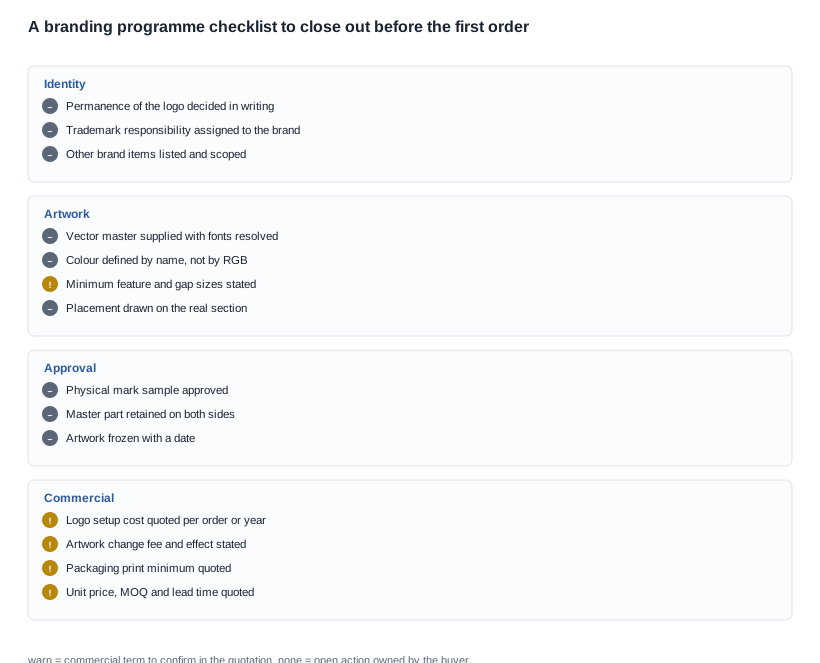
The questions to ask the supplier:
- Which logo processes are open for my model, and for the surface I have chosen?
- Does my chosen process change the tool, and if so, when is that decision due?
- What is the artwork format and specification you need, and what do you reject?
- What are the minimum feature and gap sizes for the chosen process?
- Can you produce a physical mark sample on the real material and finish?
- What is the logo setup or plate cost, and is it per order or per year?
- What is the artwork change fee after the freeze, and what is the lead time effect of a change?
- Which other items carry the brand — case, insert, carton, manual, label, Bluetooth name, app — and which of them are in my programme?
- What is the packaging print minimum, and what happens if I order in three waves?
- Who holds the master artwork and the production files, and how do I get them?
The negotiation levers sit in the same places as the risks. The setup cost per mark is one. The artwork change fee is another, and it protects a programme far better than a first-order discount does. The packaging print minimum is the third, because it sits well above the product minimum whenever a launch is low volume. The fourth is the repeat-order price: a programme whose logo is applied in mould gets cheaper over volume in a way that a pad-printed programme does not, and that difference should be visible in the price ladder before it is discovered after the first order.
Two red flags. The first is a supplier who quotes the logo without naming the process, because the process is the price and the durability. The second is artwork approval based on a photograph of a render, because that approval will not survive the first physical sample.
The pitfalls worth naming: choosing the process after the first article, sizing the mark from a flat drawing, treating the Bluetooth name or the app identity as covered by the logo fee, and assuming a color option exists because a color exists on a different model.
Branding decisions are made once and then live for the life of the product. Which is why the useful thing we can do is simple: tell you, for a given model and a given surface, which processes are open, which one we would recommend against the mark's likely permanence, and which of them force a tooling decision. Send the model, the surface and the answer to the permanence question, and we will come back with that, in writing.
Related reading


