

A request for a bespoke temple usually arrives as a single sentence: "we want our colour and our shape on the temple." Inside that sentence are two programmes with different owners, different cost behaviour and different points of no return, and separating them early is the difference between a short approval cycle and a retool that nobody budgeted for.
The second reason to separate them is evidential. Our published range states a colour for two models out of twenty-eight — V03 Pro lists three colours and V06 lists four — which means the customization options that most buyers ask about are, in the catalogue, the least documented. That is not an argument against custom temple colour. It is an argument for going into the conversation with the right questions and for treating the sample as the only place where a colour can be properly judged.
This guide is for brand owners and channel buyers who are working out what a temple colour and a temple shape actually involve, who should sign each one off, and what to put in writing before either is frozen. It uses our own catalogue as the evidence base, because a catalogue is the most honest starting point available: it shows exactly which customization options are documented, which are merely claimed, and which are blank.
Customization options for temple colours: the two programmes in one request
The useful way to read a temple customisation request is as two programmes running in parallel, with one of them usually further downstream than the other. The colour programme is about surface and finish: which colour the temple presents, how it is applied, how closely it has to match a reference, and how it behaves over a production run and after handling. The shape programme is about geometry: the profile the temple is cut and finished to, how it meets the front, how it hinges, and what tooling has to exist for that profile to be produced consistently.
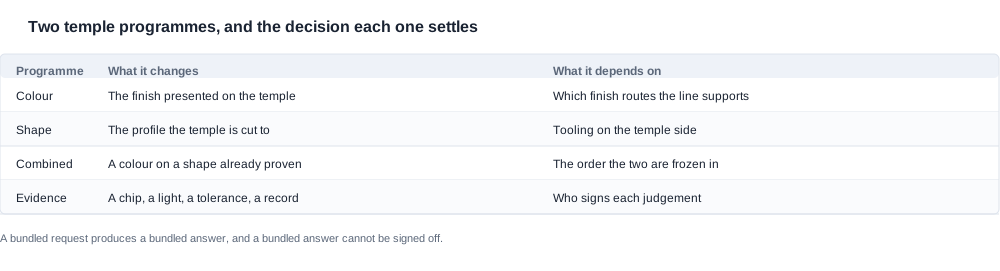
The table separates the two so that a buyer can see which of them a supplier is actually answering when they respond to a request. The practical point is that a single bundled request tends to produce a single bundled answer — a mood board, a photograph, a general assurance that both are possible — and a bundled answer cannot be scheduled against, priced, or signed off. The same request split into two produces two answers with two owners and two dates.
Colour also has a visual-credibility function that shape does not. A buyer choosing a temple colour is usually making a brand decision with a retail consequence: the colour will sit against a face, under a store light and in a phone camera photograph, often next to a lens or a display element that imposes its own tonal expectations. That makes the approval method more consequential than a photograph in a supplier's studio. The sample has to be judged under a light that resembles the buying conditions, and ideally the reference itself has to come from the same production material rather than from a printed swatch or a screen, because a printed swatch is a third object and will not predict the finished surface.
Shape, by contrast, is mostly invisible in a photograph and entirely visible in the hand and on the head. It shows up in comfort, in how the temple meets the front of the frame, in the silhouette from the side, and in how the whole product reads as a designed object rather than an assembly. A buyer who approves shape from a flat rendering is approving an idea, not a product.
So the two programmes have different evidence, different risk, and different failure modes. What a buyer should not do is let one supplier response cover both, because the colour question and the shape question rarely have the same answer, the same cost, and the same timing — and a single answer usually means the harder one has been deferred.
There is a practical consequence of the separation that changes what a buyer should ask a supplier to bring to the first meeting. The colour programme is best judged on a physical object, so the request should be for something that can be held: a chip in the production material, or a unit built on the intended route. The shape programme is best judged in use, so the request should be for a unit that can be worn and handled rather than a drawing of one. Asking for both in the same sample does not make the sample more informative. It makes it vaguer, because a unit asked to satisfy a colour question and a shape question at once is carrying two pieces of evidence in one object, and the second question tends to be answered by general impression.
What the catalogue publishes on temple shape and colour
Our catalogue is precise about some things and silent about others, and the silence is instructive. On colour, only two entries publish a colour line: V03 Pro with three colours, and V06 with four. A weight appears against a single model in the whole range, MT6 at 158 g. Charging time appears against every entry, twenty-six of them capped at two hours or less, and D17 and ZH12 nearer one hour. An interface is documented on twenty-four of them, seventeen magnetic and seven Type-C, with CY05 and CY03, and MT6 and L1 Pro left blank. A Bluetooth version appears for fourteen models — K01 and K02 at V5.3, the remainder at V5.4 — while eleven camera models show none at all.
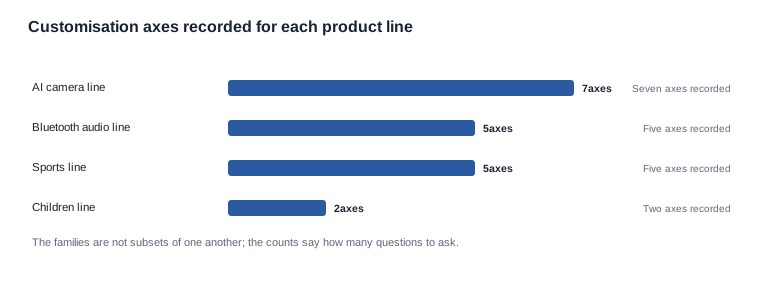
The same selectivity applies to the custom side. Internally, each product line carries a recorded count of customisation axes: the AI camera line shows seven, the Bluetooth audio line and the sports line five apiece, the children's line two, and the electrochromic entry three. Nothing is disclosed about customisation on the bone-conduction entry, and the AR entry is not described. These three families are not subsets of one another, so an assumption carried from the camera line into the audio line will not hold. The counts are useful to a buyer precisely because they do not disclose the names: they tell you how many decisions a line involves, and the names themselves are the questions to ask.
On certification, the two published channels — the previous site and this independent site — both claim CE, FCC and RoHS. Which models those claims cover, and the numbers behind them, have not been confirmed, and the catalogue PDF carries no CE, FCC or RoHS wording at all. The export certification page of the catalogue is an image, and what it shows is ten patent certificates, eight of them design and two of them utility model. The sports line adds an IP54 mark with no third-party test report number behind it, and the children's line has no certification information supplied in any form.
Several catalogue items are also open, and they are better quoted back to a supplier as open than quietly tidied away. A05 and A06 are listed with parameters that read identically, and the field separating them has not been identified. The model name L2 Utral carries what looks like a typographical error for Ultra, and what Pro Max signifies has never been defined. MT5 is annotated with a page reference that does not sit right, and whether it belongs to the camera or the sports group is unresolved. V06 and S7 carry similar page-reference annotations. The electrochromic, bone-conduction and AR entries hold no formal model number. None of the twenty-eight entries is published with a real photograph, a video or a test report.
Before that conversation, it is worth separating two things that suppliers often write in the same sentence. A published colour is a fact about a model: the finish as it leaves the line, with no adjustment. An available colour is a statement about what could be produced, and the distance between those two is the distance between a colour you can order now and a colour that has to be developed, sourced and qualified first. Most buyers discover which one they were looking at only when the sample arrives in a finish that had been described as available but had never actually been run on that model. The question that separates the two costs nothing to ask: has this finish been produced on this model before, and if so, on which route.
For a buyer whose programme depends on a temple colour, the practical conclusion is direct: the catalogue will not give you the colour options and it will not give you a reference finish. Both have to be requested, and the request has to name the evidence you want with it — a physical chip in the production material, a unit built on the intended route, a photograph under a stated light.

Why colour and shape are separate decisions with separate owners
The reason these two programmes need different owners is not organisational neatness. It is that a colour decision and a shape decision carry different costs once they are made, and a decision taken at the wrong point in the sequence cannot be undone by changing your mind about it.
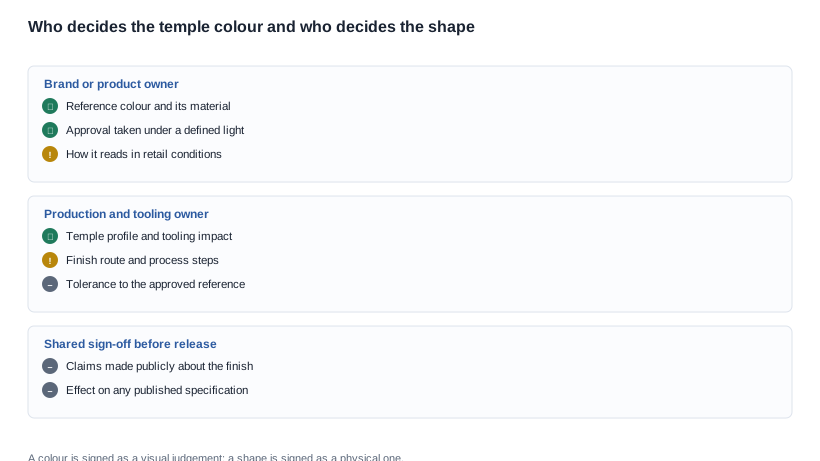
The grouping above is the one we would expect to hold in a professional programme. Someone with brand or product authority owns the colour, because it carries brand meaning and because it is judged against a reference rather than a specification. Someone with production and tooling authority owns the shape, because it carries tooling and repeatability consequences. Compliance and quality sign off on the claim that results — if a colour is presented as scratch-resistant, or a finish as tested to a standard, that statement needs an owner who can defend it. Procurement owns the commercial consequence of each decision separately, which is where the trade-offs become visible.
The failure mode of merging them is specific and expensive. A colour change after the finish route has been set may need a different process, a different coating or paint supplier, or a different base part, and it may therefore re-open a cost and timing question that everyone believed was closed. A shape change after tooling has started is a different order of problem entirely, because the tool itself has to change. Put the two in one instruction and the instruction is executed in the order it was written, which is not necessarily the order that is cheapest to reverse.
Buyers often ask which decision to take first. The answer depends on which of the two carries more of the programme's risk, not on which seems more important. If the product concept is a distinctive silhouette, the shape is the risky decision and the colour should follow it. If the programme is a rebrand of an existing, already-shipped model, the shape may already be proven and the colour is the only thing actually changing. The mistake is to assume the answer, and the second mistake is to let a supplier choose the sequence simply because it is the sequence their line runs fastest.
There is a further ownership point that is easy to miss: the person who signs a colour is signing a visual judgement, and the person who signs a shape is signing a physical one. These need different evidence and often different reviewers. A colour approved by a person who will never wear the product is a weak approval; a shape approved on a screen is not an approval at all.
The ownership point has a cost consequence that buyers sometimes discover only at the end. A change requested by the wrong owner is processed as a general enquiry rather than as a decision, and it comes back as a price, a schedule or a refusal instead of an instruction. A change requested by the right owner is processed as a specification revision and comes back as a dated confirmation. The two requests may describe the same colour, and only one of them leaves the programme with a record it can work from. The difference in how long each takes to close is usually larger than the change itself would suggest.

The sequence that keeps a colour change out of tooling
There is a specific ordering that keeps a colour change from becoming a tooling event, and it follows from one asymmetry. Colour is comparatively cheap to change late and expensive to change once the production route is committed. Shape is the reverse: cheap to change while the design is still open, extremely expensive to change once the tool exists.

The sequence in the diagram starts with the reference and works backwards from the point of no return. The reference has to exist in a material that matches what will be produced, because a colour agreed on a swatch or a screen is an agreement about a different object. It then has to be approved under a defined light, because a finish that reads correctly under one light source and flat under another has not been approved, it has been photographed. After that comes a production-material chip so that the line has something physical to match against, and a retained reference panel from the first batch so that later orders are compared against an object rather than a memory. Only once those exist should the shape be finalised, because the shape decision changes what has to be reworked when a colour is corrected.
This ordering has a practical consequence for the way a programme is documented. A colour should be recorded with its reference, its material, its approval light, its approver and its date, and the record should travel with the purchase order rather than living in somebody's inbox. When the first production units arrive, the comparison that matters is against that record and against the retained panel, and the tolerance — even if it is only a verbal judgement — should be agreed in advance. The alternative is a conversation about whether the batch "looks right", which cannot be resolved by anybody who was not present.
The harder case is the one every buyer should plan for: a colour that is approved and then has to change after the first batch has been built. That is not a failure of the sample process; it is a failure of the reference. It usually happens when the reference was a photograph, or when the light in the approval meeting was not the light in the market. If a colour change lands after production, the questions to ask are which process steps are affected, whether the change is a supplier change or a specification change, and whether the original colour can be retained as a variant for the units already produced. The answer determines whether you are looking at a second finish route on the same product line or at a genuine line change.
It is worth looking at that case from the factory's side, because the argument for this ordering is really an argument about absorption. A late colour change is not an administrative event on a production floor: the finish route has to be re-set, the units already built become stock in a colour nobody wants, and the schedule now carries two finishes where it carried one. A supplier who tells you plainly that a late change is expensive is giving you information, not refusing you anything. It tells you that the ordering in the diagram is not administrative tidiness, and that the reason a programme wants the colour frozen before the shape is finalised is not that colour is the more important decision. It is that colour is the one that can still be absorbed without re-opening the tool.
The questions to ask before a temple colour is frozen
The list below is what a buyer should put in writing before a temple colour becomes a commitment. They are questions for the supplier, and each of them is designed to make the answer checkable rather than reassuring. The commercial answers belong in the supplier's own quotation.
- Which models in the range can carry a custom temple colour, and which cannot?
- For each of those models, how many colour options are available without a tooling change?
- Is the temple colour applied as a coating, a paint, an insert or a moulded-in colour, and does the answer differ by model?
- What reference material will you supply, and in what production material should the approval chip be made?
- Under what light source should the reference be judged, and will the judgement be photographed that way?
- What is the accepted tolerance for a production unit against the approved reference?
- Is a colour reference panel retained from the first batch and shipped with later orders?
- Which tooling, if any, is affected by a colour change, and what does that do to the timing of a later adjustment?
- Does the colour change affect any published specification, such as the charging interface or the weight, and are those values restated afterwards?
- Which test evidence exists for the finish, and which claims may therefore be made publicly about it?
- What is the minimum order quantity for the coloured configuration, and how does it change if the shape stays as the standard one?
- What happens to the programme if the colour is rejected at the first batch inspection — is the finish route retained for other colours?
- Which temple shape options are available on the same model, and can they be combined with the chosen colour in one order?
- What does a change of temple colour do to the delivery plan, and what would you need from us to hold that date?
Record the answers, not just the decision. A short log of what was asked, what was answered, and which answers came back conditional travels with the purchase order and settles most of the arguments that would otherwise arrive attached to the first invoice. Two fields in that log are worth more than the rest: the name of the person who approved the reference and the date it was approved. A programme that holds those two fields can resolve a dispute in minutes, because the approved object is identifiable. A programme without them turns every complaint into a question of memory, and memory is not a reliable instrument on a production floor.
Read the answers for what they reveal about process rather than for the words themselves. A supplier who can name the finish route, the reference material and the tolerance, and who is honest about which of them are not yet fixed, is telling you they run a repeatable process. A supplier who answers every question with "yes, we can do that" without a single mechanism is telling you something else, and it is better to learn that from a quotation than from a first delivery.
A temple colour should only be frozen against a reference that exists in the production material, and a supplier who cannot supply one should say so rather than offer a photograph instead. We will not describe a colour range we cannot evidence, and we would rather a programme starts with a smaller, proven set of options than a larger set that has to be corrected later. That discipline is the same one that makes the customization options worth paying for.
If you want the wider custom programme assessed before a temple colour is fixed, the customization options overview on this site is where the structure of the range and its documented parts are set out.
Related reading
- Temple material choices and the questions they raise — why the material decision carries its own set of constraints.
- Packaging artwork and print constraints — where a colour decision meets the box it ships in.
- Logo and branding decisions in a custom order — the other place brand colour tends to be settled.
- What a certification programme can and cannot move — the claims a new finish can and cannot support.


