

Packaging is the first thing a customer sees and the last thing a programme controls. By the time a carton is designed, the product it wraps has usually changed twice, and the artwork inherits every decision nobody managed to close. That is why the available choices fall into three impact levels, and why the level matters more than the choice itself. Two options that look identical in a sample can sit in different levels, because one of them needs a tool and the other needs a printer. This guide sorts and explains the whole set of available customization options for packaging and design work by what each one forces you to change downstream.
The sorting rule is simple. An option is low impact when nothing has to be retooled and no document has to be re-issued. It is middle impact when print and paperwork move together, because a wording or model-string change has to be reflected in several places at once. It is high impact when a tool changes, and a tool change is the one level at which a decision effectively becomes permanent. This classification is worth doing before the first artwork brief, because it decides which questions you ask, which evidence you keep, and how much of the brief you can still afford to change later.
The examples that follow come from camera glasses programmes, where packaging has to state what is in the box, which colour the unit is, and which model string appears on the carton. They are also the reason the published catalogue matters to a packaging brief: an option is only safe when the printed claim is backed by a specification the product actually has. Read the three levels first, then apply the comparison at the end, and you will know what to ask a supplier to put in writing.
Customization options: three impact levels for packaging
The three levels are not about how ambitious the design is. A restrained carton with a single colour and a plain insert can still sit at the high-impact end if it requires a new die-cut or a different case, while a busy multi-language carton can sit at the low-impact end if nothing about the product changes. What separates the levels is the number of physical and documentary artefacts that have to move when the decision is taken.
The low-impact end covers anything that can be produced from existing tools and existing files: print artwork within the standard carton dimensions, sticker labels, insert cards, leaflet wording, packing configuration, and the arrangement of units inside the carton. Nothing about the product changes, so the specification stays valid and the test plan stays valid. The middle covers artwork and cross-document work: any change to the model string, the printed specification, the included accessories or the packaging copy, because the same information usually has to appear on the carton, the manual insert, the label and the product listing. The high-impact end is where tooling enters: a different case, a different temple tip, a different material or finish, a colour that needs its own tool, or a carton structure that needs a new cutting die.
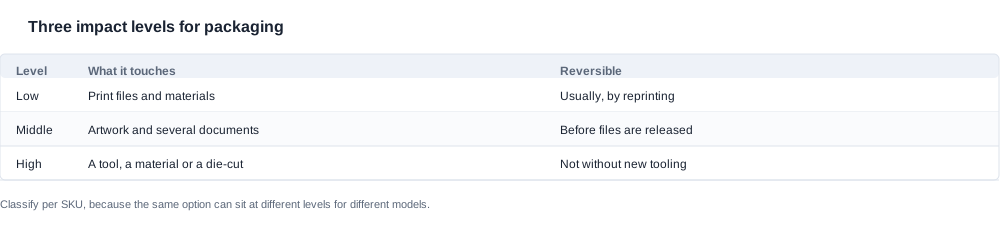
Figure 1 — The three levels, what each one touches, and whether it can still be reversed.
Two properties make this sorting useful. The first is reversibility: a low-impact decision can usually be reversed by reprinting print materials, and a high-impact one cannot be reversed without scrapping a tool or accepting a second mould. The second is the number of documents that have to agree afterwards. A decision that changes what is inside the box changes the packing list, the carton artwork, the manual insert and the after-sales process, and the gap between those documents is where buyers lose track of what they actually ordered.
The classification is worth applying per SKU rather than per programme, because the same option can sit at different levels for different products. A model whose catalogue entry prints no charging-case row at all makes an illustrated case in the artwork a high-impact choice, because the artwork may then be telling a buyer something the specification has not confirmed, and a low-impact one for a model whose case position is already published. Any brief that treats a product line as one object will eventually pay for that shortcut.
The low-impact end: changes with no structural effect
Low-impact options are the ones where the decision stays on paper and in print. Carton artwork within the existing template, an insert card for the specification summary, a sticker carrying a serial or regulatory mark, the colour of the printed carton rather than the colour of the product, the number of units per carton and the leaflet set: all of these can be produced from files and materials that already exist. The decision that remains is not technical but administrative. Who owns the artwork, who signs it, which file version goes to print, and whether you receive an editable file or only a print-ready PDF.
That administrative layer is where low-impact options are usually lost. The print decision gets made quickly because it looks trivial, and then the wording on the insert is copied from an older insert for a product that has since changed. Nothing about it is visible until a customer compares the box with the website, and by then the correction is a reprint rather than an edit. The cheapest discipline in packaging is to keep one artwork register, with one owner and one version number per artefact, and to have every printed file pulled from that register rather than from an email thread.
A second low-impact decision worth making deliberately is what is printed about the product. Print statements tend to be inherited from a previous carton, and inherited statements are the ones most likely to be wrong. A carton that describes charging performance should quote what the specification actually says, and our own catalogue draws that distinction explicitly: charging time is published for every model in the range, and for 26 of the 28 the figure stops at two hours or less, with two models closer to one hour. A limit written as a limit is a specification. A limit restated as a promise is a marketing claim, and the two behave very differently once a customer measures the difference.
The low-impact end also includes the packaging decisions that look like product decisions from a distance, such as showing a colour on the artwork that the product does not come in. Colour information in our catalogue appears on two models only, one of them listing three colours and the other four, which means most products in the range exist in a single finish. Before an artwork file shows a particular finish, check that the SKU in question actually has it, and note that our catalogue publishes no touch-control line and no translation line for any model, so printed copy implying either of those features has no specification behind it.
That check is quick, and it catches most artwork errors before they turn into print runs. Read every statement on the carton as a claim, ask which published line supports it, and then confirm that the line belongs to the SKU on the carton rather than to a sibling model. If nothing supports it, there are only two honest routes: cut the statement, or ask the supplier to state the specification in writing first. The second route takes longer and produces a better product, because the claim is then one you can defend later instead of one you have to withdraw.
The middle: artwork and cross-document work
The middle level is where packaging decisions start to need a written record, because the same information has to travel with the goods into more than one place. A model string is the clearest example. Names across this product range are not uniform: some models use a letter with a number, some a letter with a suffix, some a number with a letter, and some a word in place of a number. The variety is harmless until somebody types the string by hand into four different files. A carton artist copies it from a brief, a listing editor copies it from a spreadsheet, a firmware engineer copies it from a document, and now the printed box and the device screen disagree by one character.
That disagreement is expensive to fix later because it touches the tooling of the supply chain rather than only the printing. It also propagates: the packing list, the inspection checklist, the after-sales records and the warranty claim form all refer to the product by name, so a single typo in the artwork propagates into every record that the programme produces afterwards. The fix is not complicated. Keep one string register, give it an owner, and require that the carton, the insert, the label, the listing and the device menu all pull from it.
The second middle-level task is cross-document consistency of the specification itself. When a printed carton states what the product does, the statement has to match the released specification for that SKU, and the specification may be more specific than the artwork was briefed against. A carton that lists the interface, the charging time and the case contents has three separate opportunities to state something the specification does not say, and each of them is a separate chance to publish a claim that the factory cannot support.
The third is the accessory list. The catalogue shows how easily this drifts: across the range, case arrangements differ from model to model, with five camera models giving a capacity figure, two more naming a case without quantifying it, and four of them — the V03 Pro and the V06, and the V03 and the S7 — carrying no charging-case row at all, which leaves the case position of those four unpublished rather than settled. Any carton artwork, insert or listing that shows a case in the box has to be checked against the specific SKU rather than against the family, because within one family the answer is not consistent.
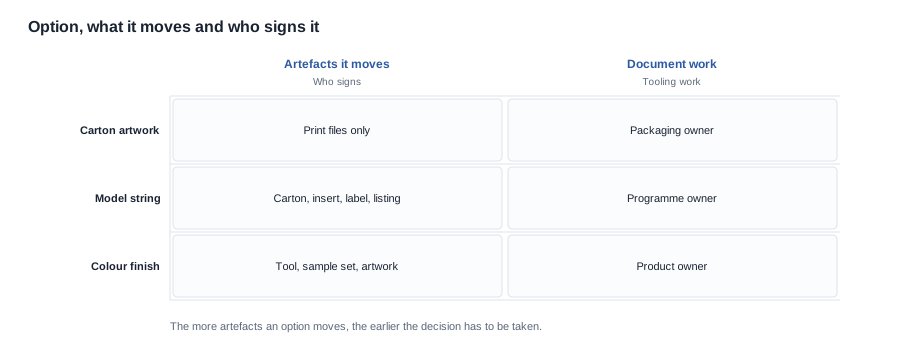
Figure 2 — Three middle-level options, the artefacts each one moves, and the role that has to sign.
The middle level is where a programme most often fails to notice the cost, because each individual change looks small and nobody adds them up. The way to keep the total visible is a document impact list attached to every packaging decision: which files change, which records change, and who signs each. If the list has more than a handful of entries, the decision belongs at the high-impact end and should be treated accordingly.
Cross-document work also sets the sequence of the decision, not only its scope. A change that has to appear in four places needs four revisions in sequence, and each revision waits for the previous one to be confirmed, otherwise the carton approves a string that the insert no longer matches. This is where programmes lose days without losing anything: nothing is wrong, the work is simply not running in parallel. Fixing the string register as the single source removes the sequence, because every file is then corrected in one pass instead of a chain.

The high-impact end: where tooling enters
Tooling is where packaging stops being packaging. As soon as an option requires a different mould, a different material, a different die-cut or a colour that needs its own tool, the decision moves from a print file to a physical asset that has an owner, a location and a maintenance history. The commercial consequences follow immediately: the option is no longer reversible by reprinting anything, it cannot be changed without a new tool, and it needs a written schedule before it can be released to production.
Colour is the most common way a programme walks into this level by accident. A range that offers three or four finishes needs a decision for each one about whether the finishes share a tool or require their own, and that decision is expensive to revisit once the tools are cut. In our catalogue the question is usually smaller than it sounds, because only two models publish a colour range at all, but the principle scales: know how many colours a SKU has, and know whether each one is a print, a finish or a separate tool, before the artwork brief is approved.
The same logic applies to what is depicted. An illustration of a charging case on a carton is harmless when the SKU ships with a case and misleading when it does not. A printed mention of sealing or of a protection rating has to match the model it appears on: an ingress rating appears in our catalogue for two models only, so a generic carton statement about sealing cannot be printed across the range. Weight is an even sharper example of the same discipline, since it appears for a single model in the catalogue, and a shipping or handling document that inherits a weight from a sibling model is simply wrong.
The high-impact end also carries the decisions that are usually left in the supplier's hands. Who owns the tool? Where is it stored? What happens to it when the programme ends? Which party authorises a change? These are not packaging questions, but they are triggered by packaging decisions, and the trigger is usually missed because the conversation was about how a box looks. A buyer who asks what the packaging decision does to the tool schedule, and who asks it early, avoids the situation where a print change has quietly become a tool change.
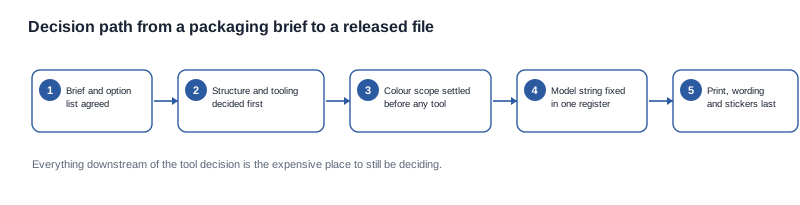
Figure 3 — The sequence in which packaging decisions should be taken, from the brief to the released file.

How to choose between customization options
Choosing between options is a comparison, and a comparison needs criteria that survive contact with a supplier. The useful criteria are all countable, which is the point: an option that touches one tool and two documents is a different decision from an option that touches three tools and nine documents, and the difference shows up in cost long before it shows up in a quotation.
Count the artefacts first. Which tools change, which materials change, which files change, and which records change. Then count the evidence: what would have to be produced to prove the option exists, and whether that proof already exists or has to be created. Then look at reversibility: before a tool is released, most decisions can be reversed; after it is released, the reversal stops being a print run and becomes a new tool. Finally, look at the signature: the more roles that have to agree, the earlier the decision has to be made, because the number of roles rarely shrinks as the programme goes on.
Four rules follow from those criteria, and they are worth applying in this order.
- Decide structure before surface. Whether a case, a tip or a carton die-cut changes is a structural question and belongs at the front of the sequence.
- Decide colour scope before any tool is released, and treat each extra finish as a separate tool question rather than a print option.
- Fix the model string before any artwork file is released, and pull every printed instance from a single register.
- Leave wording, leaflet content and sticker decisions to the end, because they are the cheapest parts of the brief to change and the easiest to correct.
When two options survive all four rules, the deciding question is usually about the programme rather than about the option. Which one can still be changed after the next customer order, and which one has to be right before it? An option that must be right before the next order belongs at the top of the sequence; an option that can still be changed afterwards belongs at the bottom. Programmes that invert this order pay for the inversion twice, once in the delay and once in the reprint.
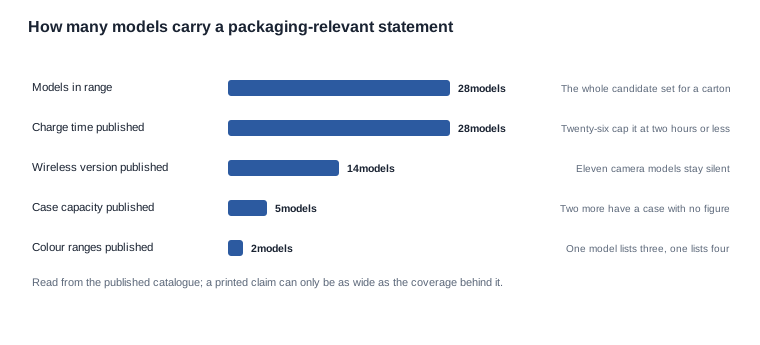
Figure 4 — How many of the 28 catalogue models carry each packaging-relevant statement, which is the coverage a printed claim can rely on.
The last criterion is the one buyers most often skip, and it is the one that decides a supplier comparison. Ask two candidates the same question about the same option: which files, tools and records does this change, and what evidence can you show today. The answer that names artefacts is the answer you can plan against. The answer that names a feeling, or only a finish sample, tells you the decision is still open on their side as well.
Where CYNRIN stands on customization options
Packaging work should be quoted against the impact level of each option, because the level is what predicts cost. We will tell you which tools a request touches, which documents have to be re-issued, and whether a decision is still reversible at the point you are deciding it. Where a request depends on a product characteristic, we will point to the published specification for that model rather than to a family, which matters most in the cases where the family answer is wrong: the presence of a charging case, the number of colour finishes, the stated charging time and any protection rating.
Two of the figures a packaging discussion most often needs are absent from the catalogue altogether: the lead time, the warranty duration and any order minimum attached to them. We will not invent them for a carton brief, because a packaging decision should not be made against an assumed schedule. What we will do is place the terms that govern the programme into a written commercial offer, where they can be dated and set against another supplier on the same basis.
What we ask in return is a brief that states three things: the level of change you are asking for, the market the goods ship into, and the date by which the decision has to be made. A brief like that can be costed against the artefacts it moves. A brief that only describes how the box should look cannot, because the same look can be produced at three different impact levels, and the difference stays invisible until somebody counts the tools involved.
We also do not publish touch-control or translation specifications for any model, and we will not print a claim on a carton that the specification behind it does not support. The certification material in our catalogue is presented as images of certificates, so any printed compliance claim has to match the certificate itself rather than a summary of it. In practice this is good discipline: a carton that says exactly what it can prove is easier to defend in a market, and easier for a channel partner to resell without a second round of questions.
Where a buyer asks us to choose, we would rather return the criteria and the options than return a single answer, because the choice depends on the brief, the market and the programme. If you want a starting point for that brief, the wider set of routes is summarised in the customization options overview, with the related questions covered separately for colour ranges, materials and finishes, logo and branding application and manual and insert options. The effect of a packaging change on compliance scope is treated in the certification scope note, the cost drivers behind a brief are set out in the packaging cost factors, and the overall menu sits on the customization options page.


