

Ask a buyer what their temple is made of and you will usually get a model name and a material acronym in the same breath, as though the second had been deduced from the first. It has not. A temple material is a set of coupled decisions — weight, stiffness, adjustability, how the surface takes a finish, how the part behaves when it is dropped — and each of those decisions reaches the buyer through a different route. The customization options that are actually available to a buyer are usually settled before that buyer sees any of them.
This matters for people who specify. A product manager who writes "temple in TR90" has made a decision about weight and flex and has silently made three more — about how the hinge is attached, about whether the part can take a sprayed finish, about whether the geometry that works with a moulded part is even available in the tooling. Each of those decisions has a different owner and a different point of no return.
This guide is written for brand-side product and engineering staff, and for channel buyers, who need to understand what a temple material actually commits a programme to. It uses our own published range as the reference point, because the honest starting point for any material conversation is what the supplier has actually documented, and on our side the answer is more specific in some places and more open in others than most buyers expect.
Customization options for temple materials: what the range actually lists
Material is not one of the specification lines our published range carries. What the range does carry is a set of electrical, physical and cosmetic lines that are useful for a first comparison, and a material question has to be asked rather than looked up.
The published lines are these, and they do not all describe the same kind of thing. A colour line appears for two entries only: V03 Pro with three and V06 with four. A weight is given for MT6 alone, at 158 g, and an IP rating appears against V06 and S7. Nothing else on the sheet describes how the temple looks, what it is made from, or how long it will last. The rest of it is electrical: a charging time for all twenty-eight entries, twenty-six of them stopping at two hours or less as a stated ceiling and D17 and ZH12 at roughly one hour; an interface line on twenty-four of the entries, seventeen magnetic and seven Type-C, and nothing at all for CY05 and CY03, and L1 Pro or MT6; a Bluetooth version on fourteen models, K01 and K02 at V5.3 and the others at V5.4, with eleven camera models carrying no version row; a charging-case capacity on five camera models, a case named without a figure on the KY06 and the MT5, and no charging-case row printed for the V03 and the V06, and the V03 Pro or the S7; and resolution on eight models at 8MP and three at 13MP — S7 and L2 Utral, and L1 Pro.
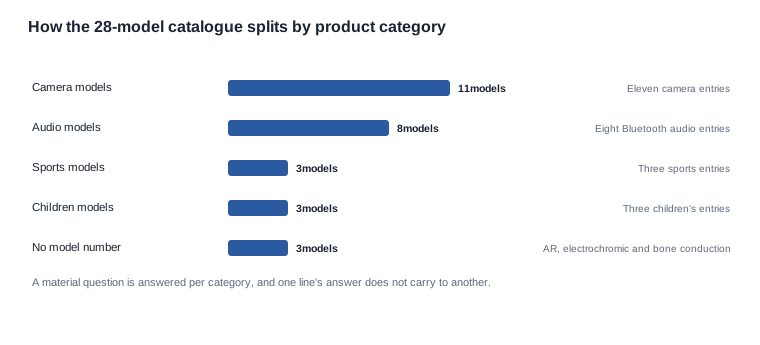
How that range is organised matters for a material conversation, because a material question is answered per category rather than per brand. The twenty-eight entries divide into eleven camera models, eight Bluetooth audio models, three sports models, three children's models and three entries carrying no model number at all — the AR glasses, the electrochromic pair and the bone-conduction pair. A buyer who has assumed that all temples in a range share one material is usually carrying an assumption from the camera line into three other lines that do not support it.
Writing down what a useful material line contains is worth the exercise, because most material enquiries fail at this point rather than at the comparison stage. A material line that helps a buyer compare two suppliers names the material and its standard, states which parts of the model it applies to, gives the finished mass of that part rather than the mass of the whole product, and describes the surface treatment. A material line that does not help says "premium alloy" and stops. The gap is visible in our own range in a specific way: several models carry no weight figure at all, and MT6 is the only entry where a weight appears, so even for the models that do carry a number the buyer has a single product-level reference rather than a breakdown by part. That is enough to identify a suspicious claim and not enough to verify one, which is the honest position to be in when the other supplier publishes more than you do.
The custom side of the internal table is organised the same way, and again it is recorded as counts rather than as a menu. Seven axes are recorded against the AI camera line, five against the Bluetooth audio line, five against the sports line, two against the children's line, and three against the electrochromic entry. The bone-conduction entry is silent on customisation, and the AR entry is not described in this respect at all. The families are not subsets of each other, which means the count for one line tells you nothing about what another line will accept. For the children's line specifically, the application and firmware capability is itself recorded as awaiting verification rather than as settled, and the same caution should apply to any material question on that line.
Read the open items as part of the answer rather than as an appendix. The A05 and A06 sheets are word for word alike, so nobody can currently say which field is meant to differ between them. The label L2 Utral appears to be a slip for Ultra, and the term Pro Max has not been defined by anyone. MT5 sits on an anomalous page reference, and whether it belongs with the camera models or the sports models is still an open question. The same kind of annotation sits against V06 and S7. Three entries — the AR pair, the electrochromic pair and the bone-conduction pair — carry no formal SKU at all. And the whole range, all twenty-eight of it, is published without a single real photograph, a product video or a test report. None of these blocks a material discussion, but each of them is a question a buyer should get answered rather than assume.

Why a temple material choice and a temple shape choice are different jobs
A temple material and a temple shape are decided by different people, against different constraints, at different points in the programme — and confusing the two is the source of a large share of the rework that happens between the first sample and the first batch.

The two chains in the diagram run in parallel. The material chain runs from functional intent, through weight and stiffness, into the process route that will make the part, and out to what that route means for finishing and for timing. The shape chain runs from the profile the designer wants, through the tooling that will produce it, into how it sits on a head and how the whole product reads in profile. They meet at a small number of couplings, and those couplings are where a material decision quietly overturns a shape decision.
The couplings are worth understanding individually, because each one behaves differently. A thin rigid section needs a different hinge and fastener approach than a moulded one, so the material choice can force a change to the front-to-temple joint. A rigid profile in a stiff material transmits pressure to the wearer's temple, so the shape may need to open out slightly to stay comfortable. A flexible material can accommodate a shape that a rigid material would have to be machined to, which is sometimes the cheaper answer and sometimes not. Whether a finish can be applied at all is a material question before it is a colour question, and a coating that will not adhere to one surface is a decision made at the front of the programme rather than the end of it.
Because the couplings sit between two chains with different owners, they need an explicit owner too. The material decision in most programmes is made by engineering, and the shape decision by design, and the buyer — the person paying for the units — is usually the only party who sees both in the same meeting. That is a good position to be in, provided the buyer asks for the coupling list explicitly rather than assuming that two separately-approved decisions compose automatically.
The order in which they are settled is also a commercial question rather than a technical one. A shape decision that is reopened late is expensive, because tooling is committed. A material decision that is reopened late is expensive in a different way: the process route has to be re-qualified, and a second route is a second supplier conversation. Which of those is cheaper to avoid depends on the programme, and the honest answer is that most programmes should fix the material before the shape, because the material constrains more of the downstream options than the shape constrains of the material.
There is a fourth consequence of the separation that is worth putting in front of a buyer early, because it is easy to miss and expensive to discover late. A material choice and a shape choice rarely stay independent for the whole programme: one of them is normally settled first, and the other is then constrained by it. The order in which they are taken is therefore a technical dependency rather than a stylistic preference, and reversing it later does not merely cost the same amount again. It can invalidate work already done, because geometry drawn for a stiff part may not be drawable for a flexible one at all, and because the process route that was priced for one may not exist for the other.

What to ask a supplier for on material
Most material conversations go wrong because they are held at the level of names. "What material are the temples?" produces a material family; it does not produce a specification that anybody can be held to. The requests below are the ones that turn a name into something a buyer can compare, and each of them is a question rather than an answer.
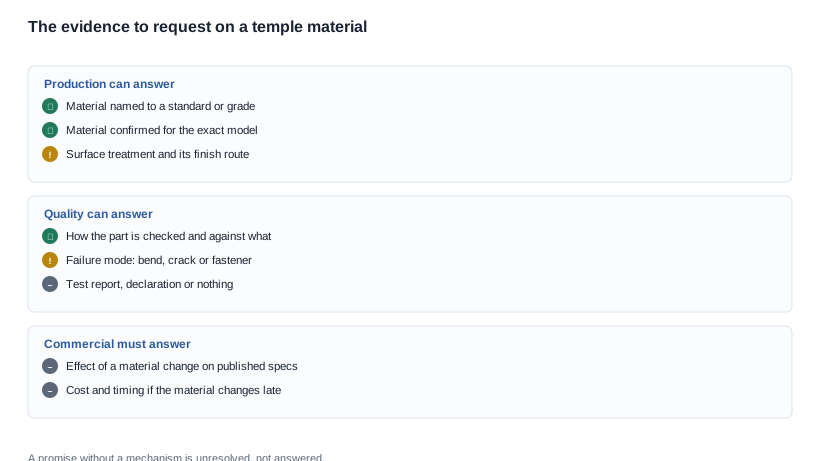
Four things are worth insisting on. First, a material named to a standard or a grade, because "premium alloy" or "high-grade acetate" is a marketing word and cannot be compared across suppliers or re-checked at a later inspection. Second, the material actually used on the model you are ordering, as distinct from the material used on the model you are looking at in a photograph, since a range can mix. Third, the surface treatment and how it interacts with a colour, since the finish route is where material and colour meet. Fourth, the failure mode, because a part that bends and a part that snaps are different commercial problems and the difference should be established before it is discovered in a customer's pocket.
The checklist groups the requests by who can answer them. The production side can state the material, the grade and the route. The quality side can state how the part is checked and against what. The commercial side can state what happens to the programme if the material changes, which is the question that determines whether a later adjustment is a conversation or a crisis. Any request that comes back as a promise without a mechanism should be treated as unresolved rather than answered.
There is also a way to read a supplier's material answer that is more reliable than reading the answer itself. Ask what the material was chosen to do, rather than what it is. A supplier who says the material was chosen because the temple has to survive a stated drop, or because the part has to take a sprayed finish and bond to a particular front, or because the geometry could not be produced any other way, has told you the decision and its reasoning. A supplier who lists material families without saying what the choice was solving has told you their sourcing menu, which is useful but not the same thing, and the gap between the two answers is where the assumptions live. The second question is what happens when the assumption behind the material choice fails — a temple that is too stiff for the geometry it was designed around does not fail quietly, and a programme that has never asked that question has not finished its own due diligence.
Two further questions are routinely omitted and routinely matter. The first is whether a material change alters any published specification — most obviously weight, but also the way the part is described in a product listing once the programme is live. The second is what evidence exists for the material itself: a test report, a supplier declaration, or nothing beyond a sample. Those three states carry very different weight, and the same discipline applies to material as it does to everything else in a technical file. A material claim without a document is a claim, and it should be recorded as one.
The materials a buyer will be offered, and what separates them
Across the market a buyer will be offered roughly six temple material families. Which of them suits a programme is a function of the product, the price position and the channel, and the families are separated by properties that matter to a buyer rather than by chemistry.
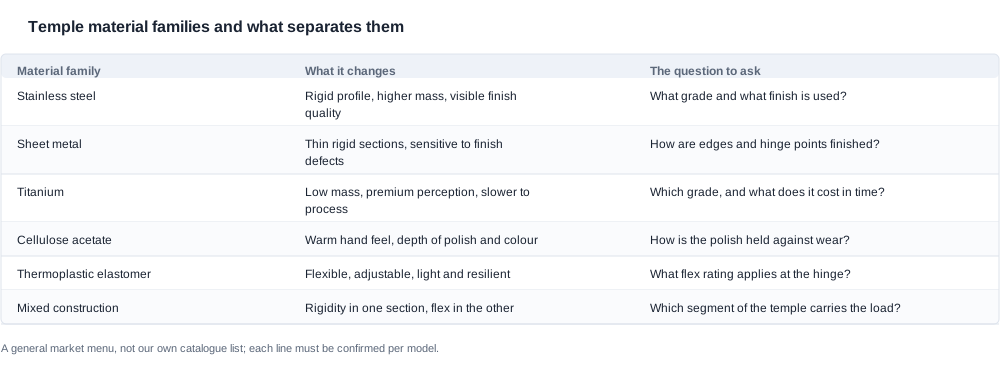
The table is a general market menu, not a list of what our own range can supply, and every line in it has to be confirmed against the specific model. What separates the families in practice is five things. The first is mass, which changes what the product feels like over a long session and changes what the specification sheet has to say. The second is stiffness and flex, which decides whether the temple can be adjusted, and therefore whether the fit is a range or a single setting. The third is how the part fails — bend, crack, or a fastener loosening — which determines what your returns exposure looks like. The fourth is how the surface holds an appearance: a polished surface, a coated surface and a moulded surface all age differently, and a colour applied to any of them has a different life. The fifth is where the cost sits in the process, because a metal temple moves the effort into machining, forming and finishing, while a moulded part moves it into tooling and finishing, and the two behave very differently against a delivery date.
The selection logic that follows from this is straightforward but rarely stated. If the product must survive being dropped, is carried by children, or is sold into a price-led channel, the failure mode and the cost position usually matter more than the material name. If the product is a design-led object where the temple silhouette is the brand, the material is chosen to serve the shape rather than the other way round. And if the product is a rebrand of an existing platform, the material is usually inherited, and the realistic customisation options are the ones that can be applied to the existing part rather than the ones that would need a different part.
One warning is worth stating plainly, because it recurs in every material discussion. A material is not a quality level. A better material does not produce a better product if the geometry, the finish and the hinge are poorly executed, and a well-executed part in a straightforward material can outperform a badly executed part in an expensive one. The question a buyer should be asking is not which material is best but which material is right for the duty, and whether the supplier can show the evidence for the performance they are claiming for it.
When two suppliers quote different materials for the same position, the useful comparison is not the material name but the work each of them is asking the buyer to accept. One may be quoting a temple in which a moulded segment carries the flex while a metal section carries the load; the other may be quoting a single rigid part and expecting the geometry to do the work instead. Both can be correct answers to the same brief, and the difference shows up in the weight, in the finish route and in how the part behaves after a year of wear rather than in the specification line itself. A buyer who wants to compare fairly should ask each supplier to state, in the same format, what the material is doing in the temple and what it is not doing, because a comparison of names alone rewards whichever supplier has the broader catalogue rather than the better answer. The same discipline applies to the elements that cannot be seen at all: the markings on the part, the traceability of the batch, and whether the material documentation travels with the goods into the destination market.
Where this sits against our own documentation
It is worth being direct about what our own published material position is, because a buyer who assumes a full specification table is in front of them will make different decisions from one who knows it is not. We publish charging, connectivity, capacity, resolution, protection and weight lines, and in a few places colour. We do not publish a temple material breakdown, and we do not publish a photograph, a video or a test report for any of the twenty-eight entries. For the custom side, the internal table records how many axes each line carries rather than naming them, which is deliberately unhelpful as a menu and useful as a prompt for the questions a buyer should be asking.
Certification sits in three states across our documentation, and they should be held at their true weight. Our published material carries no conformity framework we could point to, and no certificate number exists for us to quote, which leaves the framework to be established in writing against a named model rather than read off a page. The catalogue PDF itself contains no such wording, and the export certification page of the catalogue holds an image of ten patent certificates rather than test reports, eight of them design and two of them utility model. On the sports line, IP54 is marked in the catalogue with no third-party test report number attached to it. On the children's line, no certification information is supplied in any form.
What may be claimed publicly follows from that. Comparative advantage in parameters is only defensible against competitor units actually in hand. Acoustic performance is not currently supported by a third-party measurement report. A protection rating has to stay unpublished until its report exists. The electrochromic entry publishes no performance parameters of any kind, which leaves no room for a differentiated claim there. Our bone-conduction entry carries a 35dB figure, and that number raises the sharpest compliance question in the range; the children's line is where a safety or health claim carries the most risk.
We will not fill those gaps with adjectives. A buyer reading our catalogue will find real published figures in the electrical and physical lines, a handful of open items, and a set of claims that are still awaiting confirmation. That is a thinner document than a competitor's might be, and it is deliberately so: the alternative is a specification sheet that looks complete and cannot be defended. If you need the material and customisation options for a programme assessed against that position, the customization options line on this site is where to start, and the questions in the sections above are what we would ask for in return.
Related reading
- Temple colour and the two programmes it creates — where the finish decision sits relative to the material decision.
- Minimum order quantities for bespoke configurations — how the order size interacts with a made-to-order temple.
- How lead time interacts with a customised order — what changes when the part is produced rather than pulled from stock.
- The full customization options checklist — the wider list a programme usually works through.


