
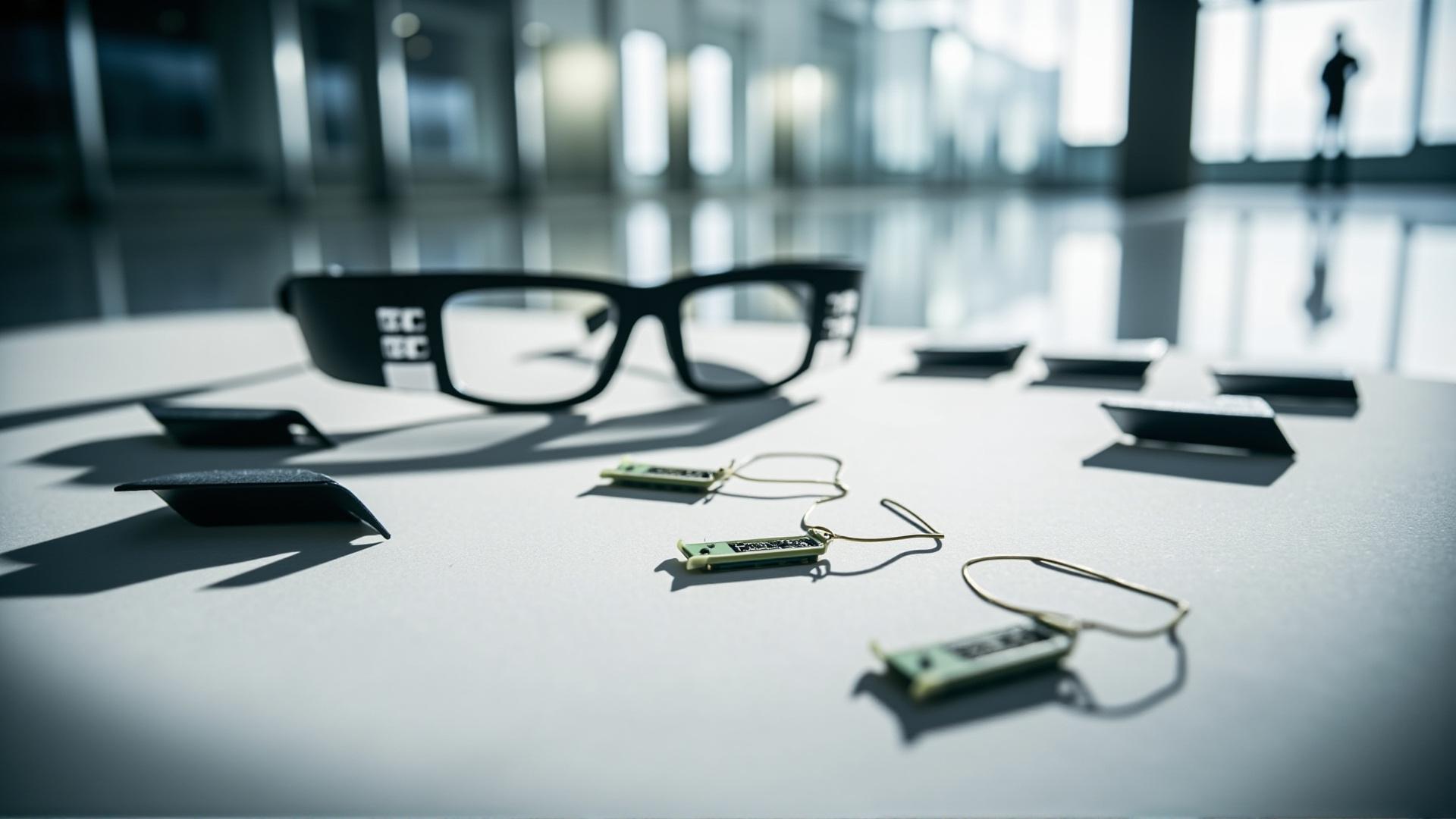
The CY03 publishes five rows — an 8 MP camera, a 290 mAh frame cell, a charge time of two hours or less, about seven hours of rated endurance, and a 1400 mAh charging case. It publishes no sensor model, no field of view, no video specification, no frame weight, no ingress rating and no certificate number. That combination makes the charging case the most testable claim on the model, and also the most commercially important one, because the case is what a retail customer actually sees in the box. This is the CY03 review checklist we would run on a production consignment, in the order we would run it, with the completion condition for each step stated so the sign-off is a record rather than an opinion.
What a CY03 buyer review can actually settle
A buyer review is not a re-run of the specification sheet. It is the set of measurements that tell you whether the shipment matches the order, and for this model that set is narrower than it looks and more useful than it feels.
The camera is the obvious place to start and the wrong place, because nothing is published to compare against. There is no sensor model, no field of view, no video resolution and no frame rate for the CY03, so a camera test against a specification is impossible. What remains is a consistency test: shoot the same scene on several units from the same batch and judge whether the output varies visibly. That is a real question with a usable answer, and it is the question our AI camera glasses imaging guidance sets up.
The endurance rating is the second obvious target, and it has the same shape of problem. About seven hours is a point figure with no test condition attached. You cannot verify it, because the condition behind it is not published. What you can do is declare a workload of your own, run it, and record what comes out. A number you produced under a condition you stated is worth more than a published number with no condition, and it is the only one you can put in a contract.
The case is the third target, and it is the only place where a published number and a physical measurement line up directly. 1400 mAh is published. A case that under-delivers against its label is a returns driver, because the customer experiences the case rather than the specification. This is where the review earns its keep, and it is why the checklist below starts with power and ends with paperwork.
The frame weight is the fourth target, and it is the one the catalogue cannot help with at all. No weight is published for this model. The only published weight anywhere in the catalogue is the MT6 at 158 g, and that is the eyewear body including its cell and camera and excluding the foldable case — it is a different model on a different platform and is not a proxy for the CY03. Measuring across units therefore does two jobs: it gives you a baseline for your own acceptance criteria, and it gives you the spread, which is the number that actually governs an incoming inspection.
The CY03 inspection sequence and why the order matters
Inspection steps are not interchangeable, because each one can disqualify a shipment and each one takes a different amount of time. Running them out of order means you discover the disqualifying problem after you have spent a week on the measurements that do not matter.

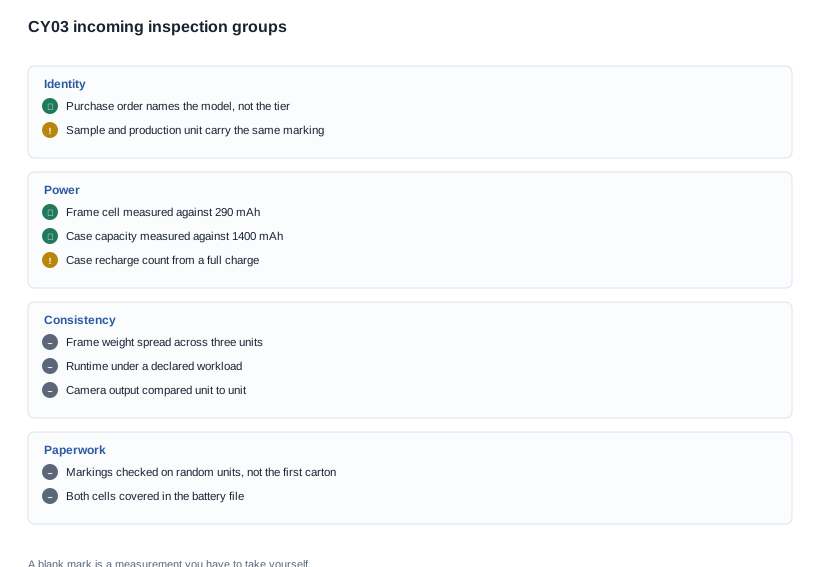
Step one is identity, and it costs nothing. The CY03 and the CY05 publish identical rows in the same catalogue, and the catalogue does not state what separates them. Before you open a carton, confirm that the units inside are the model your purchase order names. Check the marking, the model designation on the packaging, and the specification on the label against the order. A shipment that contains the CY05 against an order for the CY03 is a commercial dispute with a simple resolution, and it is entirely preventable with one photograph.
Step two is power, because it is where the published claims are concentrated. Measure the frame cell and measure the case separately, and then count how many times a full case recharges a frame that has run down. The arithmetic on the published figures — a 1400 mAh case against a 290 mAh frame — suggests somewhere around four recharges, and the real number depends on where you stop and at what charge level, so measure it and publish the measured figure rather than the calculated one. It is more credible, it is true, and it is the figure your support team will need.
Step three is the charge. Time a full charge on both sides of the frame, not one side. A magnetic contact can seat correctly on one temple and marginally on the other, and a single-sided timing can hide a seating or contact problem that shows up as a slow charge or an intermittent one on other units. If you are unsure whether the interface is a magnetic contact or something else, note that the catalogue publishes no charging method row for this model — the question of how it charges is itself something to confirm in writing.
Step four is endurance under your own declared workload. One workload, one start state, one end point, several units. Record all three. The difference between a camera running and a camera idle is the entire question on a camera product, and you are the only party that can answer it for your channel.
Step five is consistency across units. Frame weight spread, runtime spread, camera output compared unit to unit. These are the acceptance criteria you will actually apply to the next consignment, and they are worth far more than a pass or fail against a published number you cannot reproduce.
Step six is the paperwork, and it is deliberately last. It does not need the hardware on the bench, and you can run it in parallel with the measurements rather than in series with them. But do not let it be skipped when a shipment is on a tight schedule, because the paperwork items are the ones that follow the goods out to the customer.
Building CY03 acceptance criteria from the published rows
An acceptance criterion is a threshold you set before the goods arrive, together with the action you take when the measurement misses it. If the threshold is set after the measurement, it is not a criterion; it is a description.
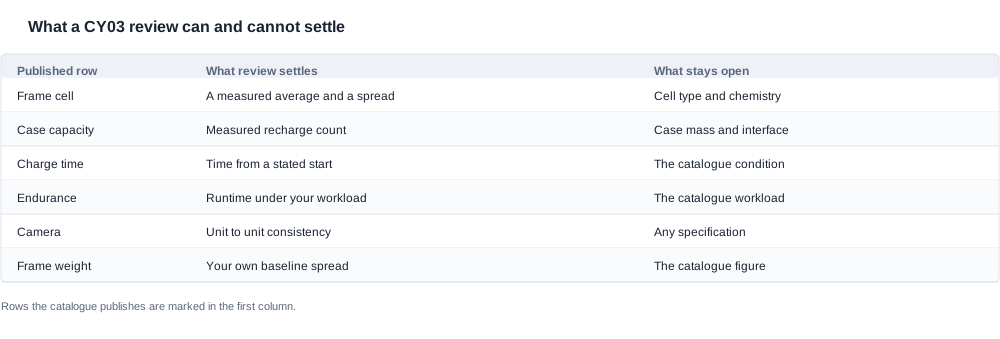
The published rows give you a starting point for exactly two criteria, and they are enough to build on.
Criterion one: case recharge count. The published figure is 1400 mAh of case against 290 mAh in the frame. Set your criterion as a minimum number of full frame recharges from a fully charged case, measured on a defined discharge endpoint, across a defined number of units. The number you set is yours — the catalogue publishes no recharge count, and we will not invent one — but the measurement method should be fixed before the goods land, because the method is what makes the result transferable to the next consignment.
Criterion two: frame weight spread. There is no published weight for this model, so the first consignment establishes the baseline and the second consignment is judged against it. The criterion that works is a spread, not a mean: a batch whose weights sit inside a narrow band is one where the frame assembly is controlled, and a batch whose weights scatter is one where something in the assembly is loose. Record the mean, record the spread, and write down what happens when the spread widens.
Two criteria can be built from the published rows and two cannot, and the second pair is where red flags usually appear.
You cannot build a camera criterion from published data. There is no sensor specification to test against. What you can build is a consistency criterion — a reference capture from the approved sample, shot under a fixed condition, that production units are compared against. This is a legitimate and widely used approach precisely because no published sensor specification exists to test against.
You cannot build an endurance criterion from published data either. About seven hours carries no condition. The criterion you can build is your own: a declared workload, a declared endpoint, and a tolerance you have decided on the basis of what your channel actually needs.
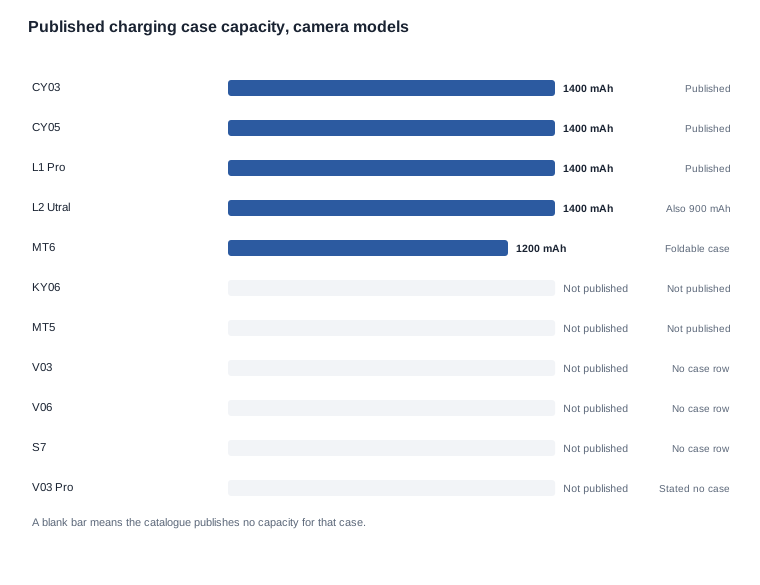
The chart above is worth reading for a second reason. The CY03 publishes a 1400 mAh case, but so do the CY05 and the L1 Pro. The L2 Utral publishes a 1400 mAh case as well, and additionally publishes a 900 mAh option. The MT6 publishes a 1200 mAh foldable case. The KY06 and the MT5 both carry a case whose capacity the catalogue does not publish. The V03 Pro and the V06, and the V03 and the S7 have no case row at all, and what the carton carries for those four is an open item for the supplier to close. If your acceptance criterion is built around case capacity, you should know which of those eleven configurations you are actually holding.

CY03 checks that need a sample rather than a document
Some of the checklist cannot be closed with paperwork at all, and these are the items where a sample order pays for itself.
The camera comparison needs units. Order a sample of the production configuration, not a sample of a different build, and compare its output with the units in the consignment. Where the sample and the production run differ in firmware or enclosure, the comparison is void. State this in the purchase order: which configuration the sample represents, and how long the approval of it remains valid.
The physical rows need a sample. Frame weight, frame dimensions, case mass, case dimensions and packed unit weight. None of these are published for this model, and all of them are measurable on a single unit. The packed unit weight is the one with commercial consequences, because it determines the freight class, and the freight class determines the delivered cost per unit.
The battery document needs the hardware to be meaningful. A test summary that does not name the cell actually fitted in the shipped configuration is a document about a different product. Two cells travel in every unit of this configuration, and the document has to cover both, with the declared watt-hour rating following the larger one. This is the item that most often delays a first consignment, and the battery transport compliance notes set out the chain.
The charging behaviour needs the hardware. Whether the frame charges from a case, from a pad, or over a wired connector; how long it takes from a stated start; whether the case indicates its state. The catalogue publishes no charging method row for the CY03, which means the interface has to be established by observation and by written confirmation rather than read off a sheet.
Two further points on how to run these checks. First, sample across the consignment rather than at the front of it. A consistent sample from the first cartons tells you about the first cartons. Second, record the checks that did not produce a number as well as the ones that did, because a missing measurement and a failing measurement are different problems and the remedies are different.
Non-destructive, destructive, and the order in which you run them
Not every check can be run on a unit you intend to sell, and mixing the two up is how a review turns into a stock loss. Weight, markings, charging behaviour and runtime are non-destructive: they can be run on units from the consignment and those units still ship. The battery documentation review is non-destructive in the physical sense but destructive in the administrative sense, because an opened or modified cell invalidates the paperwork it was shipped with. Anything that requires dismantling, a modified cell, or a deliberate discharge to zero belongs on a unit designated for that purpose and never on saleable stock.
The practical rule that follows is to separate the two populations at the point of unpacking, not at the point of testing. Identify the designated test units first, mark them, and remove them from the saleable count before anyone starts the measurements. Then the measurements themselves can be ordered freely, because the cost of an aggressive test has already been paid for by the units you set aside. This is a small operational point, but in a review conducted under time pressure it is the difference between a rejected consignment and a damaged one.
There is a second ordering point that applies to the destructive population specifically. Endurance and recharge testing both consume the cell's remaining capacity, so a unit that has been through a full runtime test has a partly discharged cell by the time the recharge count begins. If both measurements are on the same unit, the recharge count is measured from a condition you did not intend. Either run them on separate units, or run the recharge count first and the runtime test last, and record which order you used — otherwise the next consignment will be judged against a figure that was measured in a different sequence.
The CY03 paperwork checks that come after the measurements
Paperwork is the part of an incoming review that gets skipped, because it is the part with no physical component and no obvious deadline attached to it. It is also the part that determines whether the goods can legally be sold in the destination market, and that cost sits inside the landed cost of the order.
The marking check has to be done on randomly picked units. A compliant document does not guarantee the marking is on every unit, and a marking applied to the carton rather than to the product is the commonest version of this failure. Pick units from the middle and the bottom of the consignment, not from the top, and check the product rather than the packaging. The certification checklist sets out how the file normally runs.
The certification scope has to be checked against this model specifically. Our catalogue carries a company-level export certification page whose content is images rather than text, and the catalogue text contains no reference to CE, FCC or RoHS. There is no per-model certification row anywhere in it. So the document that covers the CY03, the model schedule it names, the issuing body and the validity period all have to be requested in writing and checked against the model designation on the goods. A buyer who asks us for "our CE certificate" and receives a company statement has been given something real and something that will not answer a market access question on its own.
The application and data-handling question belongs in the file. Where the companion application comes from, who publishes it, where the footage it handles is stored and what the retention policy is are all unpublished for this range. For a camera product with a microphone, that is a reasonable question to put to a supplier before the listing goes live in a market that asks it.
The commercial record has to match what was received. Quotation, purchase order, minimum order quantity, lead time, payment terms, warranty terms, and the defect remedy. Check them against the physical consignment before the invoice is paid, not after. The charging solutions piece covers how a case changes the delivered cost, and the AI camera glasses range page lists where this model sits among the eleven camera configurations.
What the review record has to contain to be worth keeping
A review is only worth something later if it can be read without the person who ran it. That means the record has to carry the context that makes each number interpretable, and it costs almost nothing to write down at the time and a great deal to reconstruct afterwards.
For every measurement, the record needs the unit identity, the measurement method, the condition it was taken under, the result, and the person who took it. A weight without the unit identity is not a baseline; a runtime without the workload is not a runtime; a recharge count without the discharge endpoint is not comparable with the next consignment. The same applies to the paperwork checks: record which document was checked, which revision or issue number it carried, which units the marking check covered, and what the declared model scope was.
Two things belong in the record as well, and they are the ones most often left out. First, the conditions under which the review was run at all — whether the consignment was in its original packaging, whether the units had been stored at a stated temperature, how long they had been in transit. A review of units that have been left in a hot container for a week is measuring something other than the product. Second, the explicit list of checks that were not run, and why. A record that shows six of the eight checks completed is a different artefact from one that shows eight of eight, and the buyer should be able to tell which they are looking at before they rely on it.
Keep the record against the consignment, not against the individual buyer or the individual warehouse. The next consignment of this model should be judged against the previous one, and that comparison is only possible if both records are in the same place and in the same format.
What we will and will not sign off on for a CY03 shipment
This model's reviewable claims are concentrated in the case and the cell, and a buyer who measures those two carefully knows more about the shipment than one who reads three specification sheets. We will not estimate the rows we do not hold: we will not quote a frame weight, a sensor, a field of view, a certificate number or a recharge count that our documentation does not contain, and we would rather tell you that than give you a figure you cannot verify against a sample.
We will say plainly which of the checklist items above are ours to close and which are yours. The published rows, the case capacity, the cell capacity, the charge-time ceiling, the endurance rating and the fact that this model carries no published charging method row are all documented, and we will confirm them. The physical measurements, the consistency tests, the workload-dependent endurance figures, the certification scope and the commercial terms are items we will supply the evidence for but that you have to verify against the goods you receive.
If you want the criteria before the goods rather than after, send us the model, the quantity, the destination market and the configuration you intend to order, and we will tell you what can be agreed in advance and what has to be measured. The published rows for this model are on the CY03 smart glasses specification list, and the charging side of the review is set out in CY03 smart glasses charging options.
Related reading
- How case capacity changes landed cost — charging solutions
- The specification for this model — AI camera glasses
- Why resolution is not image quality — AI camera glasses imaging
Send us the target market, the quantity and the required configuration, and we will come back with what is available and what is not.


