

The CY03 is the retail workhorse of the 290 mAh platform: 8 megapixels, a 290 mAh cell, a charge time of two hours or less, roughly seven hours of rated endurance, a 1400 mAh charging case, and — this is the row that catches people out — no published charging method at all. It is a product whose case is both its best commercial feature and its largest undocumented cost, and it publishes exactly the same rows as the CY05. This article takes the sheet apart row by row, because a specification is not a list of facts but a list of claims with different levels of evidence behind them, and the difference only shows up when you read the rows against each other.
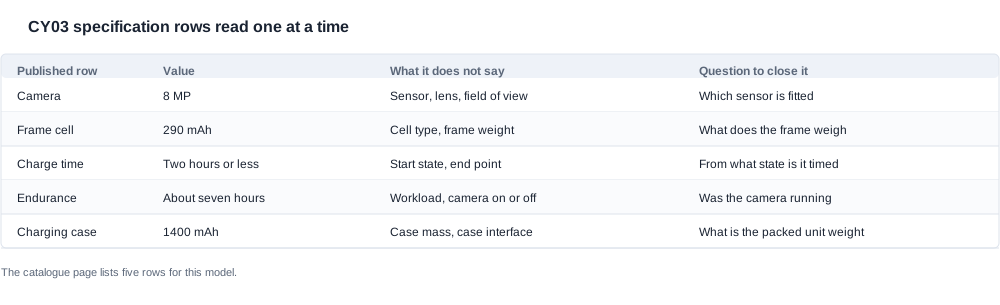
The CY03 rows one at a time, and what each one commits
8 megapixels. The camera is the least documented part of the sheet and the most commercially visible, which is an uncomfortable combination. No sensor model, no field of view, no video format, no frame rate, no aperture, no stabilisation, no low-light behaviour and no storage arrangement appear for this model. The camera imaging notes explain why those omissions matter more than the resolution number itself: a sensor with small pixels can produce a worse image than a lower-resolution sensor with large pixels, and indoors, which is where first-person content is usually recorded, that gap widens.
A 290 mAh cell. Shared with the CY05 and the L1 Pro, and the L2 Utral, and the largest frame cell published in the camera range. The V03 and the V03 Pro, and the MT5 publish 220 mAh, the V06 and the S7, and the KY06 publish 260 mAh, and the MT6 publishes 265 mAh. Being at the top of the ladder is a real argument for a channel that sells on endurance, and it is an argument that does not need a price comparison to work.
About seven hours. A point figure with no condition published. On a camera product the camera is the dominant load, so the condition is the question, and the how to compare battery life method covers what to ask when a rating arrives without one. Read the figure as an upper reference rather than as a working day, and treat the workload as the item to be established before the figure is used in planning.
Two hours or less. A ceiling, not a typical figure, and stated without the starting state of the measurement or the completion criterion. This is worth being careful about in one specific way: "two hours or less" permits exactly two hours, and it is a different assertion from "under two hours". Every model in the catalogue publishes a charge time, so the absence is not of the number but of the condition that would let you convert it into an operational figure.
A 1400 mAh charging case. The largest published case in the range, more than four times the frame cell, and the reason the product can be sold on an all-day proposition. The CY03 charging options analysis covers what it does to the delivered cost, and the shipping weight breakdown covers the parcel.
And the row that is not there. The catalogue publishes no charging method for this model. It publishes one for seventeen models as magnetic, and for seven as Type C — including the V03 Pro and the L2 Utral. The MT6 and the L1 Pro, and the CY05 and the CY03 are the four where the row is simply absent. That absence is a specification fact in its own right, and it is one a buyer should read as an open question rather than as a default.

What the CY03 does not publish, and why each absence matters
An absent row is not automatically a problem. Some absences are harmless because the channel does not need them; others are expensive because they sit directly on a number somebody else will check.
Frame weight and frame dimensions. Not published. The weight decides both the daily-use judgement and the freight class, and the only published weight in the catalogue is the MT6 at 158 g, which is the eyewear body including its cell and camera and excluding the foldable case — a different model on a different platform. Measure it on a sample rather than requesting it in writing.
The colour and finish list. Not published for this model. Two camera models do publish theirs: the V03 Pro in orange, off-white and black, and the V06 in orange, ice blue, black and black ice blue. So the catalogue publishes colour for some models and not for others, and for the CY03 the list has to be requested — which matters directly if the range decision is about how many packaging SKUs to carry.
The camera specification. Not published, as set out above.
The charging method, the case interface, the case mass and the case charge time. Not published.
The ingress protection rating. Not published, so there is no durability claim available for this model. Only the V06 and the S7 carry one, and both also publish a detachable inner frame and an ergonomic design line.
The certificate numbers and the covered model schedule. Not published. Our catalogue carries a company-level export certification page whose content is images rather than text, showing ten patent certificates — eight appearance-design patents and two utility-model patents — and the catalogue text contains no reference to CE, FCC or RoHS and no per-model certification row. So the model-level document is something to request in writing, naming this model and this configuration.
The commercial rows. Minimum order quantity, lead time, production capacity, the pricing basis, the payment terms and the warranty terms are not published either, and they belong in a quotation rather than in a product discussion.
The useful way to hold all of this is as a distinction between three kinds of specification. A fact is a number the catalogue publishes — cell capacity, charge time, endurance rating, case capacity, resolution. A rating is a published number without a stated condition — and the charge time and the endurance figure both fall here, because the numbers are published but the conditions are not. An open item is anything absent, which is everything else on the list above. A buyer who knows which of the three they are looking at does not need to be told what to do with it.
What features means when the catalogue publishes none for this model
The CY03 page publishes no feature row at all. Neither does the CY05 and the KY06, and the L1 Pro and the MT5 or the V03. This is worth understanding, because "features" in a product page is a much looser term than "specification" and the two behave differently in a buying decision.
Some models in the camera range do publish feature lines, and reading them makes the distinction concrete. The V03 Pro publishes a flexible temple, a photochromic lens and a Type-C charging port, in three published colours. The V06 publishes an ergonomic design, an extra-long endurance claim, a detachable inner frame and IP54 water protection, in four published colours. The S7 publishes an ergonomic design, a 13 MP sensor, a detachable inner frame and IP54 water protection. The MT6 publishes portability, light weight and a foldable 158 g charging case.
Those are structural statements about the product. A flexible temple is a component difference, a detachable inner frame is a serviceability decision, an IP54 rating is a testable performance claim, and a published colour list is a packaging input. Every one of them can be checked, photographed, compared, or costed.
For the CY03, none of that is published. Which means the feature set of this model has to be established in a different way — by asking what the component configuration is and what it enables, rather than by reading a feature list. That is a harder exercise than reading a list, and it is the reason a buyer who wants a feature-led proposition should establish it early.
There is a commercial reason this matters more here than in most categories. A feature line is the only thing that distinguishes two models inside the same resolution tier. Eight of the eleven camera models are published at 8 MP, so the resolution figure does no differentiating work in that tier. Within that tier, the V03 Pro's flexible temple and photochromic lens are the visible differentiators, and the CY03 has none published. A buyer building two 8 MP SKUs therefore cannot use this model for the visible-differentiation role without establishing its feature set first — which is a different task from the CY03-versus-CY05 twin question, and both of them have to be answered before a range is built.
The practical instruction is simple: when a catalogue publishes no feature row, ask for the component configuration rather than for a feature list. "What is the temple construction", "what does the charging arrangement consist of", "what is the hinge and temple material", "what is the lens and what coatings are fitted" — these questions return factual answers that can be put on a page, checked on a sample and costed in a quotation. A request for "the features" returns adjectives.
The 290 mAh platform and what sharing it buys a range
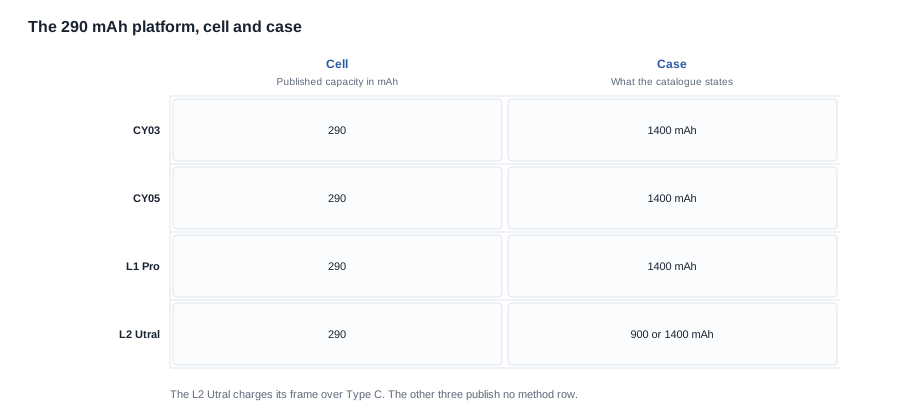
Four models share this platform: the CY03 and the CY05 at 8 MP, and the L1 Pro and the L2 Utral at 13 MP. All four publish a 290 mAh frame cell, a charge time of two hours or less, and about seven hours of rated endurance. Three of them publish a 1400 mAh charging case, and the L2 Utral publishes a 1400 mAh case as well as a 900 mAh option.
What that sharing actually buys a brand is worth being precise about, because "platform sharing" is often used loosely.
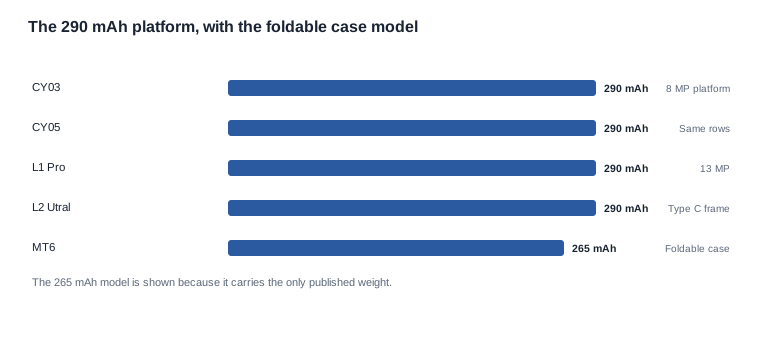
One accessory programme. The 1400 mAh case serves three of the four models, so the charging accessory, the battery documentation and the customer instructions can be written once. The L2 Utral's 900 mAh option and the MT6's 1200 mAh foldable case are the two that break the programme.
One camera specification request. If the sensor and the optical arrangement are the same across the platform, ask for the camera specification once for the platform rather than four times per model. That is a negotiation saving as much as a documentation saving.
One firmware baseline, in principle. Firmware customisation is a real conversation for a private-label buyer, but the catalogue publishes no firmware baseline for any camera model, so this is something to confirm rather than assume.
One certification scope, to be checked. Whether a document covering the CY03 also covers the CY05 and the L1 Pro is a scope question that has to be asked. A document that names models rather than configurations does not automatically extend across the platform.
And one dependency you do not want. The CY03 and the CY05 publish identical rows, so a platform that contains both of them contains two SKUs with nothing published to tell them apart. That is the constraint that sits under the whole platform, and it is why the platform is useful for building a range and dangerous for building one without the twin question answered first.
The comparison with the L2 Utral is the one that shows what a platform buys when the platform actually differentiates. The L2 Utral is on the same cell with the same case capacity, it charges its frame over Type C, and it carries the 900 mAh case option — so it offers a customer-visible difference in the charging setup and the accessory choice that the CY03 cannot match, because the CY03 publishes no method row at all. The L1 Pro versus L2 Utral battery and charging comparison covers the flagship pair, and the AI camera glasses which model to pick piece covers the range decision.
How to read a CY03 specification sheet in five steps
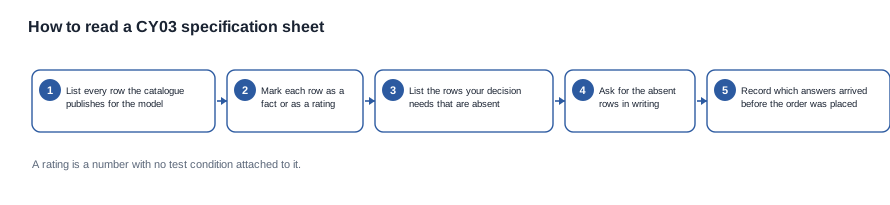
- List every row the catalogue publishes for the model. For the CY03 that is five rows, and writing them out in full takes a minute. The point of listing them is that everything else gets judged against a fixed baseline.
- Mark each row as a fact or as a rating. Cell capacity and case capacity are facts. The charge time and the endurance figure are ratings, because their conditions are not published. This single marking changes how you can use them: a fact can go on a product page and into a tender response, and a rating needs a condition attached before it can do either.
- List the rows your decision needs that are absent. This list is the request. It is short — sensor, field of view, video specification, storage, weight, dimensions, colour list, charging method, ingress rating, certificate scope — and each entry is a question rather than a complaint.
- Ask for the absent rows in writing, with the model and the build named. A request that names the model gets an answer that names the model. A general request gets a general answer, which closes nothing.
- Record which answers arrived before the order was placed. The answers that arrive after the order are the ones that cannot be used in a specification sheet without an amendment.
The fifth step is the one that gets skipped, and it is the one that determines whether the sheet you are working from is the sheet the factory is working from. A specification review that records dates and names is also the input to a change log later, and it is the document that a buyer's auditor or insurer will ask for.
CY03 specification questions and the order to close them
The order below is arranged by cost of delay rather than by topic, and every item has a completion condition that can be checked.
- What differs between the CY03 and the CY05, in writing. Completion condition: an answer naming the model, with a date.
- The camera specification, closed once for the platform. Completion condition: a sensor, a field of view, a video resolution, a frame rate and a storage behaviour, applicable to the platform rather than to one build.
- The endurance test condition behind the seven-hour figure. Completion condition: a stated workload, a stated start state and a stated end point.
- The charging condition behind the two-hour ceiling. Completion condition: the starting state and the completion criterion, recorded as a ceiling rather than converted into a tighter claim.
- The charging method and the case interface. Completion condition: a written interface description for the exact configuration, plus a case input and a case charge time.
- The case mass, dimensions, and the resulting packed unit weight. Completion condition: a measured figure on a sample, and the freight class that follows from it.
- Frame weight, dimensions and the colour list. Completion condition: a measured weight with a recorded spread, and a colour list tied to packaging SKUs.
- The certification position for this model in each destination market. Completion condition: a document reference, a scope and a date, per market.
Two red flags are worth naming because they recur in this category. The first is a supplier who fills the absent charging-method row by inference, because magnetic is the majority case in the catalogue. The second is a supplier who quotes a frame weight for a model that has none published. In both cases the answer is a configuration reference rather than a number, and in both cases the assumption reaches the packaging artwork before anyone notices.
Turning the sheet into a specification your own team can use
Once the rows are separated into facts, ratings and open items, the remaining work is to convert them into a document your product, operations and compliance teams can each use without re-interpreting them. In practice that means three short outputs rather than one long one.
A claim sheet for the product and marketing teams. It lists only the facts, each with its exact published wording, and it says plainly which claims are not available. It exists so that nobody has to reconstruct what is safe to say from a catalogue page, and so that the forbidden claims are written down as forbidden rather than left to individual judgement.
An operating sheet for procurement and logistics. It carries the physical and commercial rows, marks the ratings as ratings, and carries the open items with their owners. It exists so that the delivery-cost model and the packaging design are built from the same list, and so that the list is the one used when the goods arrive.
An evidence sheet for the compliance and quality teams. It carries the certification scope, the battery documentation covering both cells, the component and module list, and the change log. It exists so that a market access question can be answered from a file rather than from a recollection.
The three sheets share one source — the catalogue rows — and one discipline: anything that is not in the source is on the open-items list rather than in a cell. Keeping that discipline is what stops the three teams from drifting apart over a year, and it is what makes the specification reviewable by someone who was not in the room when it was written.
The CY03 specification boundary and what we will not fill in
The CY03 is the strongest retail proposition in this range and its price has to be set knowing what the 1400 mAh case does to the delivered cost, which is not knowable from the documentation. We will publish the 8 MP figure as a resolution class rather than as an image quality claim, we will not present the seven-hour figure as a working day, and we will not present the two-hour ceiling as anything tighter than a ceiling. We will not quote a weight, a case weight, a colour or a certificate number that the documentation does not contain, and we will not describe a charging method for a model whose page carries no such row.
The CY03 smart glasses value analysis covers the commercial case, the AI camera glasses battery comparison shows where the model sits on the published battery rows, and the published CY03 specification list is the row-level baseline this article is built on.
Related reading
- The published rows for the sibling — CY05 smart glasses specifications and features
- The money side of the accessories — CY03 smart glasses charging options
- The commercial rationale — CY03 smart glasses value for money
Send us the channel, the target price band and the markets, and we will tell you what the case does to the delivered cost and which figures have to be closed first.


