
The CY03 smart glasses publish a 1400 mAh charging case — the largest case capacity published anywhere in this camera range — alongside a 290 mAh frame cell, a charge time of two hours or less and roughly seven hours of rated endurance. What the catalogue does not publish for this model is the charging method itself. There is no charging interface row on the CY03 page, and there is not one on the CY05, the L1 Pro or the MT6 either. That single absent row is the reason this article is not a simple "here are your charging options" piece: the frame-side interface has to be established before the packaging, the instructions and the accessory list can be designed, and it is the largest unresolved variable in this configuration.
What the CY03 charging rows do and do not say
Read the catalogue page for this model as a list of five rows rather than as a specification, because three of the five are charging facts and one of them is missing.
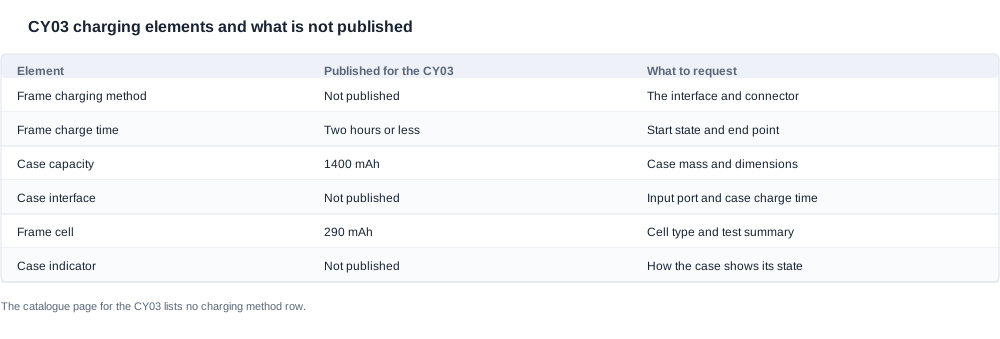
The frame cell is 290 mAh. That is the largest frame cell published in the camera range, shared with the L1 Pro and the CY05, and the L2 Utral. It is the cell that determines how long the frame runs on its own, and therefore how often the case has to do its job.
The charge time is two hours or less. This is a ceiling, not a typical figure, and the ceiling is stated without the two things a buyer needs to use it: the state of charge at the start of the measurement, and the point at which charging is considered complete. "Two hours or less" permits exactly two hours. It is a useful bound for planning, and it is not a substitute for a measured figure, and it should not be tightened into "under two hours" on a product page, because that is a different assertion than the one the catalogue makes.
The endurance rating is about seven hours. A point figure with no test condition attached, and on a camera product the camera is the dominant load. Whether the camera was running during the measurement is the question that decides whether the figure describes a working day or half of one.
The charging case is 1400 mAh. More than four times the frame cell, and the largest published case capacity in the range. The CY05 and the L1 Pro publish the same 1400 mAh, the L2 Utral publishes a 1400 mAh case as well as a 900 mAh option, and the MT6 publishes a 1200 mAh foldable case.
The charging method is not published. The CY03 page lists the pixel figure, the cell capacity, the charge time, the endurance rating and the case capacity — five rows — and no charging interface row. Across the whole catalogue, seventeen models are published as magnetic and seven as Type C, including the V03 Pro, the L2 Utral, the D11, the D12, the D17, the ZH12 and the bone-conduction model. The CY03 and the CY05, and the L1 Pro and the MT6 are the four where the row is simply absent. That distinction is worth holding on to: an absent row is not a magnetic row with the label missing, and it is not a Type C row either. It is an unanswered question, and the answer has to come from a supplier in writing.
Two further absences matter for a charging conversation. The case's own input port is not published, so you do not know whether the customer needs one cable or two. And the case's own charge time is not published, so the case's contribution to the weekly charging routine is an assumption rather than a specification.
The missing interface row and what it costs a buyer
An absent interface row is easy to overlook because it looks like a formatting gap. It is not. It propagates into five downstream decisions, and each of them is expensive to reverse once packaging artwork is signed.
The in-box accessory set. Whether the box contains a case only, a case plus a cable, or a pad, depends on how the frame charges and how the case is fed. A magnetic frame and a case that shares the same input as the frame gives one cable and one routine. A case with its own connector gives two. This is invisible on a specification sheet and immediately obvious to a customer who opens the box.
The instruction artwork. A magnetic contact needs a seating instruction and a warning about metal surfaces interfering with the contact, because a frame sitting on a steel desk or in a pocket with a metal object will fail to charge, and that is the single most common reason a buyer concludes a magnetic product is faulty. A Type C frame needs a different instruction entirely. Writing the wrong one means reprinting.
The certification scope of the accessory. The case is a second lithium cell. Whether the frame charges through the case or independently, the case is still shipped and still regulated, and the battery documentation has to cover it.
The battery transport file. The declared watt-hour rating follows the larger cell, and the packing instruction has to describe the configuration that actually ships. A configuration change at this stage — adding a case to a product whose original documentation was written without one — invalidates work that was otherwise correct.
The fulfilment promise. A weekly charging routine is what the case supports. A nightly one is what a pad or a cable supports. These are different claims on a product page, and only one of them can be made truthfully depending on what is actually in the box.
There is a second, quieter cost, which is negotiation. A buyer who arrives with the interface question already answered by a supplier document negotiates from a position of knowledge. A buyer who arrives with it unanswered is negotiating for a fact. The difference shows up in how long the technical exchange takes and in how much of the commercial discussion has to wait on it.
Two cells, one parcel: the CY03 logistics chain
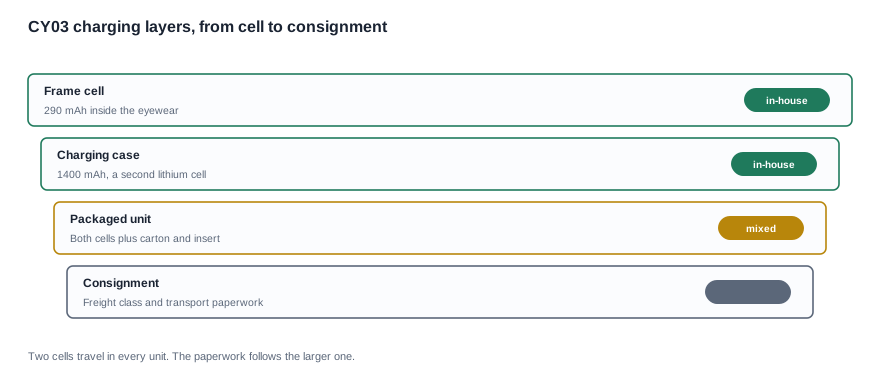
Once the case is in the configuration, the charging story stops being a product feature and becomes a logistics chain, and the chain has four links. Each link has a number that is published or a number that is not, and the unpublished ones are the ones that move the delivered cost.

Link one: the frame cell. 290 mAh, published, and the smaller of the two. It sets the capacity that has to be refilled and therefore how often the case is used, but it does not set the declared rating for transport.
Link two: the case cell. 1400 mAh, published, and the larger of the two. This is the cell that sets the declared watt-hour rating, and therefore the packing instruction, the carrier documentation and, in practice, the mode of shipment the configuration is comfortable with. A consignment that is comfortable as a parcel on one carrier can become a freight-only consignment on another, and that is a mode change rather than a price difference.
Link three: the packed unit. The frame contributes 290 mAh and the case 1400 mAh, and the parcel carries both plus the carton, the insert and the printed material. The case mass, the case dimensions and the resulting packed unit weight are all unpublished. These three numbers determine the freight class, and the freight class determines the delivered cost per unit. For a channel shipping by air in small quantities, this is regularly the largest single line in the landed cost, and it never appears on a product page.
Link four: the consignment. Two cells per unit changes the freight class, adds the transport documentation, and increases the warehouse volume per unit. For a business running on thin stock and fast turns, that last point is not trivial — the case occupies space that earns nothing, and it does so in every unit of every delivery.
The commercial consequence is that the case has to be in the cost model before the order, not after the first consignment lands. That means either measuring the packed weight on a sample, or building the model with a stated assumption and a sensitivity range. The first is a day of work. The second is defensible if it is written down, and indefensible if it is not.
CY03 charging questions and the answers we can give
Buyers ask the same charging questions about this model repeatedly, and most of them have a precise, answerable form. Here they are, with what our documentation actually says. When you work out what to ask, keep the two levels separate: the published answer below, and the question that closes the gap it leaves open.
How does the frame charge? The catalogue publishes no charging method row for the CY03. What we can tell you is that the row is published for seventeen models as magnetic and for seven as Type C, and that for this model, the L1 Pro and the MT6, and the CY05 it is absent. The interface has to come from the supplier for this exact configuration.
How long does it take to charge? Two hours or less, with no stated starting state and no stated completion point. The figure is published for all twenty-eight models in the catalogue, so it is not missing; what is missing is the condition that would let you convert it into a planning number for your own operation.
How long does the battery last? About seven hours, as a manufacturer rating, with the workload behind it unpublished. The honest way to use it is as an upper reference, not as a working day.
What does the case add? 1400 mAh against a 290 mAh frame cell — more than four times the frame capacity. The case is what turns a seven-hour device into a multi-day proposition for the customer, and it is also what turns the parcel into a two-cell consignment.
How heavy is the packed unit? Not published, and the single most commercially consequential gap on this model. Measure it.
What does the case charge from? Not published. This is the question that decides whether the customer needs one cable or two, and it is the one that most often surfaces after the packaging has been approved.
What is the case for, commercially? It raises the achievable basket value, it removes the anxiety of running down mid-session, and it changes both the packaging design and the shipping weight. It is also, depending on the channel, a cost rather than a feature — and that determination is a procurement judgement, not a product fact.
How the two-hour ceiling is used, and how it gets misused
The charge time is the row most likely to be mangled on the way from a catalogue to a product page, and the mangling is not usually deliberate. It is a single word.
The catalogue publishes "two hours or less" for this model, and for twenty-six of the twenty-eight models in the range. Two hours or less is a ceiling: it says the charge does not take longer than two hours. It does not say the charge takes less than two hours, because a charge that completes in exactly two hours satisfies the published statement and would violate the tighter one. The two phrases describe different sets of products, and the difference between them is the difference between a statement you can evidence from our documentation and one you cannot.
For a buyer planning the operation rather than the listing, the ceiling is genuinely useful in two ways. It bounds the worst case for a single frame, so you can size the overnight window in which the case has to do its work. And it gives you a question to ask — what is the starting state — because a ceiling measured from empty is a different ceiling from one measured from a flat battery, and the gap between those two conditions is where the planning risk sits. Ask the question, record the answer, and your operational figure becomes yours rather than ours.
The same logic applies to the endurance rating, with the added complication that the workload is the missing condition rather than the charge level. About seven hours tells a buyer that the frame is in the upper-middle group of this range. It does not tell them how long the frame lasts while recording video, which for a camera product is the only duration that matters commercially. If your operation depends on the device surviving a scheduled recording session, the published rating is a reference point and the measured figure under your own workload is the plan.
The third place these figures get misused is in comparison. Two models with different published conditions cannot be ranked by their numbers alone, and a buyer who puts the CY03's seven hours next to a five-to-eight-hour range and concludes anything from it is comparing a point against an interval. The correct way to compare is to compare the conditions, and where the conditions are unpublished for both, to measure both on the same workload yourself. That is the only comparison that survives a customer question.
What the case changes in the customer's routine, and what it does not
The retail proposition a case supports is a weekly charging rhythm rather than a nightly one. The customer puts the frame into the case at the end of a session and collects it charged. That is a real and valuable proposition, and it is the strongest thing about this configuration.
What the case does not do is extend the published endurance figure. The frame's own rating is about seven hours under a condition the catalogue does not state, and no amount of case capacity changes that number. A listing that says "seven hours of use, or all day with the case" is making two claims, and only the first is even close to documented. The accurate framing is that the case removes the need to charge on a schedule, not that it multiplies the runtime.
There is a second thing the case does not do, which is reduce the parcel. It increases it, and the increase is large enough to change the freight class in some configurations. Buyers who build a channel economics model on the frame cell and then add the case later find that the accessory they positioned as a feature is the line that moves the delivered cost. Modelling the case from the start, with the mass measured, is what prevents that.
And there is a third thing worth naming because it is easy to assume otherwise: the case does not remove the need for the charging instructions. If the frame charges through a magnetic contact, the seating instruction and the warning about metal surfaces are what turn a charging complaint into a satisfied customer. If it charges over a wired connector, the instruction is simpler but the accessory list changes. Either way the instruction exists, and it has to be written for the interface that actually ships.
Closing the CY03 charging gaps before the order
The gaps on this model are all closable, and the order below closes them at the lowest cost per unit of information. Read it as a due diligence sequence to work through before you order, and as the trade-off between what a document can settle and what only a measurement can.
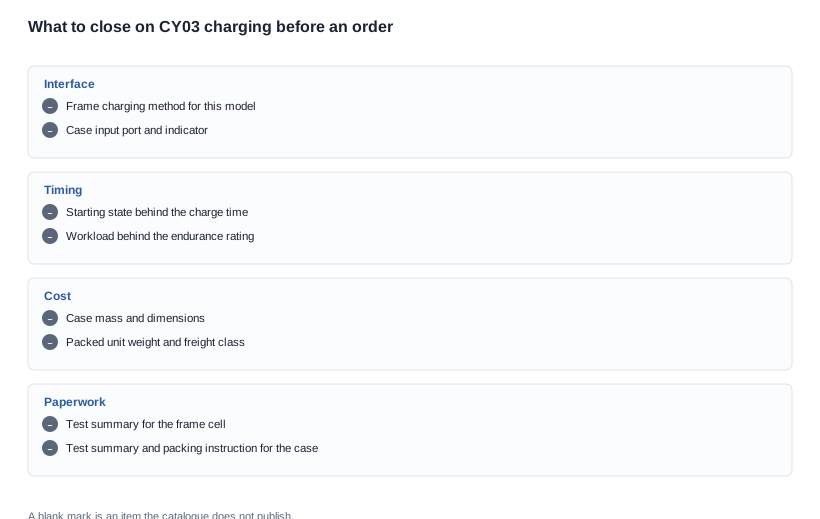
- The frame charging method and the connector. Request it in writing, naming the CY03 and the configuration. If the answer is that it varies by build, get the build reference recorded on the purchase order.
- The case input port and the case charge time. Both determine the in-box accessory set and the instruction artwork.
- The charging condition behind the two-hour ceiling. Ask for the starting state and the completion criterion, then record both.
- The workload behind the seven-hour rating. Ask whether the camera was running, and at what frame rate and resolution if it was.
- The case mass and dimensions, and the resulting packed unit weight. Measure these on a sample rather than requesting them in writing, because a measured figure settles the freight class and a stated figure only moves the uncertainty.
- The battery documentation for both cells, the declared watt-hour rating, and the packing instruction that covers the configuration as shipped.
- The freight class for the packed configuration, for each mode you intend to use. Ask for it with the measured weight in hand, not before.
- The certification position for this model in each destination market, including the treatment of the case as an accessory.
The criteria that separate a closed item from an open one are the same for all eight. A closed item has a document reference or a measured figure attached to it, and it is recorded against the purchase order. An open item has a verbal answer, a general capability statement, or a promise of a later update. Those are worth having as a starting point and worth nothing as evidence, and the difference is worth about two weeks of launch time on a European programme.
Two red flags are worth naming because they recur in this category. The first is a supplier who treats the absent charging-method row as a magnetic row by default, because magnetic is the majority case in the catalogue and the inference feels safe. It is not safe, and an interface assumption built on it surfaces in the packaging artwork stage at the most expensive possible moment. The second is a supplier who quotes a case weight for this model. We do not publish one, and a supplier that does is quoting a figure for a different model or a different revision. Ask which.
A note on how the case decision interacts with the rest of the range
The camera range does not treat the case consistently, and that is worth knowing before you build a private-label line across several of these models. The L1 Pro and the CY03, and the CY05 publish a 1400 mAh case. The L2 Utral publishes a 1400 mAh case and a 900 mAh option, and it charges its frame over Type C. The MT6 publishes a 1200 mAh foldable case and no charging method row at all. The KY06 and the MT5 carry a case whose capacity the catalogue does not publish. The S7 and the V03, and the V06 and the V03 Pro have no case row, and the catalogue prints nothing about the case for any of the four.
That spread is a real cost-model input. A brand running several of these models under one accessory programme has to treat the case as a per-model variable rather than a range-wide constant, which changes how the packaging is specified, how the freight is planned and how the customer instructions are written. It is also the reason a range decision should be taken against the published rows rather than against an assumption that a case is a feature of the camera category in general.
Where you want to compare the case economics across models, the CY03 smart glasses value analysis covers the commercial structure of a case-led proposition, and the CY03 versus MT6 positioning sets the two ends of the trade against each other.
The CY03 charging boundary and what we will not quote
The CY03's case is the strongest retail feature in the camera range and the heaviest parcel, and both facts come from the same cell — which means the buyer has to price it and merchandise it as one decision rather than two. We will publish the 1400 mAh capacity and the 290 mAh frame cell because they are documented. We will not describe the frame's charging method, because the catalogue carries no such row for this model and we would rather tell you that than borrow a neighbouring model's interface. We will not quote a case weight, a case dimension, a case interface, a case charge time, a packed unit weight or a certificate number that our documentation does not contain, and we will not present the roughly seven hours as a working day, because the test condition is not published and the case configuration changes the routine entirely.
The published CY03 specification list is the honest baseline, and the CY03 smart glasses charging case options piece sets out what a case decision does across the whole camera family. Send us the channel, the volume and the destination country, and we will tell you what the 1400 mAh case does to the delivered cost per unit once the packed weight is known.
Related reading
- The catalogue rows for this model — CY03 smart glasses specifications and features
- The cost side of the accessories — AI camera glasses charging case options
- The freight arithmetic — AI camera glasses shipping weight
Send us the channel, the volume and the destination country, and we will tell you what the 1400 mAh case does to the delivered cost per unit.


