

Every published hardware row of the CY05 and the CY03 is identical: an 8-megapixel camera, a 290 mAh cell, a charge time of two hours or less, a rated runtime of about seven hours, and a 1400 mAh charging case. If you are trying to position these two against each other on price, the honest conclusion is that the catalogue gives you no technical basis for doing it. Any price positioning between them has to be a commercial decision, and that decision has to be made on terms the catalogue does not publish.
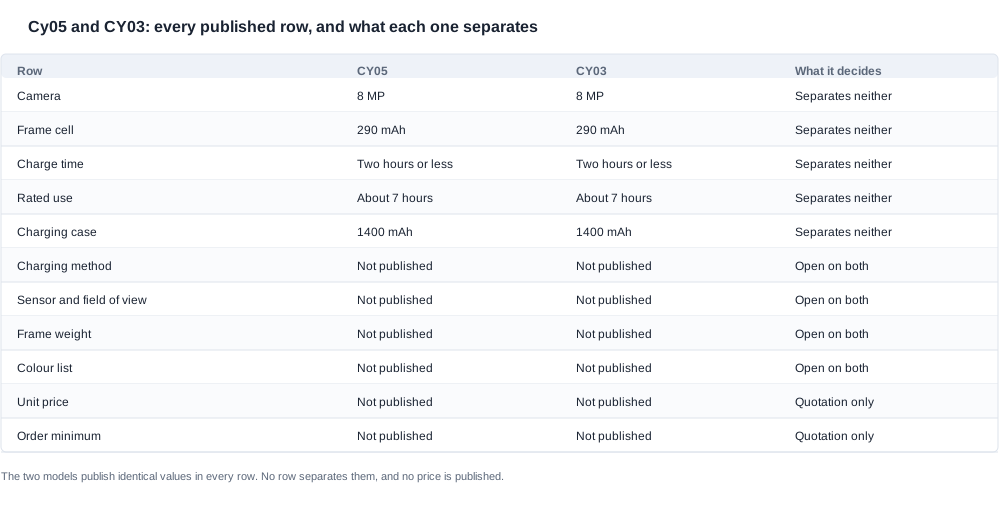
We publish no unit price, no quantity break, no order minimum and no lead time for either model, and we will not invent a price difference, a specification difference or a reason to prefer one. What this page sets out instead is the mechanism: what the identical rows actually mean commercially, which commercial terms carry a price difference when the hardware does not, and how to build a range ladder that a customer can understand without claiming something the documentation does not support.
Cy05 versus CY03 price positioning: why the catalogue cannot settle it
The reason the catalogue cannot settle a price question between these two models is not a gap that a better document would close. It is structural. Two models that publish the same five values have, by definition, the same cost structure at the level our documentation can see, and the same cost structure produces the same price unless something outside the specification differs.
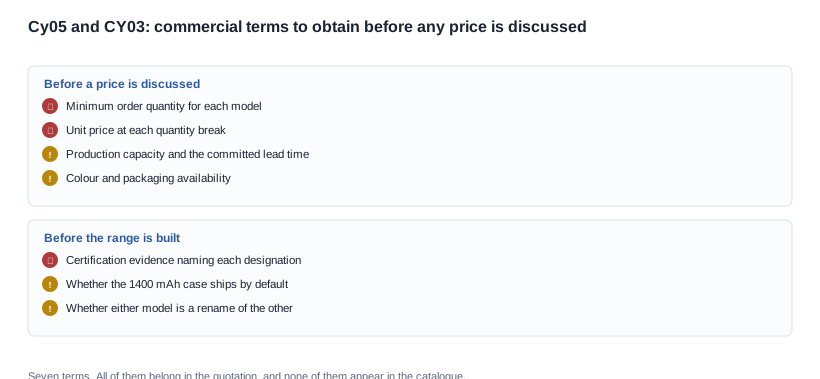
That outside something is a short list — the order minimum, the committed lead time, the production capacity, the colour and packaging availability, the certification status, and whether the case ships by default — and none of the six appears in the catalogue. So the answer to "why would one of these cost more than the other" is always one of those six, and the practical work of a buyer is to obtain all six for both models before any positioning is attempted.
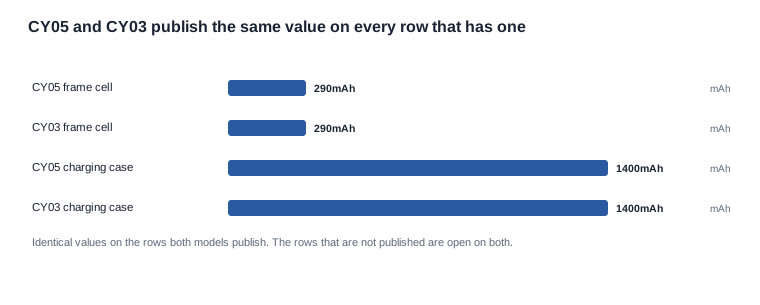
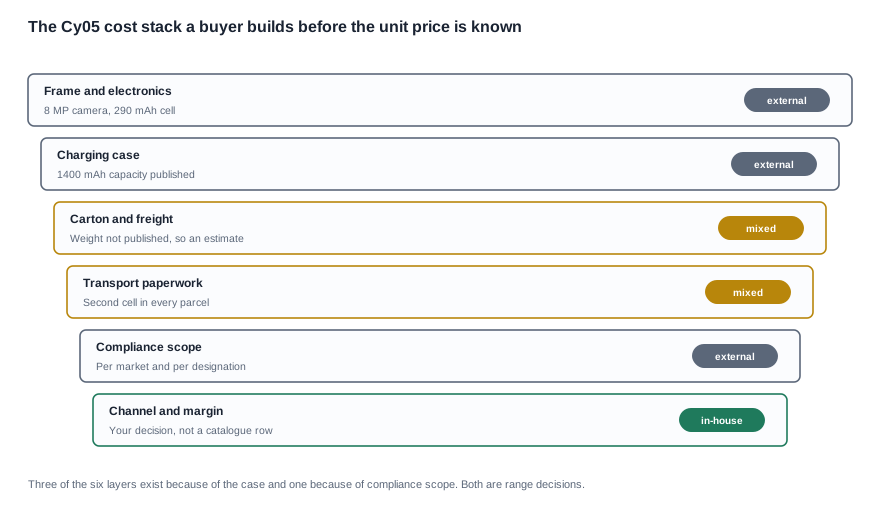
A note on what this page will not do. It will not label the two models as entry, mid or high price points, because that labelling is a price-tier claim and our catalogue publishes no prices. It will not tell you which one is better value. It will not quote a price difference. Everything below is about the structure of the decision, and the structure is what determines whether a range built on these two models holds together.
Three explanations for identical CY05 and CY03 rows
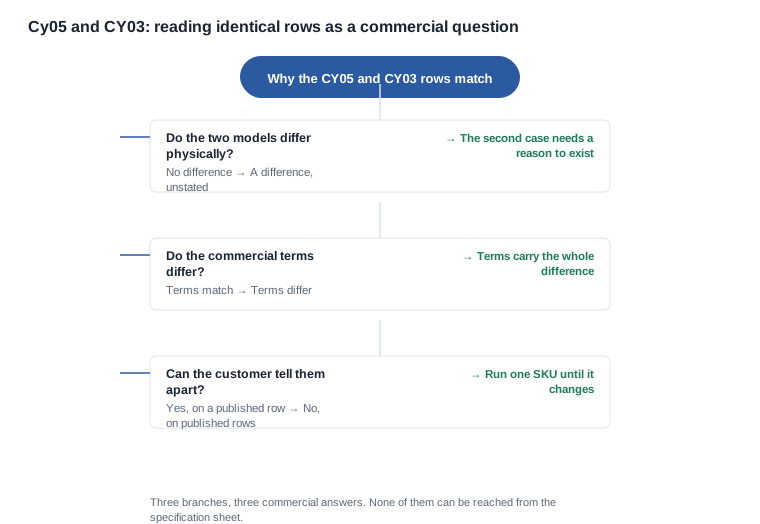
When two products are specification-identical in the source material, three explanations are possible, and the right response to each is different.
They are the same product under two designations. In this category that happens more often than buyers expect, particularly where a model has been renamed for a market or carried over from an earlier programme. If that is the case, building two stock-keeping units creates channel confusion and no differentiation. The right move is to ask directly, and to ask it in a way that gets a yes or a no rather than a description.
They are the same platform with a commercial difference. A different order minimum, a lead-time commitment, a colourway, a packing format or a supply arrangement would produce identical published rows. This is the most likely explanation of the three, and it is entirely legitimate — but it has to be established in writing rather than assumed, because a buyer who builds a range on an assumed commercial difference and then finds the terms are identical has wasted the packaging artwork.
A specification difference exists but was not published. Possible, and it has a specific consequence: your differentiation is currently invisible to anyone reading the data, including your own customers and your own sales team. A listing that differentiates two products on an unnamed feature is a listing that cannot answer a customer question, and it will be asked.

The commercial terms that actually move a price
These six terms are the whole of the price mechanism for a pair of models with identical hardware rows, and each one is worth obtaining in writing for both models rather than for one.
- The order minimum. Not published for either model. This is usually the single largest driver of the effective unit price, and it is frequently the real reason two otherwise identical products sit at different price points — a model with a lower order minimum costs more per unit at a given quantity.
- The production capacity and the committed lead time. Not published. A shorter committed lead time is worth real money to a channel buyer, because it is the difference between holding stock and replenishing against demand, and it is one of the most common foundations of a commercial tier.
- Colour and packaging availability. Not listed for either model in the catalogue rows. Whether a colour is already in production, whether the packaging is shared and whether a bespoke carton is possible are all commercial conditions rather than specification rows.
- The certification evidence status. No certificate number is published for either model, and our catalogue carries a company-level export certification page whose content is images rather than text with no mention of CE, FCC or RoHS anywhere in its text. If one model's documentation is complete and the other's is not, that difference is worth more than any specification, because it decides whether the product can be sold in a given market at all.
- Whether the 1400 mAh case ships by default. The case capacity is listed for both models. Whether the case is standard equipment, an option, or a separately quoted accessory is not stated, and it is the single largest physical line in the box.
- Whether one of the two is a rename of the other. Not published anywhere. It is the most consequential of the six because it determines whether a two-model range is possible at all.
Why these six and not the other rows
There is a reason this list contains commercial terms and not specification rows. A specification row that is identical on both models is, by definition, not a point of difference, so chasing it tells you nothing. A commercial term can be identical or it can differ, and the difference is where the price lives.
The practical method is to request all six for both models in one message and to ask for them as a table rather than as prose. A table of six terms and two models produces a page that any reviewer in the business can read, which a paragraph of supplier description does not. It also produces the awkwardness early: if the table comes back with identical entries, the two-model range has no basis, and that is much cheaper to discover in a spreadsheet than on a packaging proof.
Ask for the terms as the basis of a quotation rather than as a comparison exercise. A buyer who requests a comparison between two identical products gets an answer about whether they differ, and a buyer who requests a quotation for both models gets the actual commercial terms for both. The second framing is also the one a supplier is set up to answer, which means the reply comes back faster and in a usable format. Ask for the order minimum, the quantity breaks, the lead time, the certification scope and the case contents for each model, and let the quotation format carry the comparison for you.
Then negotiate against the terms rather than against the rows. There is no point pressing on a specification difference that does not exist, and every hour spent looking for one is an hour not spent on the order minimum or the certification scope, which are the two terms that actually decide whether the programme works.

Building a CY05 range ladder without inventing a specification
If you conclude that the two models are commercially distinct, position them on the axis that actually differs rather than inventing a technical one. The patterns that work are all commercial and all honest.
One becomes the volume model and the other the retail or documented model. The distinction is the order minimum, the lead time and the completeness of the paperwork that travels with the goods. It requires no specification claim at all.
One carries a fuller documentation pack for a regulated channel. This is a legitimate and increasingly common split, and it works particularly well in markets where the compliance file is the thing a channel buyer checks first.
One is held for faster replenishment. Where the supplier can commit a shorter lead time on one designation, that commitment is a real commercial asset and it is a sound reason for a customer to choose the other product.
None of those patterns requires a specification claim, and all of them are honest. The failure mode is subtler and worth naming: a channel that lists two products with near-identical bullet points and no stated reason to choose either is not building a range, it is fragmenting one.
What each answer to the identity question means for the range
The three explanations produce three different programmes, and a buyer who has not worked through all three before ordering tends to discover which one is true from the returns.
If the answer is that they are the same product under two designations, the programme is a single-model programme with a naming decision attached. Decide which designation goes to market, write it into the product file, and have the other one removed from the range plan before the artwork is started. The cost of leaving both in is a second set of packaging, a second listing, a second set of spare parts and a channel partner who will eventually ask why your two products are identical. The saving is that every remaining commercial term only has to be obtained once.
If the answer is a commercial difference, the programme is a genuine two-model range and the difference has to be written into the copy. That means the product pages have to lead on the difference, not on the shared rows, because a shopper reading two pages that say the same five things will choose on price and will do so in a marketplace where price comparison is automatic. The difference might be the order minimum, which is invisible to the shopper and therefore needs to be expressed as something they can act on — faster replenishment, a wider colour range, a fuller documentation pack for their market, or a different channel. If the commercial difference cannot be expressed in customer-visible terms, it is not a reason to run two models.
If the answer is that a specification difference exists but was not published, then the range is workable but the documentation is the problem. The remedy is to get the difference documented at model level, so that the specification sheets, the certification files and the listing copy all describe the same object. That is a paperwork task with a commercial deadline attached, because a range that cannot be described correctly is a range that generates misdeliveries and returns.

How to verify the answers before the ladder is built
There is a short verification routine here, and it is worth running because the answers to these questions are usually written in a way that sounds definitive and is not.
Tie every answer to a model designation. A reply that says the case ships by default, without naming the designation it applies to, has not answered the question. Ask again with the designation in the sentence. This single check catches more problems than any other step in a comparison of this kind, because suppliers habitually answer at the platform level when the question was asked at the model level.
Check whether the two answers are independently sourced. If both sets of terms come from the same sentence of the same document, they are one answer and not two, and the comparison has no second column.
Ask for the terms in a table. Prose answers hide equality; tables expose it. A table with two columns and six rows also makes the decision legible to people who were not in the meeting.
Confirm the certification position separately for each designation. This is the one term where an error is not commercially recoverable, because a document that names the CY03 does not automatically cover the CY05 even where the two publish identical rows, and market access is not something a buyer can fix after the goods have shipped.
Re-check the answers against a sample unit. Where a term has a physical consequence — the charging method, the case contents, the colour — the sample settles it faster than a second round of correspondence, and it settles it in a way that can be attached to the purchase order.
The sequence that keeps the ladder honest
The order of operations matters, because the packaging artwork is the expensive commitment and it is the point at which a two-model range becomes real.
First, ask whether the two are one product under two designations. A yes answer ends the discussion and saves the artwork revision.
Second, request the six commercial terms for both models in one message, as a table, with the answers tied to each model designation rather than to the family.
Third, compare the terms rather than the specification rows. The rows are identical and will stay identical; the terms are where the difference will be.
Fourth, assign each model a role — volume, retail or documented — and check that the role survives a change of supplier or a change of configuration.
Fifth, write the role into the customer-facing copy. If a customer cannot see a reason to choose one over the other, the range is not doing its job, and no amount of internal structure compensates for that.
If the commercial terms turn out to match as well, the honest answer is to run one SKU. That is not a failure of the product or of the range strategy; it is the range strategy working correctly on the evidence available.

Our Cy05 and CY03 position on the question
Identical published rows are a signal to ask a sharper question, not to assume a difference. Buyers who build a price ladder on two identical products without establishing the commercial basis are the ones who end up with unsold inventory in a channel, because the ladder has no rung that a customer can see.
We will not invent a price difference, a specification difference or a reason to prefer one model. If asked which is better value, our answer is that the published data does not support the question, and that the six commercial terms above are what would settle it. We publish no unit price, no quantity break, no order minimum and no lead time for either model, and we will not quote a typical figure for any of them, because a typical figure a buyer cannot verify is worse than no figure at all.
We will also say plainly what the rest of the range does publish, because it is often the more useful comparison. The L1 Pro and the L2 Utral sit on the same 290 mAh platform at 13 megapixels, the L2 Utral publishes a Type-C interface and a second case capacity at 900 mAh, and the MT6 publishes a folding 1200 mAh case and the only frame weight in the range. The range selection guide sets out how those axes combine, and the published CY05 specification list is the row-level reference for this model.
The criteria to apply before you order
A buyer who wants to know how to evaluate the replies should set the criteria down first, because a reply that arrives without criteria attached is usually accepted on its tone rather than on its content. These are the questions to ask, and the standard each answer has to meet.
- How to evaluate the identity answer: it must state whether the two designations are one product or two, and it must name the document or the source the statement comes from.
- How to evaluate the order minimum answer: it must be a number per model, not a range for the family, and it must say whether it differs between the two.
- How to evaluate the lead time answer: it must state a committed figure rather than a typical one, and it must say what the commitment is conditional on.
- How to evaluate the certification answer: it must name the market, the document and the model designations covered, because the point of the question is whether both are covered.
- How to evaluate the case contents answer: it must say whether the 1400 mAh case is standard equipment and whether the frame can be charged without it.
The red flags to watch for are simple and worth naming: a family-level answer to a model-level question, a figure with no date, a lead time expressed as an average, and a certification document that names one designation when the range needs two. When you evaluate a reply against a written criterion, you can show the reasoning to a colleague; when you evaluate it against an impression, you cannot.
Tell us your target volume, market and required configuration, and we will tell you what separates these two commercially or confirm that nothing does. Either answer is useful; a manufactured one is not.
Related reading
- The camera range both models belong to — AI camera glasses
- Why a good-better-best range needs real axes — selecting smart glasses by market
- What to request when comparing identical models — OEM ready platforms
Share the target market, the quantity and the required configuration, and we will come back with what is available and what is not.


