
The CY05 smart glasses publish five specification rows and one structural fact: 8 megapixels, a 290 mAh frame cell, a charge time of two hours or less, a rated runtime of about seven hours, and a 1400 mAh charging case. The structural fact is that a 1400 mAh case is the accessory this model ships with, and the fact that the CY05 publishes exactly the same specification as the CY03 is the first item a buyer should resolve.
The second half of the page deals with the other half of the question, which is features. The camera glasses family is described in terms of first-person capture, an AI voice assistant and real-time translation, and none of that language is tied to a per-model row anywhere in our catalogue. Features that are named rather than specified are the most common source of a product page that cannot be defended, and the CY05 is a good example of why.
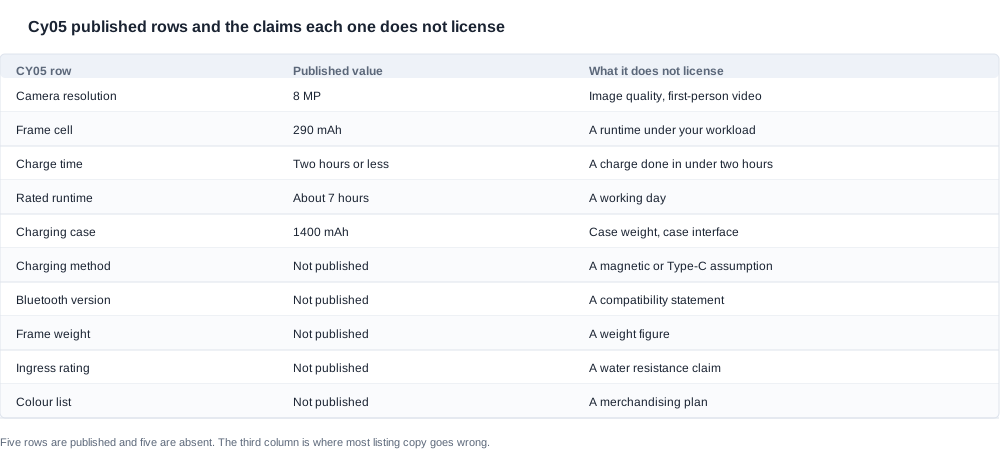
The table above is the working version of this page. Read it as a permissions list: each published row licenses a specific claim and forbids several others, and most listing copy goes wrong because a row is used to support a claim it does not cover.
The CY05 published rows, read one at a time
8 MP camera resolution. This is a resolution tier, not an image quality statement. The sensor model, the field of view, the video format, the frame rate and the low-light behaviour are not published for this model, and without the field of view you cannot tell whether the product suits first-person video or only stills. Ask for all of them in writing, and treat the resolution figure as the only camera claim that is available today.
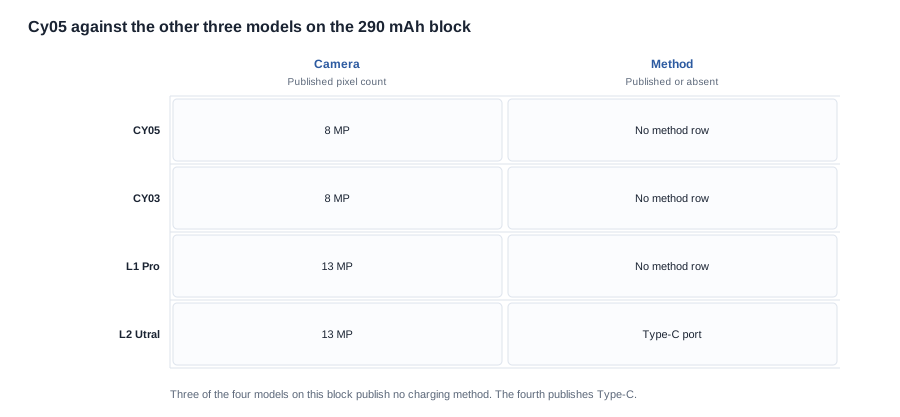
290 mAh frame cell. This is the largest cell in the camera group, shared with the CY03 and the L1 Pro, and the L2 Utral. The V03 Pro and the MT5, and the V03 sit at 220 mAh, the V06 and the S7, and the KY06 — each at 260 mAh, and the MT6 at 265 mAh. On the KY06's 260 mAh the difference is roughly twelve per cent, which is a real difference in the battery and a rounding error in the product. The cell decides the energy budget; it does not decide the runtime.
Charge time of two hours or less. Stated as a ceiling, and a ceiling is worth keeping as one. The starting state is not specified, and that is the standard ambiguity in any charge-time figure: full to empty is the normal reading, and empty to usable is a different number and the one that matters if a customer charges the product overnight. Write it as two hours or less rather than as under two hours, because a ceiling permits exactly two hours and the stricter phrasing does not.
Rated runtime of about seven hours. A rated figure with no published test condition. On a camera product the camera is the dominant load, so this number cannot be compared against the audio models' endurance figures and should not sit beside them in a single table. Our method for comparing battery life covers why, and the CY05 battery life analysis takes this model in more detail.
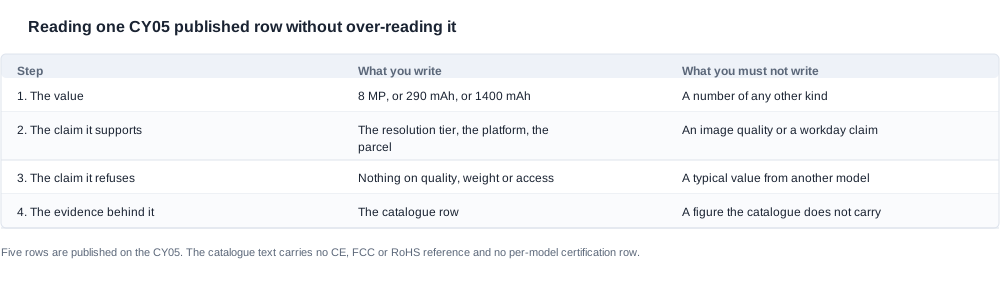
1400 mAh charging case. The largest published case capacity in the range, shared with the CY03 and the L1 Pro, and one of two options on the L2 Utral. It is the single feature that most distinguishes this product commercially, and it carries the most operational cost: a second battery in the parcel, a heavier carton, a different freight class and a battery transport document. The charging case options breakdown covers the commercial side.
The two rows that are absent and that buyers assume are present
Two absences catch people out often enough to be worth naming in detail, because both are rows that the rest of the catalogue makes you expect.
The charging method. The CY05 catalogue entry publishes a pixel row, a cell capacity, a charge time, a runtime and a charging case capacity. It publishes no charging method row. Across our catalogue, seventeen models publish magnetic charging and seven publish a Type-C interface; four publish nothing, and the CY05 is one of those four alongside the CY03 and the MT6, and the L1 Pro.
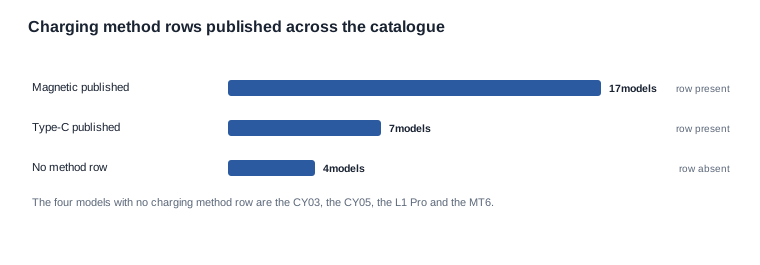
That absence has a concrete consequence. If the frame charges magnetically, the box needs a dock or a pad and the customer has to learn a charging orientation; if it charges over Type-C, a lost cable is replaceable anywhere and the parcel carries no proprietary accessory. A product page, an accessory list and an instruction card all depend on which one it is, and none of them can be finalised on the assumption.
The Bluetooth version. The camera models in our catalogue publish no radio version at all, and the CY05 is no exception. A row of "Bluetooth 5.x" on a camera-glasses specification sheet is a common sight and it is almost always unsourced. It matters because a radio version is what a compatibility statement, a pairing instruction and a support script are built from, and a buyer who has to source those three documents from the supplier instead of transcribing them has turned a day's work into a lead-time item.
Named but not specified: the CY05 feature language
Our camera-glasses family is described in terms of first-person content creation — short video, live streaming, daily capture, hands-free calling, meeting notes and real-time translation — and an AI voice assistant is listed as a family capability. These are use cases. What is not published is whether the translation runs on the device or in the cloud, which languages are supported, whether a subscription is involved, and where any data is processed. The AI feature notes set out the four questions to ask before an AI label goes on a product page.
Why the distinction matters commercially rather than legally. A device that translates on the handset works in a shop, on a site visit and in a market with no connectivity for the consumer, because the translation happens on the device. A device that translates through a cloud service needs a network, which changes who can use it and where. For a brand selling into a market with patchy coverage, or selling a product to corporate buyers who will ask whether content leaves the device, that difference is the whole feature. It is also the difference between a feature you can put on a product page and a feature you can only describe.
The same caution applies to the assistant. An assistant that runs in the cloud is a different product from one that runs on the device, and only one of the two works without a network connection. Neither behaviour is published for the CY05, and the question is answered in one sentence of a written request.
And the family description is not a per-model warranty. Our catalogue describes the camera-glasses family in those terms and does not tie each of them to the CY05 individually. A buyer who reads the family description as a per-model feature list will end up with a listing that promises capability no document supports, and the exposure arrives as a returns argument rather than as a complaint at the factory.
How the feature language behaves in a channel
The practical difference between a named feature and a specified one only appears when a customer uses the product. That is why the gap matters at the specification stage rather than at the quality stage.
Take a translation claim as the case. A customer in a market where the phone has no data plan tries the feature and it fails, because the translation ran somewhere the customer's phone could not reach. Nothing on the specification sheet was wrong; the specification sheet simply did not say which kind of translation was on offer. The return arrives at the channel partner, the channel partner asks the brand, and the brand asks the factory a question that was never part of the original scope. A feature that had been scoped precisely would have avoided that entire chain.
The same applies to the assistant and to live streaming. Both are named in the family description, and neither is tied to a per-model row for the CY05. Whether the streaming runs over the phone's connection or the glasses' own radio is not published for this model, and that single fact decides whether a customer in a covered area gets a working feature and a customer in an uncovered area gets an error message.
The procurement answer is to ask for the deployment, not for the name. Three questions cover it: does the function run on the device or on the phone, what network does it need, and what happens when that network is not available. A supplier who answers those three has given you enough to write the claim, the instruction card and the support script. A supplier who answers with the feature name has given you nothing that can be put on a listing.
Turning the row set into a procurement specification
Once the rows are understood, the next step is to convert them into a document a supplier can quote against, and the conversion is mostly a matter of discipline about what a row licenses.
Take each published CY05 row and write it as a specification line with three parts: the value, the condition, and the verification method. The frame cell becomes "290 mAh, as the published cell capacity, verified against the supplier's own bill of materials line". The charge time becomes "two hours or less, from the stated starting state, verified on the sample unit". The runtime becomes "about seven hours under the workload defined in the acceptance criteria, measured over one full shift". The case becomes "1400 mAh, as the published case capacity, verified on the delivered unit".
The three parts matter individually. The value is what the supplier commits to. The condition is what stops two parties reading the same number differently, which is the single most common dispute on a rated figure. The verification method is what lets a quality team accept or reject a shipment without a negotiation, and it is what converts a catalogue row into a contractual acceptance criterion.
The lines that cannot be written this way should be recorded as open, not as assumed. That means the charging method, the frame weight, the colour list, the case interface, the sensor specification and the endurance condition all appear on the specification sheet as named open items with an owner and a date, rather than disappearing or being filled with a plausible value. A specification sheet with six honest open lines is a document a supplier can quote against. A specification sheet with six invented values is a document that fails at the first inspection, and the failure is attributed to the buyer who wrote it.
The CY05 rows that are absent, and what each one blocks
Working through the remaining absences by consequence rather than by order, the register is short and each item has a named milestone it holds up.
| CY05 row | Published or not | The milestone it blocks |
|---|---|---|
| Sensor model | Not published | Any first-person video claim |
| Field of view | Not published | The decision to use the product for video |
| Video format and frame rate | Not published | Storage sizing and file handling |
| Frame weight | Not published | Sizing range, freight class, returns rate |
| Frame dimensions and temple length | Not published | Size range for optical channel distribution |
| Ingress protection rating | Not published | Any outdoor or all-weather positioning |
| Colour list | Not published | Packaging artwork and merchandising |
| Case weight and dimensions | Not published | Parcel cost and the carton specification |
| Case charging interface | Not published | The accessory set and the in-box cable |
| Endurance test condition | Not published | Any working-day statement |
| Bluetooth version | Not published | Compatibility and pairing documentation |
| Certification per model | Not published | Market access in each destination market |
The weight row deserves a note of its own, because it is the one most often filled in from elsewhere. The only frame weight our catalogue publishes anywhere is 158 g, and it belongs to the MT6: the glasses body including its battery and camera, excluding its folding charging case. The CY05 carries a 290 mAh cell and a 1400 mAh case that the MT6 does not have in the same form, so the MT6's figure is not a proxy for this model and should not appear on a CY05 specification sheet. The MT6 specification list covers what that published weight does and does not tell you.
The CY03 identity question sitting underneath the CY05 sheet
The CY05 and the CY03 publish identical specifications — 8 megapixels, 290 mAh, two hours or less, about seven hours and a 1400 mAh case — and our catalogue does not state what distinguishes them. Possibilities include a colourway, a lens, a packaging tier or a firmware branch, but none of them is documented, and until one of them is, ordering both is a way to end up with two thin lines and a customer who cannot tell them apart either.
There is a compliance dimension to this that is easy to overlook. A document that names the CY03 does not automatically cover the CY05, even where the two publish identical rows, and the CY05 has no per-model certification row of its own anywhere in our documentation. So the duplication is not only a merchandising problem; it is a question about which model designations the paperwork actually names.
Get the difference answered before the first purchase order, and treat the answer as the foundation of the range structure rather than as a detail to be confirmed later. The CY05 versus CY03 price positioning analysis covers the commercial consequences of each possible answer, and the CY05 limitations analysis sets out the same gap as a register of blocked decisions.
What we will publish on a CY05 product page
We publish the five rows that exist, and we publish them with the qualifier that belongs to each one. The 8 megapixels appears as a resolution tier. The 290 mAh appears as a cell capacity. The charge time appears as two hours or less, as a ceiling. The about seven hours appears as a rated figure. The 1400 mAh appears as the charging case capacity.
We will not present the 8 MP as a picture quality claim, because the sensor model and the field of view are not in our documentation. We will not present the seven hours as a working day. We will not claim an ingress rating that is not in the source — our catalogue publishes an IP54 marking on the V06 and the S7 only, and nothing for the CY05. We will not present the translation and assistant features as verified capabilities for this model, because they are described at the family level and are not tied to a per-model row. And we will not fill an unpublished row with a typical value from another model in the range.
The method behind those refusals is straightforward, and it is worth spelling out because it is reusable on any model in this catalogue. Take one published row and write what it states, in the supplier's own terms. Then write the claim it will support in a customer-facing listing. Then write the claim it will not support under any wording. Then delete every claim with no published row or sample evidence behind it, and attach the sample evidence that is permitted for the ones that survive. That procedure is what turns a catalogue into a specification sheet that a quality team can accept and a channel partner can rely on.
Six questions to close before the first order
These are the questions to ask, in the order a procurement team should ask them. Each one is attached to a milestone, so the answer arrives in time to be used rather than in time to be interesting.
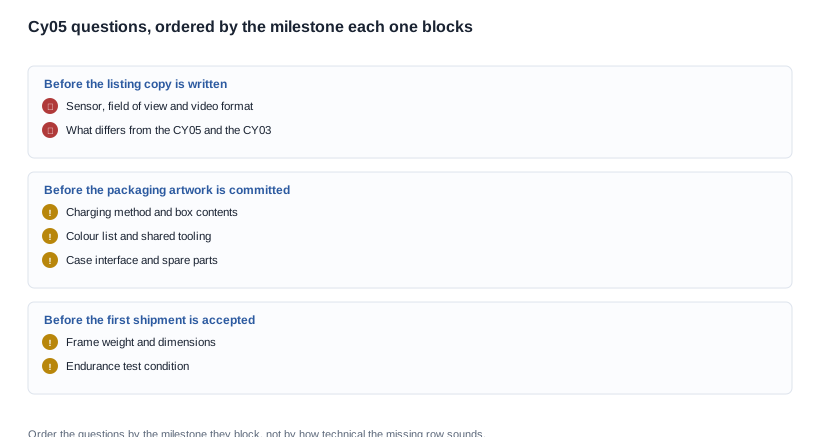
- What sensor, what field of view, what video format and what frame rate does the CY05 publish? This is the question that decides whether the product can be marketed for first-person video, and it is the one with the longest tail into the listing copy.
- What does the seven-hour endurance figure measure — camera active or not, radio connected or not, and from what starting state? Without the condition the number cannot be repeated in a specification without a dispute.
- What is the frame weight in grams, with the battery fitted and the case excluded? The 158 g figure belongs to the MT6 and cannot be substituted.
- How is the frame charged, and does the case charge it? This determines the box contents, the accessory list and the in-box cable.
- What colours exist, and is the tooling shared with the CY03? This determines the artwork, and it is where the range question becomes concrete.
- Which model designations appear on the certification file, for each destination market? A file that names the CY03 does not automatically cover the CY05.
A buyer who wants to know how to evaluate the replies should set the criteria before the answers arrive: which model each figure applies to, which configuration it was measured on, what it excludes, and whether the answer is a measurement or a description. Those four criteria turn a reply into evidence and separate it from a family-level statement, and the CY05 limitations analysis sets out the same register as blocked decisions with a closure route for each one.

Send us the target market, the expected volume and the channel, and we will tell you which configuration makes sense for it and which figures remain unpublished. The AI camera glasses buying guide covers the category-level questions, and the certification status for the camera range covers the paperwork that has to travel with the goods.
Related reading
- The platform this model shares — CY03 smart glasses best for
- Building a tiered camera range — AI camera glasses which model to pick
- The gap register behind this page — CY05 smart glasses limitations
Send us the target market, the expected volume and the price band, and we will tell you which configuration makes sense and which figures remain unpublished.


