

The D12 smart glasses battery life question is narrower than it sounds, because the D12 publishes very little: Bluetooth V5.4, a 100 mAh cell, a charge time of two hours or less, about seven hours of rated use, Type-C charging, and no feature lines at all. There is no surround-sound row on this model, no charging case row, no weight, no acoustic figure, no microphone specification, no cycle life and no test condition for the seven-hour figure. What that leaves is a single power architecture and a single endurance claim, and the whole commercial question is whether that one claim can be used in a listing, in a channel forecast, in a shift plan and in a support script. In our view it can carry a rated statement and a procurement decision, and it cannot carry a working-day statement, an all-day statement or a comparison against another model, because none of those is supported by a figure whose conditions are unpublished. This page is written for the buyer who has to decide what to print and what to test, and it is deliberately narrow: one model, four published rows, and the protocol that turns an unproven figure into a defensible one.
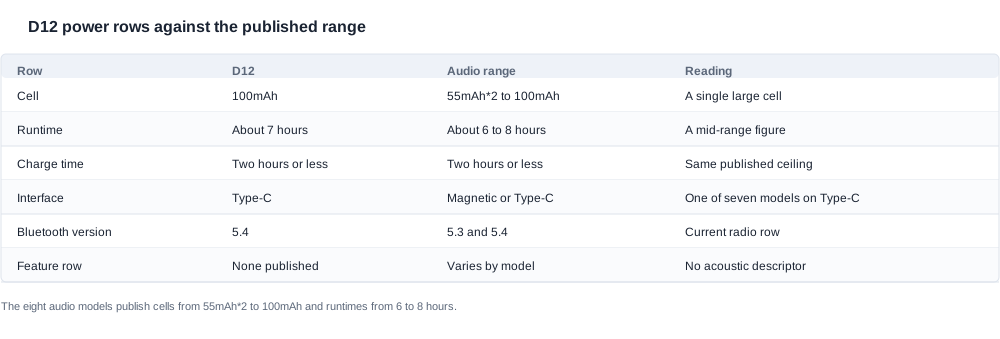
D12 endurance: what the published row supports
The published rows, read exactly
The D12's page carries five standard rows and nothing else. Bluetooth version 5.4. Cell 100 mAh, a single cell. Charge time two hours or less. Rated use about seven hours. Charging interface Type-C. There is no feature line, which places the D12 among the few models in the audio range with nothing on that line, and there is no charging case row, so what ships in the box is a quotation item rather than a specification.
Two of those five rows carry a precision that has to be respected. The charge time is a ceiling. Two hours or less allows a two-hour charge and the catalogue does not publish the start state, the end point, the charger or the temperature that produced the figure. The seven hours is a rated figure, and no workload, volume level or connection state is published alongside it.
Where the D12 sits against the published range
The D12 is not a weak model and it is not a strong one in any way the catalogue can demonstrate. Structurally, it shares its single-cell Type-C architecture with the D11, which publishes the same 100 mAh cell, the same Type-C interface, the same charge-time ceiling and the same rated runtime, and which does carry a surround-sound line and a long-battery-life line. Elsewhere in the audio range, the figures move from about six hours on the G07 and the YK12 to about eight hours on the LC-105-1 and the K02, and the LC-105-2 and the K01, and the cells move from 55mAh2 to 90mAh2 to 100 mAh.
The pattern across that range is the important one. The largest single cell does not publish the longest runtime, and paired cells of 55 mAh publish both six hours and eight hours depending on the model. So the endurance figure in this category is not a function of capacity, which means a buyer cannot rank models on it and a channel cannot promise a working day from it.
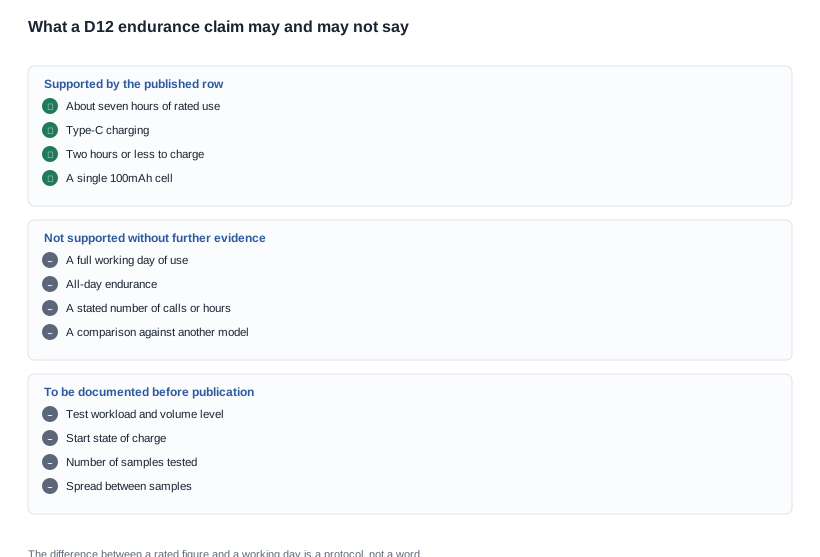
The three claims the figure supports
A rated statement. The catalogue rates the D12 at about seven hours of use. That is true, quotable with attribution, and the foundation of a listing sentence.
A procurement statement. A single 100 mAh cell with about seven hours of rated use and a Type-C interface is a product for a customer who charges regularly, in a workflow where an exhausted device is an inconvenience rather than a failure. That is a real commercial statement about who the product suits.
A planning statement. A charge time of two hours or less means an overnight charge is sufficient, and that the charging moment can be scheduled rather than squeezed into a break.
The four claims it does not support
A working-day claim. About seven hours is not a working day unless the working day is seven hours, and the catalogue does not say how the figure was measured.
An all-day claim. The word all-day is a stronger claim than the published figure carries, and it is a claim that a customer will test in the worst possible conditions, which is exactly where a rated figure is least reliable.
A comparison against another model. The G07 and the YK12 publish the same 55mAh*2 cells as the LC-105 pair and about six hours against about eight, so a comparison made without a common workload is a comparison of test methods rather than of products.
A second-day claim. Nothing in the published rows supports a product that works away from a socket for more than a shift, and no charging case row exists for the D12, so the accessory that would make such a claim possible is not documented either.
Why about seven hours is a rating and not a working day
The difference between a measurement and a condition
A rating tells a buyer what the manufacturer publishes. A working day is a claim about a customer in a specific environment with a specific workload, and the two differ by the conditions that separate them. Three conditions are missing from the published row, and each one changes the result.
The workload. Whether the product runs continuous audio at a high volume or at a moderate level, with one connected device or several, changes how much the power path draws. The catalogue does not publish the level, and a level is the single most important number in an endurance figure.
The connection state. A product that is paired to several devices, or that is repeatedly reconnecting, does more work than one that is stable for the whole period. The published figure does not say how many connections it carried.
The temperature. A lithium cell in a cold environment delivers less current and charges more slowly, and a working environment is not a laboratory.
The age of the cell. The seven hours describes a new cell under a test condition. A cell at the end of its service life delivers less, and no cycle life is published, so the buyer cannot model the degradation curve.
Why the difference matters commercially
A channel that prints "about seven hours" and a channel that prints "all-day battery" are making different promises with the same evidence. The first is supportable, and it can be defended in a complaint because it points at a published row. The second is a promise the catalogue cannot back, and it will be tested by customers in the conditions least favourable to the product.
The commercial cost of overreaching is not only the refund. It is the return rate, the review rating, the support load and, in a channel that has to keep a marketplace account healthy, the listing that gets taken down. The discipline that prevents it is simple: attribute the figure, attach the condition, and keep the comparison out of the copy.
A useful way to frame the internal decision
For an internal planning document rather than a public listing, the seven-hour figure is more useful than it looks, provided it is used as a design input rather than a promise. A shift plan built on about seven hours of rated use with a charge at the break is a reasonable plan. A shift plan built on about seven hours with no charge anywhere in the shift is a plan that will generate returns. The figure belongs in the shift plan with the assumption written next to it, so that when the sample measurements come back, the plan can be corrected rather than defended.
The acceptance protocol for a D12 battery claim
The six steps, and why each one is there

- Fix the workload before the test. Volume level, content, number of connected devices, and whether the product runs continuously or intermittently. Written down before the units are charged, because a workload chosen after seeing the results is not a workload.
- Start every unit from the same state. The same state of charge, confirmed the same way for every unit, because a charge-time figure measured from different starting points is not comparable.
- Run to shutdown. Not to a warning light, and not to a cut-off chosen by the tester. The elapsed time is the result.
- Repeat across every unit in the delivery. Not on a single unit, and not on a unit kept at the office. The spread between units is the acceptance band, and a single unit cannot show a spread.
- Log the charge time from the same start state. This is the step that turns the two-hour ceiling into a measurement, and it is the step most often skipped because the charger is at hand and the answer seems obvious.
- Record the result as a range, and publish the claim with the workload attached. A range with a condition is a defensible statement. A single number without either is not.
A five-day acceptance schedule
The protocol above does not need to take long, and the schedule below is the one we suggest, counted in working days from the day the shipment is received.
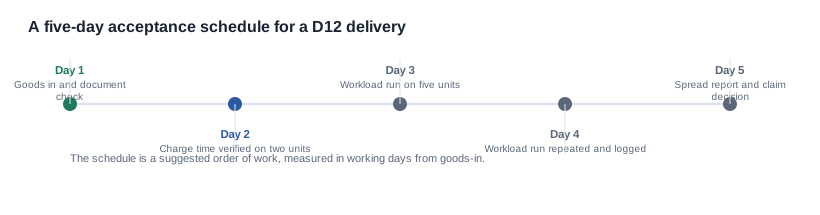
Day one is goods in and the document check, because a battery claim on a shipment with the wrong paperwork is worthless. Day two is the charge-time verification on two units, which is a quick job and which tells the buyer immediately whether the two-hour ceiling holds in their own conditions. Days three and four are the workload runs, repeated, because that is where the spread appears. Day five is the spread report and the decision on what the claim will say.
What the protocol produces
Three outputs, and each of them is a document rather than an opinion. First, a measured runtime under a stated workload, with a range. Second, a measured charge time from a stated start state, with a range. Third, a recommendation on the wording the channel can use, with the condition attached.
That third output is the one that saves the most money, because it replaces an argument about wording with a piece of evidence. When a buyer can say "in our measurement, under a workload of X, the D12 ran between A and B hours from a full charge, and the charge took between C and D hours", nobody has to argue about whether "all-day" is defensible.
A single cell in the working day
The architecture and what it obliges
The D12's single 100 mAh cell is a simple pack with a simple consequence. Because there is one cell, the pack has one ageing characteristic, which is easier to model over a product life. Because it is a single cell, the charge current is what one cell accepts, and the charge time of two hours or less is the figure the catalogue publishes.
What the single cell also means is that there is no second cell to carry the product through a second period. The models in the range that publish about eight hours do so with paired cells, and the models that publish about six hours do so with paired cells as well. There is no other model in the audio range with a single 100 mAh cell and a longer published runtime than the D12's about seven hours, so the D12 sits at the top of what a single cell in this range publishes, which is a reasonable place for it to sit and is worth saying plainly to a buyer who is weighing it against a paired-cell model.
The charging routine the Type-C interface creates
Type-C charging means the customer supplies the cable, which means the accessory content of the parcel can be minimal, which means the parcel cost and the freight class are as low as this category gets. It also means the charging moment is a visible act that happens near a socket or a power bank, and it means the customer has to find the port on the frame.
For a channel, the routine produces three commercial items: a decision about whether a cable ships in the box, a quick-start page with a diagram, and a support script for the customer who charged it for an hour and the battery did not move. That last one is answered by the protocol above rather than by a script, because a charge that does not move is a fault, and a fault rate is a measurable acceptance criterion.
What no charging case changes
No charging case row is published for the D12. The catalogue publishes a case capacity for several camera models, and for a group of camera models it publishes a case row with no capacity, and for a small number of camera models it publishes no case row at all. For the audio models, no case capacity is published. So a buyer who wants a D12 with a case has to request the case configuration in writing, and a buyer who wants a D12 that works for two days has to request the accessory that would make it possible, because the published rows do not describe one.

What a buyer should ask the supplier to send
The request list for the D12, in the order it works
The request is short, and it is the same list a buyer would send for any model in this range, which is itself a point worth making: because the catalogue publishes so little, the supplier's written answers carry most of the specification.
- The runtime workload, volume level, number of connected devices and start state behind the published figure.
- The measured runtime range across the units supplied.
- The charge time from a stated start state, with the end-point definition and the charger used.
- The cell specification, the cycle life and the behaviour at end of life.
- The acoustic configuration, including whether the product has a documented sound configuration, since the D12 publishes no feature line and the absence of a line is not a description.
- The measured frame weight and the packed weight.
- The exact box contents, including whether a cable is supplied.
- The file that names the D12 under its exact model designation for the target market.
The acceptance rule, and the three failures it catches
An answer is accepted when another buyer could ask the same question, get the same answer and reach the same conclusion. That rule catches three failures. A figure without a method fails, because the next shipment may differ. A method without a figure fails, because it cannot be published. And a statement that a document exists fails, because what closes the row is the document itself, not a description of it.
How to choose where the figure may be used
The published number has several legitimate uses and one illegitimate one, and separating them is a criteria question rather than a wording question. It is legitimate to use the about-seven-hour figure in an internal shift plan, provided the assumption is written next to it. It is legitimate to use it in a listing sentence that attributes it to the catalogue. It is legitimate to use it as the basis for a sample acceptance test, since the test exists to replace the rated figure with a measured one. It is legitimate to use it in a total cost calculation, because the charging routine and the accessory content are what the cost really depends on.
It is not legitimate to use it to promise a working day, to promise a whole shift with no charging opportunity, to rank the D12 against another model in published copy, or to state a charge time as a typical figure when the published row is a ceiling. The trade-offs a buyer has to weigh are short: a claim that is stronger sells better in the short term and costs more in returns, while a rated statement is duller and defensible, and the difference between the two is usually smaller than the cost of a batch of returns.
The red flags to watch for in draft copy are familiar. Any sentence with the word "all-day". Any sentence that puts a number next to the word "working". Any sentence that compares two models on runtime. Any sentence that mentions a charging case for the D12, whose configuration is not published. When a reviewer sees one of those, the question to ask is which published row supports it, and if there is no answer, the sentence does not go on the page.
The documentation question that has to be asked early
One export certification page in our catalogue sits at company level and shows pictures rather than typed words; the catalogue text names no CE, FCC or RoHS. There is no per-model certification row anywhere, and that page lists ten patent certificates — eight appearance designs and two utility models — which is a statement about the company rather than about the D12. So market access has to start with a document request, and the request has to name the exact model designation, because a file that covers one designation does not automatically cover a sibling with the same specification. The certification status for this model covers the distinction in full, and the range certification discussion covers how the same question is handled across the audio family.
What the D12 rows settle, and what a buyer still has to obtain
We publish the electrical rows for every model in the range. For the D12 that means Bluetooth V5.4, a 100 mAh cell, a charge time of two hours or less, about seven hours of rated use and Type-C charging. We do not publish a price, a minimum quantity, a delivery schedule, a warranty term or a production capacity figure, so we cannot tell a buyer whether the D12 represents good value, and we will not describe it as the longest-running model in the range, because the published rows show the opposite in several places. We do not publish a frame weight for the D12, so no claim about how it feels over a long shift is available from this page. We do not publish an acoustic description for the D12, and we will not borrow one from a sibling model, because the absence of a feature line is a fact about the page and not about the hardware.
We will do the part that matters. Send us the quantity, the target market, the working period the product has to cover and the workload the customer will actually generate, and we will tell you which published rows already answer the question, which need a written answer from the supplier, and what an acceptance protocol would look like for the D12 in that specific situation. We will also tell you where the published figure is enough and where it is not, because a buyer who knows that the seven-hour figure supports a rated statement but not a working-day statement can make a sound commercial decision without anyone inventing a number. That distinction is the entire content of the D12 smart glasses battery life question, and it is the same distinction we draw for every model we list.


