

Certification is the part of a Bluetooth audio glasses programme that buyers most often approach as a checklist and most often mishandle as an inference. The mishandling has a specific shape: a company-level export certification page is read as though it were a per-model conformity assessment, and a product claim is built on it. This article starts from what our catalogue actually contains — which is a company-level export certification page whose content is images rather than text, no per-model certification row anywhere, and no reference to CE, FCC or RoHS in the catalogue text at all — and then sets out the documents a buyer has to request in writing, the two separate EU instruments that are routinely confused with each other, and the way to read a supplier's answer without inheriting their assumptions.
Bluetooth audio glasses certification: what our catalogue actually publishes
Being precise about this is the whole point of the article, so it is worth stating the facts one at a time, in the order a buyer is likely to need them.
Our catalogue carries an export certification page. It is a company-level page, not a per-model page, and its content is presented as images rather than as extractable text. What appears on it is a set of ten patent certificates — appearance-design patents and utility-model patents covering the designs we build. That is what the page is. It is not a conformity assessment, it is not a product certificate, and it does not identify a model.
The catalogue text contains no reference to CE, FCC, RoHS, REACH, UKCA, the Radio Equipment Directive, the EMC Directive or the General Product Safety Regulation. We checked the full text layer of the catalogue and those references are absent, not merely sparse. There is no place in the document where a buyer can read a conformity claim for the LC-105-2 and the G07, the K01 and the D11, the LC-105-1 and the K02, and the D12 or the YK12.
There is no per-model certification row. Not one model in the catalogue publishes a certification entry, a test report number, a certificate number or a status field that says pending. The absence is uniform across all twenty-eight models, which is what makes it safe to describe as a catalogue-level boundary rather than as an oversight in one place.
The UN 38.3 test summary is not published. Every product in this range contains a lithium cell, and every product that travels by air or by sea needs a transport file. Our catalogue does not publish it, so it has to be requested in writing from whoever built the configuration, and it has to be checked against the cell part number that will actually be in the unit.
What this means in practice. Every certification item in a Bluetooth audio glasses order is a document request, and the buyer's task is to ask for the documents rather than to look up a claim. That is not a disadvantage. It puts the two suppliers on the same footing from the first question, because a company-level page is something every factory has and a per-model file is something only a factory that has actually assembled the product can produce.
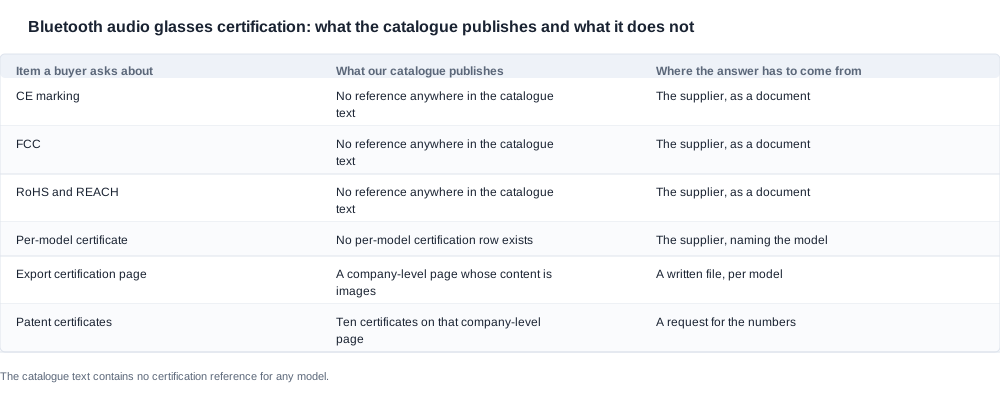
| Item a buyer asks about | What our catalogue publishes | Where the answer has to come from |
|---|---|---|
| CE marking | No reference in the catalogue text | The supplier, as a document |
| FCC | No reference in the catalogue text | The supplier, as a document |
| RoHS and REACH | No reference in the catalogue text | The supplier, as a document |
| Per-model certificate | No per-model certification row exists | The supplier, naming the model |
| Export certification page | A company-level page shown as images | A written file, per model |
| Patent certificates | Ten certificates on that company page | A request for the numbers |
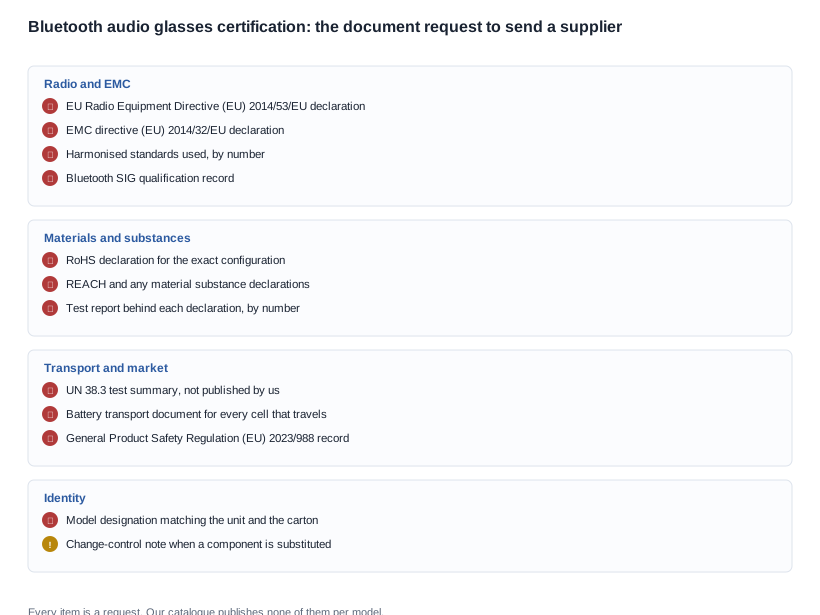
Bluetooth audio glasses certification: the documents a buyer has to request in writing
The request list below is deliberately specific, because a request for "certificates" produces a folder of images and a request for "the compliance file for this model, this configuration, these markets" produces evidence. Each item has a completion test that produces a document with a number on it. Send the requests in this order:
-
The EU Declaration of Conformity under the Radio Equipment Directive, (EU) 2014/53/EU, with the test report number and the harmonised standards used.
-
The EMC Declaration of Conformity under the EMC Directive, (EU) 2014/32/EU, as a separate instrument with a separate test report behind it.
-
The harmonised standards list, so that EN 300 328 and EN 301 489 can be read as standards rather than mistaken for directive numbers.
-
The Bluetooth SIG qualification record for the specific model, and the product-listing evidence behind it.
-
The RoHS declaration and the REACH declaration, each naming the model designation and each carrying the test report number behind it.
-
The UN 38.3 test summary for every cell type that travels, plus the battery transport document that sits on top of it.
-
The market-specific records for each destination, including the economic-operator record and, where the destination market requires it, the record under the General Product Safety Regulation, (EU) 2023/988.
-
The change-control statement, naming what may be substituted without reissuing the file and who is notified.
The radio conformity declaration. For products placed on the European market with a radio, the relevant instrument is the Radio Equipment Directive, (EU) 2014/53/EU. What you want is the EU Declaration of Conformity that cites it, together with the test report number behind it, and the harmonised standards used. Note the direction number carefully, because it is the single most commonly mis-transcribed number in this category.
The EMC declaration, as a separate instrument. Electromagnetic compatibility in the European Union runs under a different instrument, the EMC Directive (EU) 2014/32/EU. It is not an alternative reference for the radio directive; it is a separate legal instrument with a separate scope, a separate test programme and its own declaration of conformity. A supplier who produces one document covering "radio and EMC" and cites a single directive number has either merged two duties or produced one declaration where two are required. Both are worth a question.
The harmonised standards, by number. EN 301 489 is a family of EMC harmonised standards and EN 300 328 is a radio-spectrum harmonised standard. Both are standards, not directives. A declaration cites a directive for the legal basis and standards for the technical method, and a buyer who cannot tell the two apart in a document has not read the document. The Bluetooth SIG certification buyer checklist covers the qualification side of the radio question, and the Bluetooth SIG certification checklist covers the membership and product-listing requirements.
The material compliance declarations. A RoHS declaration and a REACH declaration for the exact configuration, each naming the model designation, each with the test report number behind it. These are the documents most often supplied as a company-wide statement covering "all products", which is exactly as useful as a model-specific statement for a model that is not in it.
The transport file. A UN 38.3 test summary for every cell type that travels with the product, plus the battery transport document. Not published by us; requested in writing; checked against the cell part number. The battery transport compliance buyer checklist sets out the structure of that file, and the battery transport compliance declaration of conformity article covers the paperwork side of it.
The market-specific records. Depending on the destination, a record under the General Product Safety Regulation, (EU) 2023/988, which becomes applicable from 13 December 2024, and an economic-operator record for the market concerned. The bluetooth audio glasses export considerations article covers what each destination adds to the file.
Bluetooth audio glasses certification: radio, EMC and the two separate instruments
The radio and EMC instruments deserve their own section, because the confusion between them is not a detail — it changes what you are entitled to receive and what your supplier is obliged to have done.
What each instrument covers. The Radio Equipment Directive, (EU) 2014/53/EU, covers the radio spectrum and the safety and health requirements for radio equipment. The EMC Directive, (EU) 2014/32/EU, covers electromagnetic compatibility for equipment. A Bluetooth audio glasses product is in scope for both, because it has a radio and because it has electronics that emit. The two are assessed separately and the two produce separate declarations, and the market-access question a buyer asks — "is this product properly documented for the EU" — has to be answered twice.
How the standards sit on top of the directives. EN 300 328 is a harmonised standard used to demonstrate conformity with the radio requirements, and EN 301 489 is the EMC harmonised standard family used to demonstrate conformity with the EMC requirements. Both numbers appear in declarations and both are frequently mistaken for directive numbers by people reading the document quickly. A good test: if the number on the document is 2014/53 or 2014/32, it is a directive and it is the legal basis. If it is EN 300 328 or EN 301 489, it is a standard and it is the method.
Why the Bluetooth version row is not a certification row. All eight audio models publish a Bluetooth version — 5.3 for the K01 and the K02, 5.4 for the other six. That is a specification claim about the radio, and it is verifiable on a sample. It is not evidence of conformity, and no amount of checking the version on the unit substitutes for the declaration. Keeping those two ideas apart is what stops a buyer from believing that a specification sheet is a compliance file.
What to do with the two declarations once they arrive. Check that each cites the right directive for its own scope, that each carries the harmonised standards it claims, that each names a test report number, and that the model designation on each matches the unit and the carton. Then freeze the set: a change to the radio module, the antenna or the firmware should reopen the file, and the question of who triggers that belongs in the purchase order.


Bluetooth audio glasses certification: the battery that travels with the product
Every model in this range contains a lithium cell, and several of the configurations in the wider catalogue add a second one. That makes the transport file part of the certification conversation rather than a separate logistics conversation, and it is the part most often forgotten when a buyer assembles a compliance pack.
The cells that travel are not always the cells that are charged. In the audio range the published configurations are the 90 mAh x 2 frames, the 100 mAh single-cell frames and the 55 mAh x 2 frames. Every one of those is a cell that travels with the product. If a case or a dock is included in the carton, a further cell travels inside it. The transport file has to name every cell type that is in the box, not only the cells inside the frame.
The test summary has to match the cell. A UN 38.3 test summary is written against a specific cell. If the supplier changes the cell vendor, the summary has to be reissued even though the published capacity in the catalogue has not moved. The catalogue publishes capacity and cell count for every model but no cell part number, which means the only way to control this is to make the cell part number a controlled line on the purchase order and to require notification before any substitution.
The catalogue does not publish it, so it has to be asked for. This is the position for every model in the range. The request is straightforward — the test summary for each cell type that travels with the shipped configuration, plus the transport document that sits on top of it — and it is worth making before the goods are booked rather than at the carrier's acceptance point, where the only available remedy is a re-tender.
The failure this prevents. A device cleared on its own and then shipped with a case is two different transport products, and the mismatch is discovered at the port rather than in the factory. The battery transport compliance penalties article covers the consequence side, and the battery transport compliance supplier questions article covers the request side in more depth.

Bluetooth audio glasses certification red flags in a supplier answer
A supplier answer about certification comes in a small number of shapes, and most of them are recognisable before anyone opens a document. These are the ones worth stopping on.
A certification claim with no model in it. "We are CE certified and RoHS compliant" is a company statement. It is not a product fact, and it becomes a product fact the moment it is written on a listing, a carton or a tender document. The question to ask is which model, which configuration and which market the statement covers.
One declaration offered for two instruments. A single document cited against the Radio Equipment Directive and used to cover EMC as well is either a partial file or a merged one. The request for a separate EMC declaration is easy to make and hard to fudge, because a separate declaration needs a separate test report behind it.
A file for a sibling model. This is the most common documentary defect in the category and it is invisible until someone reads the carton against the file. The model designations have to be compared character by character, because "LC-105-1" and "LC-105-2" differ by one character and carry different files.
Standards cited as directives. If the document cites EN 300 328 or EN 301 489 in the position where a directive number should be, the file has been assembled rather than reviewed. Ask for the legal basis separately from the technical method.
A company-wide materials declaration. A RoHS statement covering the whole product line, with no model list, does not tell you whether your configuration is in it. The request is for a declaration naming the model, and it costs nothing to make.
A transport summary that has not been reissued. Ask for the test summary date against the cell part number on the bill of materials. If the cell changed after the summary was written, the summary describes a cell that is no longer in the product.
A patent page offered as a certificate. Ten patent certificates covering the designs are a real and meaningful part of what we do, and they are a different thing from a conformity assessment. A buyer who receives the patent page in answer to a request for a conformity declaration has received a page, not a file. The OEM ready platforms export documentation article covers the distinction between company-level capability and model-level evidence, and the OEM ready platforms certification coverage article covers the coverage question behind it.
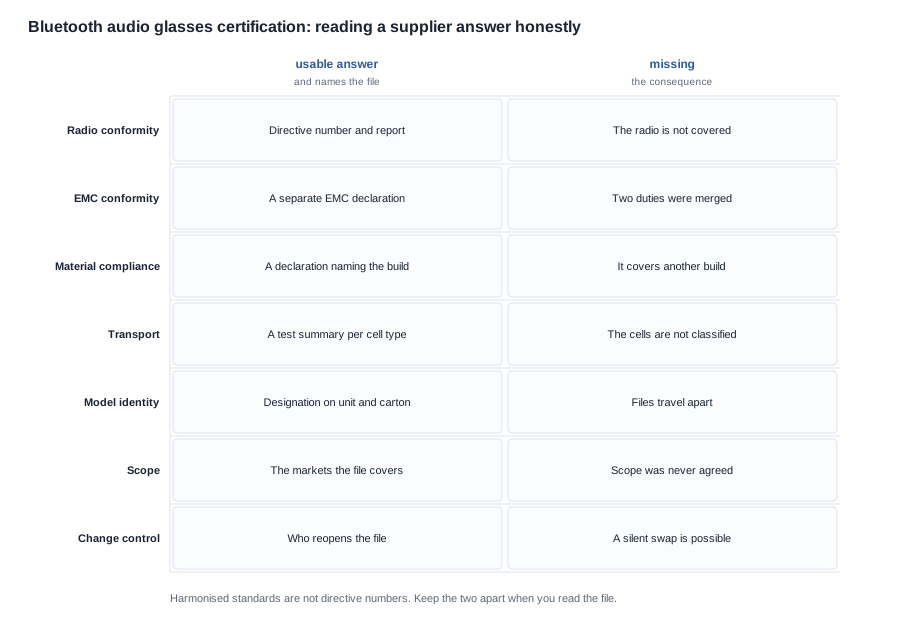
The order in which to run these checks. Red flags are easiest to act on when they arrive in a sequence rather than as a pile, because each one determines what the next one can even be. Start with the scope: does the answer name a model, a configuration and a market, and if it does not, nothing after it can be checked. Then the instruments: are the radio and the EMC claims separate, and does each cite a directive number in the directive position. Then the identity: does the designation on each document match the unit and the carton character by character. Then the substance: does each claim carry a report number that can be requested independently. Then the battery: does the transport file cover every cell that travels with the shipped configuration. Then the control: what changes reopen the file, and who is told. A supplier who answers all six in order has demonstrated something that matters more than the speed of the answer, which is that the file exists and that somebody maintains it.
Two things follow from that sequence for the buyer on our side of the table. The first is that a per-model file is more expensive to obtain than a company page, and that cost is visible in the quotation, which is exactly where it should be — a supplier who has not run the assessment for your configuration will quote lower, and the difference between the two quotations is the assessment. The second is that the file has to be reissued when the configuration moves, which is why the configuration document has to be frozen before the file is requested rather than after.
Bluetooth audio glasses certification: the boundary of what we publish
We publish what we can verify and we do not publish what we cannot. Our catalogue publishes specification rows for the models we build, and it carries a company-level export certification page whose content is images, showing ten patent certificates. It publishes no per-model certification row, no certificate number, no test report reference and no conformity claim for any model in the range. We will not state that a model holds CE, FCC, RoHS or any other conformity approval, because the catalogue does not contain that information and because a company-level page is not the same instrument as a per-model file.
We will do three things instead. First, we will tell you precisely which documents exist for a given configuration and destination, so that you know what to ask for and what to check when it arrives. Second, we will tell you which parts of the file are ours to produce and which parts have to come from the test laboratory or from the compliance file, because that determines who you press when something is missing. Third, we will tell you which rows our catalogue does publish for that configuration — cell configuration and count, charging method, a charge time of two hours or less, the rated endurance, the Bluetooth version — so that the technical file and the compliance file can be reconciled against the same product.
For a buyer, the practical sequence is short. Ask for the document list before asking for the documents. Match the model designation on every document to the unit and the carton. Confirm that the radio declaration and the EMC declaration are separate instruments with separate reports. Confirm that the transport file covers every cell that travels. Treat the document set as a controlled item on the purchase order, so that a change to the radio module, the firmware or the cell reopens it. And record the whole set against the configuration it was issued for, because the configuration, not the model name, is what the file actually covers.
That sequence is not a formality, and it is not something our catalogue can shorten for you. The bluetooth audio glasses buying guide article covers the technical rows a purchase order has to carry, and the bluetooth audio glasses bulk ordering article sets out where the document requests belong in a volume programme.


