
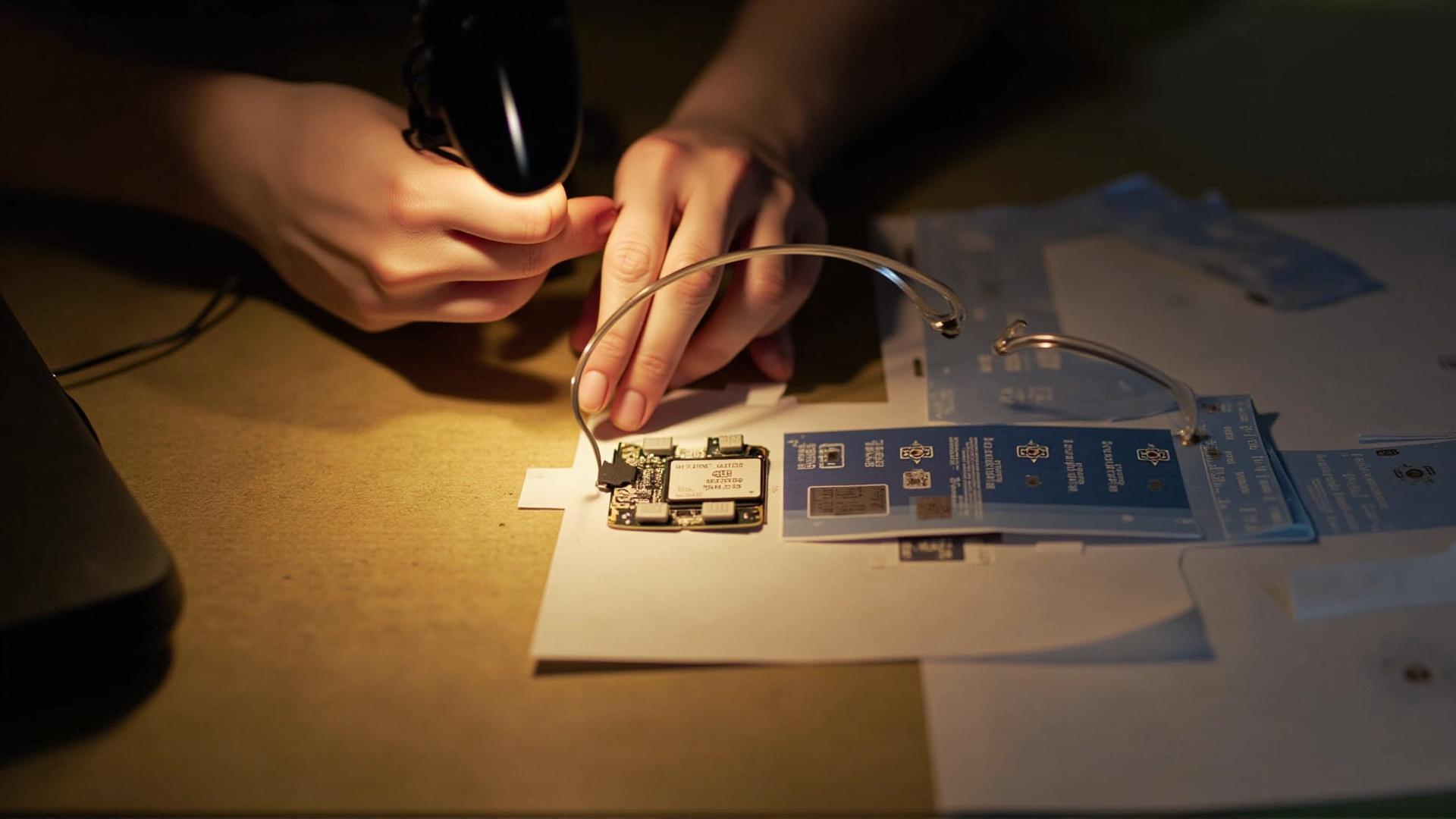
The D12 publishes a 100 mAh cell, a charge time of two hours or less, about seven hours of rated use, Type-C charging and no acoustic descriptor. It publishes no certificate number, no issuing body, no validity date and no model coverage list — and that is not a criticism of the model, it is a statement about what a catalogue page can and cannot carry.
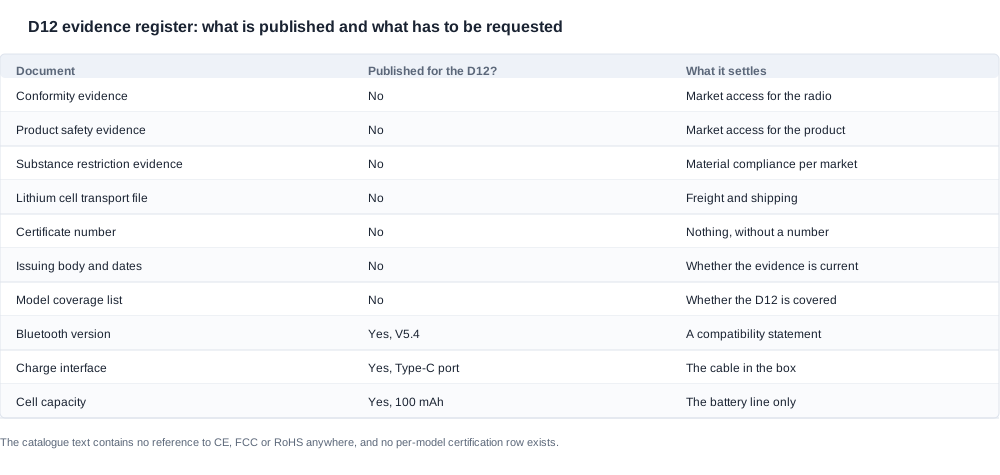
This page is for the buyer who has to put a compliance file together before an order can ship. It sets out what our documentation actually records, what has to be requested in writing, why a published Bluetooth version is not a substitute for any of it, and which rows beyond certification are also unpublished for this model.
D12 certification status: what the catalogue actually records
It is worth being exact about this, because "no certification" and "no published certification evidence" are different statements and only one of them is true.
Our catalogue carries a company-level export certification page. That page is an image page: its extractable text is the section title and the page number, and everything else on it is imagery. The catalogue text contains no reference to CE, FCC or RoHS anywhere — not for the D12, not for the sibling audio models, and not at company level. There is no per-model certification row for the D12 or for any other model, and there is no record of a pending confirmation either, so there is nothing to chase up from the document itself.
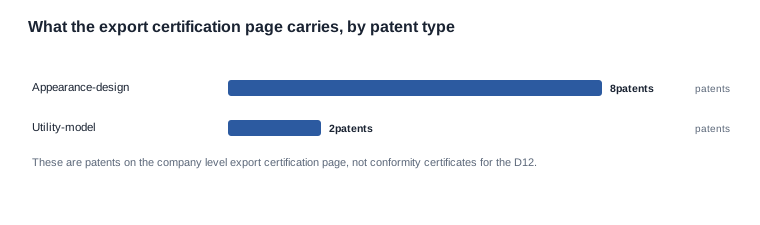
What that page does carry is ten patent certificates — eight appearance-design patents and two utility-model patents. Those are intellectual-property records, not conformity assessments, and they do not stand in for a test report, a declaration of conformity or a certificate number in a market-access file.
So the accurate position for the D12 is this: the catalogue publishes the electrical and radio rows for the model and nothing at all in the way of certification evidence. Any statement that the D12 holds CE, FCC or RoHS certification would be a claim our documentation does not support, and a buyer who relies on such a statement in a listing or a tender response carries the risk personally. What a buyer can do is request the file, and that request is straightforward.

The five documents to request for the D12, and why each one is separate
The reason certification work feels slow is that buyers treat it as one item when it is five, and each of the five is decided by a different party on a different timetable. Separating them is what turns a stalled compliance file into a scheduled one.
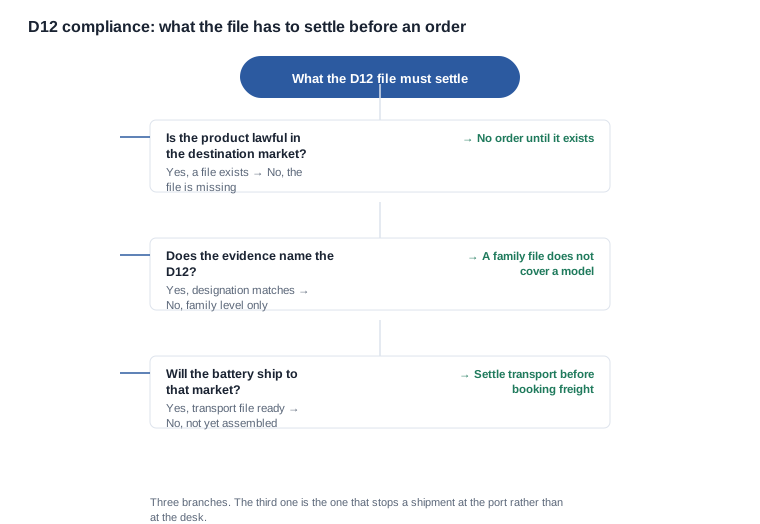
- The conformity evidence naming the D12 designation. No number means there is nothing to check, and a document written at family level does not automatically cover a specific model. This is the most common reason a buyer's compliance file stalls, and it is the item to put on the critical path first. The certification checklist sets out the wider request list.
- The issuing body, and its standing in your market. A test report is not a certificate, and radio coverage does not extend to product safety. For the radio side, the relevant EU instrument is the Radio Equipment Directive (EU) 2014/53/EU; where EMC is involved, the EN 301 489 series is a harmonised standard rather than a directive, and the two are regularly confused in supplier paperwork.
- The validity dates, checked against the ship date. Certificates expire and can be suspended. A file assembled eighteen months ago is not a file, and the check that catches this is a date comparison rather than a document request.
- The model coverage list, and the battery configuration it refers to. A document naming the D12 does not automatically cover a different battery in the same housing, and the cell is the part most often left out of a coverage list.
- The lithium cell transport evidence. A 100 mAh lithium cell travels under transport rules that require their own paperwork, and that paperwork is separate from market access. Settle it before booking freight rather than at the port. The battery transport guidance covers what the file has to contain.
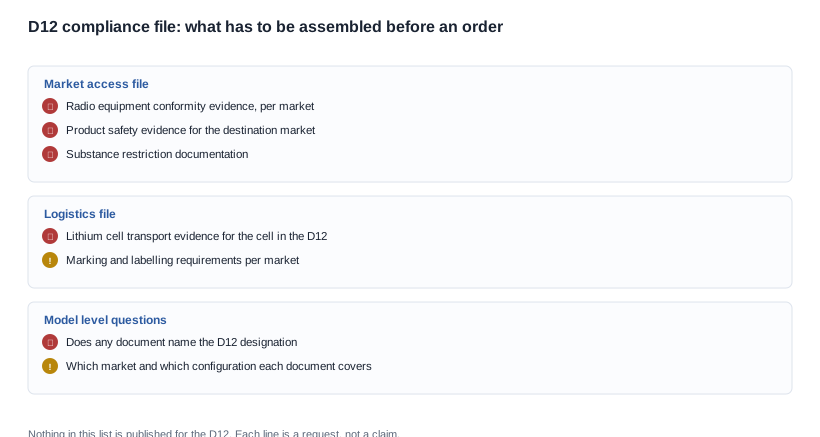
The order of those five matters commercially. The first and the third set the launch date, the second and the fourth determine whether the product can be sold in the market you intend, and the fifth determines whether it can leave. Asking for them in one message, addressed to the model designation, with the destination market named, is what turns this from a sequence of follow-ups into a single request.
How to write the request so it comes back usable
The difference between a certification request that produces a file and one that produces a general reply is almost always the precision of the request. Six details turn a message into a document request, and each of them costs nothing to include.
Name the model designation and the market in the first line. A request that says "your smart glasses" will be answered with a family-level answer, and a family-level answer is exactly the reply that cannot be filed. A request that says "the D12, for placement in the European Union, with the radio and the product safety assessments both named" produces something that can be filed.
Ask for the document number, the subject of the document and the scope in one sentence. A bare certificate number can be looked up in the issuing body's own register, which is the fastest verification there is, but only if you have the number. Asking for the scope at the same time saves a second exchange.
Ask which configuration the assessment covered. This is where the detail usually breaks. A radio assessment covers a radio configuration, and a product safety assessment covers a battery configuration, and the two answers are not always the same. Asking now is cheaper than discovering the mismatch at the port.
Ask whether the evidence is current or historical. Evidence that was produced for an earlier programme can often be reused, and reusing it is a legitimate procurement saving. But you cannot reuse what you were never given, and an answer that does not say which it is leaves the question open.
Ask for the document language, and for an English or a bilingual version if you have to file it internally. A translation requirement discovered in week six rather than week two is a scheduling problem, and this is the point at which to discover it.
And ask the supplier to say plainly what they do not have. This last one is counter-intuitive and it is the most valuable question in the set. A supplier who states which files do not exist for this model has saved you a month, because you can go straight to the testing body or to a certification partner with a specific brief. A supplier who answers only what they do have leaves you assuming the remainder is merely slow rather than absent.
Why a Bluetooth version cannot stand in for certification evidence
The D12 publishes Bluetooth V5.4, and that row is genuinely useful. It supports a compatibility statement, it tells you the radio generation, and it lets a brand write a pairing instruction and a support script from published data rather than sourcing them from the factory.
But a radio version is not a test report, not a certificate and not a declaration of conformity. It says which version of a protocol the product speaks. It says nothing about how the product was assessed, by whom, against what, and with what scope.
Buyers moving between models sometimes assume that documentation transfers with the specification, because the specification does transfer. This is where it bites hardest in this catalogue, because the D12 and its sibling models publish an identical set of electrical rows — the same 100 mAh cell, the same two-hour-or-less charge ceiling, the same rated seven hours, the same Type-C interface. Identical specification does not mean identical paperwork, because certification attaches to a model designation and to a configuration, not to a cell capacity.
There is a second point about the radio row that matters for this model specifically. The D12 publishes no acoustic descriptor at all. Its sibling in the same 100 mAh group publishes a surround-sound row; the D12 does not. That difference is the single published specification difference between those two models, and it means that any acoustic claim written for the family has to be checked against the D12's own entry rather than carried across from a neighbouring model. On the compliance side the same discipline applies: the radio row is shared, the evidence is not.

The D12 rows beyond certification that are also unpublished
A buyer who has only chased the certification file often finds a second list waiting. These rows are separate from market access, and each one changes a decision rather than merely a description.
Ingress protection. Not published for the D12, so no durability claim is available for it. The audio models in this catalogue carry no ingress marking at all; the IP54 marking appears in the catalogue on the V06 and the S7, and on no other model. The IP ratings and durability guidance explains how the marking works and what it does not tell you.
Acoustic evidence. No driver size, no frequency response, no leakage figures and no microphone pickup distance are published for the D12. For an audio product that is the central absence: there is no sound quality claim available and no call quality claim available, and the absence of a surround-sound row is the visible symptom of it. The open-ear audio technology page and the noise control and microphone pickup page set out what to ask for.
Physical specification. Frame weight, frame dimensions and temple length are not published for this model. Our catalogue publishes exactly one frame weight anywhere, and it belongs to the MT6 — the glasses body including its battery and camera, excluding its folding charging case — so there is no published weight for any audio model and no number can be borrowed.
Colour and packaging. No colour list is published for the D12, so a merchandising plan waits on a conversation with the factory rather than a selection from a list.
Charging case. The catalogue publishes no charging-case capacity for the D12, so the accessory set and the freight weight of a case-equipped package are open items.
The runtime condition. About seven hours is published with no test condition, which is a rating rather than a measurement of a working day.


What a complete D12 file settles, and what it does not
It is worth separating these two things clearly, because a buyer who expects a certificate to answer a product question will be disappointed, and a buyer who expects a product specification to answer a compliance question will be worse off.
A complete file settles market access. It establishes that the product may lawfully be placed on the market in the jurisdictions it covers, that the obligations attached to the radio, the battery and the substances in the product have been met for that configuration, and that the transport paperwork is in order for the shipment in front of you. Those are the three things a compliance file is for.
It settles nothing about how the product performs. A certificate does not tell you how the D12 sounds, how it sits on the head, how the microphone behaves in a noisy room, how long the battery lasts in your own workload, or what it weighs. Those come from a sample unit and from measurement, and the D12 specification page is the published baseline for what our documentation does hold.
And the practical sequence is short. Ask for the conformity evidence for the D12 designation, per destination market, with the document numbers. Ask for the issuing body, the standard assessed against, and the validity dates. Confirm which model designations and battery configurations each document covers. Assemble the transport file and check it against the configuration being shipped. Then record every document with its number, its date and its scope, and re-check the file before each shipment rather than at the start of the programme.
What to put in the purchase agreement
A compliance file that lives only in a folder is a compliance file that fails the first time a customer, an inspector or a freight forwarder asks about it. The clauses that matter are short, and they belong in the agreement rather than in a side email.
The evidence itself. State which documents the supplier is providing for the D12, by name and number, with the markets they cover. If a document is still being obtained at the time of the order, say so, name the date it is expected and state what happens to the shipment if it does not arrive.
The scope. State that the evidence covers the D12 designation and the battery configuration being ordered. This is the clause that prevents the classic failure, where the paperwork arrives naming a different model and the buyer discovers it during a customs query.
The obligation to report changes. The supplier should tell you if the evidence is withdrawn, amended, suspended or superseded, and if the product, the battery, the radio or the firmware changes in a way that affects it. A silent change is the risk here, because a compliance file is only valid for the configuration it was issued against.
The record. State that the supplier will pass on the certificate numbers and validity dates in a form the buyer can file, and that the buyer may verify them with the issuing body.
And the handover. State where the file goes on delivery, who owns the maintenance of it, and the point at which the buyer takes responsibility for re-checking it. Nothing here is contentious, and every one of these clauses exists because a missing file is discovered at the worst possible moment — a shipment held, a listing withdrawn, or a tender response invalidated.
Where our D12 position on evidence sits
We would rather show you a short, accurate list of the documents we hold than a long list of claims we cannot substantiate. For the D12 that list is short. We publish the 100 mAh cell, the two-hour-or-less charge ceiling, the rated seven hours, the Type-C interface and the Bluetooth V5.4 radio row, and we publish the absence of an acoustic descriptor honestly, because that absence is a real and usable fact — it is the difference between this model and the one it is most often confused with.
We will not convert the company-level export certification page into a model-level certification claim, and we will not tell you the D12 holds CE, FCC or RoHS when our own documentation contains no such reference. We will not quote a frame weight, a colour list, a case capacity or an acoustic figure that the catalogue does not hold. And we will not use the absence of a surround-sound row to imply a negative acoustic conclusion — the row is not published, which is a different statement from a measurement showing the D12 lacks the feature.
Ask us for the certification evidence and we will tell you plainly which items we can produce, which have to be requested from the testing body, and which remain a question for the destination market rather than for us.
What the supplier provides and what the buyer has to verify
There is a division of work in any compliance file, and a buyer who does not draw it clearly ends up either doing everything or trusting everything. Three parties are involved and each has a different job.
The supplier provides. The documents, with their numbers, their issuing bodies and their dates, for the model designation and configuration being supplied. That is the part a factory is genuinely able to produce, and asking for it in the format described above is the whole of what is needed to get it.
The third party confirms. The issuing body's own register is the independent check, and it is available to any buyer who holds a document number. A certificate that cannot be found in the issuing body's public register is not a certificate you want to file, and that check costs nothing but the phone number of the issuing body. A certification partner can also carry out the verification and the gap analysis for several markets at once, which is usually cheaper than doing it market by market when a range is going into several jurisdictions.
The buyer verifies and files. The buyer checks that the scope covers the designation and the configuration, checks the dates against the ship date, checks that the documents travel with the goods, and keeps the file current. This is the part that is routinely outsourced by accident — it is the part nobody owns, and the part that fails when the programme changes a cell or a firmware branch.
Where the risk concentrates. The biggest risk in a compliance file is not a bad document; it is a valid document that has quietly stopped applying. A cell substitution, a supplier change on a component, a new firmware branch, a design tweak that alters the radio — each of those can invalidate a document that was perfectly good last quarter, and none of them is visible in the file itself. A buyer who re-checks the file against the physical product before each shipment, rather than annually, is the only one who catches it.
And what that means for this model in particular. Because the D12's published electrical rows are identical to its sibling's — the same 100 mAh cell, the same charge ceiling, the same rated hours, the same Type-C interface — a buyer comparing the two models on documentation will find no difference in the data and may conclude there is none in the paperwork. There is a difference, and it is in the model designation, the acoustic descriptor and the test conditions behind the rating. Request each separately.
Related reading
- The document set to request — certification checklist
- Battery transport before you book freight — battery transport
- What is published for this model — D12 specifications
Share the target market, the quantity and the required configuration, and we will come back with what is available and what is not.


