

A verdict on value for money needs two numbers: what the product costs, and what it does for the programme. The catalogue gives us the second and withholds the first. There is no unit price, no price tier, no landed cost and no minimum order figure for the D17 or for any other model, so this article does not tell you whether the D17 is worth its money, and it does not rank it against the ZH12, the YKC02, the V06 or the S7.
What it does instead is name the four factors that determine what a configuration actually costs to deliver and to accept, and give the request that makes two quotations comparable when they arrive. That is a method rather than an answer, and it is the part a procurement team can use without waiting for anybody to publish a price.

D17 smart glasses value for money: read this as a cost-driver method
The published configuration that the method starts from
The D17 publishes Bluetooth version V5.4, a 115 mAh cell, a charge time of about one hour, roughly seven hours of rated use, Type-C charging, a Remote Control Photo feature line and a Surround Sound feature line. No camera row, no case line, no mass, no ingress marking.
That row is the input to the method, and it is short enough to hold in the head. Four factors then sit on top of it, and each of them moves the cost of the configuration in a direction a buyer can reason about before a quotation exists.
What the method is not
It is not a ranking, and it is not a recommendation. It does not say that the D17 is the better buy, or the cheaper one, or the one to pick for a given budget, because the inputs for that judgement are not published and a version of it written without those inputs would be a guess dressed as an analysis.
It is also not a list of price tiers. The catalogue does not publish a price structure, and inventing a tier structure — entry, mid, upper — for models whose prices are not published would produce a ranking with no basis and a guarantee that somebody would quote it back at us.

Why there is no price comparison in this article
What we do not publish, and why that is the honest position
We publish no unit price, no price band, no landed cost and no margin for any model in the catalogue. We do not publish a minimum order quantity or a lead time either, and we do not publish a capacity figure for the factory, a warranty period, or a certification number.
There is a commercial reason for this and a factual one. The factual one is the important one: a published price becomes a reference point that is quoted back at a negotiation, and a reference point that is not connected to a real quotation is a liability. A buyer who is handed a price and later finds a different one on an invoice has been given a document that cannot be reconciled with reality.
The three questions a buyer can actually put to a supplier
- What is the unit price of this exact configuration, at a stated quantity band, against a stated destination and a stated packing? A price without those four qualifiers is not a price.
- What sits outside that unit price? Tooling, branding, packaging customisation, certification work, the dock or the case, the spare cell, the sample, the freight, the insurance. Each of these is a separate line on a quotation and each of them has a scope attached.
- What changes as the quantity band changes? The breakpoint structure is where the real commercial information sits, and it is a legitimate question to ask before committing to a configuration.
The total cost of a programme is the sum of those lines plus the cost of the open rows, and the second part is the part this category is worst at estimating. A model with five unpublished rows and a model with one unpublished row can land at the same unit price and at very different programme costs, because the second one needs a sample, a test session, a document request and a compliance review before it can be ordered.
What "value" can mean when the price is not published
With no price available, value has to be defined as something else, and there are two useful definitions.
Value as documentation readiness. The D17 publishes a radio version, so compatibility copy, a connection procedure and a support script can be written today. The camera models publish no radio version, so the same three documents wait on a supplier. That difference has a value, and it can be measured in the programme schedule even when it cannot be measured in money.
Value as open-row count. A short published row with a short open list is cheaper to bring to order than a long published row with a long one behind it. The D17's open list is: mass, dimensions, case, ingress position, control method, the triggered device, the audio arrangement, and the conformity documents.

Four factors that move the cost of a configuration
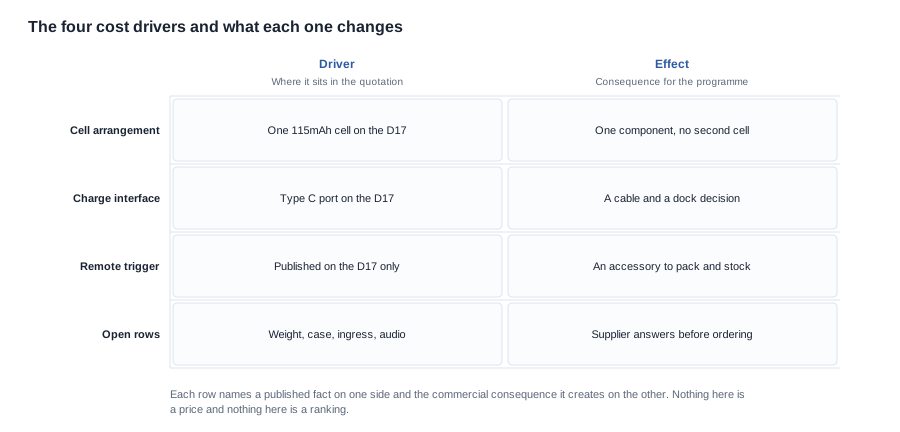
Factor one: the cell arrangement
The D17 publishes a single 115 mAh cell figure. Compare that with the YKC02, which publishes 70mAh2 — a two-cell arrangement written as a multiplier — and with the K01 and the K02 at 90mAh2 and the LC-105 pair and the G07 and the YK12 at 55mAh*2.
A single cell and a two-cell pack are not the same component and not the same assembly step. They differ in the bill of materials, in the tooling, in the internal volume they occupy and therefore in the case design, in the assembly time, and in the failure modes that quality control has to cover. A programme that assumes a two-cell pack can be built from a single-cell model because the runtime figures are close has assumed wrongly, and the assumption surfaces at tooling.
The question to ask is narrow and answerable: is the published figure per cell, how many cells ship in the unit, and what replaces the cell when it reaches end of life.
Factor two: the charge interface and the dock it implies
The D17 publishes Type-C charging. The YKC02 publishes magnetic charging. On the pillar, that is a cable against a proprietary dock, and the two have different cost structures in ways that are not visible in a unit price.
A Type-C port means the charging consumable is a commodity: a cable can be sourced independently, bundled, replaced in the field, and shipped as a separate line at almost no cost. A magnetic dock means the accessory is model-specific, comes from the same supplier, has to be stocked in every market the product reaches, and becomes a service item that the after-sales team has to carry.
The dock question that saves money is the one about what is in the box. If the dock is included, it is part of the product and its cost belongs in the unit price discussion. If it is quoted separately, it is a second SKU with its own packaging, its own minimum order and its own shelf space, and a programme that treated it as part of the product will discover the cost later.
Factor three: the feature lines
The D17 publishes two feature lines and the YKC02 publishes two, and the two sets are different in kind.
Remote Control Photo is the one that has a cost consequence. A remote that triggers an external device is an accessory: it has to be packed, counted, stocked, replaced and explained. Three practical questions decide whether it is a line item or a rounding error: does it ship in the box, is it available as a spare, and is it the same part across the range or model-specific.
Surround Sound is the one with a specification consequence. The line does not publish a driver count, an amplifier arrangement or a leakage figure, so the bill of materials behind it is not readable. That matters for a buyer who intends to compare configurations on their acoustic content, and for a buyer who intends to write a claim: the claim is supported by the line, and nothing more.
A feature line is also a documentation consequence. A line that exists has to be described in the listing, in the instructions and in the support script, and each of those needs an acceptance answer. The cost of a feature is not only in the hardware.
Factor four: the open rows
The fourth factor is the one most likely to be underestimated, and it is the reason this article exists.
Every unpublished row on the D17 is a cost before it is a delay. Mass and dimensions require a sample or a drawing. The triggered device requires a supplier answer and possibly a test unit. The audio arrangement requires a specification and a listening test. The conformity documents require a laboratory relationship, a document set and a review against the destination market. The ingress position requires either a report or a written statement that no marking exists.
The order in which these are closed determines the schedule, not the number of them. The conformity question has the longest lead time and the fewest dependencies, so it goes out first. The measurements need a sample, so they wait for the sample. A programme that closes them in the reverse order will hold a sample it cannot use, because the paperwork it needs to interpret it is still in transit.
The four drivers, and the published row behind each
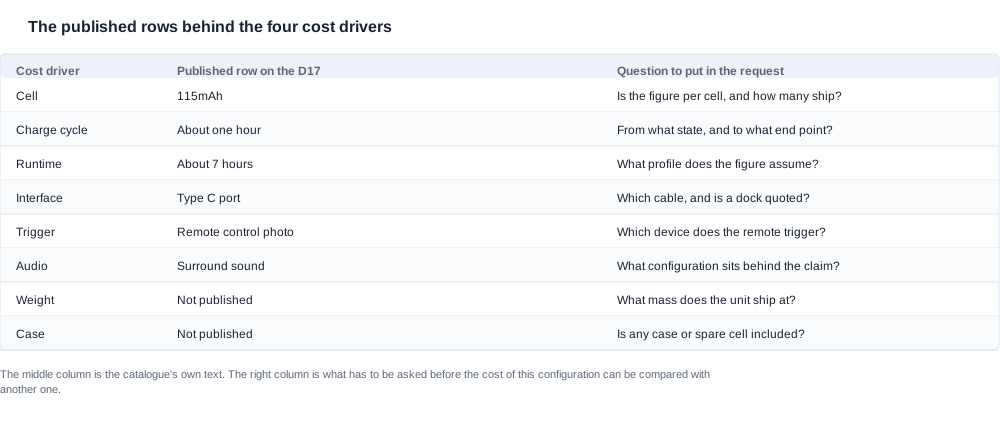
What a quoted configuration has to specify before the figure means anything
A unit price is not a property of a model. It is a property of a model, a quantity band, a packing format, a destination and a set of commercial terms, and a quotation that leaves any of those out cannot be compared with another quotation that specifies them differently.
The five qualifiers that have to travel with every figure.
- The quantity band. Prices move at breakpoints, and a figure quoted at the top of a band is not comparable with a figure quoted at the bottom of another.
- The packing format. Carton quantity, unit and master-carton dimensions and the gross weight all move the freight cost, and the freight cost is part of the landed cost even when it is not on the invoice.
- The destination. Incoterms and the named place decide who carries the risk at what point, and a figure quoted on one basis cannot be set beside a figure quoted on another.
- The accessory set. Whether the cable, the dock, the case, the spare cell and the printed material are in the box decides whether the price describes a product or a variant.
- The terms. The payment milestones, the deposit and the credit period decide the working capital a programme ties up before the first sale.
A supplier who will not specify those five is not quoting a configuration. They are quoting a catalogue entry, and a catalogue entry is a starting point for a negotiation rather than an answer to one. In this category that distinction matters more than usual, because the D17 and the YKC02 differ on exactly the accessory-related rows — a Type-C port against a magnetic dock — that the qualifiers are there to expose.
The two comparisons that will mislead you
Two comparisons are tempting and wrong, and both of them will be attempted by somebody in the evaluation meeting.
Comparing the D17's 115 mAh cell with the camera models' 260 mAh cell. The two numbers are real, and they are not comparable, because the products do different work: one is an audio frame with a remote trigger, the other is a camera platform with a sensor, storage and a removable inner frame. A cell figure is a component value, and a component value only becomes a cost value when the product around it is the same. The D17 and the V06 are not two versions of one thing, and the cell row is the clearest place where pretending otherwise produces a wrong conclusion.
Comparing about one hour against two hours or less as if both were durations. One is a stated figure, the other is a ceiling. Treating them as the same kind of number produces a "twice as fast" claim that the catalogue does not support, and a claim of that kind is the sort of thing that ends up on a product page.

Making two quotations comparable
A quotation is comparable when the two offers are for the same object, priced on the same basis, and assessed against the same criteria. That is a discipline, and it is the whole of what this article can offer in place of a price.
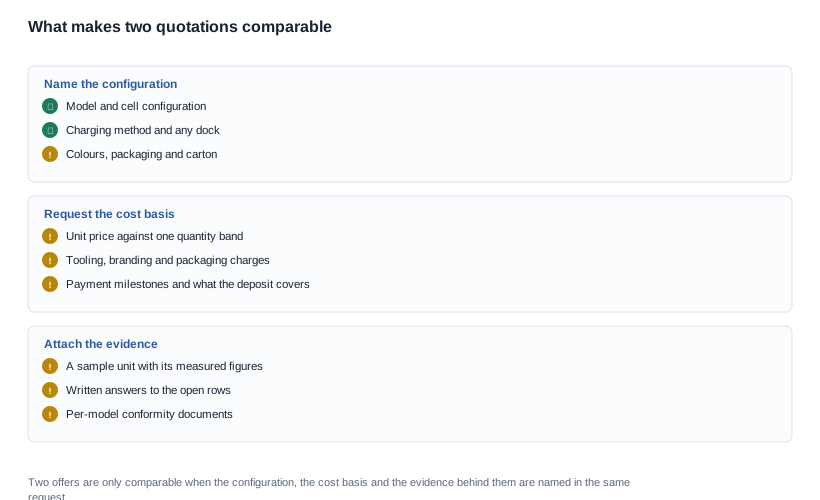
The fields that have to appear in the request
A request that produces comparable answers names the same eight fields for every model on the shortlist.
- Model and cell configuration. The exact model number, and whether the published cell figure is per cell and how many cells ship.
- Charging method and the dock. Which method, and whether the dock or the cable is inside the box.
- Contents of the box. Case, spare cell, cable, dock, printed material, and the language of that printed material.
- Unit price at one stated quantity band, to the stated destination and packing.
- Separate lines for tooling, branding, packaging customisation, sample cost and any certification work.
- Payment milestones, and what the deposit covers.
- Written answers to the open rows, per model.
- A sample unit for the shortlisted models, with the method for recording the measured results.
Equivalent offers: the criteria that make two quotations comparable
Two offers are equivalent when the configuration, the packaging, the destination, the documentation set and the payment terms all match, and when the answers to the open rows are equivalent rather than merely present. An offer with a shorter open list is not the same as an offer with a closed one, and the difference has to be carried into the evaluation rather than averaged away.
The practical habit that keeps this honest is to record the evaluation basis in writing before the quotations arrive. A comparison sheet with fixed criteria and a fixed weighting, completed by two people independently, catches the drift that a side-by-side of two totals cannot.
When two suppliers answer the open rows differently
The open rows rarely come back identical, and the difference is usually one of granularity rather than of substance: one supplier answers a mass, another answers a class of mass, one gives a charge-cycle duration with a start state, another gives one without.
The way to handle it is to keep the rows, not to average them. A row answered at a finer granularity and a row answered at a coarser one are not two answers to the same question, and the coarse answer does not become half as good as the fine one — it stays an open row, and it is recorded with the granularity it arrived at.
There is a commercial use for that as well as a technical one. A supplier whose answers carry dates, units and model numbers is a supplier whose quality control can be audited, and a supplier whose answers are prose is telling you something about the file you are going to receive when something goes wrong. That is due diligence, and it is worth doing before an order rather than after a defect.
The trade-off nobody writes down
There is a trade-off in this category that is easy to leave out of a comparison sheet because it does not appear on a quotation: a configuration that is cheaper to buy is not always cheaper to run. A model that needs a proprietary dock, a spare cell and a compliance review in every market carries a running cost that never appears on the invoice, and a model whose rows are published today carries a documentation cost of almost nothing.
That is the closest thing to a value argument that the published data supports, and it is a framework rather than a conclusion.
What we can and cannot tell you about value
What we can tell you. The D17 publishes a radio version, a cell figure, a charge time, a runtime, a charging method and two feature lines. It publishes no camera row, no case line, no mass and no conformity row. Its charging arrangement is a Type-C port rather than a proprietary dock. Its remote trigger is an accessory that has to be packed and stocked. Its open list is short and known, and every item on it has a named recipient.
What we cannot tell you. We do not publish a price for the D17, we do not publish a price band, and we do not publish a ranking of the D17 against the ZH12, the YKC02, the V06 or the S7, and we will not write a best-value claim, because none of the inputs for that judgement is public. We do not publish a landed cost, a margin, a minimum order quantity, a lead time, a warranty period or a factory capacity figure.
Our position is that the missing numbers are somebody's to supply. A supplier who quotes a configuration, names the accessory set and answers the open rows in writing has given a buyer everything needed to compute a value position. A supplier who quotes a single figure has given a buyer a number and nothing else, and the difference between the two is the difference between a procurement file and a purchase.
Send us the models on your shortlist, the quantity band, the destination market and the packaging, and we will tell you which published rows set the structure of the comparison, which questions have to be in the request, and which of the two models the evidence supports. The comparison framework sets out how the models sit against each other, and the D17 specification breakdown lists the row this method starts from.


