

A buyer who asks how the D17 compares usually wants a ranking, and the D17 does not have one to give. The catalogue publishes no price for it, no mass for it, and no per-model conformity row, so the comparison that can be made is a comparison of published rows and of the gaps sitting around those rows. That is a narrower thing than a ranking, and it is more useful, because a ranking built on unpublished figures collapses the moment somebody asks for the evidence.
The published row of the D17 is short and complete in itself: Bluetooth version V5.4, a 115 mAh cell, a charge time of about one hour, roughly seven hours of rated use, Type-C charging, and two feature lines — Remote Control Photo and Surround Sound. There is no camera row on the model page, no ingress marking, and no charging-case line. Everything below is built on those rows and on what their absence means.
D17 smart glasses compared: setting up the framework before the models
Most comparison articles start by lining two products side by side. That order is wrong for a catalogue with this many gaps, because a side-by-side table invites the reader to treat every cell as equally solid. Some cells carry a published figure; some carry a published absence; some carry nothing at all. A comparison that does not separate those three states is not a comparison, it is a decoration.
The one split that decides most of the comparison
Before anything else, the models have to be sorted by whether they publish a camera row, because that single row determines what kind of product a model is and therefore which questions are even relevant to it.
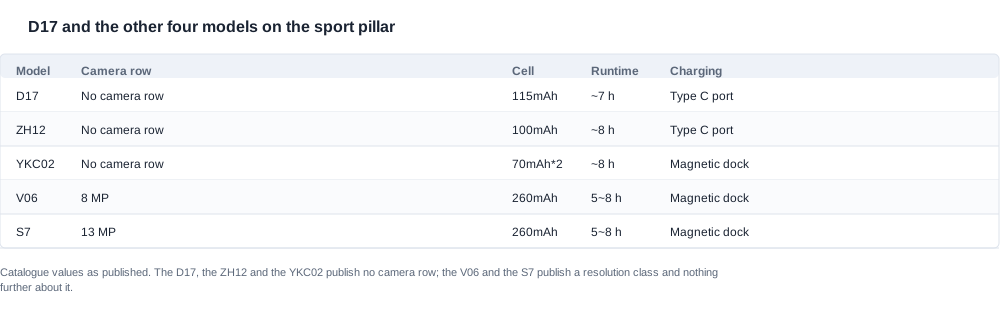
Three of the models on our sport pillar publish no camera row at all: the D17, the ZH12 and the YKC02. Two of them are camera models that sit on the same pillar because of their positioning rather than their class: the V06 publishes an 8 MP camera and the S7 publishes a 13 MP camera. Inside the wider catalogue the split is the same one: three sport models, eleven camera models and eight audio models.
The consequence for the D17 is immediate. A remote shutter is a trigger for a device that is not the frame. A camera is a lens, a sensor and a storage path. A programme that buys a trigger and a programme that buys a camera are not comparing two products, they are running two different briefs against one supplier. Any comparison that puts the D17 and the S7 on the same scale without saying this has already lost the argument.
The published row of the D17 in full
The D17 row is worth reading slowly, because each line carries a different kind of commitment.
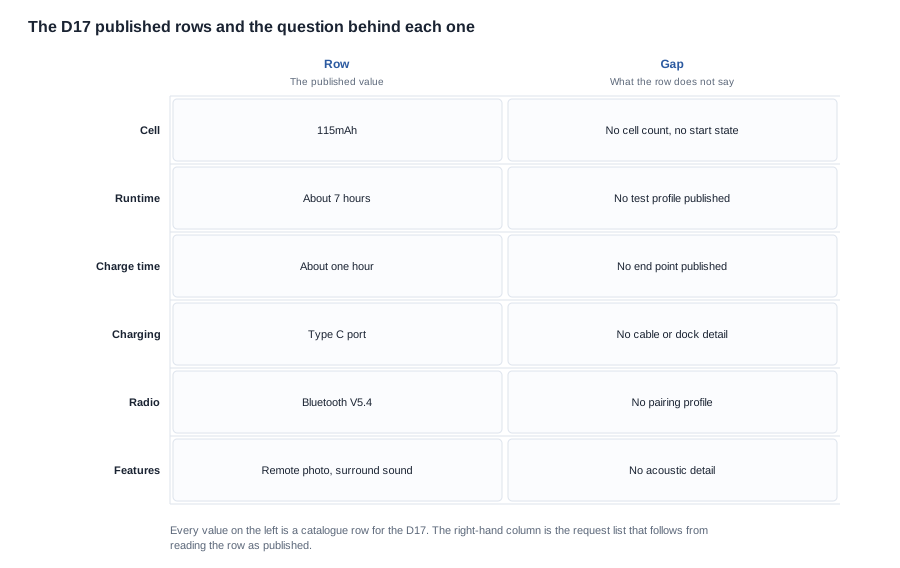
Bluetooth version V5.4 is a compatibility line. It is the same radio version the ZH12 publishes, and it lets a compatibility statement, a connection procedure and a support script be written from the catalogue today. That is a documentation asset, not a performance claim.
A 115 mAh cell is a component line. It is a single figure, published for one cell on this model, and it is the figure the D17 is known for — not to be confused with the 100 mAh of the D11 and the D12, which are audio frames with a different charging method.
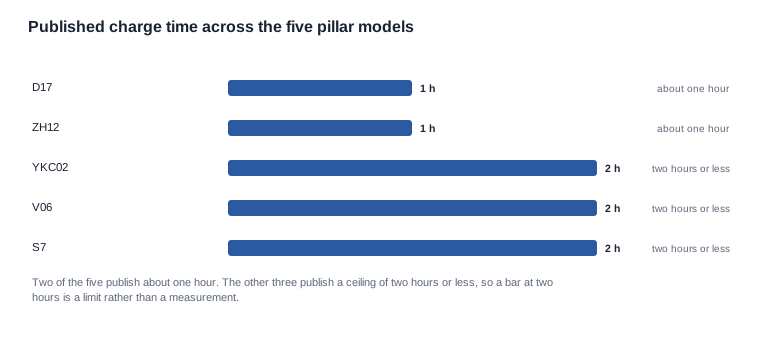
A charge time of about one hour is the shortest published charge time in the catalogue, and it is the only kind of figure on this row that is a stated duration rather than a ceiling. Twenty-six of the twenty-eight models in the catalogue publish a charge time of two hours or less, which is a limit; the D17 and the ZH12 publish about one hour. Those are different claims and a buyer should not treat them as the same shape of number.
Roughly seven hours of rated use is a point figure rather than a range, and it is the same shape of figure the D11 and the D12 publish. Nothing about the measurement profile behind it is published.
Type-C charging places the D17 in a group of seven models out of twenty-eight. The other seventeen publish magnetic charging, and four camera models do not publish a charging method at all.
Remote Control Photo and Surround Sound are the two feature lines. One of them is a capability a listing can describe; the other is a claim about sound. Both need an acceptance answer before either goes into customer-facing copy.
What the framework deliberately leaves out
Four categories are excluded from this comparison on purpose.
Prices and price bands. We publish no unit price, no price tier and no landed cost for any model, and we do not publish a ranking. What we publish instead is the structure a buyer can ask a supplier to price against, which is the subject of the cost-driver method rather than of this article.
Mass and dimensions. No model in this comparison states a mass, and the only mass published anywhere in the catalogue belongs to the MT6 glasses body, which excludes its folding charging case. A comparison that quoted a typical figure for the D17 would be quoting a number nobody can verify.
Conformity status. The catalogue holds one export certification sheet, at company level, and it is built from images rather than from text; no CE mark, FCC reference or RoHS statement appears in the written catalogue either. Not one model carries a certification row. Conformity is therefore a document to request, not a row to compare.
Market data. No market size, share or growth figure appears here, because the only defensible numbers available are our own structural counts.
The model kinds on the pillar and where the D17 sits
The sport smart glasses pillar groups five models, and the D17's position inside that group is best described by what it shares with each of them.
Three models with no camera row
The D17, the ZH12 and the YKC02 are the three models in the catalogue that publish no camera row and carry a surround-sound line in some form. Between them they separate on exactly three published points: the cell figure, the runtime figure and the charging method.
The D17 publishes 115 mAh, about seven hours, about one hour to charge and Type-C. The ZH12 publishes 100 mAh, about eight hours, about one hour to charge and Type-C. The YKC02 publishes 70mAh*2, about eight hours, a charge time of two hours or less, and magnetic charging.
The YKC02 is a sport model, and it is not an audio model. It appears in the same block of catalogue pages as the eight audio models, which is exactly the sort of adjacency that produces a classification error in a comparison. Its catalogue name is a sport glasses name and it publishes a Long Battery Life feature line, so it is grouped with the D17 and the ZH12.
Two camera models on the same pillar
The V06 and the S7 publish identical values on every standard row: a 260 mAh cell, a 5 to 8 hour runtime, a charge time of two hours or less, magnetic charging, and no charging-case line on the page. The published difference between them is the camera class — 8 MP on the V06, 13 MP on the S7 — plus a colour line on the V06 and an ingress marking on both.
Two models that are identical on every row except one are not two products in the ordinary sense. They are one platform at two camera classes. A buyer comparing them should be asking what the camera class changes in the finished product, not reading the two specification pages as if they described different devices.
The charge-time row splits the pillar differently from the camera row
The camera row separates the pillar into three models without a lens and two models with one. The charge-time row separates it into two and three, and does it the other way round: the D17 and the ZH12 publish about one hour, the YKC02, the V06 and the S7 publish two hours or less.
That is a useful thing to notice, because it means the fastest published charge belongs to a model with no camera. The two models that carry a camera both publish the slower ceiling. For a programme with a short turnaround between shifts, the camera class and the charge time point in opposite directions, and a buyer who has not noticed that will discover it during planning rather than during a quotation.

Dimensions worth comparing, and the ones that are not on the rows
A comparison needs dimensions before it needs models. For this family, five dimensions carry almost all of the decision, and one commonly assumed dimension carries none of it at all.
Dimension one: what the product has to do
The first dimension is functional and it is the one that settles the D17 against the camera models. If the brief requires the product to capture, the D17 is out of scope on the published rows, because a remote shutter on a frame with no camera row triggers something external. If the brief requires audio with a remote trigger, the D17 is one of exactly two models in the catalogue that publish a trigger row, the other being the ZH12.
Dimension two: how long the unit is away from a charger
The second dimension is the charge and runtime pair, read with the caution the figures require. A charge time of about one hour is a stated duration. A charge time of two hours or less is a ceiling. A runtime of about seven hours is a point. A runtime of 5 to 8 hours is a bracket. A ceiling and a bracket can be compared with each other, but neither can be turned into a promise about a specific shift without knowing the start state and the test profile, and the catalogue publishes neither.
Dimension three: the documentation burden
The third dimension is the least visible and often the most expensive. The D17 publishes a radio version, so compatibility copy can be written today. The V06 and the S7 publish no radio version, so a compatibility statement on either of them waits on a supplier. The D17 publishes two feature lines that both need an acceptance answer. The camera models publish a camera class and nothing further about it, so the storage, video format and sensor detail all wait on a supplier as well.
A model that can be documented today is worth more than a model that looks better on paper. For a channel with a launch date, that difference shows up as schedule rather than as specification, and it is the difference that a buyer can actually negotiate.
A worked example: two briefs, one framework
The framework is easier to trust once it has been run. Take two hypothetical programmes, both hypothetical rather than customer projects, and neither of them a reference case.
Programme one is a channel that sells a bundle: a pair of glasses with a subscription attached, sold on a marketplace, described in a few lines, and stocked rather than configured. The requirement is that the device plays audio for a full working day and that the listing can be written this week. On the framework, the decisive dimension is documentation, not specification. The D17 publishes a radio version, so the compatibility statement and the connection procedure can be drafted immediately, and the D17's about-seven-hour runtime supports a working-day description without inventing a number. The camera models would introduce a class the brief never asked for, and the V06 and the S7 would add a storage and video-format question to a bundle line that has no answer yet.
Programme two is a brand that wants a product of its own on a shelf, with a compatibility statement, a support script, a physical retail environment and a channel that asks about durability. Here the decisive dimension changes. The inner frame system published on the S7 and the V06 matters, because a retail channel has to serve a range of head sizes, and the ingress marking on those two models answers a question a retailer will ask. The D17 publishes neither. A buyer running this brief with the D17 is not choosing a lesser product; they are choosing a product whose size and durability rows are not yet written down, and the work is a supplier request rather than a comparison.
The same catalogue, two briefs, two different sets of decisive dimensions. That is the point of running the framework before the models, because a buyer who starts with a favourite model will find the dimensions that favour it and stop reading.
Dimension four: physical
The fourth dimension is the weakest on the published rows and the most consequential in practice. The D17 publishes no mass and no dimensions. The S7 publishes an ergonomic design note and a removable inner frame, which is the only size system published anywhere in this group, and an IP54 marking. The V06 publishes the same ergonomic note and the same removable inner frame, plus a colour line.
A comparison on this dimension therefore mostly compares absences. What a buyer can do is narrow the question: ask for the mass, the dimensions and the range of inner frame sizes, and treat a supplier answer as the real specification.
Dimension five: acoustic
The fifth dimension is where feature lines get over-read. The D17 publishes Surround Sound, the ZH12 publishes 立体环绕音 in Chinese, and the YKC02 publishes Surround Sound with a Long Battery Life line. Neither line publishes a driver count, an amplifier arrangement, a leakage figure or a frequency response. The line supports a spatial audio claim in a listing. It does not support a comparison between the D17 and any other model, because there is nothing on the rows to compare.
Building a supplier request from an unfinished comparison
A comparison that ends in a list of open rows is only useful if it ends in a request. The point of the framework above is that the same set of questions applies to every model on the pillar, so one request can close them all at once.

The five-question request
The request that closes the most open rows in one round of correspondence has five parts, and each part names a model rather than a programme.
The questions to ask are model-specific on purpose. A programme-level request gets a programme-level answer, and a programme-level answer cannot be written into a specification sheet for a named model. Asking each model separately is the difference between a usable file and a file that has to be re-opened.
- The trigger. Which device does the remote control photo on the D17 trigger, how is the remote paired, and does it ship in the box or is it a separate order line?
- The acoustic arrangement. How many drivers sit behind the surround-sound line on the D17, what drives them, and what does the unit do at low volume?
- The physical rows. What mass and what dimensions does the D17 ship at, and what is the mass of the frame with the cell fitted?
- The charge cycle. From what state of charge does the about-one-hour figure start, and what end point does the cycle stop at?
- The conformity papers. Which conformity documents cover the D17 in the destination market, and can they be supplied against the model number rather than against a family?
When to send the request matters as much as what is in it. Send it before the model shortlist is agreed if the open rows could change the shortlist, and send it after only if they cannot. On this family they can: the mass, the case and the acoustic detail are all rows that a shortlist can be built without, and all three are rows that a listing cannot be written from.
What to do with an answer that comes back as a description
Suppliers often answer in prose where a figure is wanted: a description of a driver arrangement rather than a driver count, a description of a charging cycle rather than a start state and an end point, a description of the certification position rather than a document.
The handling rule is simple and worth stating plainly: a description does not close a row. It changes an open row into a differently worded open row, and the file should record it that way. Writing "supplier describes a two-driver arrangement" under a row that asked for a driver count is accurate, and leaving the row marked as open is what stops the figure from migrating into a specification sheet six weeks later without a source.
The acceptance criteria for a closed row
A row is closed when three things are true, and this is the checklist a procurement file can be audited against without anyone having to interpret the answer.
- The answer names the model. A figure given for a family of models, or for "our smart glasses", has not closed the D17 row. It has moved the open row up a level.
- The answer has a unit or a boundary. A mass, a duration, a count or a document name closes a row. A characterisation of a characteristic does not.
- The answer is in writing and dated. A verbal answer on a call belongs in the file as a note against the open row, because the person who gave it may be on a different project in six weeks, and the file has to survive that.
When two of the three are missing, the row stays open and the answer is filed as received. A file where every row is closed usually means the answers were generous, and a diligence question about one supplier row will find the rest.
What we publish about the D17, and what we do not
We publish the row, and the row is short: a radio version, a cell figure, a charge time, a rated runtime, a charging method, a remote photo trigger and a surround-sound line. We also publish a camera row for the eleven camera models, an ingress marking for the V06 and the S7, and a case capacity for some of the camera models. Those are the facts, and they are what a listing can be built on.
We do not publish a price, a mass, a dimension, a case for the D17, an ingress marking, a touch control, a sensor specification or a per-model certification row, and we would rather say that than fill the gap with a plausible number. A procurement file built on our published rows will be short in a few places, and those places are exactly the ones a supplier can close in a single email.
What we will do is point at the parts of the file that are still open, keep the models apart so that a feature line from one model never migrates into another, and answer the questions a buyer actually has to ask before a purchase order. The D17 specification breakdown sets out the row in detail, the limitations piece works through what cannot be promised, and the model pages carry the product itself.
Send us the models you are weighing, the quantity band and the destination market, and we will tell you which published rows decide it and which questions still have to be answered before the order. If you are not yet sure which model to choose from the published rows, start with the framework rather than with a shortlist — the first question to ask is the one that separates a product with a lens from a product with a trigger, and everything after it is cheaper to answer than it looks.


