
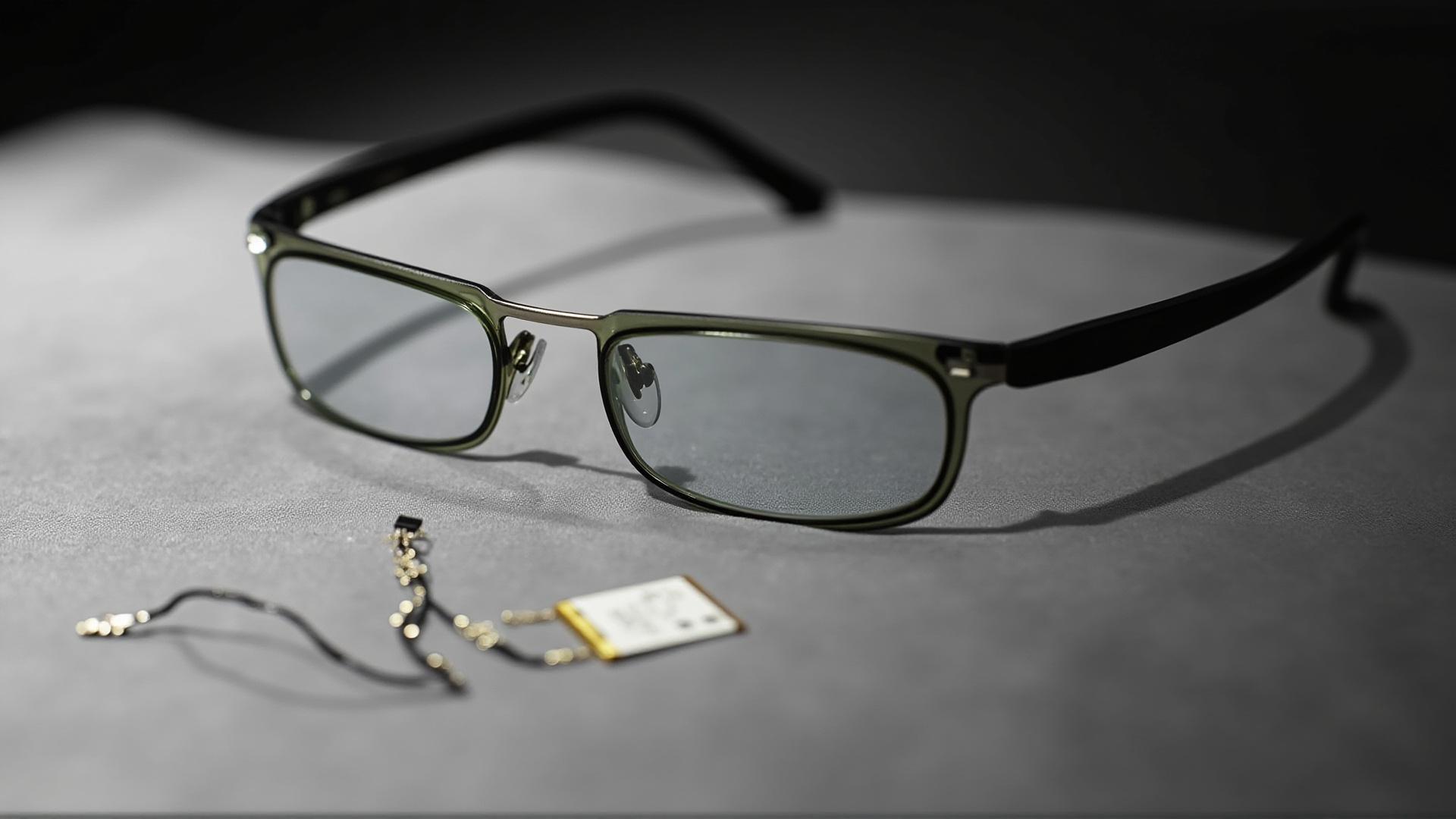
The D17 publishes a short and internally consistent row set, and there is a method to reading it that most specification pages never bother with: take each line separately, decide what it licenses a product page to say, and then decide what it does not license the page to say. The published lines are Bluetooth version V5.4, a 115 mAh cell, a charge time of about one hour, roughly seven hours of rated use, Type-C charging, and two feature lines — Remote Control Photo and Surround Sound.
Seven lines, and no camera row. Everything a buyer needs in order to describe this product accurately can be read off those lines. Everything else is either a gap to be requested or a claim to be avoided, and the limitations breakdown works through the second category in detail.
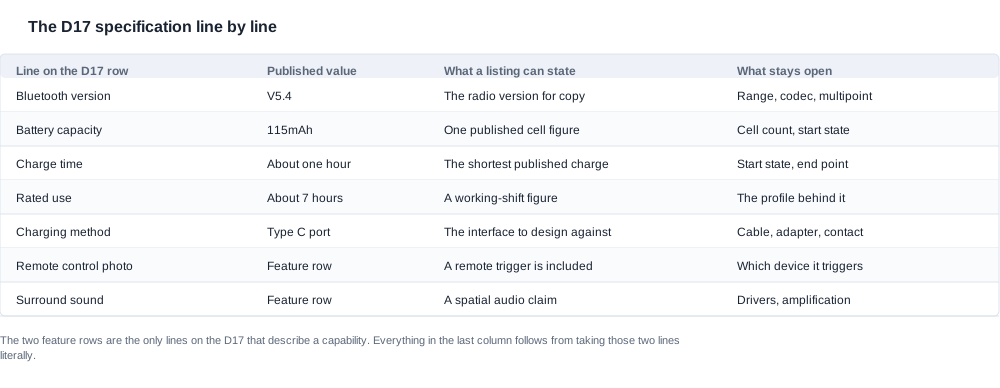
D17 smart glasses specifications and features, read line by line
Two kinds of line, and they behave differently
A specification line states a value. A feature line states a capability. The distinction is not academic, because the two lines fail in different ways and are corrected in different ways.
A specification line can be quoted directly. A 115 mAh cell and a charge time of about one hour can be written into a product page, a comparison chart, a data sheet and a carton without further evidence, because the catalogue states them.
A feature line can be paraphrased but not quantified. Surround Sound tells a buyer that the D17 carries a surround-sound line and nothing more. It does not tell a buyer how many drivers sit behind it, what drives them, what the leakage is or how the unit behaves at low volume, and no amount of careful wording turns the line into any of those figures.
The reading order that prevents the classic errors
Most errors made with this family come from reading the rows in the wrong sequence, so the sequence is worth fixing before the content.
- Start with the class. The D17 is a sport model and publishes no camera row. That single fact removes the camera, the sensor, the storage and the video questions from the file before they are opened.
- Then the charge and runtime pair. These two lines decide whether the product can be described in shift terms, and they are the lines most often over-read.
- Then the radio and the charging method. These two lines decide how much documentation can be written today.
- Then the two feature lines. These decide what a listing may promise, and they each need an acceptance answer before they go into copy.
- Finally the open rows. Mass, dimensions, case, ingress, control method and conformity documents. These are the request list.
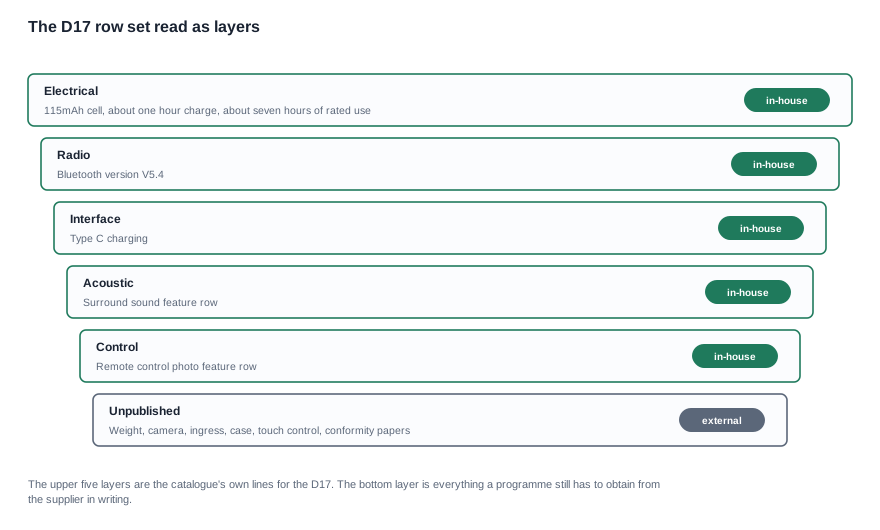
A note on what this row set does not contain
There is no weight, no dimension, no charge time for a charging case, no ingress marking, no touch-control line, no camera, and no per-model conformity row. The catalogue publishes a mass for exactly one model in the whole range, and it is the MT6 glasses body, which excludes its folding charging case.
That absence is the single most useful thing about the D17 row for a buyer. A short row has a short open list, and a short open list is a request that can be answered in one correspondence round. A model page with twelve published lines usually carries twelve open questions behind them.

The electrical block: cell, charge time and rated use
Three of the seven lines are electrical, and they have to be read together because a buyer who quotes one of them without the other two will say something the catalogue does not support.
The cell figure is a component number, not a runtime
The D17 publishes 115 mAh. It is a single figure, published for this model, and it is the figure the D17 is identified by in the catalogue.
It is not a runtime, and the catalogue itself demonstrates why. The D11 and the D12 publish 100 mAh and roughly seven hours of rated use. The ZH12 publishes 100 mAh and roughly eight hours. The same cell figure appears with two different runtime figures on two different pages, which means a runtime cannot be derived from a cell, and a claim of that shape is a fact error rather than an estimate.
It is also not a total. The YKC02 publishes 70mAh*2, a two-cell figure written as a multiplier against the cell value, and the difference between the two notations is exactly the kind of detail that gets flattened when a buyer copies a number into a spreadsheet and strips the asterisk. In a table or a chart, write the catalogue's own form.
The charge time is the shortest published in the catalogue
The D17 publishes a charge time of about one hour. Only one other model in the catalogue publishes a charge time in that form: the ZH12, also about one hour. The remaining twenty-six models publish two hours or less.
The distinction is worth stating precisely, because a ceiling and a stated duration are different claims. A ceiling of two hours or less permits exactly two hours; a statement of about one hour is a figure the catalogue offers as a description of the cycle. For a programme doing turnaround planning, the D17 is the only model on the pillar with a stated one-hour figure, and for a programme filling in a spreadsheet with a worst-case value, the two forms of wording behave differently.
What is not published is the condition. Neither line states the state of charge at the start, the end point that counts as complete, or how the device signals completion. The figure can be quoted as published. It cannot be turned into a shift-break promise without asking.
The runtime is a point, not a bracket
The D17 publishes roughly seven hours of rated use. That is a single figure.
The camera models on the same pillar publish brackets: the V06 and the S7 publish 5 to 8 hours, and the brackets are wide. A point figure and a bracket have different evidential weight, and the safest use of both is the same: quote them as published, attribute them, and do not derive one from the other.
The three questions that make the runtime usable. What volume the figure assumes, whether the radio stays connected during it, and whether the screen and any sensor are active. A buyer who obtains these three answers for the D17 can write an endurance statement for a defined duty cycle. A buyer who does not has a number and a footnote.
The radio line, the charging line and what each one commits a listing to
Bluetooth version V5.4
The D17 publishes a radio version. It is V5.4, the same version the ZH12, the D11, the D12, the LC-105 pair, the G07 and the YKC02 publish, and a different version from the K01 and the K02, which publish V5.3.
A published radio version is a documentation asset more than a performance one. It means a compatibility statement can be written, a connection procedure can be written, and a support script can be written from the catalogue today rather than from a supplier reply that arrives whenever it arrives. It does not mean the radio is better, and it does not tell a buyer anything about range, codec, multipoint or the number of devices that can be connected at once.
The camera models publish no radio version at all. That is a general fact about the eleven camera models, and it is the single largest documentation difference between the D17 and the camera models on the pillar. Nothing about a camera model's radio can be read from the catalogue, and a programme that has planned a compatibility statement around it inherits a supplier dependency.
Type-C charging
The D17 publishes Type-C charging. Seven models in the catalogue publish it, including the V03 Pro and the D11, and the D12 and the L2 Utral. Seventeen publish magnetic charging, and four camera models publish no charging method at all.
The published line is a port. What it does not publish is the rest of the charging arrangement: no cable length, no adapter, no dock, no contact design, no statement about whether a spare cell or a case is supplied, and no statement about the charging current.
For a channel buyer the charging method is a logistics decision rather than a specification. Type-C means a cable can be replaced in a market, and a cable can be bundled, and a cable is a commodity that a buyer can source independently. A magnetic dock is a proprietary accessory that has to come from the same supplier, and it has to be stocked in every market the product ships to. The published line tells a buyer which of those two worlds they are in.
The pair of lines together
Taken together, the radio line and the charging line describe how much of a product file can be written before anyone else is involved. The D17 answers both. That is why it is a strong candidate for a channel that has a documentation deadline, and why it is a weaker candidate for a channel that will not launch without a supplier answer on every line.
The charging method also sorts the catalogue into three groups rather than two. Seventeen models publish magnetic charging, seven publish Type-C charging, and four camera models publish no charging method at all. That third group is the one that catches people out, because a page with a case capacity and no charging line is easy to read as a magnetic model. It is not one, and the D17 is not in that group either: the D17 publishes its port explicitly.

The two feature lines and the acceptance they need
Remote Control Photo
The D17 publishes Remote Control Photo, and it is one of only two models in the catalogue that publish a trigger row — the other is the ZH12, which publishes the same capability in Chinese as 遥控拍照.
What the line licenses. A statement that the D17 includes a remote shutter control, and a description of what that control is for in a sport context: triggering a capture device that is mounted on a handlebar, a pole or a rig, without touching the frame or breaking line of sight.
What the line does not license. Any statement about what is being photographed, recorded or captured, because the D17 publishes no camera row. No sensor, no resolution, no field of view, no storage, no format, no runtime of any recording.
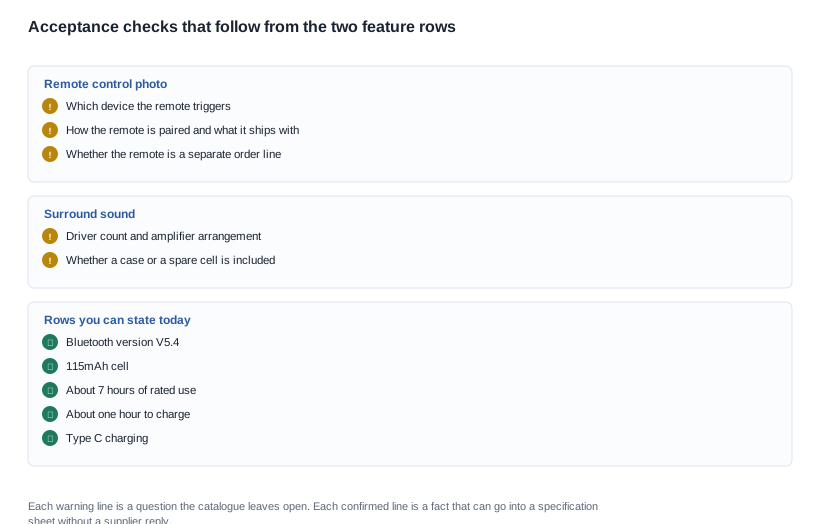
The acceptance it needs. The device the remote controls, the pairing method, the link range, and whether the remote is in the box. Until those are answered, the feature can be described but not specified, and the listing copy should describe the use rather than the mechanism.
Surround Sound
The D17 publishes Surround Sound. The ZH12 publishes 立体环绕音 in Chinese, which is the same claim in the other language and a useful reminder that a feature row has to be read on the page it belongs to. The YKC02 publishes Surround Sound with a Long Battery Life line. The D11 publishes a surround-sound line with a long-runtime line. The D12 publishes no acoustic line at all, and it is the only audio model in the catalogue that does not.
That last point is the warning. The D11 and the D12 sit on consecutive catalogue pages and publish the same cell figure, the same charge ceiling, the same charging method and the same radio version, and they differ on exactly one published line: the D11 has a surround-sound line and the D12 does not. A feature line is model-specific, and the fastest way to get it wrong is to carry it sideways from a neighbouring page.
What the D17's line licenses. A spatial audio claim on the product page. What it does not license. Any driver count, amplifier description, leakage figure, frequency response, or comparison against another model, because there is nothing published to compare.
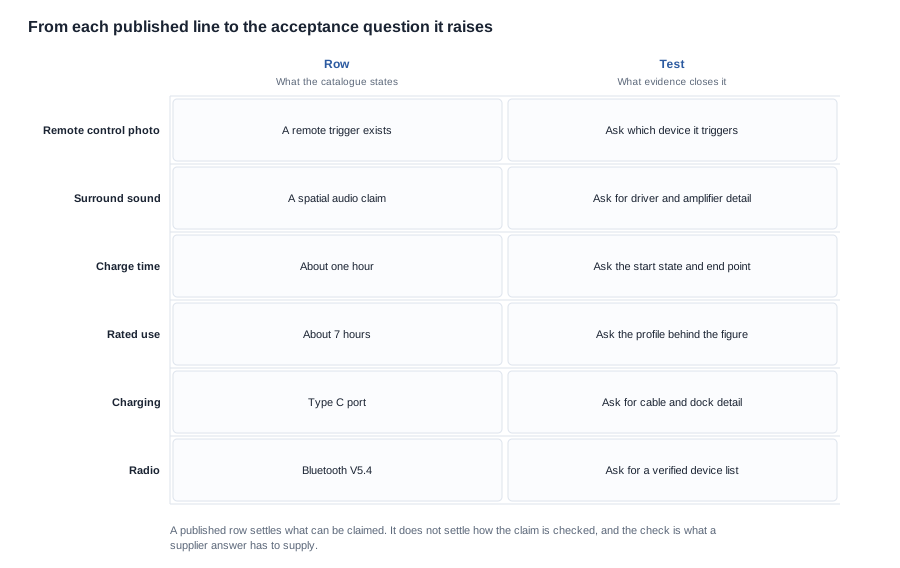
Acceptance checks that follow from the published rows
A specification is only useful when somebody can check it. The seven published lines on the D17 generate a short, concrete list of checks, and the list is short because the row is short.
Checks that need a sample, not a document
The charge cycle and the runtime are the two lines that cannot be confirmed by paperwork. A sample unit measured through a full cycle answers the start state, the end point and the profile in a way no document will.
- Charge the unit from a stated state and time the cycle to the device's own completion signal. Record the state you started from, because the published figure has no start state attached to it.
- Run the unit to the end of the published runtime under a stated duty cycle. Record volume, connection state and whether the frame stayed connected, so the figure has a profile attached.
- Weigh the unit and the frame separately, with the cell fitted. This is the one measurement that closes the mass row for good.
- Test the remote trigger against the device it claims to control, from the range you expect it to be used at.
- Listen at low volume and at high volume, on a published sample if one is available. This is the only way to describe the surround-sound line honestly.
Checks that need a document
The conformity position, the transport documentation and the radio compatibility position are all document questions, and all three are closed by a named document rather than by a measurement.
The record that has to survive the programme
Keep the published row and the measured result side by side, and label each one for what it is. A catalogue row is a published claim by the manufacturer. A measurement is an observation on one unit, on one day, in one configuration. When the two agree, the file can state the figure and cite the source. When they do not, the file says so, and that is the finding rather than an inconvenience.
How to choose between quoting a row and measuring a unit
The decision rule is short, and it is a rule about what the programme is going to publish rather than about what the buyer prefers.
Quote the row when the figure is going into a comparative or descriptive context — a product page, a range chart, a compatibility statement, a carton. A published figure attributed to the catalogue is defensible in that context, and it is the only figure available without a sample.
Measure the unit when the figure is going into a commitment — a shift plan, a service level, a warranty argument, a claim that the product lasts through a working day. A commitment is an obligation, and an obligation needs an observation behind it, not a catalogue line.
The middle case is the dangerous one, and it is where most of the effort goes: a marketing team that wants a confident number for a campaign, with a catalogue line behind it that was never written to be a commitment. The way through is to keep the two sources apart in the file and to decide, deliberately, which one the copy is standing on.
The criteria for accepting a measurement are worth fixing in advance. A figure is acceptable when the unit is identified, the starting condition is recorded, the method is written down, and at least one person who did not run the test can repeat it. Anything short of that is an anecdote, and an anecdote that reaches a product page becomes a claim nobody can defend.
The total cost of closing the open rows
The verification work is not free, and a buyer should price it before deciding that a gap can simply be tolerated. The cost has three parts: the sample, the labour of testing and recording it, and the schedule cost of waiting.
The sample is the smallest of the three. The labour is a fixed task regardless of the number of models, which is an argument for testing several models in one session rather than one at a time. The schedule cost is usually the largest, because a test that lands after a packaging print run changes the carton.
This is the practical argument for a single coordinated request across a shortlist rather than a series of model-by-model enquiries. The questions to ask are the same for every model on the pillar, the samples can travel together, and one answer round moves the whole shortlist forward.
The published set, the open set, and what we will not fill in
The published set for the D17 is seven lines, and they are enough to write a product page, a compatibility statement, a charge instruction and an endurance description with a stated profile. That is a usable product file, and it is unusual in this category to be able to say that without a single caveat.
The open set is short and known: mass, dimensions, charging case, ingress position, control method, the triggered device, the audio arrangement, and the conformity documents for the destination market. Each one is a question with a named recipient.
We will not fill those gaps with typical figures. We do not publish a price for the D17, we do not publish a mass, a dimension or a sensor specification, and we do not publish a per-model conformity row, because none of that is published for us. In the European framework the radio equipment directive is (EU) 2014/53/EU and the electromagnetic compatibility directive is (EU) 2014/32/EU, with EN 301 489 and EN 300 328 as supporting harmonised standards, and UN 38.3 is not published for any cell in the catalogue. The honest answer to "is this certified" is that the documents have to be requested, and the honest answer to "how much does it weigh" is the same.
Send us the destination market, the channel and the packaging, and we will tell you which of these lines are settled today, which need a sample, and which have to be in the file before the programme goes to a supplier. The D17 model page carries the product, and the comparison framework shows how these rows sit against the other models on the pillar.


