

A form factor question is really three questions wearing one name: how big the object is, what the customer has to carry, and where the hardware sits on the frame. The catalogue answers the third for both models and answers the first for neither, and the second is answered only indirectly.
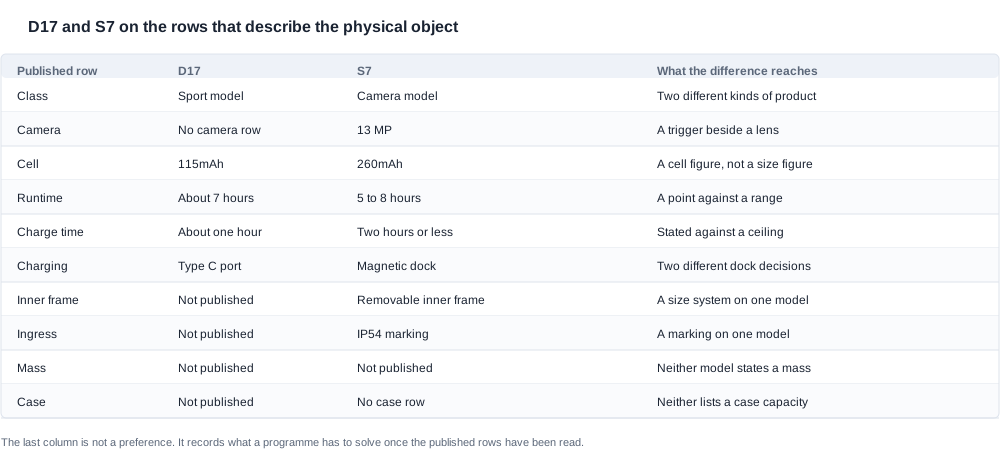
The D17 is a sport model with a remote trigger and a Type-C port. The S7 is a camera model with a 13 MP class, a removable inner frame and an IP54 marking. That is the honest form factor answer on the published rows, and this article works through what each of those differences reaches in a procurement file, and where a form factor question stops being answerable from a catalogue and becomes a supplier request.
D17 smart glasses vs S7 form factor: what the catalogue actually says
Breaking the question into three
The first question is size. Frame dimensions, temple length, lens size, the range of head sizes the product is designed for. The catalogue publishes none of this for either model. The only mass published anywhere in the catalogue belongs to the MT6 glasses body, and it excludes that model's folding charging case. So the size question, for the D17 and for the S7 alike, is a request.
The second question is what gets carried. This is the question the catalogue answers best, and it answers it in three separate ways rather than in a dimension chart. The D17 is charged over a Type-C port, so the charging object is a cable. The S7 is charged magnetically, so the charging object is a dock. And the D17 carries a remote trigger, so the D17's package has one more object in it than the S7's does.
The third question is where the hardware sits. The S7 publishes an ergonomic design note and a removable inner frame, and it carries a 13 MP camera. The D17 publishes a remote photo trigger and a surround-sound line, and no camera at all.
The consequence of splitting the question is that the two models fail it in completely different ways. The S7 publishes more physical information and less carry information; the D17 publishes the opposite. A comparison that only asked about size would have found nothing on either model, and a comparison that only asked about carry would have found the dock and the remote and stopped.
Why the comparison has to start with the class
The two models are not two positions on one scale. The D17 publishes no camera row, and it is a sport model. The S7 publishes a 13 MP class, and it is one of eleven camera models in the catalogue.
That difference decides the form factor question before the dimensions are discussed, because a frame carrying a sensor, storage and a battery at 260 mAh is a different physical proposition from a frame carrying a 115 mAh cell and a trigger. A buyer who treats the comparison as a styling or dimension comparison has already mis-set it, and the selection path piece works through the routing that follows from the class split.
What the pillar adds to the question
Our sport smart glasses pillar groups five models, and the physical story across them is uneven in a way that is worth knowing before a request goes out.
The V06 and the S7 publish the same physical rows — an ergonomic design note, a removable inner frame and an IP54 marking — and they differ on the camera class, 8 MP against 13 MP, and on a colour line published for the V06 alone. The D17, the ZH12 and the YKC02 publish no physical rows at all.
So the question "is the S7 the better form factor" has a strange answer: it is the better documented one. The S7's physical information exists in the catalogue; the D17's does not. That is not a statement about which is better made, and it is not a statement about which is more comfortable or more durable. It is a statement about what a buyer can put in a product page on day one.
The physical rows published on each side
The S7's published physical rows
The S7 publishes four lines that touch the physical object, and each of them does something specific.
人体工程学设计 — an ergonomic design note. It is a design statement, not a measurement. It supports the phrase "ergonomically designed" in a listing and it supports nothing else. There is no angle, no pressure point, no temple geometry and no dimension behind it.
可拆卸内框 — a removable inner frame. This is the only size system published anywhere in the pillar, and it is the most operationally interesting line on the page. A removable inner frame means one outer frame can be paired with more than one inner size, which is the mechanism a retailer uses to serve a range of head sizes from a smaller number of outer frames. What the catalogue does not publish is how many inner sizes exist, whether they are interchangeable across models, whether they can be ordered as spares, or how a customer is meant to choose between them.
IP54 防水 — an ingress marking. This is the only ingress marking in the whole pillar, and it is shared with the V06. Two models in the entire catalogue carry it, and no other model — not the D17, not the ZH12, not the YKC02 — carries any ingress position at all.
1300万高清像素 — the 13 MP camera class. The camera is the reason the S7 is physically larger and heavier than an audio frame, and the catalogue publishes a resolution class for it and nothing further: no sensor, no field of view, no frame rate, no video format, no storage.
The D17's published rows, read for physical content
The D17's page has no physical rows, and its published lines are about electricity, radio and features. Read for what a buyer can say about the object: it charges over Type-C, it carries a 115 mAh cell, it publishes about seven hours of rated use and about one hour of charge time, and it carries a remote trigger and a surround-sound line.
Remote Control Photo is a physical fact. It means there is a control object in the package and on the customer, and a buyer has to decide how it is supplied, stocked and replaced.
The surround-sound line is an acoustic fact, and it has no physical row behind it in the catalogue: no driver count, no amplifier arrangement, no leakage figure.
The rows neither model publishes
Mass, frame dimensions, temple length, lens size, the range of head sizes, the colour options, the packaging contents and the case. The S7 and the D17 are in the same position on all of them.
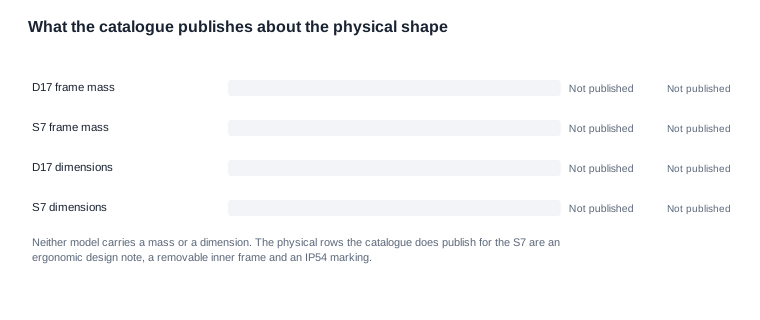
The honest summary of the size question is this: the catalogue publishes a mass for one model in the entire range, and neither model in this comparison is that model. A buyer who needs a size comparison has to build it from supplier answers, and the limitations breakdown sets out how to ask for them in a form that can be recorded.

Where a form factor question becomes a supplier question
A form factor question that the catalogue cannot answer is not a dead end; it is a request with a shape. The requests below are the ones this pair generates, and each of them is a line in a procurement file rather than a general enquiry.
The four physical requests this pair generates
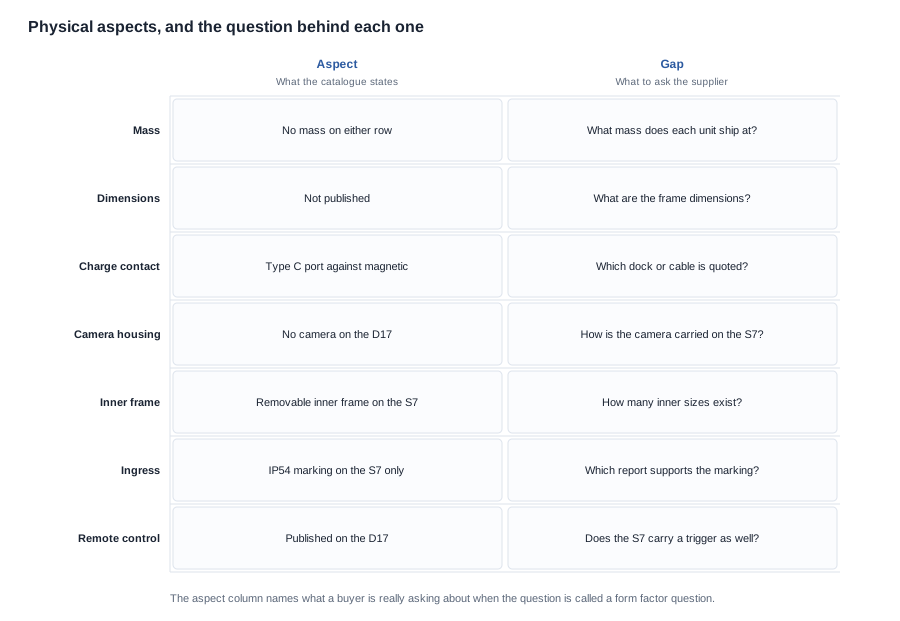
- Mass. The frame with the cell fitted, and the complete unit as shipped, for whichever model is being taken forward. Given that the only published mass in the catalogue excludes a charging case, the wording of the request matters: ask for the case separately.
- Dimensions and head range. The frame dimensions, the temple length, and the head size or size range the product is designed for. Without the range, the removable inner frame on the S7 cannot be evaluated as a size system.
- The inner frame arrangement. How many inner sizes exist for the S7, whether an inner frame can be ordered as a spare, whether the same inner frame serves the outer frame of another model, and what a retailer is meant to do when a customer is between two sizes.
- The ingress position. Which standard the IP54 marking on the S7 refers to, which test report supports it, and by which laboratory. And the same question for the D17, where the likely answer is that no marking exists — which is a legitimate answer, and a better one than a marketing phrase.
The carry burden, in objects rather than grams
The second part of the form factor question is answerable today, and it is more useful than the size question. The D17's customer carries the frame, a charging cable, and a remote trigger. The S7's customer carries the frame and a magnetic dock. The V06's customer carries the frame and a magnetic dock, in a four-colour line.
That is a small difference with a large commercial consequence. A cable is a consumable that a customer replaces, that a channel can bundle, and that a market can source independently. A magnetic dock is a proprietary accessory that has to be stocked, carried as a second line, and replaced from the same supplier. A remote trigger is a third object with its own spare-parts route, and the question of whether it ships in the box is worth asking before the carton is designed.
The carry question also decides the retail story. A product that comes with a dock has a charging ritual, a charging location and a charging consumable, and a retailer can sell the consumable. A product that charges over a cable has a simpler story, and a smaller accessory range to manage.
And it belongs in the total cost of the programme, not only in the product description. A dock per unit, ordered at a break point, stocked in every market, is a recurring commercial line that never appears on an invoice for the frames themselves. The same is true of a spare trigger. Buyers who compare two configurations on the unit figure alone will find these costs later, and they will find them in a place where there is no published row to check them against.
How to ask for a size that can be compared
A mass and a dimension are only comparable when they are measured the same way, and the request has to say what the way is. This is the single most useful habit in the whole form factor question, and it costs nothing.
The criteria that make two answers comparable. The mass is stated for the frame with the cell fitted, and the mass of any case or dock is stated separately. The dimensions are stated as length, width and temple length, in millimetres, with a tolerance where one applies. The head range is stated as a measurement rather than as a description, so that two models can be placed on the same scale. The measurement method is stated, because a figure measured on an unloaded bench and a figure measured on a head are different numbers with the same name.
What to ask, in one message. All four criteria above, for both models, in a single request, with a request for a drawing rather than a description wherever a drawing exists. A drawing closes the row permanently; a description closes it until the next person asks.
The check before you order. Confirm that the figures arrived against the model number and not against a family, and that any case or dock is named as a separate line. A size answer that quietly includes the accessory is a size answer about a different object, and it will be compared against a bare frame later.
The camera housing, and what to ask about it
Neither model publishes where the camera sits or how it is carried. The S7 publishes a camera class and an inner frame, and the arrangement of the two on the same frame is exactly the kind of thing that determines whether the product can be used in a sport context at all.
The request. Where the camera is mounted, whether the lens is on the left or the right temple, whether the mounting affects the removable inner frame, and whether a left-hand version exists. None of that is published, and all of it affects a physical decision a channel has to make.
Two commercial questions belong in the same message. The first is whether the camera arrangement changes between production batches, because a procurement contract that does not mention the arrangement is a contract that does not describe the goods. The second is what the supplier's quality control actually inspects on an incoming line for a camera model, and whether a sample order from the first batch is offered for comparison against a later one. A programme that has asked both questions has a defensible position at the pre-shipment inspection, and one that has asked neither has a dispute waiting for a reason.

The decision path a buyer can run on the published rows
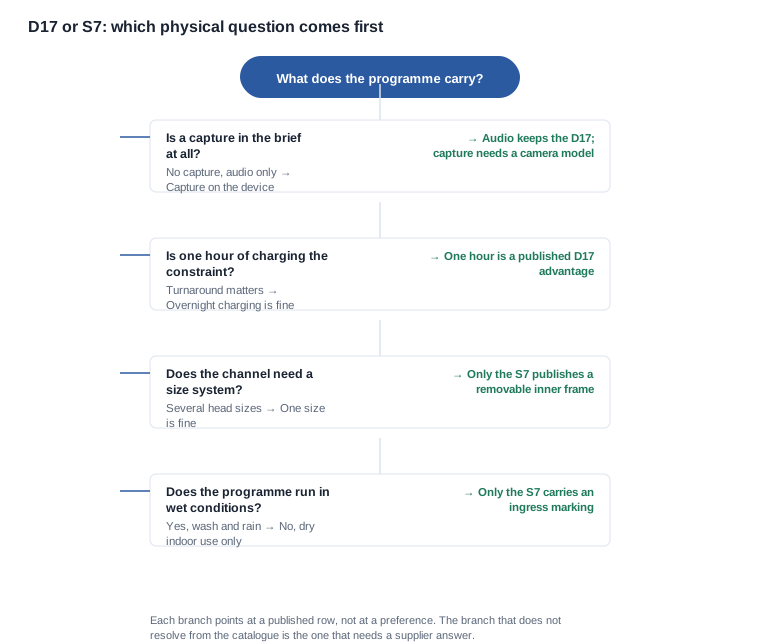
The published rows support a decision path, and the path is worth writing down because it stops the comparison from turning into an argument about which frame looks better.
The four branches
Branch one: is a capture in the brief at all? If the answer is no, the D17 stays in scope and the S7 adds a camera the brief did not ask for, with the storage, video format and sensor questions that follow it. If the answer is yes, the D17 falls out on the published rows, because a trigger on a frame with no camera row is not a capture device.
Branch two: is one hour of charging the operating constraint? The D17 publishes about one hour; the S7 publishes two hours or less. The published rows make the D17 the faster of the two on the only charge-time figure the catalogue gives for either. The condition behind the figure is not published for either model, so the branch points at a published difference rather than at a measured one.
Branch three: does the channel need a size system? The S7 publishes a removable inner frame and the D17 publishes nothing of the kind. A channel serving a broad range of head sizes has something to work with on one model and a request to make on the other.
Branch four: does the programme run in wet conditions? The S7 carries an ingress marking and the D17 does not. For a programme that will be used in rain or washed, that is a published difference on the surface of the two products, and the verification request underneath it.
The branch that usually decides it. For a buyer whose programme is a sport line, branch one is usually answered first, and the other three follow. Where branch one is genuinely open, the answer is not a model but a request: a sample, a measurement, and a decision taken afterwards.
The branch where the requirement is still open
There is a fourth situation that the tree does not draw, because it is not a branch of the product question. It is the situation where the brief itself has not been settled: the channel has not been chosen, the target market is undecided, or the same requirement is being quoted to two different channels with different obligations.
In that situation the correct output is a shortlist with criteria attached, not a model. The shortlist would carry the four branches as its columns, with the published row under each one, and the open rows listed beneath. When the brief arrives, the shortlist can be run in an afternoon, because the questions were written down before the answers were needed.
When to ask the questions matters. Asking before the shortlist is agreed is what allows the answers to change the shortlist. Asking afterwards means asking twice, once for each model that has already been carried forward, and it means the programme has already planned around a configuration that the answer may invalidate.
The red flag to watch for is a shortlist that has been agreed on the strength of a single row — most often the camera class or the charge time — with the other rows still open. That is not a decision, it is a preference with a schedule attached, and it is the state in which most form factor comparisons end up.
Recording the outcome of the path
The output of running this path should be a short record with four fields: which branch decided it, which published row that branch relies on, which requests remain open, and what the sample programme will have to measure. A record like that is auditable and a preference is not, and in a category where the two models publish identical values on most rows, the record is the only thing that distinguishes a decision from a habit.
What the catalogue supports, and what it does not
We publish what the catalogue publishes. For the S7 that includes an ergonomic design note, a removable inner frame, an IP54 marking and a 13 MP camera class. For the D17 it includes a Type-C port, a 115 mAh cell, a remote photo trigger and a surround-sound line, and nothing about the shape of the object.
We do not publish a mass, a dimension, a size range or a comfort statement for either model, and we will not estimate them. We do not publish a price for either, and we do not publish a ranking of the two. There is no published figure on either side of this comparison that would support a claim that one frame is lighter, more comfortable, better balanced or better made than the other, and we would rather say that than supply a number nobody at the factory can verify.
Our position is that the form factor question is answerable in two rounds. The carry burden and the class difference are answerable from the catalogue today, and the size and durability question is answerable with a supplier request and a sample. Send us the two models, the channel and the destination market, and we will tell you which of the four branches your published requirements reach, which requests have to go out, and what the sample programme should measure.


