
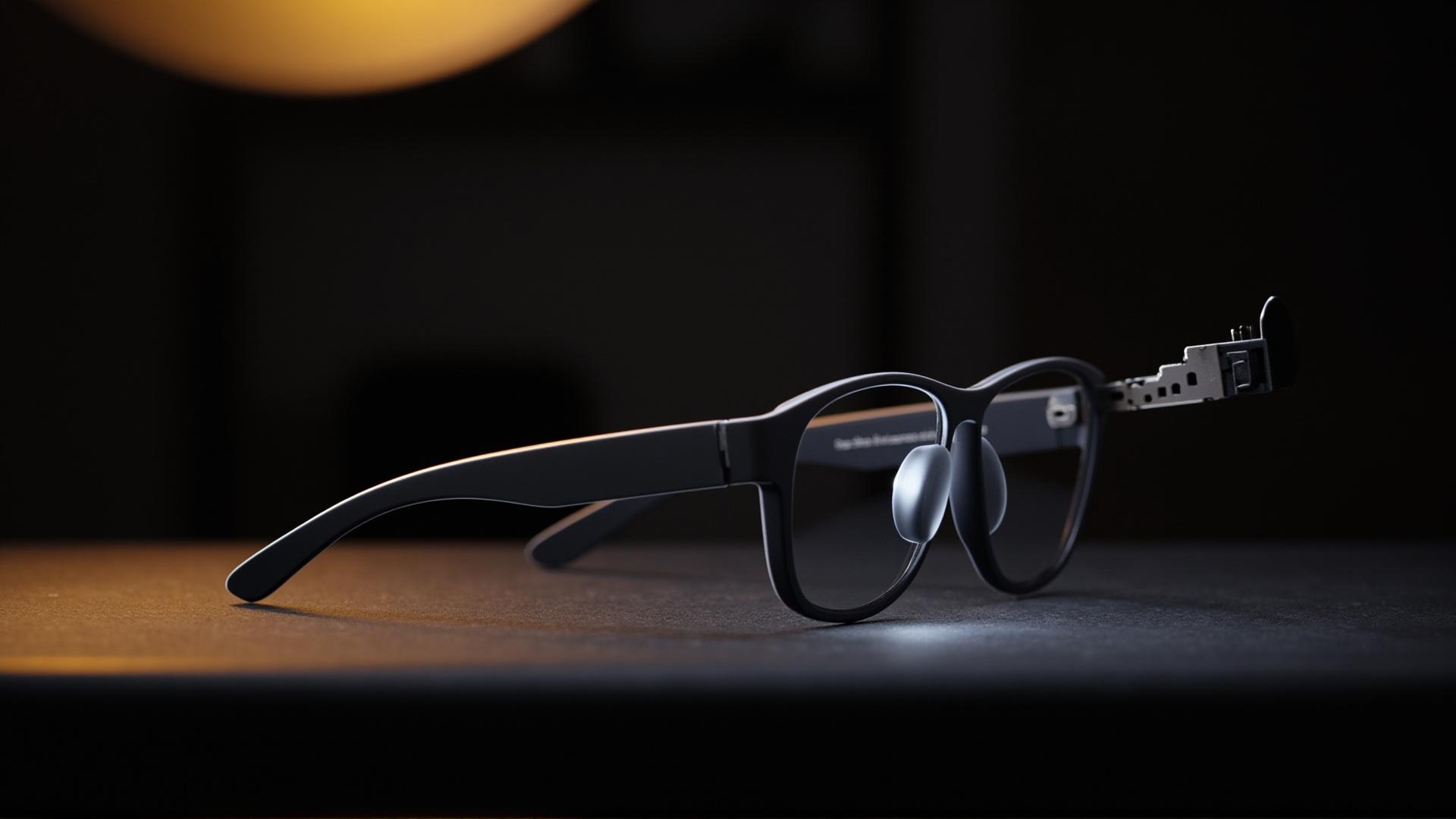
The published specifications make it clear that the D17 and the S7 are not competing for the same brief. The D17 is a sport model with no camera row, a remote photo trigger, a surround-sound line and a charge time of about one hour. The S7 is a camera model with a 13 MP class, a removable inner frame, an IP54 marking and magnetic charging.
So the question behind d17 smart glasses vs s7 which one to choose is settled by what the programme has to do, not by which frame is the better product. This article is therefore a routing tree rather than a verdict: it sends a brief to the rows that can answer it, lists the evidence that has to be assembled before either route can become an order, and stops at the point where a decision is still waiting on a supplier.
Get it wrong and the cost shows up in returns, in a packaging print run that has already been paid for, and in a support script that describes a product the customer does not have.
D17 smart glasses vs S7 which one to choose: a routing tree, not a verdict
Why the two models are on different branches
The catalogue divides its models into three classes, and the two models in this comparison sit on either side of a line that is not close. Three models publish no camera row; eleven do, and the S7 is one of them with a 13 MP class.
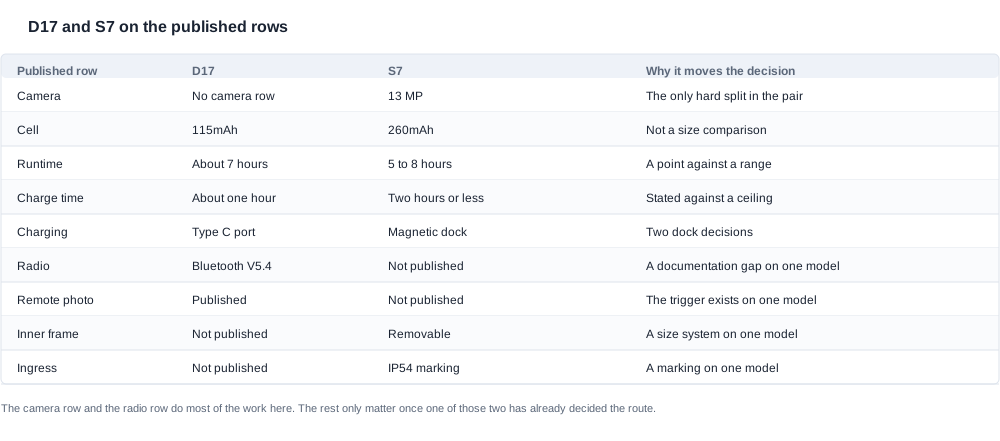
The published rows on each side, in full.
The D17: Bluetooth version V5.4, a 115 mAh cell, roughly seven hours of rated use, a charge time of about one hour, Type-C charging, Remote Control Photo, Surround Sound. No camera row, no case line, no mass, no ingress marking, no radio-gap.
The S7: a 13 MP camera class, a 260 mAh cell, a 5 to 8 hour runtime, a charge time of two hours or less, magnetic charging, an ergonomic design note, a removable inner frame, an IP54 marking. No radio version, no case line, no mass, no charging-case capacity.
Every difference that matters here is a difference of kind rather than of degree. One product triggers an external device; the other carries a lens. One publishes a radio version; the other publishes none. One is a sport model; the other is a camera model. A buyer choosing between them is not choosing between two points on one scale.
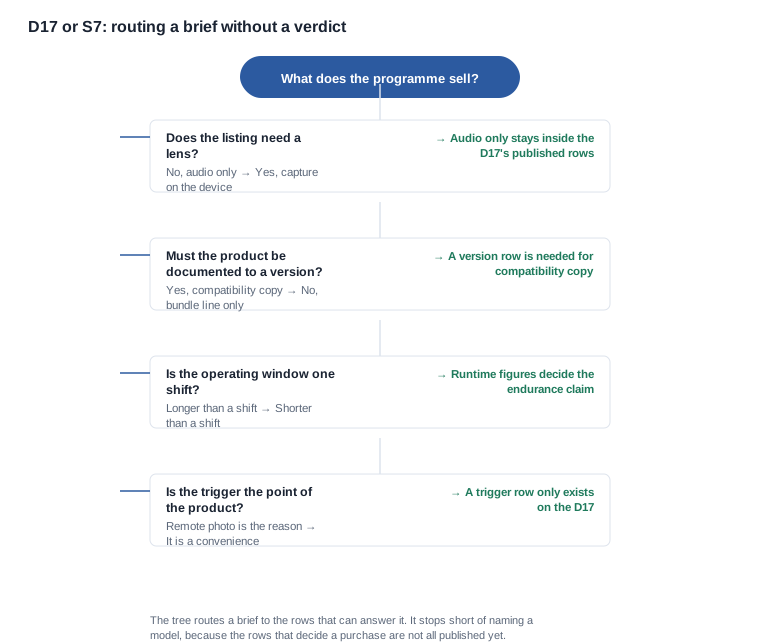
The four branches, and what each one rests on
Branch one: does the product have to capture? If the brief involves the customer taking photographs or video, the D17 falls out on the published rows, because a remote trigger on a frame with no camera row is a control for a device that is not the frame. If the brief is audio, the S7 brings a camera, a storage path and a video format into the programme, and each of those is an open row on a camera model.
Branch two: does the listing need a compatibility statement? The D17 publishes Bluetooth version V5.4. The S7 publishes no radio version at all, and that is a general fact about the eleven camera models rather than an omission on this one page. A channel that has to publish a compatibility statement, a connection procedure and a support script can write all three for the D17 today, and cannot write any of them for the S7 without a supplier answer.
Branch three: is the operating window one shift? The D17 publishes roughly seven hours and the S7 publishes a 5 to 8 hour range. The two figures are different in kind as well as in value, and neither is published with a test profile, so the branch settles an endurance claim only after the profile is known.
Branch four: is the trigger the point of the product? The D17 publishes Remote Control Photo and the S7 publishes nothing of the kind. If the remote is the reason the programme exists, that is a published difference in the D17's favour, and it is the kind of difference a customer notices in the first ten seconds of use.
The three questions that route a brief
The class question, and how to answer it before anything else
The first question is not a product question. It is a question about the requirement, and it should be answered in one sentence before a model is discussed at all.
Write the sentence in this form: the product has to [do the primary thing], and it has to [do the secondary thing]. A programme whose sentence contains "take pictures" is in the camera class. A programme whose sentence contains "trigger a camera I already have" is in the trigger class. A programme whose sentence contains neither is in the audio class, and the S7 is out of scope for a reason that has nothing to do with quality.
Why to do this first. Every other question in the routing tree is cheaper to answer once the class is settled, and a class mistake is the most expensive error available in this category, because it invalidates the comparison rather than merely skewing it. The form factor piece covers the physical consequences of the same split.
The documentation question, and why it is a schedule question
The second question is whether the product has to be documented to a level that a channel will insist on.
The published difference is a radio version on one side and nothing on the other. That is a documentation difference rather than a performance difference, and documentation differences arrive on the programme schedule rather than on the comparison table. A programme that decides it needs a compatibility statement after the packaging has been printed has converted a two-week request into a reprint.
The questions to ask, and what to do with the answers. Ask which radio version is fitted to production units of the S7, ask for a list of the devices the connection has been verified against, and ask for the written connection procedure as the factory would have a customer read it. If the answer comes back as a version, the documentation work can start. If it comes back as a description of a radio family, the programme has learned that the listing cannot yet carry a compatibility statement, which is a scheduling fact rather than a product flaw.
The trigger question, and the mistake it prevents
The third question decides whether the D17's most distinctive line is a benefit or a liability.
Remote Control Photo is on the D17 because somebody needed it. The trigger exists on two models in the catalogue, the D17 and the ZH12, and the ZH12 publishes the same capability in Chinese as 遥控拍照. On the D17 it is published in English.
The mistake it prevents is a description that runs ahead of the product. A listing that says the D17 "captures photos" is describing a camera, and it is describing a camera for a product with no camera row. The correct description is that the D17 includes a remote shutter control for an external capture device, and the acceptance for that is which device it controls, how it pairs, and whether the remote is in the box.
A programme that needs the trigger has a question. A programme that does not need it has a line of copy to delete.
The case that catches a programme that skipped the class question
The most common failure in this comparison is not a wrong answer to the class question. It is that the class question was never asked, and the programme arrived at the two models with a preference already formed.
The shape of it. A brand wants a sport line for a channel that already sells action cameras. The team assembles a shortlist from a supplier's range, and the D17 and the S7 are on it because both are sold as sport products with a camera-related feature. One of them has a remote shutter for the action camera the customer already owns, and the other has a camera of its own. Both look plausible on a spreadsheet, and the comparison runs on cell capacity and charge time, because those are the numbers that are published.
What the routing tree does to that shortlist. The class question sends it to the camera branch, because the customer has to capture and the S7 carries a camera class, and the D17's trigger is a control for a device the customer brings. The programme then has to deal with the S7's open rows — no radio version, no mass, no case line, a storage and video format question — instead of the D17's, and the decision it was about to make on a cell figure is replaced by a decision about whether a camera platform is what the brief needed.
The lesson for a procurement file. The class question is worth writing down as a sentence at the top of the file, with a date and a name against it. It takes ten minutes, and it is the only question in this comparison that can invalidate everything downstream.

The gate that has to be cleared before either route
Routing tells you which model the brief points at. It does not tell you that the model is orderable, and that is where most comparisons in this category go wrong: the routing result is treated as a decision, and the open rows are treated as details.
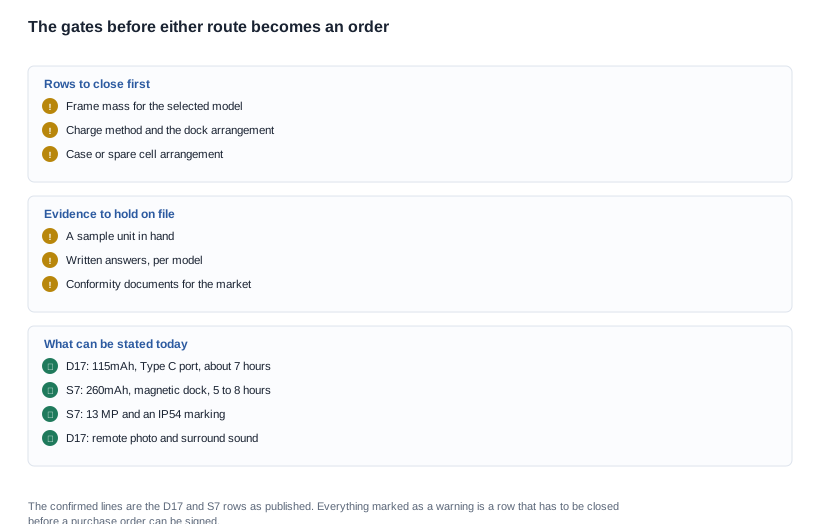
Gate one: the rows that are open on both models
Mass, dimensions, the range of head sizes, the case arrangement and the conformity documents are unpublished for both models. Neither the D17 nor the S7 states a weight, and the only mass published in the whole catalogue belongs to a different model and excludes its folding case.
A routing result that ignores these can point at a model the channel cannot physically stock or the programme cannot describe. The D17 specification breakdown sets out the D17's published row, and the spec comparison against the V06 shows how the camera models' published rows differ from each other.
Gate two: the evidence
A sample unit in hand, the open rows answered in writing against the named model, and a cost basis attached to one configuration. Until the cost basis exists on the same terms for both models, the routing result is a preference rather than a decision, because nothing has been compared on a common basis.
The check that catches this gate failing is simple: if the two options are still being described in prose rather than in quoted figures, the gate is open. A model that is described as having a longer battery life than another is not being compared; it is being remembered.
Gate three: the market
The conformity route for the destination market, the claims wording reviewed, and the claim boundaries recorded in the file. The catalogue carries a company-level export certification page whose content is images rather than text, and the catalogue text contains no reference to CE, FCC or RoHS, so there is no per-model row to read and nothing about conformity can be inferred from the catalogue. In the European framework the radio equipment directive is (EU) 2014/53/EU and the electromagnetic compatibility directive is (EU) 2014/32/EU, with EN 301 489 and EN 300 328 as supporting harmonised standards, and UN 38.3 is not published for any cell in the catalogue.
The gates run in that order for a reason. Gate one is the cheapest to close and the most likely to send the programme back to the routing step, because a product that cannot be stocked is not a product. Gate two converts a routing result into a decision. Gate three can stop a launch entirely, so it starts first when the market is already fixed, because a certification route runs in parallel with a sample programme while a decision to proceed does not.
How to verify the gate before the order
Three checks, run on the file rather than on the product. First, every published figure in the file should be traceable to a catalogue row, quoted as published, and separable from every figure that came from a supplier answer. Second, every supplier answer should carry a model number, a unit or a boundary, and a date. Third, every claim that is going to appear in a product page should have a line in the file that supports it, or a line that says it is not supported yet.
The second check is the one that catches most problems. A file where a supplier answer sits in the same column as a catalogue row is a file where the two will be confused later, usually by somebody who was not in the correspondence. Two columns, two colours, two labels: one for what the catalogue publishes, one for what a supplier has confirmed, and a third for what has been measured on a sample.
The third check is the one that catches the promise that was never made. A claim on a product page has to point at a line in the file. If it does not, the claim is a guess that has already left the building, and the cost of removing it later is paid in reprinting, in returns and in the trust of the channel that took the description at face value.
The gate that is easy to forget
A programme that runs both routes in parallel has a cost, and it is not small. Two samples, two test sessions, two sets of documentation, and a specification file that carries two configurations until one is dropped. The saving from running both is that neither gate is discovered late. The saving from running one is that the programme has one configuration to document.
How to choose between the two approaches. Run both when the class question is genuinely open, because a wrong class decision is the most expensive error available. Run one when the class is settled, because the open rows on the chosen model are the same work either way and running the other route only adds to it.

Recording the outcome without pretending it was a recommendation

The four fields the record needs
The output of a routing exercise is a short record rather than a conclusion, and the record has four fields.
- The branch that decided it, and the published row that branch rests on. If the branch cannot be named, the routing has not been done.
- The published rows that support the choice, quoted as published rather than paraphrased, so that the file can be checked against the catalogue by somebody who was not in the meeting.
- The rows that remain open, with a named recipient and a date against each one.
- The measurement the sample programme has to make, if any, and what result would change the decision.
A record like that is auditable; a recommendation is not. The difference matters more in a category where two models publish identical values on most rows, because in that situation the reasoning is the only thing that distinguishes a decision from a habit.
The step most programmes skip
Write the record before the quotation arrives. A comparison basis fixed in advance — the configuration, the packing, the destination, the criteria and the weighting — cannot be quietly adjusted once a number has been seen. A comparison basis written afterwards is a description of what was decided, and it is worth much less at audit.
The test for whether the criteria were fixed honestly is whether a model that lost would have been chosen under the same criteria with a different number in the same cell. If the answer is no, the criteria were fitted to a preference.
What a shortlist looks like when it is honest
An honest shortlist in this category usually looks strange. It often has one model on it, and a list of open rows under it that is longer than the model description. That is not a sign of a weak shortlist; it is a sign that the published rows were read rather than skimmed, and the open list is the work that remains.
What we will not do in this comparison
We will not name a winner, and we will not recommend the D17 or the S7 for a scenario. We publish no price for either model, no mass, no dimension and no per-model conformity row, and the published rows that separate them are about product class rather than about quality. A recommendation written on that basis would be an assertion dressed as an analysis, and it would not survive the first question from a customer who read the same catalogue.
We will not compare the two on a specification table and call the difference a ranking. The D17 is not a cheaper S7. It is a different product, and a buyer who wants the S7's camera, inner frame and ingress marking cannot have them on the D17 at any price, and a buyer who wants the D17's radio version, its remote trigger and its one-hour charge cannot have them on the S7 at all.
We will not carry a feature from one model to another. The D11 publishes a surround-sound line and the D12 does not, although the two are otherwise identical on the published rows, and the ZH12 publishes its feature lines in Chinese. The limitations piece covers the mistake that pattern produces most often.
What we will do is take the brief, say which branch it reaches, list the requests that branch generates, and tell you what the sample programme has to measure. Send us the two models, the destination market, the channel and the packaging, and we will tell you where the routing stops and what has to be closed before it starts again.


