
Almost every limitation of the D17 is a gap in published data rather than a defect in the product. That distinction is the whole argument of this article, because a buyer who treats a catalogue gap as a product weakness will reject a model that may suit the brief perfectly, and a buyer who ignores it will put claims on a product page that cannot be substantiated later.
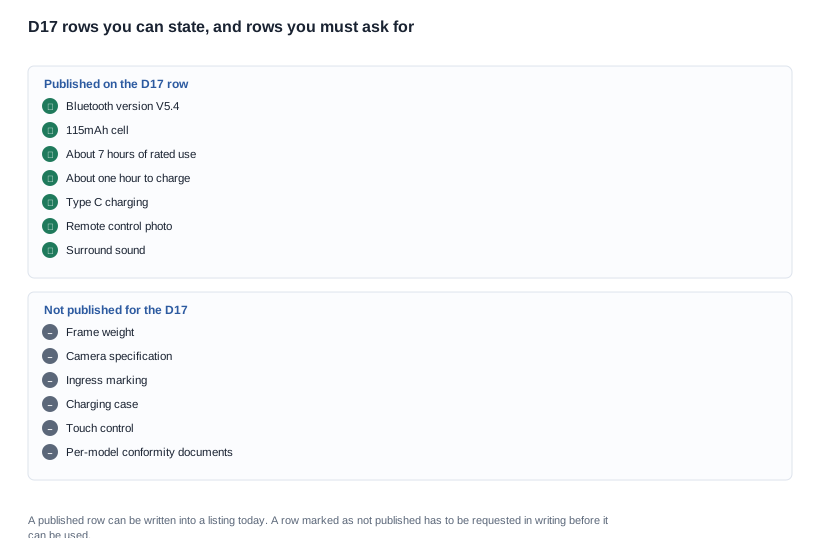
The D17 publishes seven lines: Bluetooth version V5.4, a 115 mAh cell, a charge time of about one hour, roughly seven hours of rated use, Type-C charging, a Remote Control Photo feature line and a Surround Sound feature line. There is no camera row, no mass, no dimension, no ingress marking, no charging-case line, no touch-control line and no per-model conformity row. Each of those absences is a limitation, and each of them is closable with a written supplier answer. None of them is closable with a better copy.
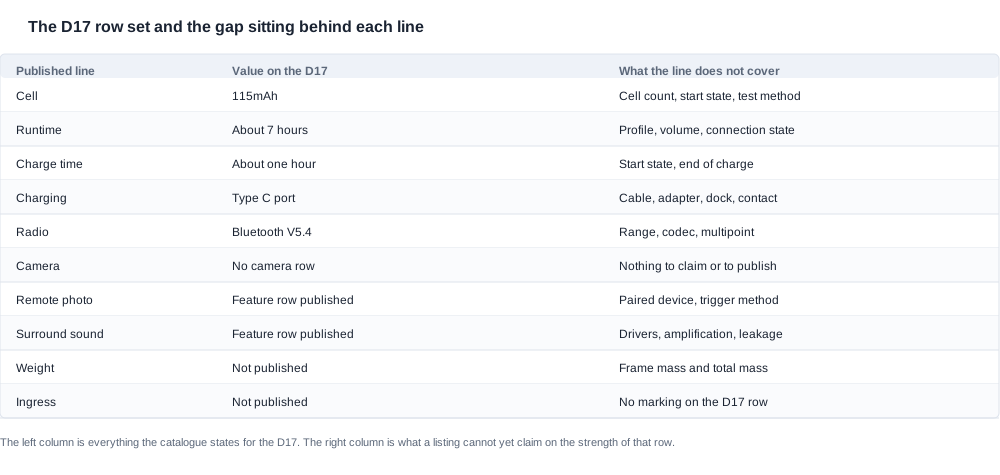
D17 smart glasses limitations: the gaps behind the published rows
What a limitation is, and what it is not
A limitation is any condition that a programme cannot ignore when it plans a listing, a quotation or a launch. It is not the same as a fault, and it is not the same as a disqualification.
Three of the limitations below are documentation risks: the model may well do the thing, and the risk is that nobody has written down what the thing is. Two are scope risks: the brief asks for something the published rows do not cover, and the answer to that is a different product, not a better question. The rest are claim risks, where a natural piece of copy would exceed the published row.
A buyer who needs certainty should treat each of these as a question with a deadline attached. A limitation that is named in a request on day one is a scheduling item. A limitation discovered during the first production inspection is a quality control incident, and it is charged to the programme.
The limitation that has to be handled before anything else
The D17's catalogue name is a sport glasses name, and it does not carry the words "audio" the way the audio models do. It publishes a photo trigger. A reader scanning the page can reasonably conclude that it is a camera product, because the product is described as taking photographs from a distance.
It is not a camera product, and the catalogue does not claim it is. There is no camera row on the D17 page: no resolution class, no sensor, no field of view, no storage. The Remote Control Photo line is a trigger for a device that is not the frame.
This is the single most important limitation to manage, because it propagates. A listing written from the trigger line alone will sell the D17 as a capture device, and every downstream artefact built on that listing — the comparison chart, the packaging copy, the support script, the returns policy — inherits the error. In the European Union the radio equipment directive is (EU) 2014/53/EU, and the electromagnetic compatibility directive is (EU) 2014/32/EU, with EN 301 489 and EN 300 328 as the supporting harmonised standards. Neither framework lets a marketing claim run ahead of what the product can actually do.
A remote shutter is not a camera, and the catalogue does not claim it is
The trigger line deserves a paragraph of its own, because it is the feature a programme is most likely to buy the D17 for.
What the line supports. A remote shutter is a control. It lets somebody operate a capture device that is mounted on a handlebar, a pole or a chest rig without touching the frame. In a sport context that is genuinely useful: the frame stays on the head, the hands stay on the equipment, and the recording is triggered without breaking line of sight.
What the line does not support. It does not support the words camera, capture, video, recording, resolution or lens. It does not support any storage claim, any file-format claim, any claim about what the triggered device records or for how long. It also does not support a claim that the trigger is compatible with a particular phone, action camera or mount, because the catalogue does not name the device it controls.
The question to ask. Which device does the remote trigger, how is the remote paired to it, what is the trigger mechanism, does the remote ship in the box or is it a separate order line, and what is the range of the control link. Those five answers are what turns the line from a marketing point into an acceptance criterion.
The reverse risk on the two camera models
The same discipline applies in the other direction, and it is worth naming because the pair of camera models is where the catalogue is richer. The V06 publishes an 8 MP class and the S7 publishes a 13 MP class, and both publish an IP54 marking and a removable inner frame. What none of them publish is a sensor model, a field of view, a frame rate, a video format, a storage capacity or a stabilisation claim.
A resolution class is a class, not a specification. A programme that writes "13 MP camera" into a product page is writing something the catalogue supports. A programme that writes "13 MP for night riding" is writing something it does not. The limitation on the camera models is therefore the mirror image of the D17's, and the request is the same shape: ask for the sensor, the field of view, the frame rate, the format and the storage arrangement against the model number.
Rows a listing cannot be written from
The published rows on the D17 split cleanly into two groups, and the second group is the one that generates the work.
Mass, dimensions and sizing
The catalogue publishes one mass in the whole range, and it is the MT6 glasses body, which excludes the folding charging case. Nothing is published for the D17, for the ZH12, for the YKC02, for the S7 or for the V06.
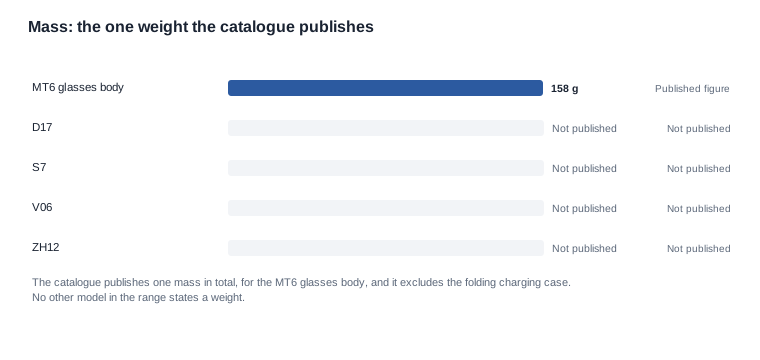
This is a real constraint on a programme, not a technicality. A channel that stocks a product has to know whether it fits the display, whether it fits the head range it serves, and whether it passes the handling and drop expectations of the category. None of that can be assessed from the catalogue.
The question to ask. The mass of the frame with the cell fitted, the mass of the complete unit as shipped, the frame dimensions, the temple length, and the range of head sizes the product is designed for. Ask for all five against the D17 by name, and ask for the tolerance rather than a nominal figure, because a nominal figure with a tolerance is a specification and a nominal figure without one is a number a factory can reproduce approximately.
Ingress and environment
The D17 publishes no ingress marking. The IP54 marking appears on two models in the catalogue and two only: the V06 and the S7.
This limitation is easy to misread in both directions. A buyer may assume that a sport glasses model with a Bluetooth radio is at least splash-resistant because sports products usually are; the catalogue does not say so. Another buyer may carry the IP54 marking across from the S7 to the D17 because the two sit on the same pillar page; that is a fact error, and it is one of the most common errors made with this family.
The question to ask. Is there any ingress position for the D17, and if there is, which standard, which test report number and which laboratory. If the answer is that no marking exists, the answer is useful in itself: it tells the programme to write a care instruction rather than a durability claim, and it tells the channel not to promise one.
Charging case, spare cells and what ships in the box
The D17 publishes no charging-case line. The catalogue is not silent about cases in general — several camera models publish a case capacity, two more publish the fact that a case exists without a figure, and four camera models carry no case row at all — but the D17 page carries no such line at all.
That is an unpublished row, not a published absence. The distinction matters for a quotation: a programme cannot assume a case is included, and cannot assume it is excluded either. The request is simple, and so is the consequence: a case changes the carton, the freight volume, the retail shelf footprint and the after-sales story, so it belongs in the commercial terms rather than in a footnote.
Control, interaction and the absence of a touch row
The catalogue publishes no touch row for any model. There is no capacitive touch line anywhere, and the only control line in the catalogue is the button control published on the AR glasses model, which is a different product with no model name of its own.
For the D17 this means a specific question: how is the device operated. Which controls exist, where are they, are they physical buttons, a touch surface or a companion application, and which functions can be reached without the phone. A listing that says "touch control" on the strength of a category assumption is making a claim the catalogue cannot support, and a buyer who needs a touch surface needs to know that before the moulding is discussed rather than after.
The neighbour confusion: 115 mAh, 100 mAh and 70 mAh
Three cell figures in this part of the catalogue are routinely confused with one another, and a buyer who has them wrong will quote a figure that belongs to a different model.
The D17 publishes 115 mAh. The D11 and the D12 publish 100 mAh each, and both are audio frames with Type-C charging and roughly seven hours of rated use, which is exactly why the D17 is sometimes recorded as a 100 mAh model. The ZH12 publishes 100 mAh with roughly eight hours and Type-C charging. The YKC02 publishes 70mAh*2, which is a different number again and a two-cell figure rather than a single one.
The pattern is worth internalising, because the three 100 mAh models do not even share a runtime: the D11 and the D12 publish about seven hours and the ZH12 publishes about eight. The same cell figure appears with different runtime figures on different pages, which is the clearest available proof that a runtime cannot be derived from a cell figure. Any internal document that says "roughly 100 mAh means roughly eight hours" is wrong on the D11 and the D12.
The naming risk on the pillar page
The D17's catalogue name carries the words sport glasses, where the audio models carry an audio descriptor. It sits on a pillar page with two camera models, and it publishes a photo trigger. The combination makes it easy for a reader to file the D17 as a camera product, and easy for a buyer to carry that filing into a specification sheet.
The mitigation is one line in the internal file. State on the first page that the D17 publishes no camera row, state that the trigger controls an external device, and state that the only two models in the catalogue publishing a trigger row are the D17 and the ZH12. A programme that has written that line down will not repeat the error downstream, and a programme that has not will repeat it in three places before anyone notices.
Conformity, transport and the shipping file
The catalogue carries a company-level export certification page whose content is images rather than text, and the catalogue text contains no reference to CE, FCC or RoHS, to REACH, to UKCA or to GPSR. There is no per-model certification row anywhere in the catalogue. UN 38.3 is not published for any cell either.
The limitation is therefore not that the D17 fails a requirement. It is that nothing about its conformity position can be read from the catalogue, which means the shipping file, the market access file and the technical file all depend on documents that have to be requested.
The question to ask. Which conformity documents cover the D17, issued against which model number, by which laboratory, with what validity, and what transport documentation accompanies the cell. For a buyer evaluating a supplier, this request is also the fastest way to see how the supplier's documentation operation actually works, and the answer is more informative than a brochure.
Turning each gap into a written question
A limitation that is written down as a question is a task. A limitation that is remembered as a concern is a delay waiting for a moment when it is expensive.

The request, in the order that closes the most rows
- Ask for the mass and dimensions first. They gate the channel decision, they gate the display and the carton, and they are the rows most often quoted from memory rather than from a file.
- Ask which device the remote trigger controls. This gates the listing copy, the packaging and the comparison chart, and it is the row with the highest risk of being misunderstood downstream.
- Ask for the audio arrangement. The number of drivers, what drives them, and what happens at low volume. The surround-sound line supports a claim; it does not support a comparison.
- Ask for the ingress position and the report behind it. Any marking, the standard, the report number and the laboratory.
- Ask what ships with the unit. A case, a spare cell, a cable, a dock, a printed manual. Each of these has a cost and a packing consequence.
- Ask for the conformity documents against the model number. This is the longest lead time of the six, so it goes out on day one even though it is answered last in a planning sense.
The acceptance rule for every answer
An answer closes a row only when it names the D17 specifically, carries a unit or a boundary, and arrives in writing with a date attached. A description of a characteristic is not a closed row; it is an open row with better prose.
Three things to do when an answer arrives in that shape. Record it against the row, keep the row marked open, and put the date on it. A programme that files the description as though it closed the row will eventually find a specification sheet carrying a number that nobody wrote down.
The acceptance criteria for each of the six questions
The six requests above close against criteria that can be written down before the answers arrive, which is what makes them auditable rather than advisory.
- Mass and dimensions. Accepted when a figure in grams is given for the frame with the cell fitted, a second figure for the shipped unit, and dimensions with a tolerance. Rejected when the answer is a class description such as lightweight.
- The triggered device. Accepted when the compatible device or device family is named and the pairing method is described. Rejected when the answer describes a shutter in general terms without naming what it operates.
- Audio arrangement. Accepted when a driver count and an amplification description are given. Rejected when the answer repeats the surround-sound wording already on the model page.
- Ingress position. Accepted when a standard, a test report number and a laboratory are given together, or when it is stated in writing that no marking exists. Both are useful; a description of sealing construction is not.
- What ships with the unit. Accepted when the contents of the box are listed. Rejected when the answer describes a retail configuration without naming the accessories.
- Conformity documents. Accepted when document names and issuing bodies are given against the model number. Rejected when the answer points at the company-level certification page, which carries images rather than text and no per-model row.
The pattern across all six is the same. A figure, a name or a document closes a row. A characterisation does not, however accurate it is.
The cost of not asking
The cost is not the number of questions. It is the number of times the same question gets asked. A model shortlist that is agreed before the open rows are closed has to be reopened when the answers arrive, and a reopened shortlist is a scheduling event that nobody budgeted for. One request, sent once, against named models, is the cheapest piece of procurement work available in this category.
What we can promise, and what we will not
We publish the electrical rows, the radio version, the charging method, the charge time, the runtime, and the two feature lines for the D17. Those are facts, and they are enough to write a product page, a compatibility statement and a charge instruction.
We do not publish a mass, a dimension, a case, an ingress marking, a touch control or a per-model conformity row for this model, and we will not quote a typical figure for any of them. If a programme needs one of those numbers, it has to come from the supplier in writing, and we would rather say that today than have a buyer discover it in a pre-shipment inspection.
Two boundaries follow from that. First, we do not publish prices for any model, so this article cannot tell you whether the D17 is worth its money in a commercial sense; the cost-driver method explains what to ask for instead. Second, we do not publish a ranking of the D17 against the other models on our pillar, because the rows that would justify a ranking are not published; the comparison framework sets out how to build one honestly.
Our position is that the limitations are a request list, not a rejection. Send us the destination market, the channel and the packaging, and we will tell you which of these rows are likely to be straightforward, which need a sample before they can be answered, and which have to be settled before the programme can go to a supplier at all.


